Best 10 AI Courses for Professionals in the USA (2026)

Riten Debnath
15 Feb, 2026
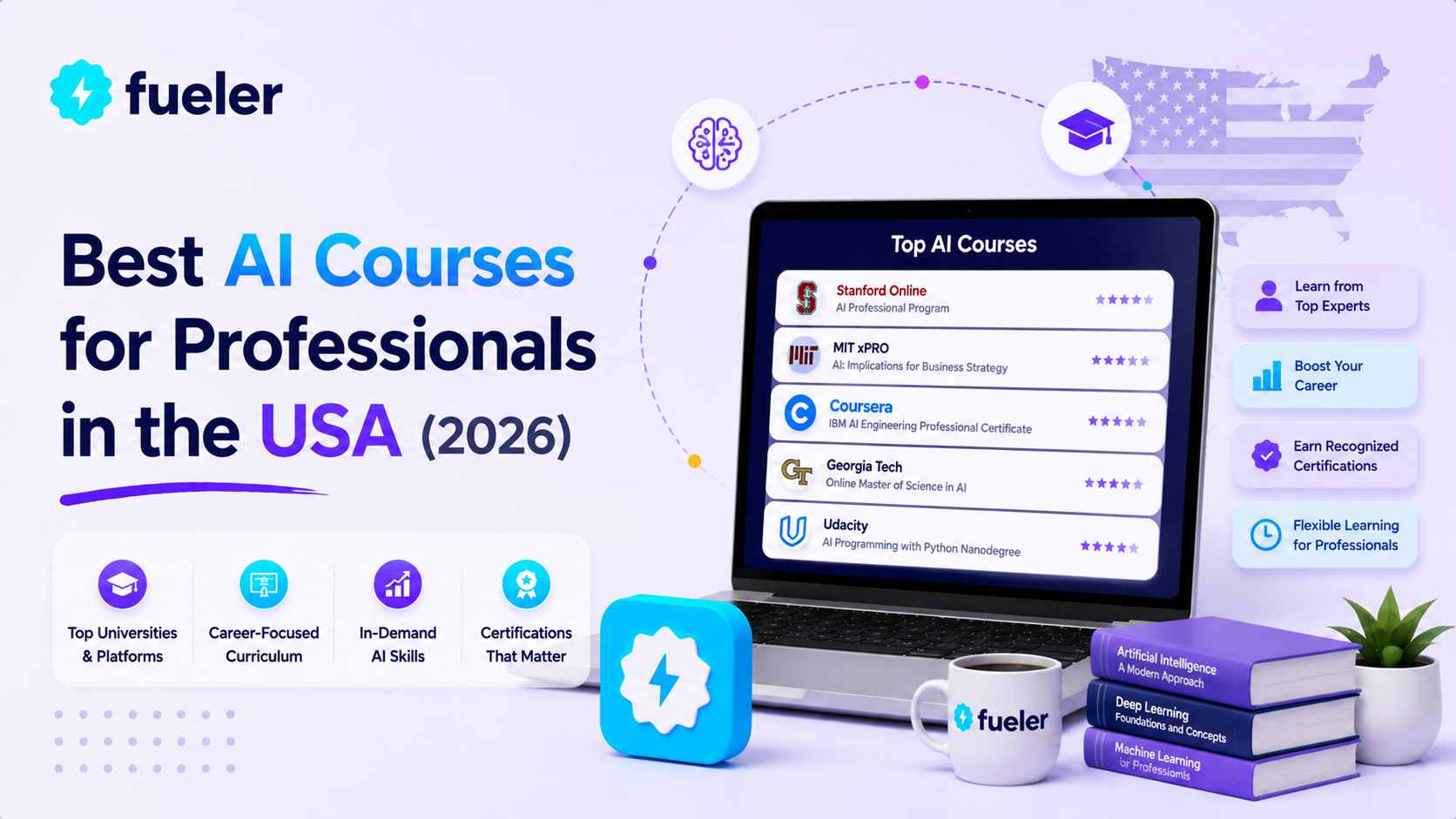
In 2026, AI is no longer a "future" skill; it is the baseline for professional survival. The "AI evangelism" of 2024 has matured into an era of AI Utility, where the focus has shifted from simple prompting to building "Agentic Workflows" and managing AI-human collaboration. For professionals in the USA, the challenge isn't finding information; it's finding high-signal, rigorous programs that provide more than just a surface-level certificate.
I’m Riten, founder of Fueler, a skills-first portfolio platform that connects talented individuals with companies through assignments, portfolios, and projects, not just resumes/CVs. Think Dribbble/Behance for work samples + AngelList for hiring infrastructure.
Below is a curated list of the top 10 AI courses and certifications for professionals in 2026, ranging from C-suite strategy to technical engineering.
1. Artificial Intelligence: Implications for Business Strategy (MIT Sloan)
This 6-week online program, co-developed with the MIT Computer Science and Artificial Intelligence Laboratory (CSAIL), remains the gold standard for non-technical executives. In 2026, the curriculum was updated to focus on the "Collective Intelligence" of humans and machines. It doesn't teach you to code; it teaches you to lead an organization where AI handles the tactical while humans handle the strategic.
- You will develop a Personalized AI Business Roadmap for your specific company, moving through six core modules that cover everything from Machine Learning to Robotics and the future of AI in society. This roadmap serves as your strategic "north star," ensuring your AI investments are tied to measurable business outcomes rather than hype.
- The program emphasizes Organizational and Managerial Implications, helping you understand how AI will reshape corporate hierarchies. You’ll explore the "centralization vs. decentralization" debate and learn how to restructure teams to leverage AI-driven productivity gains without losing human creative agency.
- You will gain access to Expert Insights from MIT CSAIL Faculty, bridging the gap between cutting-edge research and boardroom reality. This includes deep dives into Generative AI and "Agentic AI," where you'll learn how autonomous systems are beginning to manage complex, multi-step business processes.
- The 2026 version includes a specialized module on AI and Ethics for Leaders, addressing the high-stakes risks of algorithmic bias and data privacy. You’ll learn how to build "Responsible AI" frameworks that protect your brand’s reputation while pushing the boundaries of technological innovation.
- You benefit from a High-Touch Learning Environment supported by dedicated success advisers. Despite being online, the course facilitates intense peer-to-peer discussion, allowing you to compare AI integration challenges with fellow senior leaders from across the globe.:
2. Competing in the Age of AI (Harvard Business School)
Harvard’s flagship AI program is designed for senior executives who need to understand how AI changes the very nature of the firm. Whether in-person or virtual, this course uses the HBS Case Method to explore "AI-First" business models. By 2026, the focus is on Generative AI Strategy and Execution, moving beyond "how it works" to "how it scales."
- You will analyze Modern Case Studies of AI-Native Firms, learning how companies like Netflix, Ant Group, and Wayfair have used AI to create virtually infinite scale. You’ll explore the "AI Factory" model, a centralized data and intelligence hub that powers every facet of a modern enterprise.
- The program features a Hands-On AI Simulation, where you must lead a legacy organization through a digital and AI transformation. This "war game" style exercise forces you to make decisions on data infrastructure, talent acquisition, and cultural change under intense pressure.
- You will engage in Faculty-Led Deep Dives into LLM Economics, learning how to evaluate the "Build vs. Buy" decision for Large Language Models. In 2026, this is critical as companies decide whether to fine-tune open-source models or rely on proprietary third-party APIs.
- The In-Person Experience at HBS provides unparalleled networking opportunities with global leaders. Living and learning on the Harvard campus for 4 days allows for the "hallway conversations" that often lead to more strategic breakthroughs than the lectures themselves.
- The curriculum includes a dedicated section on AI Product Management, teaching you how to oversee the development of AI-driven products from a leadership perspective. You’ll learn how to manage the "Probabilistic" nature of AI products, which differ fundamentally from traditional "Deterministic" software.
3. AI for Business (Wharton Executive Education)
Wharton’s program is perfect for the leader who wants a heavy focus on Data and Analytics. Led by Professor Kartik Hosanagar, this program treats AI as the ultimate extension of Big Data. In 2026, it is particularly strong in "FinTech" and "Retail" applications, showing how AI is being used to predict market shifts and automate supply chains.
- You will master the Fundamentals of Big Data Analysis, learning how to identify which datasets are truly "AI-ready." This module helps you avoid the common pitfall of throwing high-end AI at low-quality data, saving your organization millions in wasted infrastructure costs.
- The course provides a Deep Dive into Machine Learning Methods, distinguishing between supervised, unsupervised, and reinforcement learning. You’ll learn the specific business use cases for each, such as using reinforcement learning for dynamic pricing or supervised learning for fraud detection.
- You will explore the Generative AI Stack, understanding the layers from hardware (GPUs) to foundation models to application interfaces. This "full-stack" understanding allows you to have more productive conversations with your CTO and technical leads.
- The program includes a module on Developing a Portfolio of AI Projects, teaching you how to balance "low-risk, high-certainty" automation tasks with "high-risk, transformative" moonshots. This portfolio approach ensures that your AI strategy delivers short-term ROI while building long-term value.
- You gain access to Interviews with Industry Vanguards, hearing directly from leaders at companies like OpenAI and Nvidia. These "from-the-trenches" insights provide a grounded reality check against the more theoretical aspects of the academic curriculum.
4. Berkeley Executive Program in AI and Digital Strategy
UC Berkeley offers one of the most comprehensive "Hybrid" programs, spanning 8 months. This is for the leader who doesn't just want a course, but a career transformation. In 2026, it focuses on the "Digital Innovation Ecosystem," teaching you how to build a company that can sustain AI-driven innovation over the long haul.
- You will participate in 8 Months of Immersive Learning, combining online modules with in-person sessions on the Berkeley Haas campus. This extended duration allows for a much deeper mastery of concepts like "Open Innovation" and "Technological Negotiation" than shorter programs provide.
- The program features a Capstone AI Case Study: "Agents Inc.", where you act as the CEO of a company pivoting to an agent-first strategy. You will be responsible for the entire implementation roadmap, from data alignment to cultural readiness and success metrics.
- You will learn Executive Presence and Communication Impact, specifically tailored for the C-suite. As an AI leader, your biggest challenge is often "selling" the vision to a skeptical board; Berkeley provides the tools to communicate technical complex ideas with clarity and authority.
- The 2026 curriculum includes Technology Negotiation Exercises, preparing you for the high-stakes world of AI vendor management. You’ll learn how to negotiate contracts for compute power and data access that protect your company’s future interests and IP.
- Upon completion, you join the Berkeley Haas Alumni Network, giving you lifelong access to one of the most powerful tech ecosystems in the world. This includes invitations to the annual Alumni Conference and access to private networking events in Silicon Valley.
5. AI Strategies for Business Transformation (Northwestern Kellogg)
Kellogg’s program, led by Professor Mohanbir Sawhney, is the "ROI-first" course. In 2026, it is heavily focused on Agentic AI and autonomous systems that can act on behalf of the company. It’s designed for functional heads (Marketing, HR, Finance) who need to integrate gen AI into their specific departments immediately.
- You will learn to use the AI Canvas 2.0 and AI Radar 2.0, proprietary frameworks developed by Kellogg to assess AI readiness. These tools allow you to quickly "map" your organization’s current capabilities and identify the highest-value AI use cases for your specific industry.
- The program focuses on AI and Customer Experience (CX), showing you how to use generative AI to personalize every touchpoint of the customer journey. You’ll learn how to build "Zero-Touch" service models where AI agents handle routine inquiries while escalating complex issues to humans.
- You will explore AI and Business Support Functions, specifically looking at how AI is automating HR (contract drafting), Finance (payroll management), and IT operations. This "Internal AI" focus is often where the fastest ROI is found in 2026.
- The course includes a Capstone Project on AI Implementation, where you apply the Kellogg frameworks to your own organization. You’ll leave the course with a boardroom-ready presentation that outlines the costs, value, and workforce impacts of your proposed AI initiative.
- You will participate in Live Faculty Q&A Sessions, allowing you to get real-time feedback on your specific business challenges. These sessions are known for being incredibly tactical, often turning into mini-consulting sessions for the participants.
6. Future of Secure AI Executive Education (Carnegie Mellon)
Carnegie Mellon is the global leader in AI Engineering, and this program is for the professional who needs to understand the Security and Risk side of AI. In 2026, as AI attacks become more sophisticated, this 4-day intensive program at the CMU Pittsburgh campus is essential for anyone in "Mission-Critical" industries like Defense, Finance, or Healthcare.
- You will gain Executive-Level Literacy in AI Risk and Governance, learning how to protect your organization from adversarial machine learning attacks. You’ll explore how "bad actors" can poison your training data or trick your models into leaking sensitive information.
- The program focuses on Secure AI Architecture, teaching you how to build "defensive" AI systems from the ground up. This isn't just about cybersecurity; it’s about ensuring the integrity and reliability of the AI’s output in high-stakes environments.
- You will work directly with CMU Information Networking Institute (INI) Faculty, who are at the absolute cutting edge of AI security research. This provides you with a "future-proof" perspective on emerging threats that may not yet be public knowledge.
- The curriculum includes a module on AI Policy and Regulatory Compliance, preparing you for the increasingly complex web of AI laws in the USA and Europe. You’ll learn how to ensure your AI deployments are not only secure but also legally defensible.
- The Fast-Paced, Hands-On Format is designed for busy leaders who can only afford to step away for a few days but need a massive leap in technical confidence. You’ll engage in "red team" exercises where you attempt to find vulnerabilities in AI systems.
7. The Business of AI: Shaping the Future (Columbia Business School)
Based in the heart of New York City, Columbia’s program focuses on the Intersection of AI and Human Performance. In 2026, it is uniquely positioned to address how AI impacts high-value creative and professional services. It integrates "Neuroscience" into the curriculum to understand how the human brain interacts with intelligent systems.
- You will visit NYC’s Dynamic Tech Ecosystem, meeting with "AI Vanguards" at leading startups and established tech firms. These company visits provide a "real-world" reality check that you can't get from a textbook or a recorded lecture.
- The program features a module on AI and Behavioral Science, led by faculty who study how AI influences consumer behavior and employee motivation. You’ll learn how to use AI to nudge better decision-making within your team and your customer base.
- You will explore AI in Finance and Risk Management, learning how to use predictive analytics to navigate volatile markets. This is particularly valuable for professionals in the NYC financial sector who need to leverage AI for "alpha" generation and risk mitigation.
- The curriculum includes Advanced OpenAI API Workshops, where you learn how to build your own custom AI applications without needing to be a full-stack developer. This "Low-Code/No-Code" approach empowers business leaders to prototype their own AI solutions.
- You receive Columbia Business School Alumni Credits (CIBE), moving you closer to full alumni status at one of the world's most prestigious business schools. This provides long-term value through ongoing networking and learning opportunities in Manhattan and globally.
8. AI for Product Innovation (Duke University)
Duke’s Master of Engineering in AIPI offers a Professional Graduate Certificate that is 100% online and designed for working professionals. In 2026, this is the best program for the "Builder", the person who needs to actually deliver AI products to market. It blends engineering rigor with Fuqua School of Business strategy.
- You will complete a 4-Week Python & Data Science Bootcamp before the main course starts, ensuring you have the technical foundation to actually understand the "black box" of AI. This makes the program accessible to engineers and science professionals who haven't coded in a few years.
- The program features Industry-Sponsored Capstone Projects, where you work with a real company to solve an authentic business challenge using AI. You’ll design, build, and present a functional AI product, which serves as a powerful centerpiece for your professional portfolio.
- You will master Optimization in Practice, learning how to mathematically formulate business problems as AI models. This "Deep AI" approach goes far beyond simple chatbot integration, focusing on complex systems like supply chain optimization and predictive maintenance.
- The curriculum includes a focus on Deep Reinforcement Learning Applications, a cutting-edge field in 2026. You’ll explore how sequential decision-making AI is being used in autonomous vehicles and high-frequency trading.
- The Online Part-Time Format is spread over 15 months, allowing you to balance the rigorous workload with a full-time job. It includes "Spring Residencies" at Duke’s campus in Durham, NC, providing a blend of virtual flexibility and in-person networking.
9. AI Fundamentals & Strategy Certification (USAII)
For those looking for a purely Skill-Based Certification rather than a university-affiliated program, the United States Artificial Intelligence Institute (USAII) offers the Certified Artificial Intelligence Scientist (CAIS). In 2026, this is one of the most recognized industry-standard certifications for senior leaders.
- You will master the Business and Finance Use Cases for AI, learning how to calculate the ROI of AI initiatives and how to secure funding for digital transformation. This is a "strategic" certification, meaning no programming is required the focus is on "AI Literacy" for executives.
- The program includes a Self-Paced Learning Model, allowing you to complete the certification in as little as 4 weeks or as many as 25 weeks. This flexibility is ideal for busy professionals who need to fit their learning into a fluctuating schedule.
- You receive a Comprehensive Resource Kit, including digital textbooks, videos, and practice exams. The curriculum is updated annually to reflect the latest shifts in the global AI landscape, ensuring your knowledge is current for the 2026 market.
- The certification involves a Rigorous Examination Process, which ensures that the credential carries weight in the job market. Unlike many "pay-for-participation" certificates, the CAIS proves that you have a verifiable mastery of AI strategy.
- It is Highly Cost-Effective compared to university-led executive education, making it an excellent choice for self-funded professionals or those at smaller companies with limited professional development budgets.
10. AI Essentials (Chicago Booth)
New for the 2026 winter quarter, Chicago Booth’s AI Essentials program is designed for the "Analytical Leader." Booth is world-famous for its focus on data and evidence-based management, and this program applies that same rigor to AI. It is particularly strong for those in Finance, Economics, and Data Science Leadership.
- You will learn from Professor Dacheng Xiu, a global expert in Econometrics and AI. The focus here is on "Decision-Making under Uncertainty," teaching you how to use AI to make better probabilistic bets in the market and in your business operations.
- The program emphasizes The Interaction of AI and Statistics, helping you understand the limitations of AI models. You’ll learn how to identify "overconfidence" in AI outputs and how to use human judgment to correct for algorithmic biases.
- You will engage with AI-Aided Teaching Assistants, a unique 2026 feature where custom-built GPT models help you troubleshoot technical glitches in real-time. This allows you to focus on the concepts of data intelligence rather than getting stuck on coding errors.
- The curriculum includes Workforce Analytics and Dynamic Pricing, showing you how to use AI to optimize your most expensive assets, your people and your products. You’ll learn how to build models that predict customer churn and employee turnover with high accuracy.
- The "Professor of Uncertainty" Mindset is woven throughout the course, instilling a sense of humility and caution. You’ll learn that while AI can expand the limits of human knowledge, the best leaders are those who know exactly where those limits lie.
Final Thoughts
In 2026, the divide between "leaders" and "operators" in AI is widening. The courses listed above are designed to move you into the "leader" categorysomeone who doesn't just use AI tools, but who architects the strategy that makes those tools effective. Whether you choose the engineering rigor of Duke, the strategic prestige of Harvard, or the security focus of Carnegie Mellon, the goal is to develop a "probabilistic mindset."
The most successful professionals of 2026 are those who view AI as a Force Multiplier for human judgment, not a replacement for it.
FAQs
Do I need a technical degree to take these courses?
Most of the "Executive Education" programs (MIT, Harvard, Kellogg, Booth) do not require a technical background. They are designed for business leaders. However, programs like Duke (AIPI) and Carnegie Mellon may require a "functional knowledge" of math (calculus, linear algebra) and basic Python for their more technical tracks.
Is it better to do an in-person or online AI course in 2026?
Online courses (like CXL or Wharton) offer better flexibility and are often updated more frequently to reflect the latest software changes. However, in-person courses (like HBS or Berkeley) offer Elite Networking and "immersion," which is often more valuable for high-level leadership transitions.
How do I prove the ROI of these expensive courses to my employer?
Focus on the Capstone Projects. Almost every top-tier course (Kellogg, MIT, Duke) requires you to build a strategy or product for your actual company. Present this as "consulting-grade work" included in the tuition price. You aren't just getting a certificate; you are delivering a ready-to-execute AI strategy.
Are these certifications globally recognized?
Yes. In 2026, university-affiliated certificates from the "M7" business schools (Harvard, Wharton, Kellogg, Booth, etc.) are the most globally recognized credentials in the corporate world. For more technical roles, the USAII (CAIS) is becoming a standard in the USA.
What is the most important AI skill to learn in 2026?
It is AI Orchestration. Knowing how to use one chatbot is easy; knowing how to design a system where multiple "AI Agents" collaborate with humans to complete a complex business process (like an entire marketing campaign or a financial audit) is the skill that will define the top 1% of earners.
What is Fueler Portfolio?
Fueler is a career portfolio platform that helps companies find the best talent for their organization based on their proof of work. You can create your portfolio on Fueler. Thousands of freelancers around the world use Fueler to create their professional-looking portfolios and become financially independent. Discover inspiration for your portfolio
Sign up for free on Fueler or get in touch to learn more.

What should you do next?
You've read the article. Now turn your skills into proof of work and unlock more opportunities.
Build your proof of work portfolio
Create a clean portfolio with projects, assignments, resumes, and AI stack details that companies actually want to see.
Create your Fueler portfolio →Apply through assignments, not resumes
Stand out by solving real tasks from companies hiring on Fueler.
Explore assignments →Get discovered by companies
Make your work public and let recruiters discover your skills through actual projects instead of keywords.
Get discovered →
