AI Skills That Every Graduate Should Have in 2026

Riten Debnath
23 Jul, 2026
Last updated: July 2026
Graduates entering the workforce face an unprecedented reality: traditional entry-level tasks are being automated, yet expectations for immediate operational output have never been higher. Most companies no longer hire fresh graduates to simply execute routine work, but to manage, guide, and evaluate intelligent systems.
I’m Riten, founder of Fueler, a skills-first portfolio platform building the career infrastructure for 100 million creative professionals. Fueler connects talented individuals with companies through assignments, portfolios, and projects, not just resumes or CVs. Think of it as Dribbble/Behance for work samples combined with AngelList for hiring infrastructure.
Navigating the modern job market requires more than basic digital fluency; it demands specific cognitive and system-level capabilities that turn automated intelligence into reliable business outcomes. In this guide, you will learn the eight critical capabilities that set high-performing graduates apart, how to systematically evaluate automated outputs, and practical methods to demonstrate these capabilities to prospective employers before your first interview.

1. Fundamental AI Literacy and Critical Output Verification
AI literacy is no longer about writing raw code or understanding complex mathematical algorithms. It is the ability to interpret machine-generated information, identify hidden errors, and determine when automated reasoning requires human oversight. Modern organizations prioritize entry-level talent that can validate information accuracy before it reaches high-stakes client deliverables or executive decisions.
Without strong verification habits, relying on automated answers creates significant operational risk. Graduates who master critical output evaluation can quickly spot hallucinated data, biased assumptions, and missing context. This skill transforms raw automated drafts into polished, high-value work products that business leaders can trust.
- Contextual Prompt Framing and Constraints: Mastering the ability to establish strict boundaries, background information, and clear structural guidelines when interfacing with automated systems. This skill ensures output aligns directly with organizational standards, reduces repetitive iteration cycles, and consistently generates reliable, business-ready information.
- Fact-Checking and Hallucination Detection: Developing a systematic auditing routine to verify facts, cross-reference external sources, and audit reasoning steps. Employers value graduates who catch subtle inaccuracies before publication, protecting company credibility and maintaining rigorous standards across all internal research and client reporting.
- Ethical Boundary and Bias Assessment: Recognizing algorithmic bias, privacy vulnerabilities, and data security risks within automated workflows. Graduates skilled in ethical evaluation ensure that data usage complies with industry regulations, safeguarding sensitive corporate intellectual property while maintaining fairness across customer-facing automated systems.
- Information Synthesis and Summarization: Transforming massive volumes of unstructured text and raw data into clear, actionable executive summaries. This capability accelerates decision-making processes across cross-functional teams, enabling new hires to distill complex market research into strategic operational briefings instantly.
- Human-in-the-Loop Judgment: Discerning precisely when to rely on machine efficiency and when human intuition, empathy, or strategic intervention is necessary. Mastering this balance prevents costly automated missteps, ensuring that creative problem-solving and critical client interactions retain necessary human nuance.
Why It Matters
AI literacy and output verification form the foundational safety net for modern business operations. As organizations delegate routine analysis to automated software, they need team members who prevent quality degradation. Mastering this skill allows entry-level hires to produce senior-level output while eliminating risk, directly boosting hiring desirability and long-term career growth.
2. Structured Prompt Engineering and System Instructions
Prompt engineering has evolved from asking basic questions into designing repeatable operational templates and system instructions. Companies require graduates who can program language models using natural language, establishing persona parameters, logical constraints, and precise output formatting. This transforms basic chat interfaces into dynamic internal tools for the whole team.
When graduates understand structured prompting, they stop treating software like a simple search bar and start treating it like a junior team member. By crafting detailed system instructions, they ensure that automated outputs remain consistent across multiple departments, saving hundreds of hours of manual rewriting.
- Role and Persona Specification: Defining precise functional archetypes and expertise levels within system prompts. By assigning specialized operational perspectives, graduates force models to adopt industry-specific vocabulary, analytical depth, and exact tone constraints suited for professional environments.
- Multi-Step Chain-of-Thought Design: Structuring complex tasks into sequential logic steps rather than requesting single-step answers. This technique forces intelligent systems to break down difficult problems, reveal intermediate reasoning, and significantly lower the rate of analytical errors in output.
- Negative Prompting and Parameter Controls: Explicitly stating what the system must avoid, including forbidden phrasing, repetitive sentence structures, and unauthorized data sources. Establishing negative boundaries ensures higher precision and reduces time spent editing generated drafts manually.
- Template Standardization for Teams: Building reusable prompt libraries that team members can deploy for recurring operational workflows. Graduates who organize prompt architectures help standardize customer support responses, internal documentation, and routine content production across entire business units.
- Iterative Refinement Logic: Modifying system inputs based on initial output quality through systematic feedback loops. Graduates learn to identify structural flaws in prompts quickly, adjusting context windows and instructions to achieve high-precision outcomes with minimal operational delay.
Why It Matters
Structured prompt engineering is the primary lever for personal and team productivity in modern workplaces. Employees who master natural language system design eliminate administrative friction, accelerate execution speed, and produce consistently accurate deliverables, making them indispensable assets to high-performing teams.
3. No-Code Workflow Automation and Process Engineering
Modern execution speed relies heavily on connecting disparate software applications without writing underlying source code. Workflow automation involves mapping manual business tasks—such as lead routing, report distribution, and data syncing—and building automated triggers that handle these tasks silently in the background.
Graduates who understand process engineering can identify operational bottlenecks and replace them with automated pipelines. Instead of spending hours manually copying data between spreadsheets and communication tools, they construct self-sustaining systems that process information automatically.
- Business Process Mapping: Analyzing daily operations to isolate repetitive manual steps, data transfers, and communication loops. Graduates learn to visualize end-to-end workflows, identifying exactly where automation saves time and eliminates human copy-paste errors.
- Event-Driven Trigger Architecture: Configuring automated event sequences based on specific user actions or schedule parameters. This ensures that actions like new form submissions or database updates instantly trigger downstream tasks across connected platforms.
- Data Transformation and Formatting Rules: Structuring raw incoming data so it seamlessly translates across different operational tools. Graduates ensure that dates, contact fields, and numerical values retain structural integrity during automated cross-platform migrations.
- Conditional Logic and Branching: Building intelligent pathways within automated workflows to handle edge cases. By inserting IF/THEN conditions, automated processes can route high-priority customer requests differently than routine administrative updates without human intervention.
- Error Handling and Maintenance: Setting up monitoring checks and fallback notifications when automated connections break. Graduates take accountability for automated infrastructure, quickly diagnosing pipeline failures and maintaining smooth operational delivery.
Why It Matters
Process automation scales output without increasing headcount. Graduates who enter companies with the ability to turn manual operations into automated workflows immediately stand out, proving they can save time, cut operational costs, and accelerate project execution.
4. Natural Language Data Analysis and Visualization
Data analysis is no longer restricted to specialized data engineering teams. Modern analytical tools allow non-technical professionals to query large datasets using conversational language, surfacing trends, correlation patterns, and operational insights without writing complex database queries.
Graduates equipped with natural language data skills can upload raw operational spreadsheets and immediately uncover meaningful business stories. They bridge the gap between raw data sets and strategic business decisions, giving teams clear visual answers to operational problems.
- Conversational Data Querying: Asking strategic questions of raw datasets using structured natural language inputs. Graduates can isolate performance metrics, regional sales trends, or customer churn signals instantly without relying on dedicated analytics departments.
- Automated Data Cleaning and Structuring: Identifying missing values, duplicate entries, and formatting inconsistencies automatically. This practice prepares raw datasets for high-precision analysis, ensuring that underlying metrics remain completely accurate before presenting findings.
- Dynamic Chart and Visual Generation: Converting tabular numbers into visual charts and dashboard summaries. Graduates learn to choose the correct visual representation for specific metrics, ensuring stakeholders digest critical information at a glance.
- Statistical Correlation Identification: Utilizing intelligent analytical software to highlight hidden connections within complex business numbers. This allows new hires to identify underlying causes of business shifts rather than simply reporting top-line figures.
- Executive Metric Storytelling: Translating analytical insights into clear, strategic narratives for management teams. Graduates connect raw visual charts directly to core business outcomes, framing findings around revenue growth, efficiency, or cost reduction.
Why It Matters
Data-driven decision-making is a universal requirement across marketing, finance, human resources, and product teams. Graduates who can quickly analyze raw information and translate it into visual business strategy immediately earn seat time in high-level operational discussions.
5. Multimodal Content Creation and Spatial Design
Business communication has moved beyond plain text into rich, multimodal formats involving images, voice, video, and spatial layouts. Entry-level employees are expected to build visually appealing pitch decks, product mockups, and client proposals rapidly using intelligent design systems.
Multimodal skills enable graduates to translate abstract concepts into tangible visual artifacts within minutes. By pairing structured written content with dynamically generated visual assets, they create highly engaging presentations that capture audience attention.
- Text-to-Image Visual Direction: Writing precise descriptive prompts to generate tailored graphics, interface wireframes, and editorial visuals. Graduates control lighting, composition, and brand aesthetic parameters to maintain professional design standards.
- Automated Presentation Design: Leveraging intelligent presentation frameworks to convert raw outline notes into structured visual slides. This skill dramatically reduces slide building time while enforcing consistent typography, spacing, and brand identity.
- Voice and Audio Synthesis: Utilizing speech synthesis tools to produce professional voiceovers for product tutorials, internal training material, and marketing campaigns without requiring expensive recording studio equipment.
- Asset Optimization and Formatting: Editing and scaling generated media assets across desktop, mobile, and print distributions. Graduates ensure that media files remain crisp, fast-loading, and visually aligned with corporate design guidelines.
- Rapid Interface Wireframing: Creating rough visual functional prototypes for web pages and mobile applications to illustrate product ideas quickly. This allows team members to gather immediate stakeholder feedback before committing software development resources.
Why It Matters
Visual communication accelerates project approvals and client winning rates. Graduates who can produce high-quality visual decks, functional wireframes, and multimedia assets without waiting on specialized design teams become massive force multipliers within any organization.
6. AI-Assisted Research and Information Synthesis
The sheer volume of market data, academic literature, and corporate documentation can overwhelm traditional research methods. AI-assisted research involves leveraging intelligent search engines and document extraction tools to review thousands of sources, spot patterns, and summarize findings rapidly.
Graduates proficient in research synthesis do not spend days manually skim-reading long documents. Instead, they deploy specialized tools to extract key metrics, compare competitive strategies, and build comprehensive market landscapes in a fraction of the time.
- Deep Semantic Query Construction: Writing search queries based on conceptual meaning rather than exact keyword matches. This approach uncovers deeply buried industry insights, technical whitepapers, and market reports that traditional search tools miss.
- Cross-Document Comparative Analysis: Extracting and comparing core strategic themes across dozens of long PDF reports simultaneously. Graduates can quickly identify market shifts, regulatory updates, and competitive moves across global industries.
- Source Validation and Citation Tracking: Mapping every generated summary point directly back to verified primary source documentation. This eliminates reliance on unverified internet claims and ensures all business briefings remain fully defendable.
- Competitive Intelligence Mapping: Monitoring industry rivals by automatically extracting key product updates, pricing changes, and public announcements. Graduates assemble clear competitive positioning tables for executive leadership.
- Literature and Trend Extraction: Identifying emerging technologies and market habits within dense academic or trade databases. This allows new hires to forecast market shifts early, helping their organizations stay ahead of industry disruptions.
Why It Matters
Speed of research directly impacts strategy execution. Graduates who master rapid information synthesis give their teams an unfair advantage, providing validated market intelligence in hours rather than weeks.
7. Intelligent Project Coordination and Systems Operations
Managing project lifecycles requires keeping teams aligned, tracking deadlines, and maintaining updated documentation. Systems operations involve using automated coordination platforms to transcribe meetings, extract action items, track deliverables, and update task boards automatically.
Instead of spending half their workdays taking manual notes and sending status update emails, graduates utilize intelligent operational assistants. This keeps administrative clutter low while ensuring that every team member knows their exact weekly priorities.
- Automated Meeting Intelligence: Extracting clear decisions, key owner tasks, and timeline commitments from live audio recordings. Graduates distribute clean meeting summaries instantly after calls wrap up.
- Centralized Knowledge Base Management: Structuring company wikis, operating procedures, and project archives using intelligent tags. This makes internal knowledge instantly searchable for every employee across the business.
- Predictive Task Tracking: Identifying project bottlenecks early by analyzing task completion speeds across team sprints. Graduates can flag potential deadline delays before they impact client expectations.
- Asynchronous Communication Optimization: Summarizing long team chat threads and email updates into daily briefing digests. This reduces notification overload and keeps remote and hybrid teams fully aligned.
- Resource Allocation Oversight: Monitoring team workloads and project balances to prevent team burnout. Graduates help managers reassign tasks effectively based on real-time operational capacity.
Why It Matters
Flawless project coordination keeps remote and fast-moving teams focused. Graduates who run streamlined, automated coordination systems earn a reputation as reliable operators who can manage complex projects effortlessly.
8. Responsible Governance, Security, and Ethical AI Oversight
As organizations integrate automated tools deeply into their daily operations, maintaining strict data privacy, security, and governance standards becomes non-negotiable. Ethical oversight involves evaluating how software handles customer data, ensuring copyright compliance, and preventing sensitive trade secrets from leaking into public training sets.
Graduates who understand security governance act as responsible guardians inside their companies. They ensure that efficiency gains never come at the cost of data breaches, legal non-compliance, or brand reputation risks.
- Enterprise Data Privacy Protection: Ensuring that internal company data, financial records, and personally identifiable customer information are never pasted into public, unencrypted software models.
- Intellectual Property and Copyright Auditing: Checking generated text, images, and code against copyright regulations to avoid corporate infringement liabilities.
- Governance Compliance Implementation: Aligning daily tool usage with regional privacy frameworks and emerging corporate governance guidelines. Graduates help establish baseline safety rules for internal teams.
- Model Bias and Fairness Testing: Evaluating customer-facing automated systems to detect discriminatory patterns, offensive outputs, or unfair scoring metrics.
- Transparency and Disclosure Management: Ensuring that external stakeholders, customers, and partners are clearly informed whenever automated systems generate deliverables or manage customer interactions.
Why It Matters
A single security breach or ethical mistake can destroy company trust and result in massive legal fines. Graduates who demonstrate a deep commitment to governance and security reassure leadership that they can deploy modern tools safely and responsibly.
How Does This Connect to Building a Strong Career or Portfolio?
Mastering modern capabilities means very little if prospective employers cannot see your execution in action. Today's hiring landscape has fundamentally shifted away from static resumes and degree titles toward verifiable proof of work. Employers want to see real workflow automations, verified data analysis projects, and structured prompt libraries before making a hiring decision. Documenting your system architectures, case studies, and practical project outcomes builds instant credibility. By publishing your assignments and projects on Fueler, you create a dynamic, proof-based portfolio that demonstrates true operational value to recruiters and hiring managers.
Final Thoughts
The entry-level job market is not shrinking; it is simply raising the bar for what counts as baseline technical capability. Graduates who focus purely on traditional degrees will find themselves competing for fewer routine roles. Conversely, those who combine strong human judgment with practical systems automation, data verification, and ethical oversight will command exceptional career opportunities. Focus on building real projects, documenting your execution systems publicly, and proving your operational value from day one.

Frequently Asked Questions
What are the most important AI skills for graduates in 2026?
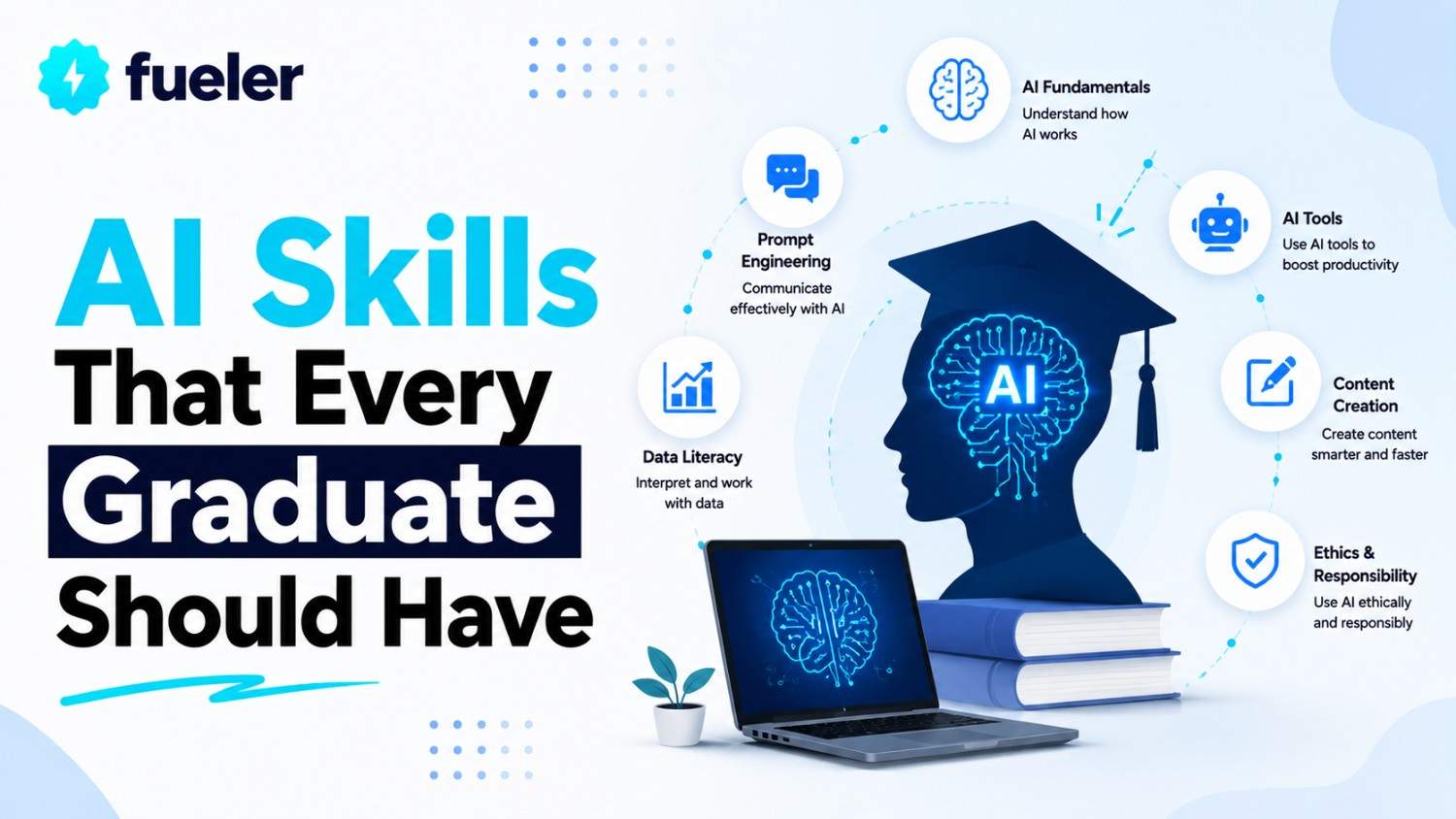
The top skills include fundamental AI literacy, prompt engineering, no-code workflow automation, natural language data analysis, multimodal design, research synthesis, project coordination, and ethical governance oversight.
Do non-technical graduates need coding to learn AI skills?
No, modern workplace AI skills focus on natural language instruction, system evaluation, and no-code automation platforms rather than writing traditional software code.
How do employers test AI skills during hiring?
Employers evaluate candidates through practical assignments, real-world case study projects, and proof-of-work portfolios that showcase execution abilities over traditional resume credentials.
Can relying on AI tools harm my entry-level career growth?
Uncritical reliance on automated output without verifying facts creates major operational risks. Combining automated execution with rigorous human oversight accelerates early career progression.
How can fresh graduates prove their AI capabilities to recruiters?
Graduates can build a public portfolio documenting workflow automations, structured prompt frameworks, and data projects, providing tangible proof of execution on platforms like Fueler.
Why 100,000+ professionals use Fueler
Fueler helps professionals showcase proof of work through projects, assignments, case studies, and achievements.
- Thousands of professionals use Fueler to create their digital portfolio
- Thousands of projects are published on Fueler. Check here
- Startups and Companies hire through proof of work on Fueler
- Used by freelancers, creators, marketers, video editors, writers, designers, and product managers
Our mission is to help the next 100 million professionals build a verified professional identity through proof of work

What should you do next?
You've read the article. Now turn your skills into proof of work and unlock more opportunities.
Build your proof of work portfolio
Create a clean portfolio with projects, assignments, resumes, and AI stack details that companies actually want to see.
Create your Fueler portfolio →Apply through assignments, not resumes
Stand out by solving real tasks from companies hiring on Fueler.
Explore assignments →Get discovered by companies
Make your work public and let recruiters discover your skills through actual projects instead of keywords.
Get discovered →
