How to Get a Tech Job in India Without a Computer Science Degree in 2026

Riten Debnath
26 Aug, 2026
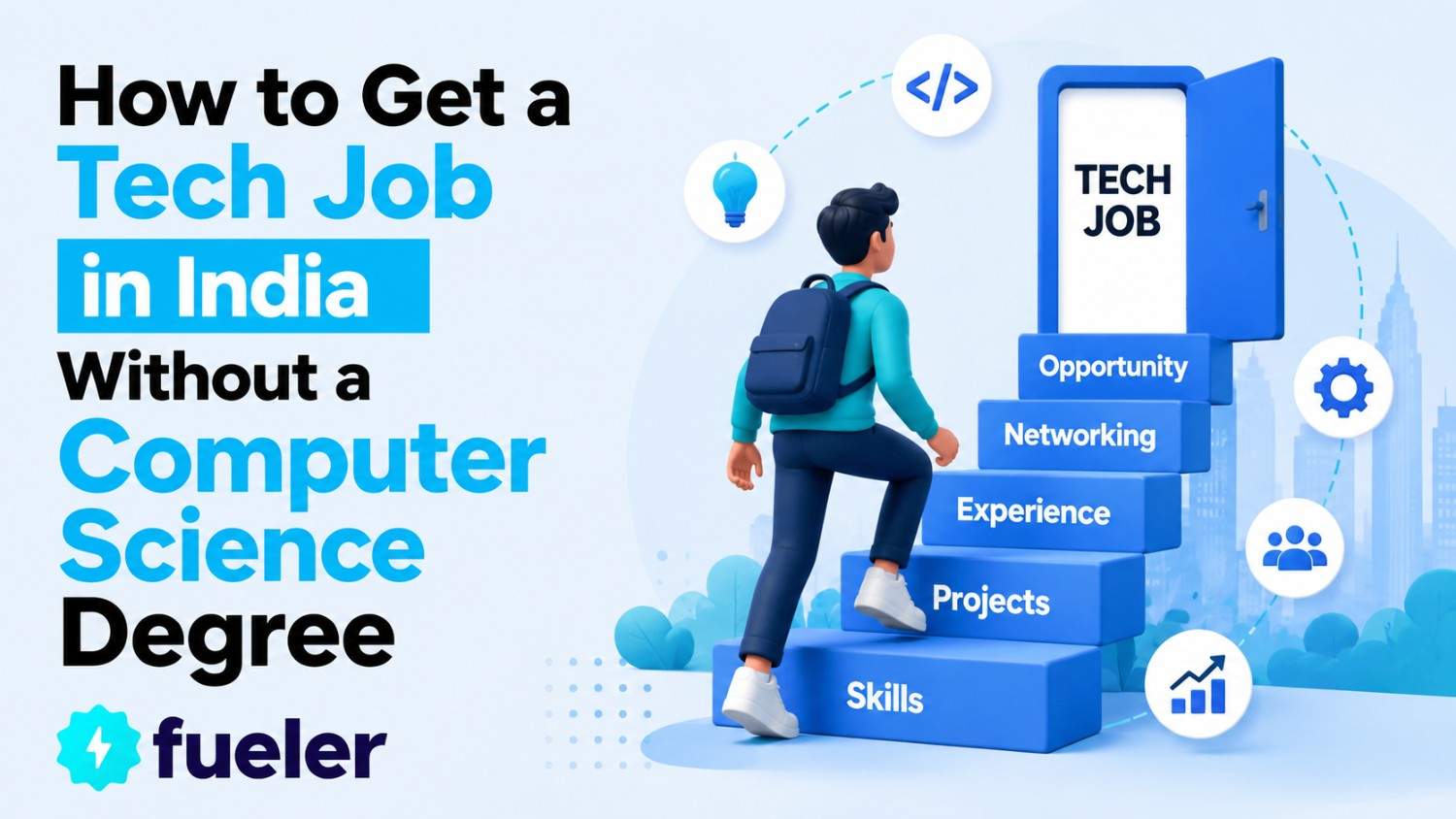
A Computer Science degree can make it easier to enter the technology industry, but it is not the only way to build a career in tech. People from commerce, science, engineering, design, finance, marketing, and other backgrounds are increasingly learning technical skills and moving into technology roles through practical experience, online learning, internships, freelance projects, and self-directed work.
The important part is that not having a Computer Science degree does not mean you can skip the learning process. You still need to understand the fundamentals, build useful projects, solve problems, communicate clearly, and show employers that you can perform the work expected in the role. For candidates searching for tech jobs without a degree in India, the strongest approach is to replace the missing academic signal with several practical signals that demonstrate your ability.
I’m Riten, founder of Fueler, a skills-first portfolio platform building the career infrastructure for 100 million creative professionals. Fueler connects talented individuals with companies through assignments, portfolios, and projects, not just resumes or CVs. Think of it as Dribbble/Behance for work samples combined with AngelList for hiring infrastructure.
In this guide, I will explain how to get a tech job in India without a Computer Science degree, which skills you should learn, how to build practical projects, use open-source work, network with technology professionals, approach assignments, and create Proof of Work that gives employers evidence of your actual ability.
Skill-First Hiring and Technical Fundamentals
The first step toward getting a technology job without a Computer Science degree is understanding that you still need strong technical fundamentals. A company may be willing to consider candidates from different educational backgrounds, but it still needs people who can solve problems, learn new technologies, understand systems, and complete the work assigned to them. This is why replacing a degree with a collection of random certificates usually does not work.
The technology role you choose should determine what you learn. A frontend developer needs a different skill set from a data analyst, while an AI engineer requires a much deeper technical foundation. Instead of trying to learn every technology available, study the core concepts that appear repeatedly in job descriptions for your target role and gradually build practical ability around them.
- Programming Fundamentals: Learn variables, functions, data structures, debugging, APIs, and basic software development concepts if you are targeting a development role.
- Data and Analytical Skills: Build knowledge of SQL, spreadsheets, statistics, Python, data cleaning, and visualisation if you want to move into data analytics.
- Design and Product Skills: Learn user research, wireframing, prototyping, interaction design, and usability testing if you want to enter product or UI/UX roles.
- Cloud and Infrastructure Knowledge: Develop an understanding of Linux, networking, cloud platforms, containers, deployment, and monitoring if you want to move toward DevOps or cloud engineering.
- AI and Machine Learning Skills: Build knowledge of Python, machine learning, data preparation, model evaluation, LLMs, RAG, and AI application development if you want to work in AI.
Why It Matters: A degree can signal that you spent several years studying a subject, but employers still need evidence that you can perform the job. Strong technical fundamentals give you the foundation required to build that evidence through projects, assignments, internships, and professional work.
Choosing One Technology Career Path
One of the biggest mistakes I see from people trying to enter tech without a Computer Science degree is learning too many things at the same time. Someone starts with Python, moves to JavaScript, watches a few machine learning videos, learns some cloud computing, tries cybersecurity, and eventually ends up with several certificates but no strong project that demonstrates their ability in a particular role.
I would approach this differently. Choose one target role first, study the job descriptions for that role, identify the skills employers repeatedly ask for, and build your learning plan around those requirements. You do not need to know every technology before applying for your first job because depth in a relevant skill is generally more useful than shallow knowledge across many unrelated areas.
- Frontend Development: Focus on HTML, CSS, JavaScript, React or another relevant framework, APIs, Git, responsive design, testing, and deployment.
- Data Analytics: Build skills in Excel, SQL, statistics, Python, data visualisation, dashboards, and business analysis.
- Software Engineering: Learn programming, data structures, algorithms, databases, APIs, testing, Git, backend development, and basic system design.
- AI Engineering: Combine Python, machine learning, deep learning, LLMs, RAG, APIs, databases, evaluation, and deployment.
- Cloud and DevOps: Develop knowledge of Linux, networking, cloud services, Docker, CI/CD, infrastructure, monitoring, and security fundamentals.
Why It Matters: Companies hire people for specific responsibilities, not for a general label such as "technology enthusiast." Choosing a clear career direction makes your learning more focused and helps you build a portfolio that matches the jobs you actually want.
Building Strong Projects and Case Studies
Projects are one of the most important ways to demonstrate your ability when you do not have a Computer Science degree. A hiring manager cannot see everything you learned from an online course or YouTube tutorial, but they can inspect an application you built, understand your technical decisions, and ask you questions about how you solved specific problems.
Your projects should also become progressively more difficult. Your first project can help you understand the basics, while your later projects should demonstrate independent thinking, technical depth, and your ability to solve problems without following a tutorial step by step. Instead of building five similar applications, create a small number of projects that demonstrate different parts of the job you want.
- Real Problem Selection: Choose a project that solves a clear user or business problem instead of building another generic tutorial application with no meaningful purpose.
- Technical Complexity: Gradually add databases, APIs, authentication, testing, deployment, automation, or other components that are relevant to your target role.
- Independent Decision-Making: Explain why you selected particular technologies, architectures, models, or workflows rather than simply copying an existing implementation.
- Measurable Outcomes: Track genuine results such as processing time, application performance, model accuracy, conversion rates, or other useful metrics whenever your project allows it.
- Detailed Documentation: Explain the problem, your approach, implementation, challenges, results, limitations, and future improvements so another person can understand your work.
Why It Matters: A project gives employers something concrete to evaluate. For candidates without a traditional Computer Science background, strong projects can demonstrate technical ability, problem-solving skills, curiosity, and independent learning in a way that a list of certificates cannot.
Building a Proof of Work Portfolio
Building projects is only part of the process because employers also need an easy way to understand what you have created. This is where a Proof of Work portfolio becomes valuable. Instead of asking recruiters to trust statements such as "I know Python" or "I have experience with React," your portfolio can show exactly what you built and how you approached the problem.
I believe this is one of the biggest advantages candidates can create for themselves today. A well-organised portfolio can bring together your projects, assignments, freelance work, open-source contributions, case studies, and other evidence of your skills. You can also build a Proof of Work portfolio that gives hiring teams a clearer picture of your practical capabilities.
- Project Case Studies: Explain the problem, process, technology, challenges, results, and lessons from your strongest projects.
- Live Work Samples: Add deployed applications, dashboards, websites, prototypes, or other work that employers can actually inspect.
- Technical Evidence: Link to GitHub repositories, documentation, architecture diagrams, notebooks, or other relevant technical material.
- Assignment Work: Include meaningful take-home assignments and practical challenges when you have permission to share them publicly.
- Learning Progress: Show how your capabilities developed over time through increasingly complex projects rather than simply listing completed courses.
Why It Matters: Your educational background explains where you studied, but your Proof of Work can demonstrate what you can actually do. This becomes especially useful when your degree does not directly match the technology role you are targeting.
Using Open Source to Build Real Experience
Open-source contribution is another powerful way to build credibility without depending entirely on your academic background. You do not need to contribute to the most famous project on GitHub from your first day. You can begin with documentation, tests, small bug fixes, accessibility improvements, examples, or other clearly defined contributions.
The value of open source is that you are working inside an existing project with other people. You have to understand someone else's code, follow contribution guidelines, communicate with maintainers, respond to feedback, and make changes without breaking existing functionality. These experiences can be very different from building a personal project where you control every decision.
- Documentation Contributions: Improve setup instructions, examples, tutorials, or explanations so other users can understand a project more easily.
- Bug Fixes: Find and resolve smaller issues that match your current technical ability while learning how real software projects are maintained.
- Testing Contributions: Add or improve tests that help maintain software quality and demonstrate your understanding of how applications should behave.
- Code Review Experience: Learn to respond to feedback and understand why experienced developers may recommend changing your implementation.
- Community Participation: Participate in discussions, issues, and project communities so you learn how technical teams communicate and collaborate.
Why It Matters: Personal projects show that you can build something yourself, while open-source contributions can show that you can work within an existing technical environment. That combination can make your profile more convincing to employers.
Getting Experience Through Freelance Work and Internships
You do not have to wait for your first full-time technology job before gaining professional experience. Small freelance assignments, internships, volunteer projects, college projects, startup work, and independent client assignments can all help you understand how technology work happens under real constraints.
A client project is different from a tutorial because someone else has expectations about the final result. You may have to understand unclear requirements, communicate changes, work within a deadline, fix unexpected problems, and make decisions based on limited resources. These experiences can teach you skills that are difficult to develop through courses alone.
- Small Client Projects: Start with manageable websites, dashboards, automations, data reports, applications, or other work that matches your current skills.
- Startup Internships: Look for early-stage companies where you can work closely with a small team and take responsibility for meaningful tasks.
- Volunteer Technology Work: Help non-profit organisations, communities, student groups, or small businesses where your technical work can solve a genuine problem.
- Freelance Assignments: Use freelance projects to practise requirements gathering, delivery, revisions, communication, and client management.
- Documented Professional Experience: Ask for permission to turn suitable work into a case study while protecting confidential information and accurately describing your contribution.
Why It Matters: Real-world experience teaches you how to work with requirements, deadlines, feedback, and other people. These are important professional skills that cannot always be demonstrated through a course certificate or personal project.
Networking and Finding Technology Opportunities
Networking is important when you are trying to enter tech without a traditional background, but effective networking is not about sending hundreds of people the same message asking for a referral. Good networking starts by becoming part of the communities where people working in your target field already spend time.
You can follow developers, designers, data professionals, founders, recruiters, and technology communities online while also attending meetups, hackathons, conferences, workshops, and local events. When you eventually approach someone for advice, having a project or portfolio to share makes the conversation much more useful because they can respond to something concrete.
- Technical Communities: Participate in communities related to programming, data, design, AI, cloud, cybersecurity, or another field that matches your career goal.
- Industry Events: Attend meetups, hackathons, conferences, and workshops where you can meet professionals and understand what companies are actually looking for.
- Thoughtful Outreach: Ask specific questions about a person's experience or seek feedback on your work instead of immediately asking for a job.
- Sharing Your Work: Publish useful project breakdowns, technical learnings, experiments, or case studies so people can discover what you are capable of.
- Maintaining Relationships: Stay connected with people you meet by continuing to interact with their work and sharing useful updates about your own progress.
Why It Matters: Many opportunities are discovered through professional relationships before they become formal applications. A strong network can also give you feedback, referrals, project ideas, and a better understanding of the skills companies actually value.
Applying Through Assignments and Skills-Based Hiring
A practical assignment can be particularly valuable for someone without a Computer Science degree because it gives you an opportunity to demonstrate your ability directly. Instead of relying only on your academic history, you get a defined problem and the chance to show how you think, build, test, and communicate.
This is one reason I believe skills-first hiring can create more opportunities for candidates from non-traditional backgrounds. You can learn more about skills-first hiring and how practical evidence can become part of a stronger hiring process. However, skills-first hiring does not mean employers stop caring about fundamentals. It means candidates have more ways to demonstrate those fundamentals.
- Understanding Requirements: Read the assignment carefully and make sure you understand the actual problem before immediately starting implementation.
- Making Technical Decisions: Explain important choices about technologies, architecture, design, data, or implementation rather than submitting unexplained work.
- Testing Your Solution: Check your work carefully, identify edge cases, and make sure the final result actually solves the stated problem.
- Documenting Your Process: Include a concise explanation of your approach, challenges, assumptions, and improvements so reviewers can understand your thinking.
- Presenting the Outcome: Make the final submission easy to inspect by providing a working demo, screenshots, repository, documentation, or other appropriate evidence.
Why It Matters: An assignment can reduce the gap between your educational background and the job requirements because the employer gets to evaluate your actual work. Strong performance on practical assessments can become an important signal for candidates who do not have a conventional technology degree.
Creating a Resume That Supports Your Proof of Work
Your resume should support your portfolio rather than trying to replace it. When you do not have a Computer Science degree, it can be tempting to fill the resume with every course, certificate, and technology you have touched. This usually makes the document harder to understand and does not necessarily prove that you can use those skills.
Instead, describe your work in terms of problems, actions, technologies, and outcomes. A statement such as "Learned React and Node.js" gives an employer very little information, while "Built and deployed a full-stack inventory application using React, Node.js, and PostgreSQL with authentication and REST APIs" gives them something concrete to investigate.
- Project-Based Experience: Put your strongest projects in a prominent position when you do not yet have extensive professional technology experience.
- Specific Technical Contributions: Explain what you personally built rather than describing the entire project as though you completed every part.
- Relevant Skills: List technologies that you can actually discuss in an interview instead of creating a long list based on short tutorials.
- Quantifiable Results: Use genuine metrics when they exist, such as performance improvements, processing time, accuracy, users, or other measurable outcomes.
- Portfolio Integration: Add links to your strongest Proof of Work so recruiters can move from your resume to detailed evidence quickly.
Why It Matters: Your resume gets you into the conversation, but your portfolio and projects can help continue that conversation. A clear resume makes it easier for recruiters to understand your profile without forcing them to search through unrelated information.
Preparing for Technical Interviews
A strong portfolio can help you get an interview, but you still need to demonstrate your knowledge when you speak with the hiring team. This is particularly important for candidates without a Computer Science degree because interviewers may use technical questions to evaluate the fundamentals that a formal degree would normally cover.
Your preparation should match the role. Software engineering candidates may need data structures, algorithms, databases, APIs, debugging, and system design. Data analysts may face SQL, statistics, business cases, and data interpretation. AI candidates may need Python, machine learning concepts, model evaluation, and Generative AI fundamentals.
- Core Technical Questions: Understand the concepts behind the technologies listed on your resume instead of memorising definitions.
- Coding Practice: Practise writing code without relying on autocomplete or AI tools so you can demonstrate independent problem-solving ability.
- Project Discussions: Be prepared to explain the architecture, trade-offs, bugs, limitations, and improvements associated with your projects.
- Problem-Solving Approach: Explain how you think through unfamiliar problems rather than rushing toward an answer without describing your reasoning.
- Communication Skills: Practise explaining technical ideas in simple language because technology teams need people who can communicate with both technical and non-technical stakeholders.
Why It Matters: A portfolio can demonstrate what you built, but an interview demonstrates whether you understand your work deeply enough to make decisions independently. You should be able to defend the important choices behind every project you present.
How Does This Connect to Building a Strong Career or Portfolio?
For someone without a Computer Science degree, the biggest challenge is often not learning technology. It is proving that the learning has translated into useful ability. You may spend hundreds of hours learning Python, SQL, React, AI, or cloud computing, but a recruiter cannot directly observe those hours. They can only evaluate the evidence you choose to present.
This is where a strong portfolio becomes important. You can build a career portfolio that actually gets jobs by connecting your projects, assignments, professional experience, and learning into a clear story about what you can do.
Your portfolio should make the hiring manager's job easier. Instead of asking them to believe that you are capable, give them enough evidence to evaluate your capability themselves.
A good Proof of Work portfolio can include:
- A full-stack application with a live demo and GitHub repository
- A data analysis project with SQL queries and a dashboard
- An AI application with a clear explanation of its architecture
- An open-source contribution with a link to your pull request
- A freelance project with the client's permission to showcase the work
- A technical assignment that demonstrates your problem-solving approach
You can also learn how to turn your existing work experience into a career portfolio instead of assuming that your previous career has no value. A person moving from finance into data analytics can use financial knowledge to build stronger analytics projects. Someone moving from marketing into technology can build marketing automation tools or analytics dashboards. A designer moving into frontend development can combine product design knowledge with technical implementation.
The goal is not to hide the fact that you do not have a Computer Science degree.
The goal is to make your other evidence strong enough to tell a more complete story.
Why It Matters: Your background tells an employer where you came from, while your Proof of Work demonstrates what you can do today. For candidates changing careers or entering technology without a traditional degree, that distinction can be extremely valuable.
Final Thoughts
Getting a tech job in India without a Computer Science degree is possible, but it requires a different approach to building credibility. You cannot simply remove the degree from your resume and expect employers to overlook the missing qualification. You need to replace that signal with stronger evidence of technical ability, problem-solving, communication, and real-world execution.
Start by choosing one technology role and learning the fundamentals required for it. Build three to five meaningful projects instead of collecting dozens of unfinished tutorials. Contribute to open source so you can experience collaborative development. Take internships, freelance assignments, and startup projects seriously because they expose you to real requirements and constraints. Build relationships with people in the industry and use practical assignments as opportunities to demonstrate your skills.
Most importantly, document your work.
A certificate can tell someone that you completed a course.
A resume can tell someone what technologies you claim to know.
A portfolio can show them what you actually built.
That difference matters even more in 2026 because AI tools are making it easier to generate basic code, content, designs, and other outputs. The value increasingly comes from understanding the problem, making good decisions, using the right tools, checking the output, and delivering something that actually works.
At Fueler, this is the principle I continue to believe in: people should have more opportunities to demonstrate what they can do, not only explain where they studied.
Your Computer Science degree may be missing.
Your Proof of Work does not have to be.
If you consistently learn, build, contribute, document, and improve, you can create a career profile that gives employers a much clearer reason to take a chance on you.
Frequently Asked Questions
Can I get a tech job in India without a Computer Science degree?
Yes, you can get a tech job in India without a Computer Science degree, although some employers and roles still have formal degree requirements. Candidates from non-CS backgrounds can build opportunities through technical skills, projects, internships, freelance work, open-source contributions, practical assignments, and a strong Proof of Work portfolio. The difficulty depends heavily on the role and the depth of technical knowledge required.
Which tech jobs can I get without a degree in India?
Candidates without a Computer Science degree can explore roles such as frontend developer, data analyst, QA tester, technical support specialist, UI/UX designer, software developer, cloud or DevOps professional, cybersecurity analyst, and AI-related roles. The more technically advanced the position, the more important strong programming, mathematics, system knowledge, and practical experience become.
How can I get a software developer job without a Computer Science degree?
Start by choosing a development path such as frontend, backend, or full-stack development and learn the relevant programming fundamentals, databases, APIs, Git, testing, and development tools. Build three to five serious applications, deploy them, publish your code, contribute to open source, practise technical interviews, and document your strongest projects in a Proof of Work portfolio.
Is Proof of Work important for getting tech jobs without a degree?
Yes, Proof of Work can be especially useful for candidates without traditional academic credentials because it gives employers direct evidence of practical ability. Projects, open-source contributions, freelance assignments, technical case studies, and deployed applications can demonstrate how you solve problems and execute work rather than simply stating that you have learned a particular technology.
How do I get my first tech job in India without experience or a degree?
Choose one role, learn its core skills, build practical projects, contribute to open source, look for internships or small freelance assignments, participate in relevant communities, and apply through both traditional applications and skills-based assignments. Create a focused portfolio that documents your best work and clearly explains your contribution, technical decisions, challenges, and outcomes. The goal is to gradually replace the missing degree and professional experience signals with credible evidence of what you can actually do.
Why 100,000+ professionals use Fueler
Fueler helps professionals showcase proof of work through projects, assignments, case studies, and achievements.
- Thousands of professionals use Fueler to create their digital portfolio
- Thousands of projects are published on Fueler. Check here
- Startups and Companies hire through proof of work on Fueler
- Used by freelancers, creators, marketers, video editors, writers, designers, and product managers
Our mission is to help the next 100 million professionals build a verified professional identity through proof of work
What should you do next?
You've read the article. Now turn your skills into proof of work and unlock more opportunities.
Build your proof of work portfolio
Create a clean portfolio with projects, assignments, resumes, and AI stack details that companies actually want to see.
Create your Fueler portfolio →Apply through assignments, not resumes
Stand out by solving real tasks from companies hiring on Fueler.
Explore assignments →Get discovered by companies
Make your work public and let recruiters discover your skills through actual projects instead of keywords.
Get discovered →
