
My Device Configuration


FFWS Content Engine — Multi-Agent Content Operations System for a D2C Coaching Brand

Designed and built the full content operations system for Fluent French with Swani (FFWS), a premium French-coaching brand targeting high-net-worth professionals in francophone-facing industries (import/export, pharma, logistics, procurement).
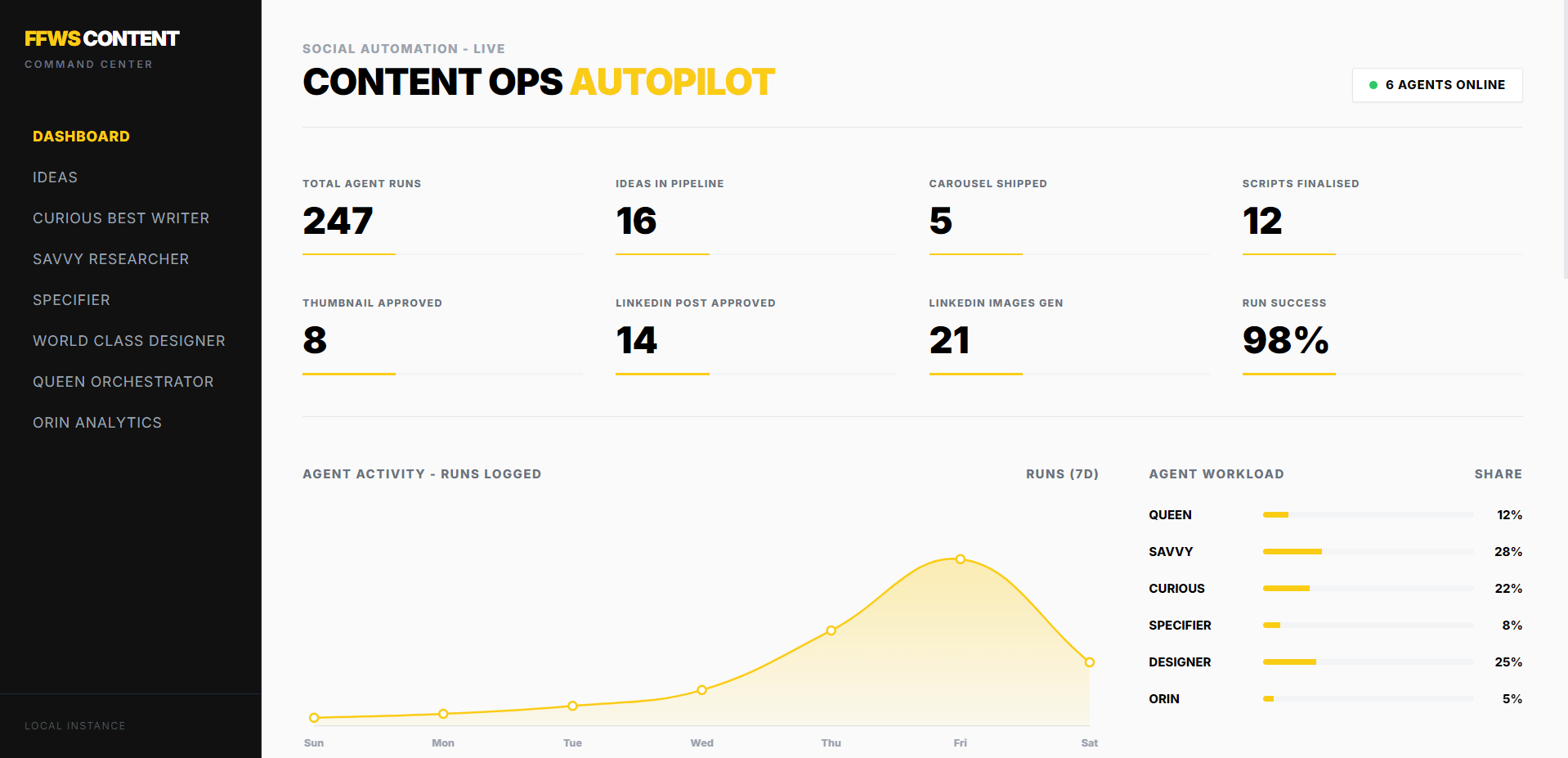
This is a 5-agent hierarchical system orchestrated by a top-level coordinator, QUEEN, running on the Hermes agent framework as its backend orchestration layer: Researcher, Writer, Designer, and ORIN (analytics), each responsible for one stage of the content pipeline.
Researcher — 3-step evidence-driven ideation. Rather than asking a model to freely invent ideas, the Researcher runs a deliberate 3-step process: (1) it pulls broad, current research on the content niche via Tavily, collecting multiple raw findings instead of jumping straight to ideas; (2) it distills that research into a structured, evidence-aware brief tied to the specific content type being produced (carousel vs. reel vs. LinkedIn post) — this step exists specifically to stop the next stage from generating attractive-sounding but ungrounded ideas; (3) a dedicated idea-generation step then uses that evidence brief — not raw research — to produce 5 content ideas for the selected format, which are individually refined before reaching the dashboard.
Designer — art direction before execution. The design stage deliberately separates creative direction from execution rather than calling Canva with a generic style prompt. After the Writer produces copy, a specification step translates each idea into a content-specific visual blueprint — defining the creative concept, a governing visual metaphor, a signature visual device, a composition plan, and how content maps to visual elements. This produces 3 genuinely differentiated visual directions per piece of content, not 3 versions of the same template. Only after that blueprint exists does the Designer step take over — narrowly scoped to translate the blueprint into a Canva creative prompt, generate candidate designs, select the top one, and render the final asset via Canva MCP for the user to choose from.
Self-refinement — a feedback loop, not model fine-tuning. The system doesn't retrain or fine-tune any underlying model. Refinement happens through a structured feedback loop: research → writing → a human approval gate → design spec → rendering → published content → ORIN's performance analysis → insights fed back into future generation instructions.
Three concrete feedback signals drive this: human approval/edits act as an immediate quality gate before anything reaches design; ORIN's analysis of published-content performance (topic, hook, format, engagement patterns) informs future ideation and writing; and the research layer itself is refreshed per run rather than reasoning only from previously generated content, keeping ideation grounded in current information rather than the system's own past output.
Content strategy is codified into a reusable framework (TEACH → CONVERT → SHIFT → PROVE) adapted from an existing content-machine methodology, giving the system a consistent daily output target of 5 reel scripts (with shooting guidelines), 5 LinkedIn posts, and 5 carousel posts. The system is deliberately architected without auto-publishing — every asset routes to a human for final review before going live.
How long did it take you to build this?
It took me around 4 weeks to build the system end-to-end, including the multi-agent architecture, research and ideation pipeline, writing system, design specification layer, Canva integration, analytics feedback loop, and human approval workflow.
How much would you charge for creating something like this?
For a system of this complexity, with a hierarchical multi-agent architecture, evidence-driven research, structured content generation, automated creative direction, Canva MCP integration, analytics-driven refinement, and human-in-the-loop approval, I would charge somewhere in the range of $2,000–$3,200, depending on the scope, integrations, and level of customization required.
01 Aug 2026
Keywords


AI Usage
AI drives the entire creative pipeline: evidence-gathering and idea generation, long- and short-form copywriting, visual art-direction (blueprint generation), and final asset rendering — executed through a 5-agent coordinator hierarchy on Hermes rather than a single model call. All system-design decisions were made manually: the agent role split and delegation logic, the 3-step research pipeline designed specifically to prevent hallucinated ideas, the decision to separate visual specification from visual execution so the Designer never free-styles a layout, the human-approval gate placed before design work begins, and the analytics feedback loop that routes ORIN's performance insights back into future content generation.