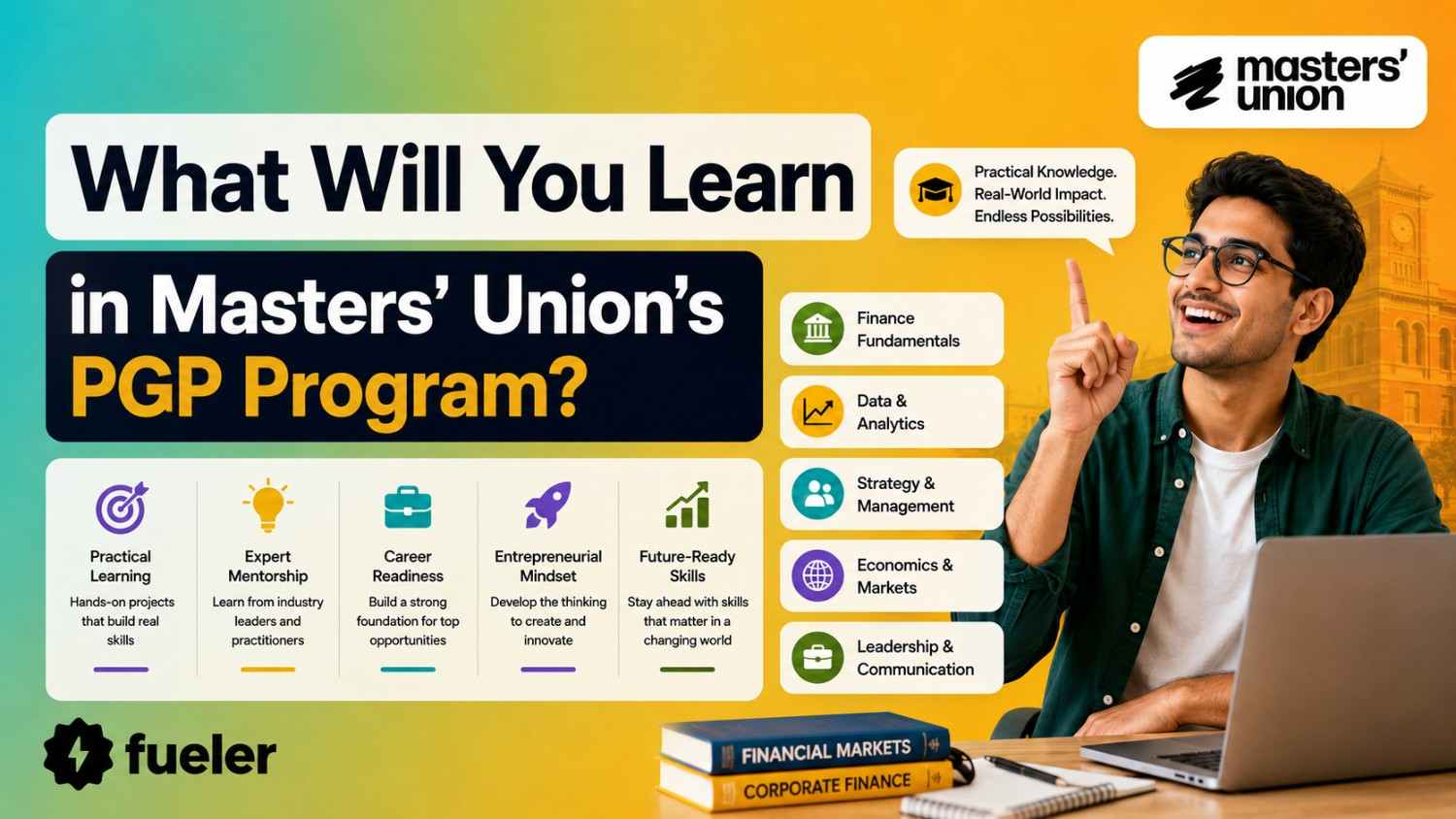
What Will You Learn in Masters' Union's PGP Program?

Riten Debnath
18 Aug, 2026
Last updated: August 2026
If you sit down with founders hiring in places like Bangalore or Gurgaon, they will tell you the same thing: standard resumes are practically dead. Nobody cares if you memorized a marketing textbook from 2012 or wrote a theoretical essay on supply chains. Modern venture-backed tech companies want to see what you have actually built, launched, and managed.
I’m Riten, founder of Fueler, a skills-first portfolio platform building the career infrastructure for 100 million creative professionals. Fueler connects talented individuals with companies through assignments, portfolios, and projects, not just resumes or CVs. Think of it as Dribbble/Behance for work samples combined with AngelList for hiring infrastructure.
Working with thousands of founders and operators has shown me that companies hire based on visible proof of work.
This brings us to a question I get asked constantly by young professionals and business students: What exactly do you learn inside Masters' Union’s Post Graduate Program in Technology and Business Management (PGP-TBM)? Is it just another glorified business degree, or are students actually picking up modern, market-ready skills?
Instead of reading through promotional glossies, let's break down the exact curriculum, hands-on challenges, business tools, and career capabilities taught inside their 16-month flagship program.
Quick Answer Summary
- Who It Is For: Working professionals, early-stage operators, aspiring startup founders, and students who prefer hands-on execution over traditional classroom lectures.
- Core Curriculum: Covers modern business strategy, product management, performance marketing, quantitative finance, generative AI workflows, and corporate ops.
- Cost: Tuition fees sit around ₹22 Lakhs to ₹25 Lakhs (plus applicable taxes and living expenses).
- Key Takeaway: You do not just study business models; you launch live businesses, manage real budgets, and build a public portfolio of work.
- Best Suited For: Self-starters looking for immediate entry into Founder's Office, Product Management, Growth, and Venture Capital roles.
What is the Masters' Union PGP Program Curriculum?
The Post Graduate Program in Technology and Business Management (PGP-TBM) at Masters' Union is structured as a 16-month immersive experience designed to bridge the gap between academic theory and real-world tech execution. Located in DLF Cyberpark, Gurugram, the program places students right in the middle of a massive corporate and startup center.
Unlike traditional business schools that rely on tenured professors, the program is delivered entirely by active practitioners startup founders, Chief Product Officers, Venture Capital partners, and corporate executives.
The curriculum is divided into core academic terms, micro-execution challenges, a full-scale venture build, a 3-month industry immersion, and a student-run venture fund. The goal is to ensure every graduate leaves with verified proof of work rather than a list of grades.
Key Facts Table
Detailed Explanation
What Will You Learn in Masters' Union's PGP Program? The program breaks down its learning framework into core business pillars, technical skills, live startup modules, and industry placements.
Core Business and Strategic Foundations
The program starts by grounding students in the fundamental mechanics of how companies operate, make money, and scale.
Students learn corporate finance, managerial accounting, competitive strategy, and business economics. However, instead of analyzing financial statements from 30 years ago, students dissect real quarterly filings, pitch decks, and unit economics of modern Indian tech companies like Zomato, Paytm, and Meesho.
You learn how to read balance sheets, build financial models in Excel, project cash flows, and analyze CAC-to-LTV ratios (Customer Acquisition Cost to Lifetime Value). Understanding these core financial levers gives students the ability to make data-backed strategic decisions when running a business.
Technology, Product Management, and No-Code Workflows
Understanding technology is mandatory for modern managers. The PGP curriculum places a heavy emphasis on product management, software logic, and digital transformation.
Students learn how software products are built from scratch. This includes user research, wireframing, writing Product Requirement Documents (PRDs), managing sprint cycles, and understanding how backend APIs interact with frontend design.
The program also trains students on no-code tools and modern AI workflows. Rather than waiting on engineering teams, students learn to build functional software prototypes, landing pages, and automated workflows using tools like Webflow, Zapier, and generative AI platforms. This capability allows operators to test ideas quickly without high initial development costs.
Digital Marketing, Growth Hacking, and Content Distribution
Building a great product is useless if you do not know how to distribute it. The marketing modules inside the PGP program focus heavily on digital-first growth hacking, performance marketing, and brand building.
Students do not just study marketing funnels on a whiteboard; they set up live ad accounts, run meta and search ads, track conversion rates, and optimize click-through ratios (CTR). You learn how to write copy, build landing pages, design email sequences, and utilize SEO frameworks to drive organic growth.
Understanding how to acquire users predictably is a core skill taught in these modules. At Fueler, we see that individuals who can publicly demonstrate how they ran successful growth campaigns or managed ad spend stand out instantly to hiring managers in tech.
Venture Capital, Private Equity, and Fundraising
For students interested in finance, startup investing, or fundraising, the program breaks down how the capital ecosystem functions.
Students learn how venture capital funds source deals, conduct market sizing, run due diligence, and structure term sheets. You analyze cap tables, valuation methodologies, venture debt, and secondary share sales.
Crucially, students participate in a student-run VC fund where they evaluate real early-stage startups seeking investment. They write investment memos, debate deal terms, and pitch investment opportunities to an investment committee. This module turns theoretical finance into practical deal-making experience.
Business Operations, Logistics, and Data Analytics
Scaling a company requires tight operational control, efficient supply chains, and continuous data analysis.
The operations modules cover supply chain mechanics, vendor negotiation, unit economics optimization, and process automation. Alongside operations, students go through rigorous data analytics training using SQL, Advanced Excel, Python, and visualization tools like Tableau or Power BI.
You learn how to pull raw user data, run cohort analyses, identify operational bottlenecks, and make data-driven decisions. Whether optimizing a delivery funnel for a quick-commerce app or managing inventory for a D2C brand, these technical operations skills are directly applicable on day one of a job.
Deep Dive: The Venture Initiation Programme (VIP) & Student Startups
The Venture Initiation Programme (VIP) is the flagship capstone of Masters' Union. Built on a "learning by doing" framework, VIP gives students an overarching, 0-to-1 operational view of building a scalable company from scratch. Rather than submitting theoretical slide decks, student teams execute across four distinct stages:
- Pre-Seed & Ideation Stage: Teams identify market gaps, conduct rigorous consumer research, and test foundational business assumptions.
- Minimum Viable Product (MVP) Build: Students build and launch functional prototypes or minimum viable offerings using limited resources.
- Go-To-Market (GTM) Execution: Teams test acquisition channels, deploy real marketing strategies, and run operational experiments to secure initial users.
- Product-Market Fit (PMF) & Validation: Students iterate based on real feedback, drive actual customer revenue, and optimize unit economics.
To support risk-taking, the program provides access to the Founders' Fellowship, offering student entrepreneurs stipends (such as ₹50,000 per month) and micro-grant funding to offset prototyping costs and living expenses. The VIP concludes on Demo Day, where student founders present their live traction and unit economics directly to angel networks and active VC partners.
Real Student Startups Born Out of Masters' Union
Graduates and current students at Masters' Union have launched several ventures through the VIP framework and campus ecosystem:
- SeedsAI: Founded by student entrepreneurs Shubham Khatri and Vansh Miglani, SeedsAI develops empathetic, voice-based AI solutions tailored for the BFSI (Banking, Financial Services, and Insurance) sector to drive financial inclusion. The startup raised $200,000 in funding from Campus Fund.
- Hive School: An industry-oriented sales training platform aimed at upskilling professionals through hybrid bootcamps, backed by strategic industry partnerships.
- Bullspree: A gamified financial literacy and stock market investment learning app built by students that secured national visibility and venture backing after pitching on Shark Tank India.
How It Works
Term 1: Foundations and The Dropshipping Challenge
Students learn core accounting, economics, and quantitative methods. Simultaneously, they are thrust into the Dropshipping Challenge, where they must set up an e-commerce store, source products, run performance ad campaigns, and generate real profit within weeks.
Term 2: Product, Growth, and The Creator Challenge
Focus shifts to product management, UI/UX design thinking, and digital marketing. Students can take on the Creator Challenge, where they build a digital audience from scratch, create content, and test audience monetization models.
Terms 3 & 4: The Venture Initiation Programme (VIP)
This is the core capstone of the program. Students form teams, pitch for pre-seed capital, build a Minimum Viable Product (MVP), execute a Go-To-Market (GTM) strategy, and attempt to achieve Product-Market Fit (PMF) with real paying customers.
Term 5: 3-Month Industry Immersion
Students leave the classroom to complete a full 3-month internship inside high-growth startups, corporate tech giants, or venture capital firms. This acts as a trial run for full-time job placements.
Term 6: Student VC Fund, Demo Day, and Career Placement
Student founders pitch their ventures on Demo Day to active angel investors and VC partners. Meanwhile, students targeting corporate roles compile their portfolios and go through placement drives for strategic roles.
Benefits
- Practitioner Mentorship: Classes are taught by leaders actively building companies, ensuring the skills taught match current hiring needs.
- Hands-on Execution Skills: You learn how to run ads, write SQL queries, build no-code tools, and manage real business budgets.
- Built-in Proof of Work: Instead of leaving with just a grade sheet, you build a verified portfolio featuring real businesses, campaigns, and product wireframes.
- Direct Network Access: Being based in DLF Cyberpark, Gurugram, gives students direct access to founders, VCs, and hiring managers.
- Fast-Track Entry into Strategic Roles: The curriculum prepares students for roles like Chief of Staff, Founder's Office, Product Manager, and Growth Lead.
Challenges / Limitations
- High Intensity and Pressure: Balancing coursework, live business management, and team challenges requires managing significant daily stress.
- Not a Government Degree: It operates as an industry-focused certificate program rather than a traditional UGC-recognized university degree.
- Significant Financial Commitment: Fees and living expenses in Gurugram represent a major financial investment.
- Unsuitable for Passive Learners: If you prefer structured textbooks and standard exams, the open-ended, execution-heavy format can feel overwhelming.
Comparison Table
Fees / Cost
- Tuition Fees: The tuition fee for the flagship PGP-TBM program sits around ₹22 Lakhs to ₹25 Lakhs.
- Taxes and Extra Charges: Government taxes (GST), student council funds, and study materials add to the base fee structure.
- Living Expenses: Accommodations and food in Gurugram generally cost between ₹3 Lakhs to ₹5 Lakhs over the 16-month duration.
- Scholarships: Partial merit-based and need-based scholarships are available based on entrance test scores (CAT, GMAT, GRE, or MU-BAAT) and background performance.
- ROI Considerations: Placement data shows average CTC packages ranging between ₹28 LPA and ₹33 LPA, providing a competitive payback period for active performers.
Career Opportunities
Primary Career Roles
- Founder's Office / Chief of Staff: Working alongside tech founders to solve operational bottlenecks, run special projects, and launch new business units.
- Product Manager: Defining product roadmaps, coordinating between engineering and design, and driving user metrics.
- Growth Marketing Manager: Managing acquisition budgets, optimizing conversion funnels, and scaling digital marketing channels.
- Venture Capital Analyst: Sourcing early-stage startups, running financial due diligence, and building investment memos.
- Business Operations Manager: Setting up supply chain workflows, vendor management systems, and team productivity structures.
Target Hiring Sectors
Graduates land roles primarily in Consumer Tech, Fintech, D2C Brands, B2B SaaS, Management Consulting, and Venture Capital funds. Salary packages generally fall between ₹18 LPA and ₹35+ LPA, depending heavily on a candidate's prior work experience and portfolio strength.
Who Should Choose This?
- Working professionals with 1 to 4 years of experience who want to pivot into product, strategy, or tech ops.
- Aspiring startup founders who want to build and test ideas with seed funding and direct mentorship.
- Individuals who learn best by running real experiments, managing budgets, and building actual products.
- Candidates targeting fast-growing startup hubs like Gurgaon, Bangalore, or Mumbai.
- Professionals who value building a visible portfolio of work on platforms like Fueler over relying solely on a traditional resume.
Who Should Avoid This?
- Candidates seeking a government-recognized master's degree (UGC/AICTE) to qualify for public sector jobs or PhDs.
- Individuals who prefer predictable academic schedules, written exams, and traditional textbook learning.
- Candidates who get easily stressed by fast-paced environments, changing team dynamics, and live execution goals.
- Anyone unwilling to actively build and document their work publicly throughout the program.
Final Thoughts
The shift toward skills-first hiring is no longer a future prediction; it is happening right now across the global tech landscape. Companies realize that academic degrees do not guarantee that someone can run a product sprint, write a converting ad copy, or analyze a complex SQL database on day one.
At Fueler, we see every day how candidates who showcase tangible work samples skip the hiring line. What Masters' Union has done with its PGP program is align business education with this exact market reality.
If you step into the program expecting a traditional campus experience where you just attend lectures and take exams, you will miss the point. But if you view it as a 16-month playground to build real ventures, run live marketing campaigns, master tech tools, and build an undeniable portfolio of work, it provides a very effective launching pad for modern tech careers.
Key Takeaways
- The PGP-TBM curriculum balances core business finance with tech, product management, and growth execution.
- Classes are taught by active industry leaders, CXOs, and VC partners rather than academic professors.
- Live challenges, including dropshipping, creator projects, and full startup builds, replace standard paper case studies.
- Students build verified proof of work that serves as their primary job application asset.
- Key career outcomes focus heavily on Founder's Office, Product Management, Growth, and Venture Capital roles.
- The program requires high self-drive, comfort with stress, and a willingness to learn by doing.
FAQs
What core subjects are taught in the Masters' Union PGP program?
You learn business finance, product management, performance marketing, data analytics (SQL, Excel), growth hacking, no-code workflows, and venture capital deal structuring through live execution modules.
Do I need prior coding experience to learn product management here?
No prior coding experience is required. The program focuses on product logic, user research, wireframing, PRD writing, and no-code tools that allow non-engineers to build functional prototypes.
How does the Venture Initiation Programme work inside the curriculum?
Students form teams, receive seed funding, build a Minimum Viable Product, execute a go-to-market strategy, and manage real operations to acquire paying customers before pitching to VCs on Demo Day.
Is the PGP program recognized as a university degree in India?
No, the Masters' Union PGP-TBM is an industry-focused postgraduate certificate program, not a UGC-recognized master's degree. It is designed specifically for corporate and startup employment.
How do graduates showcase what they learned to recruiters?
Graduates use public portfolios showcasing real work samples such as live venture metrics, product design files, SQL data models, and marketing campaigns instead of relying only on traditional resumes.
Why 100,000+ professionals use Fueler
Fueler helps professionals showcase proof of work through projects, assignments, case studies, and achievements.
- Thousands of professionals use Fueler to create their digital portfolio
- Thousands of projects are published on Fueler. Check here
- Startups and Companies hire through proof of work on Fueler
- Used by freelancers, creators, marketers, video editors, writers, designers, and product managers
Our mission is to help the next 100 million professionals build a verified professional identity through proof of work

What should you do next?
You've read the article. Now turn your skills into proof of work and unlock more opportunities.
Build your proof of work portfolio
Create a clean portfolio with projects, assignments, resumes, and AI stack details that companies actually want to see.
Create your Fueler portfolio →Apply through assignments, not resumes
Stand out by solving real tasks from companies hiring on Fueler.
Explore assignments →Get discovered by companies
Make your work public and let recruiters discover your skills through actual projects instead of keywords.
Get discovered →
