Global Learning Opportunities at Plaksha University Explained

Riten Debnath
07 Oct, 2026
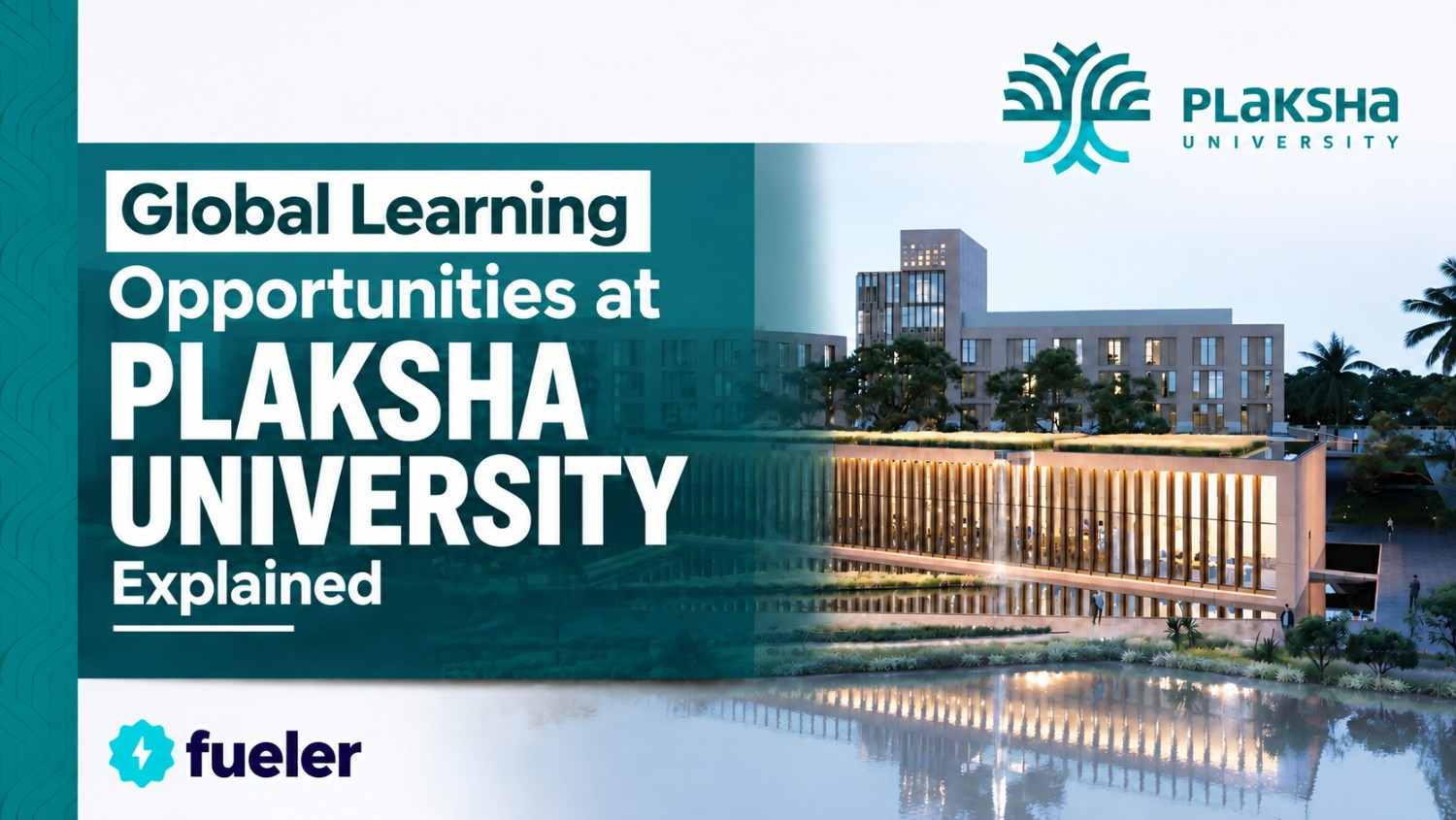
Most traditional higher education systems were built for a world that no longer exists. For decades, students were forced to choose between staying in India for a legacy engineering degree or spending upwards of 200,000 USD to study abroad in the United States or Europe.
I’m Riten, founder of Fueler, a skills-first portfolio platform building the career infrastructure for 100 million creative professionals. Fueler connects talented individuals with companies through assignments, portfolios, and projects, not just resumes or CVs. Think of it as Dribbble/Behance for work samples combined with AngelList for hiring infrastructure.
When I look at early professionals, startup founders, and fresh graduates trying to break into top-tier global tech roles, the problem is rarely a lack of raw talent. The problem is proof of work and international perspective. Recruiters at global tech firms and venture-backed startups do not just look at a university brand stamp anymore; they want to see what you have actually built, deployed, and published.
That is exactly why global learning opportunities at Plaksha University caught my attention. Plaksha isn't trying to clone legacy Indian institutes or simply act as a feeder to foreign colleges. They are integrating global academic infrastructure, top-tier international research projects, and foreign master's pathways directly into their core Indian campus in Mohali, Punjab.
If you want to understand how modern higher education is shifting toward global mobility and project-based learning, this deep dive breaks down how global learning opportunities at Plaksha University work in practice.

Quick Answer Summary
Who It Is For: High-performing tech aspirants, future founders, students seeking international research exposure, and parents researching modern alternatives to standard Indian engineering colleges or expensive four-year overseas degrees.
Primary Institutional Partners: UC Berkeley (Sutardja Center for Entrepreneurship & Technology), Purdue University, University of Pennsylvania (SEAS), University of Wisconsin-Madison, SRI International, and IISc Bengaluru.
Cost Structure: Indian campus tuition fees (approx. ₹7,80,000 per year for Category A) plus variable costs for optional summer abroad, semester exchange, or 4+1 master's programs in the US.
Key Takeaway: You get international curriculum co-design, guest global faculty, and clear pathways to top US universities without paying four full years of US tuition upfront.
Best Suited For: Self-driven builders, prospective product managers, AI engineers, and startup aspirants who want global career mobility and a strong public proof of work.
What is Global Learning at Plaksha University?
Global learning at Plaksha University is a structured ecosystem designed to give students direct access to international faculty, research projects, and foreign degree pathways. Instead of treating study abroad as an afterthought, Plaksha co-created its core curriculum alongside global academic heavyweights like UC Berkeley and Purdue University.
Context and Origin
Plaksha was founded by over 60 global tech founders, corporate leaders, and venture capitalists. They realized that traditional engineering programs in India often focus on rote memorization instead of real-world application.
To fix this, the university established the Office of Global Engagements (OGE). This office acts as a bridge between the Mohali campus and partner institutes across North America and Europe.
Why It Matters
In today's global tech landscape, working across borders is standard. An engineer in Bangalore might collaborate with a product team in San Francisco and a research lab in Zurich.
By exposing students to global teaching styles, international guest professors, and cross-border team projects early on, Plaksha removes the friction of stepping into international markets.
How It Differs From Alternatives
Traditional Indian Colleges: Most legacy universities offer zero international exchange, or limit it to a handful of students through basic memorandums of understanding (MoUs) that rarely translate into active classes.
Direct 4-Year Foreign Degrees: Studying directly in the US or UK costs anywhere between ₹1.5 Crore to ₹2.5 Crore ($180,000 to $300,000 USD) for an undergraduate degree. Plaksha brings international curriculum design and study options to India at a fraction of that cost.
Key Facts Table
Feature
Institutional Details
Location
Mohali, Punjab, India (Near Chandigarh tech hub)
Global University Partners
UC Berkeley, Purdue University, UPenn (SEAS), UW-Madison, SRI International
Primary Pathways
4+1 Master's, Semester Exchange, Summer Abroad, International Research
B.Tech Tuition Fee
Approx. ₹7,80,000 per year (Category A)
Financial Aid Available
Need-based aid ranging from 25% to 100% tuition waiver (Income < ₹50L)
Curriculum Focus
Interdisciplinary engineering, AI, Data Science, Robotics, Cyber-Physical Systems
Evaluation Method
Project-based building, hands-on labs, public proof of work
Detailed Explanation of Global Learning Opportunities
Global learning at Plaksha University is broken down into four distinct pillars. Here is how each mechanism operates on the ground.
1. The 4+1 Master's Degree Pathways
What It Is
The 4+1 pathway allows a Plaksha undergraduate student to complete their Bachelor of Technology (B.Tech) in four years in India, followed by a streamlined one-year Master of Science (MS) degree at a partner US university.
Key Partner Institutions
Plaksha has established formal 4+1 agreements with institutions such as:
University of Pennsylvania (UPenn): School of Engineering and Applied Science (SEAS).
Purdue University: Elmore Family School of Electrical and Computer Engineering.
University of Wisconsin-Madison: College of Agricultural & Life Sciences.
Year 1 (Plaksha Mohali) ---> Core Interdisciplinary Engineering Foundation
Year 2 (Plaksha Mohali) ---> Specialized Tech Focus & Lab Projects
Year 3 (Plaksha Mohali) ---> Advanced Electives & Global Exchange Option
Year 4 (Plaksha Mohali) ---> Capstone Project & MS Pathway Application
Year 5 (US Partner) ---> 1-Year Accelerated Master's Degree (UPenn / Purdue)
How It Works and Why It Matters
Normally, applying for an MS in the US requires a separate 2-year commitment, GRE exams, lengthy application processes, and high tuition fees.
The 4+1 pathway simplifies this process by aligning undergraduate course credits directly with master's requirements. This saves students one full year of living expenses and tuition abroad while securing a master's degree from an Ivy League or Tier-1 US engineering school.
2. International Curriculum Co-Design and Visiting Faculty
What It Is
Instead of licensing canned academic content, Plaksha collaborated directly with faculty from UC Berkeley’s Sutardja Center for Entrepreneurship & Technology (SCET) and Purdue University to design its undergraduate and postgraduate courses.
Real-World Implications
Global professors visit the Mohali campus to conduct modules, grade student capstones, and lead workshops.
For example, students participate in UC Berkeley’s famous "Challenge Lab" format, where they solve real industry problems posed by companies, form venture teams, and build working prototypes.
When students work on these challenges, documenting their progress and hosting their code or design prototypes creates an authentic proof of work. Sharing these live projects on platform profile tools like Fueler gives global founders and hiring managers clear visibility into a student's actual capabilities long before graduation.
3. Summer and Semester Abroad Programs
What It Is
Undergraduate students at Plaksha can opt to spend a summer term or an entire academic semester studying on-site at international partner universities.
Academic Credit Transfer
Course credits earned during the semester abroad transfer directly back toward the student’s B.Tech graduation requirements at Plaksha.
Student Impact
Spending a semester at an international campus exposes students to different research cultures, diverse peer groups, and global networking circles. It helps students build a global perspective early in their careers.
4. Joint Applied Research and R&D Centers
What It Is
Plaksha has established collaborative research partnerships with global institutions, including SRI International (formerly Stanford Research Institute) and IISc Bengaluru.
Focus Areas
SRI International: Joint R&D initiatives aimed at bridging the gap between academic lab research and market-ready commercial technology.
IISc Bengaluru: Focused research in cyber-physical systems, digital health technologies, and advanced sensor hardware.
Practical Relevance
Undergraduate students are encouraged to join these labs as research assistants. Instead of just reading about advances in artificial intelligence or clean energy, students write papers, test hardware, and build functional systems.
How Global Learning Works at Plaksha: Step-by-Step
Understanding the timeline of how a student accesses these global opportunities helps set clear expectations.
Step 1: Foundational Interdisciplinary Training (Years 1 & 2)
Students spend their first four semesters building core skills in computation, mathematics, human-centered design, and business economics at the Mohali campus.
Step 2: Selecting Major and Global Track (End of Year 2)
Students choose their specialized major—such as Computer Science and Artificial Intelligence (CSAI), Robotics and Cyber-Physical Systems (RCPS), or Biological Systems Engineering (BSE). They also consult with the Office of Global Engagements to select exchange options or research tracks.
Step 3: Global Immersion / Semester Abroad (Year 3)
Eligible candidates spend a summer or a full semester taking courses at a partner university abroad. Credits earned are mapped directly back to their Plaksha transcript.
Step 4: Capstone Execution & Proof of Work (Year 4)
Students complete a year-long Grand Challenge Capstone Project. They collaborate with global industry mentors, build physical or digital tech solutions, and document their outcomes.
Step 5: Transition to 4+1 Pathway or Global Workforce (Post Graduation)
Graduates either enter top tech companies and startups directly or move straight into their 5th year abroad to complete their master's degree at partner institutions like UPenn or Purdue.
Practical Benefits of Plaksha's Global Ecosystem
Massive Financial Savings: A student following the 4+1 pathway pays Indian tuition rates for four years, drastically lowering the overall cost of earning a US master's degree.
No Academic Silos: Because the curriculum is interdisciplinary, students work on projects combining software, hardware, and design.
Direct Access to Top Faculty: Students interact with visiting professors from institutions like Cornell, Maryland, and UC Berkeley right on the Mohali campus.
Build a Strong Portfolio: Since grades depend heavily on project outcomes rather than just paper exams, students accumulate a rich set of practical assignments. Showcasing these verified builds on platforms like Fueler gives students a distinct edge when applying for global internships or product roles.
Streamlined US Graduate Admissions: Partner agreements help reduce standard administrative hurdles like GRE requirements and complex transcript evaluations for 4+1 programs.
Challenges and Limitations
No educational model is perfect. It is important to evaluate potential drawbacks objectively before making a decision.
High Tuition Compared to State Colleges: Annual tuition and campus fees at Plaksha hover around ₹10 Lakhs INR per year. While financial aid is available, it remains higher than traditional government engineering colleges in India.
Young Alumni Network: Established in recent years, Plaksha's alumni network is actively growing. It does not yet have the decades-old alumni footprint of an older IIT or BITS Pilani.
High Academic Rigor: Plaksha's hands-on, project-heavy structure requires continuous work. Students who prefer traditional lecture-and-exam formats may find the constant building cycle challenging.
Selective Foreign Seats: Exchange spots and 4+1 master's pathways are competitive and depend on academic performance, research output, and faculty recommendations.
Comparison Table: Educational Pathways
Evaluation Criteria
Plaksha University (Global Track)
Traditional Indian B.Tech
Direct US Undergraduate Degree
Average 4-Year Cost
₹35L – ₹42L INR (Hostel included)
₹8L – ₹20L INR
₹1.5 Cr – ₹2.5 Cr INR
Curriculum Structure
Interdisciplinary, Project-Based
Branch-Specific Theory
Broad Electives & Majors
Global Faculty Access
Integrated (UC Berkeley, Purdue, etc.)
Rare / Guest Lectures Only
Direct On-Campus
Master's Efficiency
4+1 Accelerated Pathway (5 Years Total)
Standard (4 Years + 2 Years MS)
Standard (4 Years + 2 Years MS)
Evaluation Style
Continuous Proof of Work & Prototypes
Semester Written Exams
Exams + Assignments
Cost, Tuition, and Financial Aid Structure
Fee Breakdown
Tuition Fee (Category A): Approximately ₹7,80,000 per year.
Hostel Accommodation: ₹1,44,000 per year.
Meal Plan (Mess): ₹66,000 per year.
One-Time Fees: Admission fee (₹50,000) and refundable security deposit (₹50,000).
Need-Based Financial Aid
To ensure financial background does not prevent top candidates from enrolling, Plaksha provides need-based aid for families earning under ₹50 Lakhs annually:
Family Income Range Financial Aid Bracket
------------------- ---------------------
< ₹18 Lakhs / year ---> 100% Tuition Fee Waiver
₹18L – ₹28L / year ---> 75% Tuition Fee Waiver
₹28L – ₹38L / year ---> 50% Tuition Fee Waiver
₹38L – ₹50L / year ---> 25% Tuition Fee Waiver
Career Opportunities and Outcomes
Graduating with international academic exposure and hands-on project experience opens up several career pathways.
AI & Machine Learning Engineer: Designing, training, and deploying intelligent models for venture-backed tech companies.
Product Manager (APM Tracks): Leading cross-functional teams of designers and developers using human-centered design principles learned during global challenge labs.
Founder's Office / Chief of Staff: Working directly alongside startup founders to handle business operations, growth, and execution strategies.
Robotics & Hardware Engineer: Building cyber-physical systems, IoT devices, and automation tools.
Global Academic Researcher: Transitioning directly into top master's or Ph.D. programs worldwide through international lab experience.
Placement Package Expectations
Plaksha's early graduating cohorts have recorded average placement packages ranging between ₹16 LPA to ₹19.45 LPA, with top offers coming from tech firms, deep-tech startups, and global consultancies.
Who Should Choose Plaksha's Global Track?
Active Builders: Students who prefer learning by building projects over memorizing theory from textbooks.
Global Aspirants: Candidates who want international academic exposure without paying full undergraduate tuition in the US.
Future Founders: Students who want to launch startups and take advantage of Plaksha's Centre for Entrepreneurship and venture funding networks.
Interdisciplinary Thinkers: Students interested in combining computer science with biological systems, robotics, or design.
Who Should Avoid This Path?
Rote-Learners: Students who prefer traditional lecture formats evaluated purely through end-of-semester written exams.
Strict Tag Seekers: Anyone looking exclusively for an established 60-year-old brand name like an older IIT or NIT.
Uncertain Budget Planning: Families unable to secure financial aid whose budgets cannot accommodate private university fees.
Final Thoughts
Education is undergoing a major shift. The era of sitting in crowded lecture halls for four years and relying on a single paper resume is coming to an end.
Global learning opportunities at Plaksha University offer a modern approach. By integrating global university partnerships, hands-on maker labs, and clear 4+1 pathways into an Indian campus, they provide a flexible launchpad for future engineers and founders.
At Fueler, we see every day how proof of work unlocks doors faster than traditional credentials. When you combine rigorous interdisciplinary learning with real projects, you build a portfolio that speaks for itself. If you are willing to build in the open, take advantage of global research, and create real solutions, Plaksha's ecosystem offers a powerful environment to launch your career.
Key Takeaways
Plaksha University integrates international academic partnerships directly into its undergraduate and postgraduate programs.
Key global partner institutions include UC Berkeley, Purdue University, UPenn, and UW-Madison.
The 4+1 pathway lets students earn a B.Tech in India and a Master's degree in the US in five total years.
Tuition fees sit around ₹7.8L per year, with need-based financial aid covering up to 100% of tuition for eligible families.
Learning is project-driven, requiring students to generate a continuous proof of work throughout their degree.
Plaksha offers an effective option for students seeking global mobility without paying full overseas undergraduate fees.

FAQs
What are the main global learning opportunities at Plaksha University?
Plaksha offers summer abroad courses, semester exchanges, joint applied research projects, and 4+1 accelerated master's degree pathways with top US universities like UPenn and Purdue.
How does the 4+1 pathway program work for Plaksha students?
Students complete their four-year B.Tech at Plaksha's Mohali campus and then transition directly into a one-year Master of Science program at a partner institution in the US.
Which global universities partner with Plaksha University?
Plaksha collaborates directly with UC Berkeley, Purdue University, University of Pennsylvania (SEAS), University of Wisconsin-Madison, SRI International, and IISc Bengaluru.
Are scholarships available for global programs at Plaksha?
Plaksha provides robust need-based financial aid for undergraduate tuition in India ranging from 25% to 100%, which helps offset early costs before studying abroad.
Is global exposure mandatory for all Plaksha undergraduate students?
No, international exchanges and 4+1 pathways are optional tracks that students choose based on their academic goals, performance, and research interests.
What should you do next?
You've read the article. Now turn your skills into proof of work and unlock more opportunities.
Build your proof of work portfolio
Create a clean portfolio with projects, assignments, resumes, and AI stack details that companies actually want to see.
Create your Fueler portfolio →Apply through assignments, not resumes
Stand out by solving real tasks from companies hiring on Fueler.
Explore assignments →Get discovered by companies
Make your work public and let recruiters discover your skills through actual projects instead of keywords.
Get discovered →
