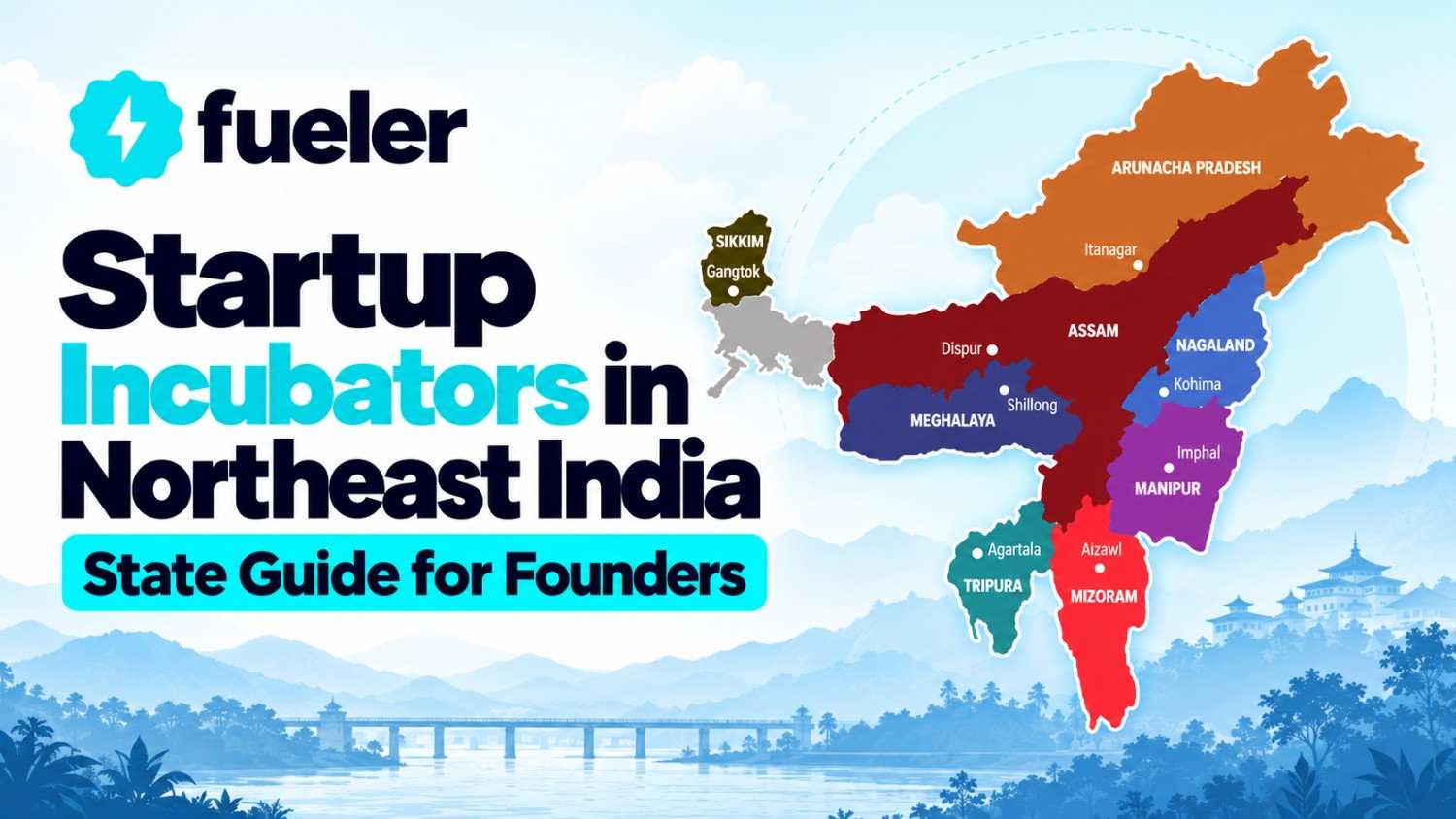
Startup Incubators in Northeast India: A State by State Guide for Founders (2026)

Riten Debnath
29 Oct, 2026
Last checked: 29 October 2026. This guide is reviewed and updated as programmes change. If you spot a missing incubator or an outdated detail, tell us (see the end of this article).
Quick answer
Startup incubators in Northeast India exist in all eight states: Assam, Arunachal Pradesh, Manipur, Meghalaya, Mizoram, Nagaland, Sikkim and Tripura. They fall into a few clear groups:
State-backed incubators such as Assam Startup The Nest, APIIP in Arunachal Pradesh, PRIME Meghalaya and T-NEST in Tripura.
Campus incubators at institutions like IIT Guwahati, IIM Shillong, NIT Agartala, NIT Silchar, Tezpur University, Tripura University and Mizoram University.
Specialist science labs called BioNEST bio-incubators, for biotech, health, food and life science startups.
Agribusiness incubators (R-ABIs and ABIs) for farming, fisheries, livestock and food founders.
STPI OctaNE centres in eight cities, one in each state, each with its own technology focus.
Livelihood and food processing centres under central schemes for rural, craft and food businesses.
There is no single "best" incubator. The right one depends on your sector, your stage, where you live, and whether the incubator accepts founders from outside its own campus.
Key takeaways
Startup support in the Northeast is real, but it is scattered across government offices, universities, science labs, farm colleges and tech parks.
No one has published a verified 2026 count of active incubators in the region. Public numbers range from 23 to 34 depending on the source and the year.
Joining an incubator does not mean you automatically get money. Most grants and seed funds have their own selection process.
Many university incubators give priority to their own students and faculty. Always check if outside founders can apply.
Your best approach is to shortlist three programmes that match your sector, check their current call for applications, and apply with clear proof of what you have already built.
Why I wrote this guide
I grew up in Agartala, Tripura. For a long time, when someone here wanted to build a startup, the advice was simple: move to Bengaluru, Delhi or Mumbai. That is where the mentors were. That is where the money was. That is where the "ecosystem" lived.
I built Fueler from a small city, so I know that feeling well. You have an idea and energy, but you do not know which door to knock on.
When I started researching this guide, I expected a short list. What I found surprised me. Support for founders exists in every single Northeast state. It sits inside state startup missions, IITs and IIMs, central science labs, agricultural colleges and national tech parks. The real problem is not that support is missing. The problem is that it is spread out, called by confusing names, and rarely explained in plain words.
I wrote about this shift earlier in my piece on how the Northeast India startup ecosystem is finally getting the support it deserves. This guide is the practical next step. My goal is simple: help every founder in the region find the right door, faster.
How this guide is different
Every entry links to a public source. Wherever possible, I link to the official website of the incubator, the university, or the government body.
No fake rankings. I do not call any incubator "the best" or "the strongest". Those claims cannot be proven, and they mislead founders.
No false "apply now". Many programmes run in cycles. If a call is closed, I say so.
Clear status labels. I separate full incubators from campus cells, approved projects and older listings that still need checking.
How many startup incubators are there in Northeast India?
This is the first question most people ask, so here is the honest answer: there is no single verified count for 2026. Different sources count different things, at different times.
Advancing Northeast, a government-backed discovery portal, currently shows 34 results in its incubator directory. But the list mixes incubators with entrepreneurship centres and innovation hubs, and some names overlap. It is a good starting point, not a final count.
The NEC Year Book 2024 from the North Eastern Council reports 33 incubators, based on NEDFi research as of November 2023.
The NEC Yearbook 2025 reports 23 incubators in a table drawn from the Startup India digital map.
The MSME ASPIRE dashboard, dated 13 October 2026, shows 25 approved livelihood incubators across six Northeast states: Assam 6, Manipur 9, Meghalaya 3, Mizoram 2, Nagaland 4 and Sikkim 1. These are livelihood centres, not tech startup incubators, and approval does not prove every centre is open today.
So if you read a headline that says "the Northeast has exactly X incubators", ask where the number came from. This guide maps more than 60 incubators, labs and programme routes. That is a map of options, not a count of independent, active incubators, because one university can run two or three different schemes under one roof.
What does a startup incubator actually do?
An incubator helps an early-stage founder turn an idea into a working business. Depending on the programme, it can help you:
Test your idea with real customers before you spend money building it.
Build a prototype using labs, workshops or equipment you could not afford alone.
Get mentoring from technical experts, business people and other founders.
Shape your business model: who pays, how much, and why.
Handle compliance such as company registration, DPIIT recognition and basic legal paperwork.
Use a workspace or coworking desk.
Meet investors and apply for government grants or seed funds.
Here is the part many founders miss: an incubator can give you access to funding without giving money to every startup it supports. Schemes like seed funds usually have a separate selection round. Joining the incubator puts you in the room. It does not guarantee a cheque.
If you are not sure whether you need an incubator, an accelerator or something else, read my simple breakdown of incubator vs accelerator vs venture builder. In short, incubators are for founders who are still figuring out what to build. Accelerators are for founders who are ready to grow fast.
How to read the directory below
Each entry has a simple status label. This tells you how strong the public evidence is. It does not tell you whether applications are open right now.
Label | What it means |
|---|---|
Verified institution | An official source confirms this incubator or incubation programme exists. Check the current intake yourself. |
State listed | A state or government directory lists it as an incubator. Operating details still need confirming. |
Campus cell | A college cell or pre-incubation centre. Useful, but usually smaller than a full business incubator and often for students first. |
Approved or announced | A facility that has been approved or announced. Do not assume it is fully running yet. |
Older listing | Appears in older records or directories. Verify before you apply. |
The "best for" notes are my practical suggestions based on each incubator's stated focus. They are not eligibility rules. Fees, equity, residency and funding terms are "not publicly confirmed" unless I say otherwise.
Quick shortlist by founder need
Start here if you already know what you are building. These are starting points, not rankings.
What you are building | Look at these first |
|---|---|
Hardware or engineering prototype | IIT Guwahati TIC, IIT Guwahati TIDF, NIT Silchar iTBI, NIT Agartala iTBI |
Biotech, pharma or wet-lab work | IITG BioNEST, NIPER Guwahati BioNEST, IASST ISVEC, CSIR-NEIST BioNEST, Guwahati Biotech Park, NEHU B3I Tura, Mizoram University BioNEST |
Agriculture, fisheries or food | NEATEHUB (Jorhat), CHF R-ABI (Pasighat), College of Fisheries R-ABI (Tripura), Veterinary R-ABI (Mizoram), ICAR NRC on Pig ABI (Guwahati) |
Clean or sustainable energy | AIC-SELCO Foundation, plus calls from technology incubators |
General early-stage business (state support) | Assam Startup The Nest, APIIP, PRIME Meghalaya, T-NEST, Nagaland's state-recognised incubators |
AI or data analytics | STPI OctaNE Agartala, plus broader technology incubators |
Gaming, animation, AR or VR | STPI OctaNE Shillong, Aizawl and Imphal |
Space technology | ISRO Space Technology Incubation Centre, NIT Agartala |
Craft, tourism or livelihood business | YouthNet (Nagaland), ASPIRE livelihood incubators, state programmes |
Food manufacturing equipment | PMFME common incubation centres that are actually running |
The state by state directory
Assam
Assam has the largest and most varied support network in the region. Guwahati alone hosts an IIT, a NIPER, a biotech park, a state incubator and several science institutes. Jorhat, Silchar, Tezpur, Dibrugarh and Kokrajhar add strong university options.
IIT Guwahati Technology Incubation Centre (TIC), Guwahati
Best for: technology, engineering, hardware and software ventures. Status: Verified institution. Official site: tic.iitg.ac.in
The TIC at IIT Guwahati offers technical support and incubation for tech-driven startups. Its biggest advantage is access to IIT faculty and engineering know-how. Soft loans may be available, but they depend on the funds and schemes active at the time, so do not assume money is part of the package. If your startup needs serious engineering depth, this should be on your list.
IIT Guwahati TIDF and IITG BioNEST, Guwahati
Best for: deep tech, biotech, healthcare and agritech. Status: Verified institution. Official site: IITG BioNEST
This is a separate route from the TIC above. IITG's BioNEST is part of a national network of bio-incubators supported by BIRAC, a central government body for biotech. It is meant for founders who need laboratory space and scientific support. If your product involves biology, medicine or advanced agriculture, this is the IIT Guwahati door to knock on first.
Assam Startup The Nest, Guwahati
Best for: early-stage ventures that want state-backed incubation. Status: Verified institution. Official site: startup.assam.gov.in
The Nest is Assam's state-backed incubator and the most common starting point for founders in the state. Older official material describes six-month cohorts. Programme length, operator and the application process can change, so check the state portal for the current call before you plan around it. Some colleges in Assam work as "spoke" incubators linked to The Nest, which helps founders outside Guwahati.
NEATEHUB (AIC-AAU Incubator), Jorhat
Best for: agriculture, food and allied rural businesses. Status: Verified institution. Source: Atal Innovation Mission directory
Hosted at Assam Agricultural University, NEATEHUB is an Atal Incubation Centre supported by NITI Aayog's Atal Innovation Mission. AIC-AAU and NEATEHUB are the same incubator, not two. If you are building anything in farming, food processing or agri supply chains in Upper Assam, start here.
AIC NIPER-Guwahati Foundation and BioNEST, Changsari
Best for: pharma, healthcare, herbal products and nutraceuticals. Status: Verified institution. Official site: NIPER Guwahati BioNEST
NIPER Guwahati runs both an Atal Incubation Centre and a BioNEST bio-incubator. Application forms for 2026 are listed on its downloads page. Ask whether you need separate applications for each route. For founders working on medicines, herbal formulations or health supplements, the lab access here is a major advantage.
Guwahati Biotech Park Incubation Centre
Best for: biotech ventures that need laboratory space. Status: Verified institution. Sources: government profile, how to associate
Guwahati Biotech Park is a practical option for founders who mainly need lab space. Leasing a laboratory or submitting a research proposal are the usual ways in. Read the "how to associate" page before you contact them.
AIC-SELCO Foundation, Guwahati
Best for: sustainable energy and livelihood technologies. Status: Verified institution. Official site: SELCO incubation
AIC-SELCO focuses on clean energy solutions that improve livelihoods, which makes it different from general tech incubators. It lists mentoring, market research, product development and coworking. If your idea uses solar or clean energy to help farmers, artisans or small shops, this is one of the few specialist options in the region.
NIT Silchar: NITS Foundation for Innovation, Incubation and Entrepreneurship
Best for: digital technology and engineering ventures in the Barak Valley. Status: Verified institution. Source: institutional NIDHI-iTBI notice
NIT Silchar hosts a NIDHI-iTBI, a technology business incubator model supported by the Department of Science and Technology. Check founder intake and external-founder rules directly with the institute.
Other Assam options
Incubator and location | Best for | Status and note |
|---|---|---|
IASST Social Venture and Entrepreneurship Council (ISVEC), Guwahati | Science-based and social technology ventures | Verified. Offers virtual incubation, mentoring and paid equipment access. IASST is also on BIRAC's BioNEST list. |
CSIR-NEIST BioNEST, Jorhat | Biotech and research commercialisation | Verified via BIRAC register. CSIR-NEIST is also an MSME host institution. |
down town Venture Labs Foundation, Assam down town University, Guwahati | Early-stage and student tech ventures | Verified. Also appears on DST's NIDHI-iTBI list. |
Centre for Technology Innovation and Incubation, Dibrugarh University | Research and technology ventures | Verified. Set up in 2013; university records show incubated startups. |
Student, research and local innovation | Verified. Separate from Tezpur's food processing centre (see the specialist section). | |
Assam University Incubation Centre, Silchar | Student and regional entrepreneurship | Verified. Also a host under the NEC-IIE initiative. |
EDIC, Assam Don Bosco University, Sonapur | Student and community ventures | Verified. Public access is mentioned; check current admissions. |
Royal Innovation Incubator, Assam Royal Global University, Guwahati | Campus innovation and early ventures | Verified. University records mention startup MoUs. |
Research commercialisation, mushroom enterprise | Verified. A useful option for founders in the Bodoland region. | |
ICAR National Research Centre on Pig ABI, Rani, Guwahati | Piggery, pork processing and allied services | Verified. The linked 2024 call is closed. Ask for the current process. |
Enterprise incubation and business development | Verified as an MSME host institution. Also runs livelihood projects. | |
IoT in agriculture | Verified. Part of STPI's eight-city OctaNE network. | |
Campus and local founders | Campus cell. Works as a spoke linked to The Nest. | |
Kaziranga University Business Incubation Centre, Jorhat | Campus and regional ventures | State listed on Advancing Northeast. Check intake and outside-founder rules. |
Indian Institute of Plantation Management, Jorhat | Plantation and agri enterprise | State listed as an MSME host. Its livelihood project is marked under implementation. |
Gauhati University Technology Incubation Centre | Academic technology commercialisation | Older listing in a university report. Confirm it is active. |
Arunachal Pradesh
Arunachal Pradesh is often left out of incubator lists, which is a mistake. The state has a dedicated state incubator and, as of October 2026, a growing network of satellite cells in colleges.
Arunachal Pradesh Innovation and Investment Park (APIIP), Itanagar
Best for: early-stage ventures that want state-backed incubation. Status: Verified institution. Official page: Startup Arunachal incubators
APIIP is the state's main incubation platform. In October 2026, the state government reported the inauguration of seven APIIP satellite incubation cells at Rajiv Gandhi University, Arunachal Pradesh University (Pasighat), Arunachal University of Studies (Namsai), NIT Jote, NEDIS Nirjuli, Dera Natung Government College (Itanagar) and Dorjee Khandu Government College (Tawang). The same release mentions agreements with five more colleges. Treat these satellite cells as entry points into the APIIP network, not as seven separate full-service incubators. For a founder in Tawang or Namsai, though, a nearby cell can make the first step much easier.
College of Horticulture and Forestry R-ABI, Pasighat
Best for: horticulture and agriculture ventures. Status: Verified institution. Official page: CHF R-ABI
This Rural Agribusiness Incubator (R-ABI) is run by a college of Central Agricultural University (CAU), Imphal, but it is physically located in Pasighat, Arunachal Pradesh. If you grow, process or sell fruits, spices, plantation crops or forest produce, this is the most relevant incubator in the state.
Other Arunachal Pradesh options
Incubator and location | Best for | Status and note |
|---|---|---|
GIS applications and drones | Verified. One of the few drone and mapping-focused centres in the region. | |
Student and academic innovation | Campus cell, set up in October 2023. Ask what support is open to outside founders. |
Manipur
Manipur has a state incubator list, a technical university incubator, an STPI centre focused on AR and VR, and a large network of district-level livelihood centres.
AIC-MTU Innovation Foundation, Manipur Technical University, Imphal
Best for: early ventures and technology innovation. Status: Verified institution. Sources: MTU records, Startup Manipur incubator list
This is an Atal Incubation Centre at Manipur Technical University. It appears on the state's official incubator list. Treat MTU's incubation work and its foundation as one entity unless the operator tells you they are separate. For a tech founder in Imphal, this is a natural first stop.
Other Manipur options
Incubator and location | Best for | Status and note |
|---|---|---|
AR and VR emerging technology | Verified. | |
Dhanamanjuri University Incubation Centre, Imphal | University-linked and early ventures | State listed on Startup Manipur. Confirm sectors, outside-founder access and open calls. |
Manipur Technology Innovation Hub | Technology entrepreneurship | State listed. A newer name is also in use online; confirm the current legal identity with the state. |
Mining cyber-physical systems and related tech | Campus cell. The institute lists a 2026-27 pre-incubation call; read the call for eligibility and deadline. |
A note on IBSD. The Institute of Bioresources and Sustainable Development has its headquarters in Imphal and is on BIRAC's BioNEST list. However, its institutional profile describes a BioNEST node in Meghalaya focused on orchid floriculture and women bio-entrepreneurs. Before you plan an application in Imphal, confirm where the facility actually operates and who it accepts.
Manipur also has nine district-level livelihood incubators under the MSME ASPIRE scheme. I cover them in the specialist section below.
Meghalaya
Meghalaya combines one of the region's most active state programmes (PRIME) with IIM Shillong, NEHU and an STPI centre for gaming and animation.
PRIME Meghalaya
Best for: entrepreneurs who want state-backed incubation and acceleration. Status: Verified institution. Official page: primemeghalaya.com/incubation
PRIME is Meghalaya's flagship entrepreneurship programme, with coworking listed in Shillong, Tura and Nongpoh. Its public page describes a nine-month programme, with business support grants of INR 3 lakh for the top 50 and INR 1.5 lakh for the next 50 selected entrepreneurs. Applications for the CMECC 7.0 edition closed on 15 September 2026. Do not wait for the next cycle to start preparing. Use the gap to build customer proof, so your next application is stronger.
IIM Shillong Foundation for Incubation and Enterprises (IIMSFIE)
Best for: early-stage enterprises, including consumer and service businesses. Status: Verified institution. Official page: IIMSFIE
IIMSFIE is IIM Shillong's current incubation foundation. You may see older names linked to the institute's incubation work, but use the current foundation for enquiries. Because it sits in a management school, it suits founders who need help with business models, pricing, go-to-market and fundraising rather than lab work.
NEHU BioNEST Bioincubator (B3I), Tura
Best for: agriculture, food, nutrition and life sciences. Status: Verified institution. Sources: operator site, NEHU announcement
This BioNEST at NEHU's Tura campus brings bio-incubation to the Garo Hills, far from the usual Shillong-Guwahati belt. NEHU Tura also hosts a livelihood incubator and an approved food processing project, so ask which programme fits your venture.
Other Meghalaya options
Incubator and location | Best for | Status and note |
|---|---|---|
NEHU Incubation Centre and Design Innovation Centre, Shillong | Design and academic entrepreneurship | Verified (part campus cell). Confirm how the two centres relate. |
Bio Resources Development Centre BioNEST, Upper Shillong | Bioresources and biotech enterprise | Verified via BIRAC register. |
Student, alumni and faculty innovation | Campus cell. | |
USTM CIIE, Baridua | University-linked ventures | Verified (part campus cell). |
Gaming and animation | Verified. A strong fit for Shillong's creative and music-linked talent. |
Mizoram
The Mizoram Startup Mission lists eight facilities in its incubator section. Being on that list does not mean each one runs a regular startup cohort open to outside founders, so check each one directly.
Mizoram University Incubation Centre and MZU BioNEST, Aizawl
Best for: university-linked and regional ventures; biotech and life sciences through BioNEST. Status: State listed (incubation centre) and Verified (BioNEST). Sources: state directory, incubemzu.com, BIRAC
Mizoram University runs two routes: a general incubation centre and a specialist BioNEST for life science startups. They share a parent, but they serve different founders. A food or health product founder should ask about BioNEST. A digital or service founder should start with the incubation centre.
R-ABI, College of Veterinary Sciences and Animal Husbandry, Selesih, Aizawl
Best for: veterinary, livestock and allied agribusiness. Status: Verified institution. Source: CAU project record
This agribusiness incubator belongs to Central Agricultural University, whose headquarters are in Imphal. But the facility itself is in Mizoram. Some lists wrongly place it in Manipur. If you work in poultry, piggery, dairy or animal health, this is your specialist option.
Other Mizoram options
Incubator and location | Best for | Status and note |
|---|---|---|
Mizoram Startup Hub, Aizawl | State startup facilitation | State listed. Confirm its structured incubation offer. |
Tharthilthlentu (TiLi), Aizawl | Local entrepreneurship | State listed. Ask about sectors, fees and intake. |
NIT Mizoram incubation, Aizawl | Academic innovation | State listed. Do not assume outside founders can join. |
Gaming and entertainment | Verified. | |
Mizoram Food Processing Research and Training Centre | Food processing and micro-enterprise | State listed and approved under PMFME. Confirm working processing lines. |
Nagaland
Nagaland's official startup page names five state-recognised incubators. Together with Nagaland University and STPI, they cover food, craft, robotics, manufacturing and IT.
YouthNet Incubation Centre
Best for: food, craft, tourism and agriculture. Status: State listed (state recognised).
YouthNet is one of the best-known names in Nagaland's youth entrepreneurship space. Its focus areas match what many Naga founders actually build: local food brands, handicrafts and tourism experiences. You may see older names linked to YouthNet; treat them as one organisation and ask the team which programme is current.
Nagaland University EDC and Incubation Centre, Kohima campus
Best for: regional and academic entrepreneurs. Status: Verified institution. Source: All India Radio report
Nagaland University was named one of four incubation centres in the Northeast under the NEC-IIE initiative. This centre is on the Kohima campus. Do not confuse it with the university's food processing project at the Medziphema campus, which serves a different purpose.
Other Nagaland options
Incubator | Best for | Status and note |
|---|---|---|
Educentre School of Business incubator | Early business development | State recognised. Workspace and mentoring. Confirm location and intake. |
Nagabots | Robotics, STEM and coding | State recognised. Ask about startup incubation separately from its education programmes. |
Nagaland Tool Room and Training Centre, Dimapur | Tooling and manufacturing | State recognised. Separate skills training from venture incubation. |
IT, cybersecurity and data | Verified and state recognised. The visible 2023 competition is closed. | |
IT applications in graphic design | Verified. |
Sikkim
Sikkim is small, but it has a technology incubator, an STPI centre focused on health and agritech, and a university incubation centre.
AIC-SMU Technology Business Incubation Foundation (AIC-SMUTBI), Majitar
Best for: technology and innovation ventures. Status: Verified institution. Official site: smutbi.com
Linked to Sikkim Manipal University, AIC-SMUTBI supports incubation and offers seed grants to selected startups. "Selected" is the key word: grants are competitive. You may see older SMU or SMIT incubator names; they point to this same foundation.
Other Sikkim options
Incubator and location | Best for | Status and note |
|---|---|---|
IT in healthcare and agritech | Verified. | |
Current students, faculty and staff | Campus cell. The official page sets out eligibility; campus affiliation matters. | |
TotalStart Sikkim Innovation and Incubation Centre, Gangtok | Technology incubation | Older listing. Confirm it still operates before you apply. |
Tripura
Tripura is my home state, and its startup support has changed a lot in a short time. In February 2026, it became the first state to launch a State Innovation Mission under the Atal Innovation Mission. It also has a strong university incubator, an ISRO space incubation centre and a fisheries agribusiness incubator.
T-NEST (Tripura Nurturing Entrepreneurship and Startups), Hapania, Agartala
Best for: early-stage founders across sectors who want state-backed incubation. Status: Verified institution. Source: All India Radio report
T-NEST was inaugurated on 26 February 2026 at Hapania, Agartala, as Tripura's flagship incubation and innovation hub under the Tripura State Innovation Mission. It is meant to connect government, colleges, industry and investors in one place. Public reports say innovation centres are planned in all eight districts, linked to T-NEST, with a focus on women and tribal innovators. The state has also partnered with T-Hub, Hyderabad, to support its incubation work. I attended the launch and wrote about what T-NEST means for founders in Tripura. Check the state's startup channels for the current application process.
Tripura University: TUBI and the NEC EDC and Incubation Centre, Suryamaninagar
Best for: ventures across sectors (TUBI) and regional technology ventures (NEC EDC-IC). Status: Verified institution. Official pages: TUBI, EDC-IC programme
Tripura University runs two separate routes. The Tripura University Business Incubator (TUBI) describes MSME-supported funding opportunities, though there is no automatic grant. The NEC-supported EDC and Incubation Centre is a separate programme for technology-based ventures. Read both pages and pick the one that matches your idea.
NIT Agartala: ISRO Space Technology Incubation Centre and NITA iTBI
Best for: space technology research (S-TIC) and broader technology ventures (iTBI). Status: Verified institution. Official pages: S-TIC, iTBI record
NIT Agartala hosts one of the most specialised facilities in the region: an ISRO Space Technology Incubation Centre. It is a research route linking academia and industry, not a general startup accelerator. For most tech founders, the NITA Foundation for Innovation, Incubation and Entrepreneurship (a NIDHI-iTBI) is the more relevant door. Confirm its current call.
R-ABI, College of Fisheries, Lembucherra
Best for: fisheries and allied agribusiness. Status: Verified institution. Source: CAU project record
Fish is central to life and food in Tripura. This Central Agricultural University incubator is the right place for founders in aquaculture, fish processing, feed or cold chains. It is often left out of general incubator lists.
Other Tripura options
Incubator and location | Best for | Status and note |
|---|---|---|
Data analytics and AI | Verified. | |
University-linked ventures | Verified historically through a ministry sanction. Confirm the current programme. |
Specialist support founders often miss
Many founders only look for buildings with "incubator" on the board. Some of the most useful support in the Northeast comes through national schemes with unfamiliar names. Here is what each one means in simple words.
BioNEST bio-incubators
BioNEST is a BIRAC programme that funds bio-incubators with shared laboratories and equipment. If your startup needs a wet lab, testing equipment or scientific guidance, BioNEST is built for you. In the Northeast, the BIRAC register lists centres at IIT Guwahati, NIPER Guwahati, IASST, CSIR-NEIST, BRDC Shillong, Mizoram University, IBSD and NEHU Tura.
R-ABIs (Rural Agribusiness Incubators)
These incubators sit inside agricultural colleges and focus on farm, food, livestock and fisheries businesses. Three Central Agricultural University colleges run them in different states: Horticulture and Forestry at Pasighat (Arunachal Pradesh), Veterinary Sciences at Selesih (Mizoram) and Fisheries at Lembucherra (Tripura).
STPI OctaNE centres
Software Technology Parks of India runs the OctaNE network, with one centre in each Northeast state. Each one has a different technology focus:
City | Focus area |
|---|---|
Guwahati | IoT in agriculture |
Itanagar | GIS applications and drones |
Imphal | AR and VR |
Shillong | Gaming and animation |
Aizawl | Gaming and entertainment |
Kohima | IT applications in graphic design |
Gangtok | IT in healthcare and agritech |
Agartala | Data analytics and AI |
If your idea matches a focus area in another state, it may still be worth asking. The right specialist support is sometimes one state away.
ASPIRE livelihood business incubators
ASPIRE is an MSME Ministry scheme for rural and livelihood businesses. These centres train people and support small enterprises in areas like food, wood, dairy, handloom and handicrafts. They are not venture capital style incubators, and they should not be treated as one. Approval under the scheme is also different from a centre being open today.
State | Centres identified in public records |
|---|---|
Assam | IIE Guwahati (wood-based), IIE Kamrup (fruit and vegetable), IIE Sivasagar (dairy), IIPM Jorhat (marked under implementation), Gauhati University Aquaculture and Biodiversity Centre, and NEHHDC (handicraft and handloom) |
Manipur | District Industries Centre incubators in Chandel, Ukhrul, Imphal East, Imphal West, Thoubal, Senapati, Tamenglong, Bishnupur and Churachandpur |
Meghalaya | MBMA Tura, MBMA Nongstoin and NEHU Tura |
Mizoram | Mizoram KVI Board, Aizawl and Lunglei (older approvals) |
Nagaland | Doeshe Village Council, Dimapur and a KBC Noklak lead (the dashboard shows four approvals in total) |
Sikkim | State Institute of Rural Development, Namchi (lead) |
Sources: MSME ASPIRE dashboard, ministry approved list, LBI register. Call the centre before you travel.
PMFME common incubation centres for food processing
Under the PM Formalisation of Micro Food Processing Enterprises scheme, the government approves shared food processing facilities. Small food businesses can use the machines to make, test and pack products without buying expensive equipment. The official approved register lists these Northeast projects:
State | Host facility | Note |
|---|---|---|
Assam | Tezpur University, Sonitpur | Inaugurated on 13 March 2026, as confirmed by PIB. |
Manipur | Central Agricultural University, Imphal | Approved. Confirm it is running. |
Meghalaya | NEHU Tura campus | Approved. |
Mizoram | Mizoram Food Processing Research and Training Centre | Approved. Confirm working lines. |
Nagaland | Nagaland University SASRD, Medziphema | Approved. Confirm availability. |
Sikkim | SIRD and Panchayati Raj, Karfectar; and MSME Division, South Sikkim | Two approved entries. Confirm locations. |
Tripura | Tripura Industrial Development Corporation, South Tripura | Approved. Confirm it is running. |
Only Tezpur has public confirmation of inauguration in my research. For the others, "approved" means exactly that.
NEC-IIE campus incubation
The North Eastern Council supports entrepreneurship and incubation centres at universities in the region. Assam University, Nagaland University (Kohima) and Tripura University's EDC-IC are examples covered above.
Regional programmes beyond an incubator building
Not all support comes from a building with a desk. Some of the most valuable help comes through time-bound programmes.
North East Growth Lab by IIMA Ventures and SAP
This is a regional programme, not a permanent incubator. The 2026 edition, run by IIMA Ventures (the startup arm of IIM Ahmedabad) with SAP, covered all eight Northeast states and focused on agriculture and rural livelihoods. According to the official programme page, it offered a three-day bootcamp in Guwahati for 25 shortlisted startups, mentoring, and grants of up to INR 5 lakh for 10 to 12 selected startups. The 2026 deadline was 15 July 2026, so it has closed. Watch for the next edition.
State startup missions and state programmes
Each state has a startup cell or mission that runs policies, recognitions and events. These are often the best place to learn about new calls. Start with Startup Assam, Startup Arunachal, Startup Manipur, PRIME Meghalaya, Startup Mizoram, Nagaland's Department of Industries and Commerce, Sikkim's startup programme and Startup Tripura. Programmes outside the region also invite Northeast founders. For example, I wrote about the Telangana Northeast Connect programme, which took Northeast founders to experience Hyderabad's startup ecosystem.
Funders and ecosystem bodies
NEDFi (North Eastern Development Finance Corporation) and the North East Venture Fund are important parts of the ecosystem. But they are financiers, not incubators. Check their current financing terms directly on their official channels before you plan around them.
How to apply to a startup incubator: a 7-step plan
Pick three programmes, not thirty. Use the shortlist table above. Choose incubators that match your sector, your stage and your location.
Check the current call. Visit the official page. Is there an open call, a rolling intake, or nothing right now? Note the deadline.
Check eligibility carefully. Can outside founders apply, or only students and faculty? Do you need to be registered as a company? Do you need to live in that state?
Validate before you apply. Talk to at least 15 to 20 potential customers. My guide on how to validate a startup idea before building it walks you through simple ways to do this.
Prepare a short pitch deck and proof of work. Show the problem, your solution, who pays, and what you have already done: a prototype, early sales, a pilot, user feedback, photos of your product.
Say exactly what help you need. "We need lab access for 3 months to test shelf life" is far stronger than "we need support".
Apply through the official channel only. Use the operator's own website or the state portal. Be careful of third parties who promise selection for a fee.
Questions to ask before you join any incubator
An incubator is a partnership. Ask these questions before you sign anything:
Are there any fees? Is there a monthly charge for the desk or lab?
Does the incubator take equity? If yes, how much and when?
Who owns the intellectual property (IP) I create while using your labs?
How many hours or days do I need to be present in person?
Which labs and machines can I use, and is there a usage charge?
How are grants and seed funds selected? Is money available right now?
Do I need to relocate, or can I join virtually?
What milestones do you expect, and what happens if I miss them?
How long is the programme, and what are the graduation terms?
Can I speak to two founders who went through this programme?
Common mistakes Northeast founders make with incubators
Thinking incubation means free money. It usually means access to people, space and schemes. Money comes later, if at all, through separate selection.
Applying to the wrong type of incubator. A pickle brand in a deep tech lab, or a software app in a fisheries incubator, wastes everyone's time.
Waiting to be "ready". Many calls are open for only a few weeks. Keep your deck and proof ready all year.
Ignoring nearby specialist support. The best incubator for your idea might be one state away.
Applying with only an idea. Even a small proof, like 10 paying customers or a working demo, makes your application stand out.
Leads we are still checking
To keep this guide honest, I have not listed weak or unclear entries as confirmed options. These leads are being checked and may be added after verification:
Assam Science and Technology University Startup Cell (has a stated plan to set up an incubator)
Innovation Hub Itanagar, Arunachal Pradesh
Centre for Entrepreneurship and Skill Development, Manipur University
NIT Manipur incubation centre
NIELIT-Jobsenz technology incubation centre, Imphal
IIIT Manipur BioNEST (named in a December 2024 BIRAC result; selection does not mean a running facility)
Entrepreneurship Development Centre Mizoram
Startup Incubation Centre, IT Bhavan, Agartala
Tripura's New Generation Innovation Network centres (guidelines published; current host list to confirm)
How this guide was researched
For journalists, researchers, educators and policy teams who want to use this guide, here is exactly how it was built.
Research date: All sources were checked on 29 October 2026.
Sources used: Official websites of incubators and universities; state startup portals for Assam, Arunachal Pradesh, Manipur, Meghalaya, Mizoram, Nagaland, Sikkim and Tripura; national registers from the Atal Innovation Mission, BIRAC (BioNEST), DST (NIDHI), STPI (OctaNE), the MSME Ministry (host institutions and ASPIRE) and NIFTEM (PMFME); NEC year books; PIB and All India Radio reports; and the government-backed Advancing Northeast directory.
How entries were treated: Private directories were used only to discover names, not to confirm them. One institution running several schemes is grouped under one parent where possible, so the same place is not counted twice.
Limits: I did not contact every operator or test every application form. Some government PDFs could be searched but not opened directly, so those entries are labelled as directory or approval evidence. Application status, fees, equity and residency terms should always be confirmed with the operator.
Suggested citation: Riten Debnath, "Startup Incubators in Northeast India: A State by State Guide for Founders", Fueler Blog, last checked 28 October 2026.
Where proof of work fits in
Every incubator, grant panel and investor in this guide is trying to answer one question: can this founder actually execute?
A strong idea is not enough. What helps you get selected is evidence. A prototype. A customer list. A pilot report. Photos of your first batch of products. A short video of your app working. Feedback from real users.
This is why I build Fueler. We help people and founders show proof of work, not just claims. Companies on Fueler hire through real assignments, and founders can use the same idea when they apply to incubators: show what you have built, not just what you plan to build. Put your projects, prototypes and customer work in one clear place, and share that link with every application.
The Northeast does not lack talent. It has often lacked visibility. Incubators solve part of that. Proof of work solves the rest.
Help keep this guide accurate
This guide will only stay useful if it stays current. If you run an incubator in the Northeast, or you have joined one, please help:
Tell us about any incubator that is missing.
Report details that have changed, such as a new name, a closed programme or a new call.
Share whether applications are open, closed, rolling or announced.
I will keep reviewing and updating this page. The goal is simple: no founder in the Northeast should have to move away just to find the right door.
Frequently asked questions
1. Which is the best startup incubator in Northeast India?
There is no single best startup incubator in Northeast India. The right one depends on what you are building. Tech and hardware founders can start with IIT Guwahati TIC or the NIDHI-iTBIs at NIT Silchar and NIT Agartala. Biotech founders should look at BioNEST centres. Farm and food founders should look at R-ABIs and NEATEHUB. Founders who want state support can start with The Nest (Assam), APIIP (Arunachal Pradesh), PRIME (Meghalaya) or T-NEST (Tripura).
2. Do startup incubators in Northeast India give funding?
Some do, but not automatically. Many incubators can connect you to grants, seed funds or soft loans, but these usually have a separate selection process and depend on available funds. For example, PRIME Meghalaya's public page describes grants for its top selected entrepreneurs, and AIC-SMUTBI offers seed grants to selected startups. Always ask how funding is selected and whether money is available right now.
3. Can I join a startup incubator before registering my company or getting DPIIT recognition?
It depends on the programme. Many early-stage and pre-incubation programmes accept founders who are still at the idea or prototype stage. Others, especially those linked to grants, may ask for a registered company or DPIIT recognition. Read the eligibility section of the current call. If it is unclear, email the incubator and ask before you apply.
4. Can founders from outside a university or another state apply to Northeast incubators?
Sometimes. Some university incubators give priority to their own students, faculty and alumni, while others accept outside founders. State incubators may prefer founders based in that state. Specialist centres like BioNEST labs and STPI OctaNE may be more open, depending on the programme. Never assume access. Check the official eligibility rules for each programme.
5. How do I apply to a startup incubator in Assam or anywhere in the Northeast?
Shortlist three incubators that match your sector and stage, check if each has an open call, and confirm you meet the eligibility rules. Then prepare a short pitch deck and clear proof of work, such as a prototype, customer feedback or early sales. Explain exactly what help you need, and apply only through the incubator's official website or your state startup portal.
What should you do next?
You've read the article. Now turn your skills into proof of work and unlock more opportunities.
Build your proof of work portfolio
Create a clean portfolio with projects, assignments, resumes, and AI stack details that companies actually want to see.
Create your Fueler portfolio →Apply through assignments, not resumes
Stand out by solving real tasks from companies hiring on Fueler.
Explore assignments →Get discovered by companies
Make your work public and let recruiters discover your skills through actual projects instead of keywords.
Get discovered →