Rohit Prasad Becomes CEO of Boston Dynamics: From Ranchi to the Future of Physical AI

Riten Debnath
10 Oct, 2026
Last updated: October 2026
A robot that can walk, balance itself, and lift objects is an impressive engineering achievement. But making that robot understand its surroundings, respond to unexpected changes, and perform useful work reliably is a different challenge altogether.
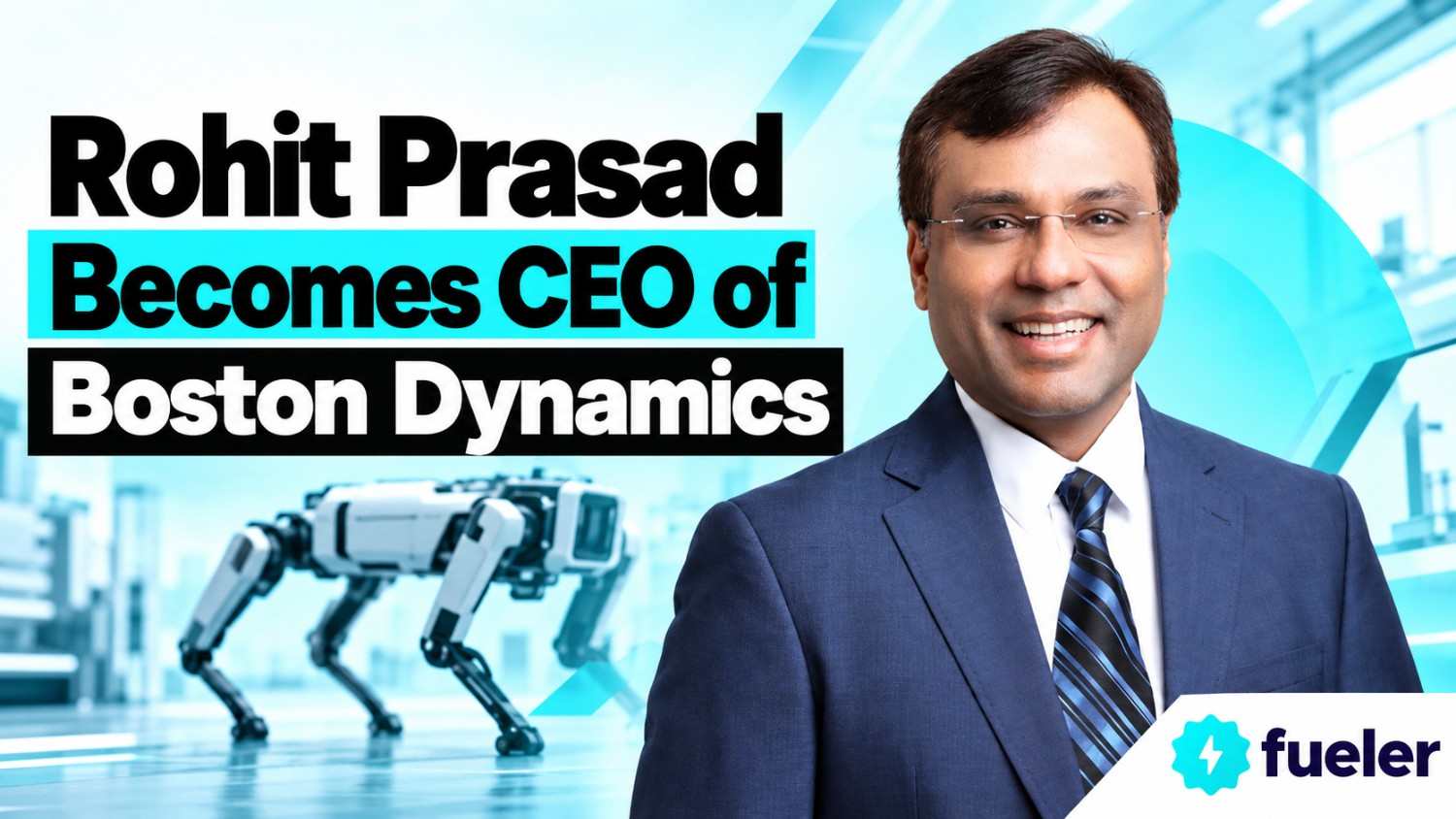
That is the challenge facing Boston Dynamics as it enters its next phase of commercial robotics. On October 6, 2026, the company announced Rohit Prasad as its new Chief Executive Officer, with his appointment taking effect on October 7. Prasad joins after 12 years at Amazon, where he helped develop Alexa and later led work on foundation models and artificial general intelligence.
I’m Riten, founder of Fueler, a skills-first portfolio platform building the career infrastructure for 100 million creative professionals. Fueler connects talented individuals with companies through assignments, portfolios, and projects, not just resumes or CVs. Think of it as Dribbble/Behance for work samples combined with AngelList for hiring infrastructure.
Prasad's appointment offers an interesting look at how expertise developed in one area of technology can become relevant in another. His career has moved from speech recognition and conversational AI to large-scale AI products. He now leads a robotics company working to bring artificial intelligence into the physical world.
His appointment also carries significance for students and technology professionals in India. Prasad grew up in Ranchi, Jharkhand, studied Electronics and Communication Engineering at Birla Institute of Technology, Mesra, and earned a master's degree in Electrical Engineering from Illinois Institute of Technology in Chicago.
But his new position is about much more than his educational background or professional journey. Boston Dynamics already has decades of experience building advanced robots. Its next challenge is turning that engineering capability into machines that businesses can use in factories, warehouses, and other demanding environments.
Prasad's background in AI could be an important part of that effort. Understanding why requires looking at his career, the robots Boston Dynamics is developing, and the company's growing focus on Physical AI.
Who Is Rohit Prasad?
Rohit Prasad is an artificial intelligence researcher and technology executive whose work has covered speech recognition, machine learning, natural-language understanding, conversational AI, and foundation models.
Before joining Boston Dynamics, he served as Senior Vice President and Head Scientist for Alexa and Artificial General Intelligence at Amazon. During his 12 years at the company, he became one of the senior leaders associated with Alexa's development from an early-stage product into a consumer AI service used in hundreds of millions of households worldwide.
His responsibilities later expanded beyond voice assistants. During the final two years of his Amazon career, Prasad led the creation of Amazon Nova and Amazon's AGI organization.
According to Amazon CEO Andy Jassy's announcement about Prasad's departure, his organization built 12 foundation models that were being used by tens of thousands of companies across different industries and use cases.
This background helps explain the significance of his move. Prasad is not joining Boston Dynamics as a traditional robotics engineer. His primary expertise lies in developing AI systems and bringing them into products used at scale.
Boston Dynamics already possesses substantial robotics expertise. The company needs to connect that physical engineering capability with increasingly capable AI systems.
Prasad's appointment brings those two areas together at the leadership level.
From Ranchi to Artificial Intelligence

Prasad grew up in Ranchi, Jharkhand, in a family of engineers. His interest in artificial intelligence began with an idea that would eventually influence his professional direction: the possibility of communicating with a computer through ordinary speech.
In an interview published by Amazon, Prasad explained that he was fascinated by the talking computer in Star Trek. The idea of speaking to a computer and receiving a response influenced his decision to work in speech processing and conversational AI.
That interest became a foundation for his career.
Rather than entering consumer technology immediately, he spent years working on the underlying technologies that allow machines to process human language. Speech recognition, natural-language understanding, and machine learning became central parts of his professional experience.
These technologies would later become important to Alexa, Amazon's voice assistant.
His journey is a reminder that major technology products are often built on years of research into narrower technical problems. A voice assistant may appear to be a single product, but making it understand spoken requests and respond usefully requires multiple systems to work together.
Prasad's career followed that path from research to large-scale product development. His move to Boston Dynamics represents another stage in that progression, this time involving machines that must interact with the physical world.
Rohit Prasad's Education at BIT Mesra and Illinois Tech

Prasad completed his undergraduate engineering education at Birla Institute of Technology, Mesra, commonly known as BIT Mesra.
The institute's records identify him as a Bachelor of Engineering graduate in Electronics and Communication Engineering from the 1993–1997 batch.
He then moved to the United States for graduate education. At Illinois Institute of Technology, he earned a Master of Science in Electrical Engineering in 1999.
Illinois Tech has also highlighted the influence of his graduate research experience. Prasad has credited his graduate adviser with teaching him to approach research through sound methodology and real-world testing, rather than concentrating only on developing an algorithm.
That distinction matters when considering the kind of work he now faces.
A technical idea can appear promising in a controlled experiment. Turning it into a dependable system requires evidence that it works under real conditions. Robotics makes this challenge particularly visible because a machine must interact with objects, people, equipment, and changing surroundings.
Prasad's documented formal engineering degrees are from BIT Mesra and Illinois Tech. His public professional history also has a connection with MIT, but he should not be described as an MIT graduate without evidence of a specific degree from that institution.
His educational journey provides context for his technical career without reducing his achievements to the institutions he attended. The more relevant point is how he applied his engineering background to research and products used at scale.
Nearly 14 Years at Raytheon BBN Technologies

Before Amazon, Prasad spent nearly 14 years at Raytheon BBN Technologies, where he worked on speech and language technologies and machine learning.
His work covered several areas:
Speech recognition
Natural-language understanding
Machine learning
Automated directory assistance
Natural-language call routing
Speech-to-speech translation
Circana's board biography describes his contributions to multiple industry-first AI efforts during his time at BBN, including automated directory assistance, natural-language call routing, and two-way speech-to-speech translation.
Illinois Tech's profile also identifies speech recognition, speech-to-speech translation, natural-language understanding, and machine learning among the areas in which he worked.
This period is important because Prasad's experience with AI predates the recent generative-AI boom. His career was already focused on the technologies that allow machines to process language and respond to human input.
Those problems are more complicated than they might appear. Recognizing speech, understanding what a person means, and generating an appropriate response are related but distinct tasks.
Working across these areas gave Prasad experience with the foundations of conversational AI before he moved into a product environment at Amazon.
For readers interested in the technical side of moving AI beyond experiments, machine learning integration challenges provide useful context on the technologies and skills involved in building machine learning systems.
Joining Amazon During Alexa's Early Days

Prasad joined Amazon in 2013 as a director of machine learning. In 2016, he was promoted to Vice President and Head Scientist of Amazon Alexa.
Amazon says he joined during Alexa's early days to help develop conversational AI that could make customers' lives easier.
Building a useful voice assistant required more than recognizing words. The system needed to understand spoken requests, interpret their meaning, use machine learning, and respond in real time.
These capabilities had to work together in a consumer product that people could use for different tasks and in different languages and cultural contexts.
Prasad worked on these technologies as Alexa grew.
In a 2022 Amazon interview, he described Alexa's development from an idea on a whiteboard into an AI service that millions of customers interacted with billions of times each week. Amazon reported that interactions had increased by more than 30% in the preceding year at that time.
That figure belongs to the period covered by the 2022 interview. It should not be presented as a current growth rate.
Amazon now describes Alexa as touching the lives of hundreds of millions of customers every day.
The experience of developing Alexa gave Prasad exposure to the demands of deploying AI at large scale. Research and product development had to come together in a service designed for everyday use.
This is one of the most relevant parts of his background for Boston Dynamics. A robot that works in a commercial environment must also move beyond an impressive demonstration. It needs to perform useful tasks consistently enough for businesses to depend on it.
From Alexa to Amazon Nova and Foundation Models

Prasad's responsibilities at Amazon eventually extended beyond conversational AI.
He became Senior Vice President and Head Scientist for Artificial General Intelligence at the company. He also led the development of Amazon Nova, its family of foundation models.
Amazon introduced Nova publicly in December 2024. The initial family included Nova Micro, Nova Lite, Nova Pro, and Nova Premier, alongside multimodal generation models such as Nova Canvas and Nova Reel.
According to Amazon's announcement about Prasad's departure, his organization built 12 foundation models during his final two years at the company. Those models were being used by tens of thousands of companies across industries and use cases.
The significance of this experience lies in the range of systems Prasad has worked on throughout his career.
His professional journey can be understood as a progression:
Speech technology → machine learning → conversational AI → Alexa → foundation models → Physical AI and robotics.
Each stage involves different technical challenges, but the broader question remains connected: how can machines process information and use it to respond in useful ways?
Foundation models extend AI capabilities across different forms of information and tasks. Physical AI introduces another requirement. The system must connect its understanding to actions performed by a machine in the real world.
AI agents and digital workflows explore a related shift from systems that respond to individual requests toward systems that can carry out tasks. Robotics introduces additional challenges because actions have physical consequences.
What Is Physical AI?
Physical AI refers to AI systems that operate in the physical world. Instead of processing information alone, these systems must perceive their surroundings, make decisions, and act through physical machines.
A chatbot can process a question and generate a response. A physical AI system has a much broader set of responsibilities.
It may need to:
Understand its surroundings.
Perceive objects and people.
Navigate physical spaces.
Interpret tasks and decide what to do.
Manipulate objects.
Respond to changes in its environment.
Work safely around people.
Perform tasks repeatedly and reliably.
These capabilities must work together. A robot that can move but cannot interpret its environment may struggle when conditions change. An AI model that can reason about a task cannot physically complete it without a robotic system capable of carrying out the required movements.
Boston Dynamics wants to combine its robotics capabilities with advanced AI to develop commercial systems at scale. The company has identified Prasad's appointment as part of its effort to accelerate this Physical AI strategy.
His experience in conversational AI and foundation models is relevant because it concerns the intelligence that helps systems interpret information and respond to it.
The challenge now is to apply that kind of capability to robots operating in factories, warehouses, and other physical environments.
This is also why the transition from digital AI to robotics should not be treated as a simple change of product category. A physical system has to deal with objects that move, environments that change, and tasks that require reliable action.
AI-first product development offers a broader perspective on how AI can become central to a product's design. In robotics, however, the AI must work alongside hardware that can perceive and act in the physical world.
Why Boston Dynamics Chose Rohit Prasad
Boston Dynamics was founded in 1992 after Marc Raibert spun it out of the MIT Leg Lab. Over the following decades, it developed robots capable of balancing, walking, and operating in difficult environments.
The company already has substantial experience in robotics. Its current portfolio includes Spot, Stretch, and Atlas, each serving a different role.
Spot: A Four-Legged Robot for Industrial Work
Spot is Boston Dynamics' four-legged mobile robot. It is primarily used for industrial inspection, data collection, and tasks in environments where sending people can be difficult or dangerous.
Boston Dynamics says Spot is used by hundreds of customers. The company has also reported deploying thousands of Spot and Stretch robots globally.
Spot demonstrates how advanced robotics can serve a defined commercial purpose. Its value is tied to the work it can perform in industrial environments, not simply its ability to walk.
Stretch: Automating Warehouse Operations
Stretch is designed primarily for warehouse and logistics operations. It handles boxes and is intended to automate physically demanding warehouse work.
Like Spot, Stretch is part of Boston Dynamics' commercial robotics business. Its focus is on a specific operational setting where businesses need machines to perform useful physical tasks.
Atlas: The Humanoid Robot
Atlas is Boston Dynamics' humanoid robot and a central part of its Physical AI ambitions.
In January 2026, the company unveiled the product version of its new fully electric Atlas. Boston Dynamics said production would begin immediately and that its 2026 deployments were already committed to Hyundai and Google DeepMind.
Atlas is being developed for industrial applications rather than as a consumer robot. Boston Dynamics lists potential tasks including part sequencing, machine tending, material handling, and order fulfillment.
The company says Atlas can adapt to dynamic environments and operate autonomously with minimal supervision.
These three robots illustrate the breadth of Boston Dynamics' work, from mobile inspection to warehouse operations and humanoid industrial automation.
Prasad's appointment comes as the company seeks to connect its existing robotics expertise with AI systems that can help machines understand tasks and respond to changing conditions.
Boston Dynamics Is Already Commercializing Robots
It would be inaccurate to describe Boston Dynamics as a company that only builds experimental robots in laboratories.
Spot and Stretch are commercially available, while Atlas remains in the early stages of its commercial journey. The company's robots are intended for commercial, industrial, enterprise, and university research applications rather than individual consumer purchase.
Boston Dynamics says its customers span more than 35 countries. It has also reported deploying more than 2,000 Spot and Stretch robots into customer operations around the world over the past five years.
That existing commercial experience matters as the company expands its work on Atlas.
Boston Dynamics already has experience introducing mobile robots into real industrial environments. It can draw on that experience as it works toward wider industrial use of humanoid robotics.
However, commercializing a new robot remains a distinct challenge. A product must be useful for its intended task, dependable in its operating environment, and suitable for repeated use.
A successful demonstration establishes that a robot can perform a task under particular conditions. Commercial deployment requires the company to deliver a system that businesses can use as part of their operations.
Prasad's experience with large-scale AI products is relevant to this transition, although his appointment alone does not establish how quickly Atlas will reach broader deployment or what capabilities it will ultimately deliver.
Who Owns Boston Dynamics?
Boston Dynamics is majority-owned by Hyundai Motor Group.
Hyundai completed its acquisition of a controlling interest in Boston Dynamics from SoftBank in June 2021. The transaction valued the company at $1.1 billion.
Following the transaction, Hyundai Motor Group owned 80% of Boston Dynamics, while SoftBank retained a 20% stake. Boston Dynamics continues to operate as an independent business within Hyundai's portfolio.
This ownership structure matters because Hyundai's interest in robotics connects the technology to manufacturing, mobility, and industrial operations.
Boston Dynamics is developing robots that can perform commercial work, while Hyundai provides a wider industrial environment in which robotics can be deployed and developed.
The relationship is particularly relevant to Atlas. Hyundai has identified humanoid robotics as part of its manufacturing automation plans.
The combination creates a connection between robotics development and potential industrial applications. The next question is whether the technology can perform increasingly complex tasks reliably and economically in those settings.
Hyundai's Bigger Robotics Ambition

Hyundai Motor Group has set a target of developing a robotics production facility in the United States with annual capacity of up to 30,000 robots by 2028.
The group has said Atlas will initially be deployed in manufacturing environments, including its Georgia operations, before wider deployment.
Hyundai's 2026 AI robotics strategy identifies Atlas as a key part of its manufacturing automation plans. The group says Atlas has 56 degrees of freedom and a lift capacity of up to 110 pounds for its targeted industrial applications.
The applications described by the company include material sequencing, assembly, and machine tending. The planned deployment is expected to begin with parts sequencing and expand toward more complex manufacturing tasks.
These plans give Prasad a different challenge from his work at Amazon.
At Amazon, his responsibilities included building AI products and models that operated through software. At Boston Dynamics, the objective is to bring AI capabilities into machines that must perform work in physical environments.
The difference is significant. Software can generate an answer or process information without physically moving an object. A robot must connect its decisions to movements that achieve the intended task.
Hyundai's manufacturing plans provide a potential setting for this work, but the planned production capacity and deployment goals should be understood as targets, not as proof that all the intended capabilities have already been achieved.
Boston Dynamics and Google DeepMind
Boston Dynamics is also working with Google DeepMind on AI for humanoid robots.
In 2026, the companies announced a strategic partnership focused on bringing Google's AI models and training systems into Boston Dynamics' next-generation humanoid robots.
The objective is to strengthen capabilities such as perception, reasoning, and tool use.
This partnership adds another dimension to Boston Dynamics' Physical AI strategy. Building a robot requires mechanical and electrical engineering, but a robot also needs systems that help it interpret what is happening around it and decide how to respond.
The company's collaboration with Google DeepMind focuses on that intelligence layer.
Prasad's experience leading AI research and product development at Amazon could be relevant to coordinating this broader direction. However, the specific results of the partnership will depend on the systems developed and how well they perform in practical environments.
The larger challenge is to make AI capabilities useful beyond digital interfaces. A robot must connect its understanding of a situation with the ability to act safely and reliably.
Boston Dynamics Is Expanding Its AI and Manufacturing Infrastructure
Boston Dynamics is investing in the physical infrastructure needed to support its work.
In June 2026, the company announced plans to transform a 323,000-square-foot facility in Waltham, Massachusetts, into an advanced robotics and AI center.
The company expects to invest $100 million in the project and says the expansion could create 1,250 new jobs by 2033. It expects to begin moving into the facility in phases starting in mid-2027.
The site is expected to bring together advanced manufacturing, artificial intelligence, workforce training, and research and development.
These plans indicate that Boston Dynamics is preparing for a larger robotics operation. Developing commercial robots involves more than creating a successful prototype. It also requires the facilities and capabilities needed to manufacture, develop, and support products.
The announced investment and job target describe the company's plans. The facility's full future contribution will depend on how the project progresses and how the company's operations develop.
Together with its commercial robots, manufacturing ambitions, and AI partnership, the expansion provides context for the scale of the work Prasad is taking on.
Prasad Takes Over From Robert Playter
Prasad succeeds Robert Playter, who stepped down as CEO in February 2026 after approximately six years in the role.
Playter was closely associated with Boston Dynamics' transition from a research-heavy robotics company toward commercialization.
During his tenure, Spot became a commercial product, Stretch was introduced for warehouse applications, and Boston Dynamics moved toward commercializing the electric Atlas platform.
Prasad takes over at a different stage of the company's development.
Boston Dynamics has already introduced commercial products and begun developing Atlas for industrial applications. The challenge is now to continue that progress while integrating more advanced AI capabilities into its robots.
The company needs to turn engineering achievements into useful products that businesses can deploy in real operating environments.
That requires more than improving a robot's ability to perform a particular movement. It requires making the complete system dependable enough for repeated use.
Prasad's background in AI gives him experience in a part of that challenge, while Boston Dynamics' existing robotics teams provide the company's established engineering expertise.
Prasad's Other Current Roles
Prasad's professional responsibilities extend beyond Boston Dynamics.
In February 2026, Circana appointed him to its Board of Directors. Circana describes him as a former Amazon Senior Vice President and Head Scientist of AGI.
His current Circana biography also states that he serves on the Board of Trustees of Illinois Institute of Technology. He has previously served as a board director for the Partnership on AI, an organization focused on developing responsible approaches to artificial intelligence.
His research background is also substantial. Circana's biography identifies him as a named contributor on more than 100 scientific articles and patents.
These roles provide additional context for his career across AI research, product development, and organizational leadership.
His appointment at Boston Dynamics brings that experience into a company whose central challenge is to connect AI with machines that operate in the physical world.
What Makes Rohit Prasad's Appointment Significant?

The significance of Prasad's appointment lies in the combination of two areas of technology.
Artificial intelligence has developed capabilities for processing text, images, audio, and other information. Robotics has developed machines capable of moving through and interacting with physical environments.
Connecting those capabilities creates a different problem from developing either one independently.
A robot can have advanced hardware but still be limited if it cannot interpret what it sees or determine what action to take. An AI model can process complex information but cannot physically pick up a box, move across a factory floor, or operate a machine without a robotic system capable of performing those actions.
Boston Dynamics has spent decades developing the physical side of this equation. Prasad has spent much of his career working on the intelligence side.
The company now wants to bring these capabilities together through Physical AI.
AI implementation strategies offer a broader perspective on the challenges of applying AI in real business operations. The robotics context adds another layer of difficulty because an AI system must work in coordination with physical machinery and real-world operating conditions.
The appointment does not prove that every technical challenge has been solved. Instead, it reflects the direction Boston Dynamics is taking as it works to develop more capable robots for commercial use.
The Bigger Shift From Generative AI to Physical AI

Much of the recent AI industry's attention has focused on generative AI. Large models can generate text, images, audio, and video, write code, analyze information, and operate software tools.
Physical environments present a different set of challenges.
A factory floor can change. Objects can move. Lighting conditions can vary. People can walk through work areas, and machines can behave differently depending on the situation.
A robot must perceive these changes and respond appropriately without constantly requiring a human operator.
That is why Boston Dynamics' strategy focuses on Physical AI. The company wants robots that can do more than repeat fixed movements. Its goal is to develop systems that can perceive their environments, adapt to changing conditions, and carry out useful tasks.
This direction connects with the broader discussion around AI-first product development, but physical AI adds the requirement that intelligent decisions must translate into actual movement and interaction.
The difference also helps explain why robotics cannot be judged only by how advanced an AI model appears in isolation. The complete system must work together, from perception and decision-making to movement and task execution.
Prasad's experience building AI systems at Amazon gives him a background in developing the intelligence behind products. His new role requires applying that experience in a setting where the performance of AI is inseparable from the capabilities of the robot itself.
From a Talking Computer to a Walking Robot

There is a clear thread connecting the major stages of Prasad's career.
As a child in Ranchi, he was fascinated by the talking computer in Star Trek. He studied Electronics and Communication Engineering at BIT Mesra before earning a master's degree in Electrical Engineering from Illinois Tech.
He then spent nearly 14 years at Raytheon BBN Technologies working on speech and machine learning. In 2013, he joined Amazon, where he helped develop Alexa. Later, he led work on foundation models and Amazon Nova.
Now, in 2026, he has moved into robotics as CEO of Boston Dynamics.
The technology has changed considerably throughout that journey, but the central question remains connected: how can machines understand information about the world and interact with people in useful ways?
Alexa addressed that question through conversation. Boston Dynamics' robots are being developed to address it through physical action.
The difference is that physical action brings additional requirements. A robot must not only interpret a task but also carry it out in an environment that may change while the task is underway.
Prasad's appointment places his AI experience within a company that has spent decades working on the mechanics of physical movement.
What Comes Next for Rohit Prasad at Boston Dynamics?
Prasad's appointment does not mean Boston Dynamics will immediately release a consumer humanoid robot or that Atlas will become a general-purpose household assistant. The research available here does not establish either outcome.
What is clear is the company's stated direction. Boston Dynamics wants to:
Combine AI with its existing robotics technology.
Commercialize Physical AI.
Expand industrial applications for its robots.
Scale Atlas toward real-world manufacturing use.
Continue the commercial growth of Spot and Stretch.
Work with AI partners such as Google DeepMind.
Expand its manufacturing and AI capabilities.
Use Hyundai's manufacturing ecosystem to help scale robotics.
The company has already begun Atlas production, has planned 2026 Atlas deployments, and is preparing for broader industrial applications. Its infrastructure expansion and partnership with Google DeepMind form part of the same wider direction.
Prasad's job will be to help turn these technologies into products businesses can use at scale. The outcome will depend on technical progress, commercial execution, and the ability to make robots dependable in the environments where they are deployed.
Building a robot that performs an impressive demonstration is one challenge. Building thousands of robots that can work reliably, safely, and economically every day is another.
That distinction is central to understanding the significance of his appointment.
Conclusion
Rohit Prasad's appointment as CEO of Boston Dynamics brings his experience in AI research, conversational systems, and foundation models into a company known for advanced robotics.
His career has progressed from speech recognition and machine learning to Alexa and Amazon Nova. At Boston Dynamics, he takes on a different challenge: helping connect AI capabilities with machines that must perceive, move, and perform tasks in the physical world.
The company already has commercial robots, an industrial focus for Atlas, a partnership with Google DeepMind, and plans to expand its manufacturing and AI infrastructure. These initiatives provide the context for its growing focus on Physical AI.
The opportunity is clear, but the outcome is not predetermined. Commercial success will depend on whether the company can turn technical capabilities into robots that perform useful work consistently and economically.
Prasad's appointment marks an important leadership change at that stage of Boston Dynamics' development. The next measure of progress will be what the company's robots can reliably accomplish outside demonstrations and inside real industrial operations.
Frequently Asked Questions
1. Who is Rohit Prasad, the new CEO of Boston Dynamics?
Rohit Prasad is an AI researcher and technology executive who previously led Alexa and Amazon's AGI organization. He became CEO of Boston Dynamics on October 7, 2026, after 12 years at Amazon.
2. Where did Rohit Prasad study engineering?
Prasad earned a B.E. in Electronics and Communication Engineering from BIT Mesra in 1997 and an M.S. in Electrical Engineering from Illinois Institute of Technology in 1999.
3. What is Physical AI, and why does Boston Dynamics focus on it?
Physical AI refers to AI systems that operate in the physical world. Boston Dynamics focuses on combining AI with robotics so machines can perceive surroundings, make decisions, adapt to changes, and perform industrial tasks.
4. What are Boston Dynamics' main robots?
Boston Dynamics' three core robots are Spot, Stretch, and Atlas. Spot supports industrial inspection and data collection, Stretch focuses on warehouse operations, and Atlas is a humanoid robot being developed for industrial applications.
5. What will Rohit Prasad do as CEO of Boston Dynamics?
Prasad will lead Boston Dynamics as it combines AI with robotics, expands industrial applications, and works to commercialize Physical AI. The company's stated priorities include Atlas, continued growth for Spot and Stretch, and manufacturing scale.
Why 100,000+ professionals use Fueler
Fueler helps professionals showcase proof of work through projects, assignments, case studies, and achievements.
Thousands of professionals use Fueler to create their digital portfolio
Thousands of projects are published on Fueler. Check here
Startups and Companies hire through proof of work on Fueler
Used by freelancers, creators, marketers, video editors, writers, designers, and product managers
Our mission is to help the next 100 million professionals build a verified professional identity through proof of work

What should you do next?
You've read the article. Now turn your skills into proof of work and unlock more opportunities.
Build your proof of work portfolio
Create a clean portfolio with projects, assignments, resumes, and AI stack details that companies actually want to see.
Create your Fueler portfolio →Apply through assignments, not resumes
Stand out by solving real tasks from companies hiring on Fueler.
Explore assignments →Get discovered by companies
Make your work public and let recruiters discover your skills through actual projects instead of keywords.
Get discovered →
