How Agencies Are Using Reddit to Do Market Research

Riten Debnath
05 Mar, 2026
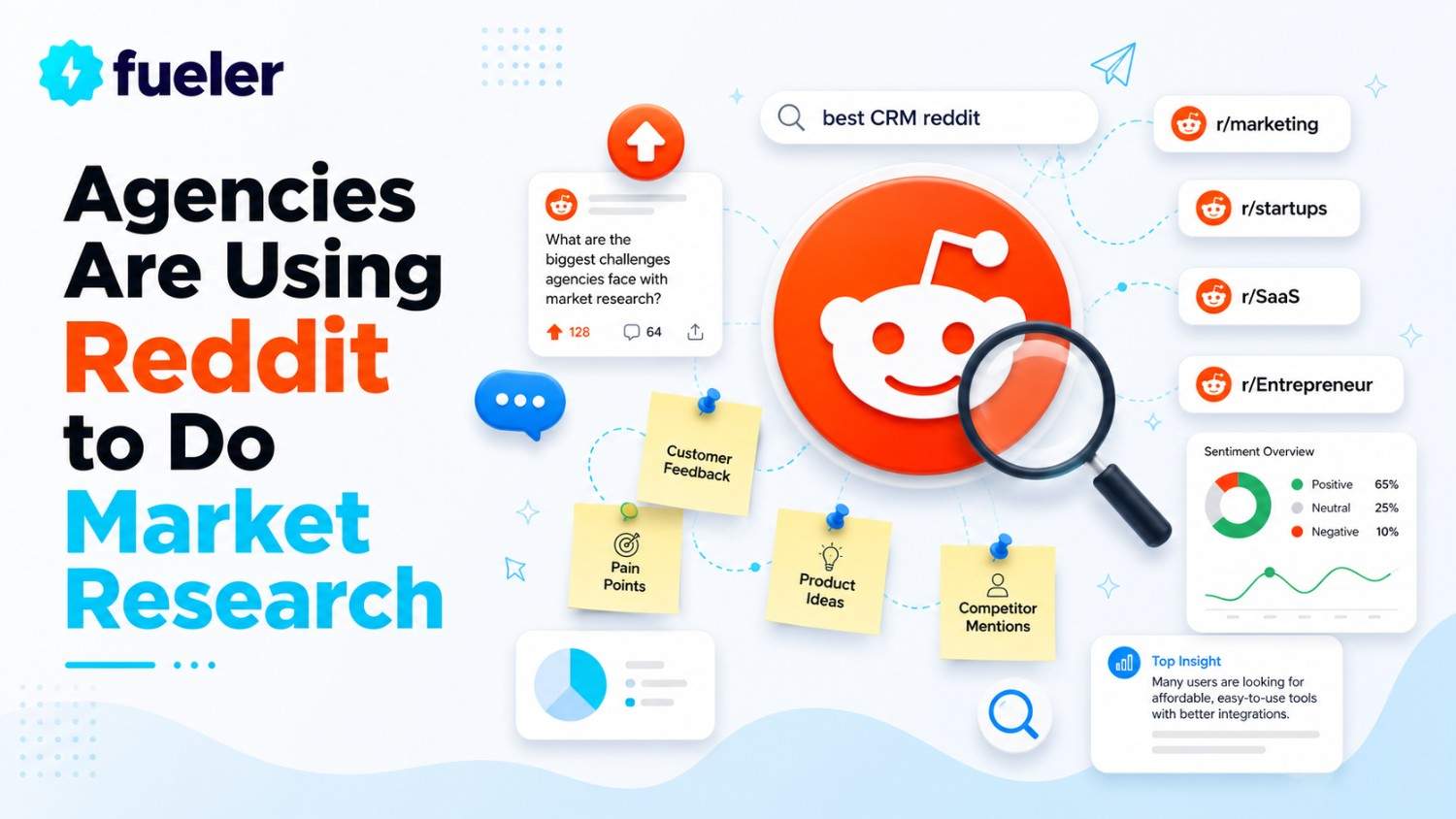
If you’ve ever spent three hours down a digital rabbit hole reading a heated debate about the best way to peel a hard-boiled egg just to feel "informed," congratulations, you’re already halfway to being a world-class market researcher. Most big-shot agencies spend thousands of dollars on boring surveys that people lie on just to get a $5 gift card they’ll never use. Meanwhile, Reddit is sitting right there, absolutely packed with people giving away their deepest frustrations, secret brand loyalties, and unfiltered opinions for free. It is the only place on the internet where a stranger will write a 1,000-word essay explaining exactly why a specific brand of toaster ruined their life, and that is pure gold for anyone trying to sell something better.
I’m Riten, founder of Fueler, a skills-first portfolio platform that connects talented individuals with companies through assignments, portfolios, and projects, not just resumes/CVs. Think Dribbble/Behance for work samples + AngelList for hiring infrastructure.
10 Strategic Ways Agencies Leverage Reddit for Research
1. Mining "Unpopular Opinions" for Massive Product Gaps
Agencies love hanging out in subreddits like /r/UnpopularOpinion or niche "rant" threads because this is where the polite filters finally come off and people get brutally honest. By analyzing what people secretly hate about the "industry leaders," researchers can identify exactly which features are actually missing in the current market. If everyone is complaining about the same "top-rated" software being too slow or clunky, an agency knows there is a massive opening for a new competitor to swoop in and save the day.
- Hunting for High-Emotion Keywords: Smart researchers use the search bar to find words like "frustrated," "hate," or "annoying" within specific subreddits to find the rawest feedback possible. This reveals the emotional triggers that make people want to switch brands, which is way more valuable than a "satisfied" rating on a corporate survey.
- Spotting the Recurring Villain: Agencies track if multiple users across ten different threads are mentioning the exact same missing feature or a bug that never gets fixed. If the "big guys" are ignoring a specific problem, that becomes the primary marketing hook for the agency’s new client.
- Analyzing the "Counter-Culture" Advice: They look for the hidden comments that disagree with the mainstream "influencer" advice to find out what the real power users actually want. These users are usually the trendsetters, and their early complaints often predict what the general public will be annoyed by in six months.
- Mapping the Competitor’s Grave: Researchers create a giant list of every "unpopular" grievance to present a roadmap of opportunities that the competition is too blind to see. It’s like having a map of all the holes in your rival's armor before you even step onto the battlefield.
- Checking the "Silent" Agreement: They pay close attention to the upvote ratio on a "hateful" comment because a high number usually means thousands of silent lurkers agree with that specific frustration. Even if only one person complained, ten thousand people clicking that "up" arrow tells you everything you need to know about market demand.
Why it matters: This works because it moves beyond the "polite" and fake feedback found in traditional focus groups, where people just say what they think the moderator wants to hear. It allows agencies to build a brand strategy based on gritty reality rather than a polished corporate image that nobody actually believes in anymore.
2. Monitoring "Day in the Life" Threads for Persona Mapping
To build a perfect buyer persona, agencies stop looking at boring demographic data like "Age: 25-34" and start reading "Day in the Life" posts in professional subreddits like /r/Marketing or /r/Nursing. These posts reveal the tiny, exhausting tasks that fill a professional's day, which they would never think to mention in a formal interview. Understanding these micro-moments helps agencies create ads that make the customer feel like the brand actually "gets" their daily struggle.
- Tracking the Unseen Workflow: Agencies look for the small, manual tasks that people complain about doing every single morning before they even start their "real" work. If a software can automate that one tiny, annoying chore, the agency can market it as a "sanity saver" rather than just another boring tool.
- Identifying Secret Stressors: They read between the lines to find out what actually keeps these professionals up at night, like the fear of a specific report being late. By identifying the "hidden" stress, the agency can position its product as the ultimate peace-of-mind solution that helps the customer sleep better.
- Learning the Tribal Language: Every profession has its own "slang" and inside jokes that outsiders don't understand, and agencies use Reddit to learn this lingo perfectly. If you use the wrong word in an ad, you look like a "suit," but if you use the right jargon, you look like a trusted peer.
- Finding the "Shadow" Tools: Researchers look for the unofficial workarounds or "hacks" that people use to get their jobs done when the official tools fail them. These hacks are basically a "cheat sheet" for new product features that people are already desperate for but nobody is selling yet.
- Observing Peer-to-Peer Recommendations: They watch which tools professionals naturally recommend to each other when nobody is looking or paying for an ad. This "dark social" data is the most honest form of market research because people only recommend things that actually make their lives easier.
Why it matters: This works because it replaces "guesses" with "lived experiences." Instead of guessing what a nurse's day looks like, the agency is literally reading the nurse's diary entries. It allows them to create marketing copy that feels incredibly personal and relevant, which is the only way to cut through the noise in 2026.
3. Using "Sort by Controversial" to Identify Brand Risks
The "Controversial" tab is the most underrated tool in any researcher’s toolkit because it shows exactly where the community is divided. Agencies use this to see which topics are "toxic" and which ones are "safe" to talk about. If a brand tries to jump on a trend that is currently being roasted in the controversial section, the agency can warn them to stay far away before they accidentally start a PR nightmare.
- Vetting Potential Influencers: Before an agency hires a big name for a campaign, they check their name in "Controversial" to see if there’s any hidden "dirt" or community backlash. This prevents the brand from being "canceled" by association because the agency did the deep-dive research that a simple Google search would miss.
- Testing Contentious Taglines: Agencies will often post a "question" that mimics a potential ad headline to see if it gets downvoted into oblivion or sparks a massive argument. It’s a free, high-stakes testing ground that tells them if their "edgy" marketing is actually just offensive or annoying.
- Identifying Sensitive Cultural Nerves: They use the controversial filter to find out which political or social issues a specific community is currently fighting about. This allows the brand to avoid "stepping in it" by accidentally taking a side in a debate they didn't even know was happening.
- Monitoring Competitor Backlash: When a competitor launches a new campaign, the agency immediately checks the "Controversial" comments to see what the real fans hate about it. They can then pivot their own client's strategy to highlight the exact opposite of whatever is causing the drama.
- Finding the "Silent Minority": Sometimes the most valuable customers are the ones being downvoted by the loud majority. Agencies look at these controversial opinions to see if there’s a neglected segment of the market that is hungry for a brand that finally speaks their language.
Why it matters: This works because it acts as an early-warning system for "Brand Safety." In a world where one wrong tweet can ruin a company, knowing exactly where the "landmines" are hidden in a community is the most valuable information an agency can provide to a worried CEO.
4. Reverse-Engineering "Holy Grail" Recommendations
Every subreddit has a "Holy Grail" product, the one thing that everyone recommends the moment a newbie asks for a suggestion. Agencies study these specific products to figure out exactly why they are so loved. They aren't looking at the specs; they are looking at the stories people tell about the product, which helps them figure out the "emotional hook" that makes a brand legendary.
- Breaking Down the "Origin Story": Agencies look for the "I used to use Brand X, but then I switched to the Holy Grail because..." stories. These "conversion" tales are the blueprints for how to steal customers away from the current market leader without spending a fortune on ads.
- Identifying the "One Key Feature": Often, a product is loved for one tiny, obscure reason that the manufacturer doesn't even mention in their own marketing. Agencies find these hidden gems and make sure their own client's product highlights that specific "magic moment" in every single ad.
- Analyzing the Community "Gatekeepers": They track which users are the "experts" that everyone listens to and study how those experts talk. By understanding what impresses the smartest person in the room, the agency can build a product that is "pro-grade" from day one.
- Measuring Brand "Durability": They look for posts from people who have used a product for five years to see if the love holds up over time. This helps agencies market "quality" and "longevity" in a way that feels real and earned rather than just a marketing claim.
- Understanding the "Fanboy" Defense: When someone attacks the "Holy Grail" product, the agency watches how the fans defend it. This tells them exactly which brand values are the most important to the core audience, whether it's the customer service, the design, or the price.
Why it matters: This works because it shows you the "Gold Standard" of your industry through the eyes of the consumer. It’s the difference between looking at a competitor's website and looking at their customer's hearts. If you know why people are obsessed with the winner, you can build a better version of the trophy.
5. Tracking "Search Intent" Through Real-World Questions
Instead of relying on dry keyword tools that just give you "Search Volume," agencies look at the actual questions people ask in subreddits like /r/ExplainLikeImFive or /r/NoStupidQuestions. These questions show the "intent" behind the search, what the person is actually trying to achieve or the specific confusion they have. This allows the agency to create content that answers the real question, not just the keyword.
- Finding the "Beginner's Wall": Agencies look for the common points where people get confused when they first start using a new type of product. By creating "How-To" guides that solve these specific "walls," the agency can capture customers at the very beginning of their buying journey.
- Identifying "Comparison" Confusion: They track posts that ask "Should I buy Product A or Product B?" to see which specific features people are struggling to compare. This allows the agency to create a "Comparison Chart" that actually answers the questions people have, rather than just listing boring specs.
- Spotting "Alternative" Uses: Sometimes people ask if a product can be used for something completely different than its intended purpose. Agencies take these "weird" questions and turn them into entirely new market segments or creative ad campaigns that no one else has thought of.
- Mapping the "Decision Tree": They watch the "Follow-up" questions that people ask after they get an initial answer. This helps the agency map out the entire customer journey, from the first spark of curiosity to the final "Where do I buy this?" moment.
- Uncovering "Hidden" Search Terms: People on Reddit often use weird, descriptive phrases when they don't know the professional name for something. Agencies take these "human" phrases and use them as high-intent keywords for their SEO strategy to catch people who aren't using the "correct" terminology.
Why it matters: This works because it aligns the brand with the user's "Natural Language." Most SEO is built for robots, but Reddit-based research allows an agency to build content for actual human beings who are confused and looking for a friendly, simple answer to their problems.
6. Analyzing "Exit Interviews" for Churn Prevention
When someone quits a hobby or switches brands, they often go to Reddit to explain why they are leaving. Agencies treat these posts like "Exit Interviews" for the entire industry. By understanding why people are "done" with a specific category, they can help their clients avoid the same mistakes and keep their customers for much longer than the competition.
- Finding the "Final Straw": Agencies look for the specific moment that made a user say "enough is enough." Was it a price hike, a bad customer service experience, or a feature that got removed? Knowing the "final straw" helps brands set "safety nets" to keep their own customers happy.
- Tracking "Regret" Posts: They read posts from people who bought a competitor’s product and now regret it. These posts are a goldmine for "Comparison Marketing," allowing the agency to say "Don't make the same mistake as these guys choose the brand that actually works."
- Identifying "Burnout" Signals: In high-stress industries, agencies look for signs that the audience is getting tired of a specific type of marketing or product. This tells them when it’s time to pivot the brand's image before the entire market gets "bored" and moves on to the next big thing.
- Learning from "The One That Got Away": They study posts from people who wanted to buy a product but couldn't find a reason to pull the trigger. These "almost-customers" are the easiest people to convert if you can just figure out that one missing piece of the puzzle that stopped them.
- Measuring "Brand Fatigue": They look for comments saying "I'm sick of seeing ads for Brand X." This helps the agency determine the "frequency cap," basically, how many ads are too many before the brand goes from "cool" to "annoying."
Why it matters: This works because it’s a "Prevention Strategy." It’s much cheaper to keep a customer than to find a new one, and Reddit provides a direct window into why people leave. If you can fix the "leaks" in your bucket before you pour more money into ads, you’ll grow much faster than anyone else.
7. Discovering "Adjacent" Interests for Better Ad Targeting
Agencies use Reddit to find out what else their target audience is interested in. If they find out that people who love "mechanical keyboards" also have a weirdly high interest in "fountain pens" and "espresso machines," they can target their ads in those unexpected places. This allows them to reach their audience in a "low-competition" environment where they aren't being bombarded by other similar brands.
- Mapping the "Interest Web": Agencies look at the "Related Subreddits" and the post history of top users to see where else they hang out. This "cross-interest" data allows them to place ads in subreddits that the competition would never even think to look at, saving the client tons of money on ad spend.
- Finding the "Aspiration" Subreddits: They look for the subs where their audience goes to "dream," like /r/Battlestations for techies. By showing their product in an "aspirational" setting, the agency makes the brand feel like a reward or a goal rather than just a boring purchase.
- Identifying "Complementary" Products: If people who buy a client's product always ask for recommendations for a second specific tool, the agency can suggest a partnership or a "bundle" deal. This increases the "Average Order Value" and makes the brand feel like it's providing a complete solution.
- Testing "Creative" Themes: They use these adjacent interests to come up with weird, creative ad concepts. If your audience loves 80s synth-wave music, an agency might design an ad with that specific aesthetic to immediately grab their attention in a crowded feed.
- Avoiding "Over-Saturated" Markets: By finding these "hidden" interests, agencies can move their budget away from the "obvious" subreddits where every other brand is fighting for attention. It’s like finding a secret, quiet shortcut to the customer’s brain while everyone else is stuck in traffic on the main highway.
Why it matters: This works because it makes "Targeting" smarter and cheaper. Instead of fighting for the same "Marketing" keyword as everyone else, the agency is reaching the same people in a "Coffee" subreddit for 1/10th of the price. It’s the ultimate way to maximize a small marketing budget.
8. Evaluating "Real-World" Product Durability
Before a brand claims its product is "tough," agencies go to Reddit to see what "tough" actually means to a real user. They look for posts in /r/BuyItForLife or subreddits dedicated to specific hobbies like /r/Hiking or /r/Tools. This research tells them exactly which parts of a product fail first and what "quality" looks like after three years of heavy use in the mud or rain.
- The "Long-Term" Review Search: Agencies ignore reviews from people who just opened the box and instead search for "3-year update" or "100 miles later." These long-term stories are the only ones that actually build trust with a skeptical audience who has been burned by "fast fashion" quality before.
- Identifying the "Weak Link": They look for recurring complaints about a specific zipper, button, or software glitch that only appears after a year. The agency can then tell the client's engineering team exactly what to fix to make their product the "sturdiest" on the market.
- Learning the "Maintenance" Pain: They read about how much people hate cleaning or fixing the product. If the agency’s client has a "self-cleaning" or "easy-repair" feature, that becomes the #1 selling point in every single video ad they produce.
- Observing the "Second-Hand" Market: Agencies look at how much a product sells for on the "used" market within Reddit communities. A high resale value is the ultimate proof of quality, and agencies use this "data point" to justify a higher premium price for their client's new products.
- Finding the "Torture Test" Videos: They look for posts where users intentionally try to break a product to see how far it can go. These "organic" torture tests are way more convincing than a lab-made ad, and agencies often reach out to these users to feature their real stories in official campaigns.
Why it matters: This works because it grounds "Quality Claims" in reality. If an agency says a jacket is "indestructible," they have 500 Reddit comments from people who wore it in a blizzard to prove it. It turns a "marketing lie" into a "community fact," which is impossible for competitors to beat.
9. Crowdsourcing "Social Proof" for Ad Headlines
Agencies often "borrow" the most upvoted comments from a thread and turn them into ad headlines (with permission, of course). Why spend weeks brainstorming a catchy line when a random person on Reddit already wrote the perfect, hilarious, or heart-wrenching summary of why your product is great? Using "Real Human Language" in ads always performs better than polished corporate copywriting.
- Finding the "Aha!" Moment Quote: They look for the one sentence that perfectly describes the feeling of finally solving a problem. These "emotional" quotes are perfect for social media ads because they sound like a friend talking to you rather than a company trying to take your money.
- Identifying the "Funny" Truth: Reddit is full of witty people who make hilarious observations about brands. Agencies take these funny, slightly "edgy" comments and use them for "self-aware" marketing that makes the brand look cool, humble, and approachable.
- Capturing the "Relatable" Struggle: They look for the "I thought I was the only one who..." posts. Using that exact phrasing in an ad headline immediately creates a bond with the viewer because it proves the brand understands their "weird" or "private" problems.
- Testing "Hook" Variations: Agencies will post several different "titles" for a story to see which one gets the most clicks and comments. The "winner" of this Reddit test then becomes the primary headline for a multi-million dollar ad campaign, ensuring it will actually work.
- Gathering "UGC" (User Generated Content) Ideas: They look for the types of photos and videos that users naturally take of the product. This tells the agency exactly what kind of "vibe" their professional photo shoots should have to make the product look "real" and "trustworthy" on a phone screen.
Why it matters: This works because "Community Language" is the most persuasive language in the world. People are trained to ignore "Professional Copywriting," but they are hard-wired to pay attention to what other people are saying. It makes the brand feel like a part of the culture rather than an intruder.
10. Sentiment Analysis of "Direct Competitor" Launches
Whenever a competitor drops a new product, agencies head straight to Reddit to watch the "Live Reaction" from the fans. They aren't looking at the tech specs; they are looking at the vibe. Is the community disappointed? Are they confused about the price? By doing this "real-time" sentiment analysis, the agency can help its client "counter-punch" with a better offer within hours of the competitor’s launch.
- Tracking the "Disappointment" Spikes: Agencies look for the "I was excited, but..." comments that appear immediately after a big announcement. These comments reveal the "broken promises" of the competition, which the agency can then "fix" in their own brand's upcoming release.
- Measuring "Price Sensitivity": They watch the debate over whether the new product is "worth it." If the community thinks the competitor is "ripping them off," the agency can advise their client to lead with a "value-first" or "transparent pricing" message to win over the angry fans.
- Identifying "Feature Overload": Sometimes a competitor adds too much "bloat," and the Reddit community hates it because it’s too complicated. The agency can then market their client's product as the "simple, clean, and fast" alternative for people who just want things to work.
- Observing the "Fanboy" Defection: They look for the "long-time fans" who are finally giving up on the competitor. These people are the most valuable "leads" in the world, and an agency can target them with specific ads that say "We know you're disappointed, come try us instead."
- Evaluating "Customer Service" Horror Stories: When a competitor's launch goes wrong (like shipping delays), the agency monitors the "where is my order?" threads. They can then run ads highlighting their own "lightning-fast shipping" and "real human support" to catch the frustrated customers.
Why it matters: This works because it’s "Competitive Intelligence" in real-time. You don't have to wait for a quarterly report to know if your rival's new product is a flop. Reddit tells you within thirty minutes, giving you a massive head start on your "counter-strategy."
5 Common Mistakes Agencies Make on Reddit
- Treating Reddit Like a Billboard: The biggest mistake is just "dumping" an ad or a link and leaving. Reddit is a community, not a static page, and if you don't stick around to talk, the community will treat you like a trespasser and downvote you into oblivion.
- Being "Too Professional" and Boring: If you use corporate jargon or sound like a robot, people will ignore you. You have to speak like a real human beingtypos, slang, and humor included, otherwise, you look like a "suit" trying to crash a backyard BBQ.
- Ignoring the "Unwritten" Rules: Every subreddit has its own vibe and "sidebar" rules. If you post a "Business Tip" in a "Hobby" sub without understanding the culture, you’ll get banned. You have to "lurk" and learn the local laws before you open your mouth.
- Getting Defensive in the Comments: Redditors love to argue, and if you get angry or "corporate" when someone critiques your brand, you’ve already lost. You have to take the hits with a sense of humor and a thick skin to earn the community’s respect.
- Faking "Grassroots" Support: Using "fake" accounts to upvote your own posts or leave nice comments is a death sentence. Reddit's algorithms and users are experts at spotting "shills," and once you're caught, your brand's reputation is permanently ruined in that niche.
Showcase Your Expertise with Fueler
Before you head off to turn your Reddit research into a multi-million dollar strategy, remember that your research is only as good as the person presenting it. When you’re trying to land that next big agency client or show off your market research skills, you need more than just a boring list of "skills" on a resume. Fueler helps you showcase your actual "Proof of Work" whether it's a deep-dive Reddit case study, a successful brand pivot, or a portfolio of real-world assignments. It’s the perfect place to host your work samples and show the world that you don't just "know" marketing, you actually "do" it.
Final Thoughts
Reddit isn't just a place for memes and arguments; it is the most honest, raw, and high-speed market research tool ever created. For agencies that are willing to stop acting like "marketers" and start acting like "listeners," the platform provides a direct line to the heart of every consumer niche on the planet. By focusing on human stories instead of dry data, you can build brands that people actually love and protect. Remember: the best research doesn't happen in a boardroom; it happens in the comments section at 2 AM.
FAQs
How can I use Reddit for market research without being a "creepy" brand?
The key is to "lurk" more than you talk. Spend 90% of your time reading and 10% of your time asking genuine, helpful questions. If you are honest about who you are and why you are asking, most communities are happy to share their opinions as long as you aren't trying to sell them something right away.
What are the best free tools for analyzing Reddit sentiment in 2026?
While you can do it manually, tools like "Subreddit Stats" and "Reddit Search Tool" are great for finding trending topics and keyword volume within specific communities. However, the best "tool" is still your own brainreading the comments yourself is the only way to catch the sarcasm and nuance that a bot would miss.
How do I find the "right" subreddits for my specific industry research?
Start with the most obvious keyword and then look at the "Sidebar" of that subreddit for a list of "Related Communities." You can also use the search bar to find where your competitors are being mentioned most often, as those are the subs where your target audience is most vocal.
Can I reach out to Reddit users directly for more detailed interviews?
Yes, but you have to be very careful and respectful. Send a polite "Direct Message" explaining exactly who you are and offering a fair "thank you" (like a gift card) for their time. Never "spam" people, and if they say no, leave them alone immediately to avoid getting your account reported.
Is Reddit research reliable compared to traditional focus groups?
In many ways, it’s more reliable because people are anonymous and have no reason to lie. In a focus group, people are often influenced by the "Alpha" person in the room or the desire to please the moderator. On Reddit, you are getting the "raw truth" that people usually only tell their best friends.
What is Fueler Portfolio?
Fueler is a career portfolio platform that helps companies find the best talent for their organization based on their proof of work. You can create your portfolio on Fueler. Thousands of freelancers around the world use Fueler to create their professional-looking portfolios and become financially independent. Discover inspiration for your portfolio
Sign up for free on Fueler or get in touch to learn more.

What should you do next?
You've read the article. Now turn your skills into proof of work and unlock more opportunities.
Build your proof of work portfolio
Create a clean portfolio with projects, assignments, resumes, and AI stack details that companies actually want to see.
Create your Fueler portfolio →Apply through assignments, not resumes
Stand out by solving real tasks from companies hiring on Fueler.
Explore assignments →Get discovered by companies
Make your work public and let recruiters discover your skills through actual projects instead of keywords.
Get discovered →
