Plaksha University Review 2026: Is It Worth It?

Riten Debnath
29 Aug, 2026
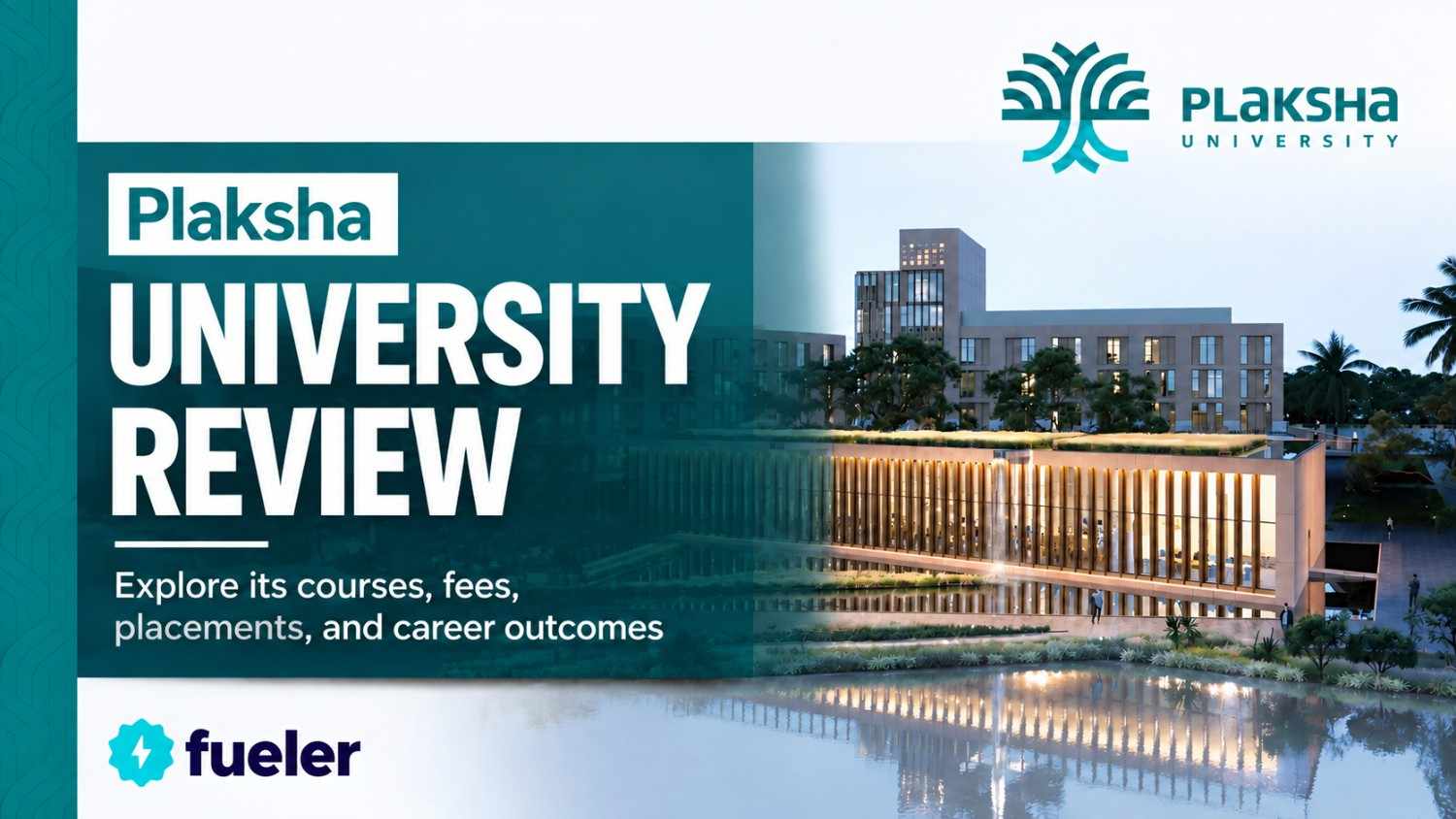
Last updated: August 2026
If you have spent any time evaluating the Indian higher education system over the last few years, you already know the painful truth: traditional engineering degrees are massively disconnected from what modern technology companies actually look for. While state universities and legacy engineering colleges continue to drill students on decade-old theoretical syllabi, the industry runs on Artificial Intelligence, real-time data engineering, and rapid product execution.
I’m Riten, founder of Fueler, a skills-first portfolio platform building the career infrastructure for 100 million creative professionals. Fueler connects talented individuals with companies through assignments, portfolios, and projects, not just resumes or CVs. Think of it as Dribbble/Behance for work samples combined with AngelList for hiring infrastructure.
At Fueler, we analyze thousands of portfolios, proof of work samples, and hiring assignments every month. We see firsthand how top tech companies hire they do not care about raw exam marks or memorized definitions. They care about functional projects, clean repositories, and demonstrable execution capability.
When a collective group of 60+ business leaders and tech founders built Plaksha University in Mohali to challenge the traditional Indian B.Tech model, it immediately demanded an analytical review. Is Plaksha University genuinely worth the substantial financial investment of ₹40+ Lakhs, or is it just another heavily marketed private institution?

Quick Answer Summary
- Who It Is For: High-performing students, aspiring tech founders, and product thinkers who want to learn by building real projects rather than studying legacy engineering theory.
- Cost: Annual tuition is ₹7.80 Lakhs, with overall 4-year B.Tech expenses reaching around ₹43.73 Lakhs including residential campus living.
- Financial Aid: Need-based aid slabs cover between 25% and 100% of tuition fees for families earning under ₹50 Lakhs annually.
- Placements & ROI: Average salary packages stand around ₹20 LPA, with median salaries at ₹17 LPA and top-tier packages touching up to ₹65 LPA.
- Key Takeaway: Plaksha is highly worth it if you actively utilize its entrepreneurship labs, project-based framework, and founder network, but it is not built for passive students seeking a traditional, exam-only college experience.
What is Plaksha University?
Plaksha University is a private, research-driven technology institution located in Mohali, Punjab, within the Chandigarh Tricity tech region. Unlike traditional universities established by a single family or corporate entity, Plaksha was built through a collective philanthropy model by over 60 tech entrepreneurs, corporate executives, and industry leaders.
Instead of following rigid academic structures where computer science exists completely separate from electronics or economics, Plaksha uses an interdisciplinary learning architecture designed alongside global academic partners including UC Berkeley, Purdue University, and the University of Pennsylvania.
Context
Plaksha was conceived to solve the core defect of Indian technical education: theoretical memorization without industry execution. The university functions more like an innovation laboratory, where students spend their years learning mathematical foundations, writing production code, building hardware prototypes, and launching software products.
Why It Matters
The global technology ecosystem evaluates talent differently today. Hiring managers at startups and global technology firms look for concrete proof of work, what code you have written, what models you have deployed, and what products you have shipped. Plaksha’s structure forces students to build verifiable project output right from their first year.
How It Differs From Alternatives
Traditional engineering colleges (including many legacy state and private institutes) follow static curricula that change once every five to ten years. Plaksha constantly updates its course modules in direct consultation with active founders and executives. Students undergo a broad foundational year covering computing, design, and quantitative reasoning before specializing in modern majors like Computer Science & AI, Data Science & Economics, or Robotics.
Key Facts Table
Detailed Explanation: Is Plaksha University Worth It in 2026?
To evaluate whether Plaksha University is truly worth your time and money, you must look closely at its core academic divisions, cost-to-value ratio, placement performance, and real-world outcomes.
1. B.Tech Majors and Academic Depth
Plaksha does not offer traditional, isolated engineering branches. Every undergraduate program integrates core computer science with specialized domain expertise.
Computer Science and Artificial Intelligence (CSAI)
- What it is: A comprehensive computing degree that embeds Artificial Intelligence, Machine Learning, and cloud systems into every semester.
- Why it matters: Traditional CS programs relegate machine learning to an elective in the final year. At Plaksha, students write algorithms and work with modern software frameworks early.
- Real-world output: Students build production software, train machine learning models, and create tools that act as tangible proof of work for software engineering roles.
Data Science, Economics, and Business (DSEB)
- What it is: A degree designed at the intersection of quantitative data analysis, financial economics, and strategic business decision-making.
- Why it matters: Modern technology platforms operate on complex data models, market incentives, and algorithmic pricing.
- Real-world output: Graduates are prepared for specialized roles like quantitative analyst, data-driven product manager, and growth strategist.
Robotics and Cyber-Physical Systems (RAS)
- What it is: A program combining mechanical hardware design, sensor networks, embedded microcontrollers, and autonomous software control.
- Why it matters: Technology is rapidly expanding beyond screens into physical hardware, electric vehicles, smart grids, and industrial automation.
- Real-world output: Students build physical prototypes in campus labs, learning to program hardware systems alongside cloud interfaces.
Biological Systems Engineering (BSE)
- What it is: A major blending computational data science, synthetic biology, and diagnostic engineering.
- Why it matters: Healthcare and biotechnology are turning into computational data industries.
- Real-world output: Trains students for bioinformatics, med-tech hardware development, and computational drug discovery analytics.
2. Postgraduate Technology Leaders Program (TLP)
The Technology Leaders Program (TLP) is a 1-year postgraduate initiative designed for early professionals and tech graduates. Co-designed alongside global university advisors, TLP combines advanced computing (AI/ML) with design thinking, product management, and business operations.
TLP is specifically built for individuals who want to skip a generic 2-year MBA and jump directly into high-growth startup roles like Product Manager, Lead Data Scientist, or Chief of Staff. Data shows that TLP graduates regularly achieve significant salary jumps, with past cohort averages reaching ₹19.45 LPA.
3. Entrepreneurship Support & Ecosystem Access
One of Plaksha's biggest selling points is the Plaksha Center for Entrepreneurship. Backed directly by founders from companies like Zomato, Indifi, Udaan, and Fractal, the center provides students with equity-free seed grants, prototyping resources, and continuous mentorship.
If you plan to launch a technology startup during your college years, this founder-led ecosystem provides access to early capital and guidance that traditional engineering colleges cannot match.
How It Works: The Student Execution Journey
Succeeding at Plaksha is about continuous output, teamwork, and building real projects.
Step-by-Step Academic Journey
- Foundational Year: All B. Tech students spend year one learning foundational mathematics, computational thinking, physics, design, and broad engineering principles.
- Major Selection: At the end of year one, students declare their specialization across CSAI, DSEB, RAS, or BSE based on their interest.
- Grand Challenges & Capstones: Teams work on interdisciplinary projects tackling real problems in energy, digital health, and smart infrastructure.
- Portfolio Assembly: Students continuously record their project work, software codebases, and prototypes. Showcasing verified assignments on platforms like Fueler gives candidates a massive advantage when applying for top-tier internships.
- Industry Placement & Founding: Final-year students either participate in placement drives with global firms and venture-backed startups or incubate their own ventures through the entrepreneurship center.
Benefits: What Makes Plaksha Worth Choosing?
- Hands-on Skill Acquisition: Students graduate with functional web apps, hardware devices, and deployed ML models instead of just paper marksheets.
- Global Faculty & Advisory: Direct interaction with visiting faculty and advisors from institutions like UC Berkeley and UPenn.
- Strong Salary Outcomes: An overall average placement package of ₹20 LPA and median package of ₹17 LPA places Plaksha among top-tier tech institutes in India.
- Founder Access: Direct access to over 60 founding trustees who run major corporate and startup ventures.
- Modern Campus Infrastructure: State-of-the-art research labs, prototyping facilities, and residential spaces in Mohali.
Challenges and Limitations: Who Should Be Cautious?
- High Total Cost: At ₹43.73 Lakhs for 4 years (tuition + residence), it requires serious financial commitment if you do not qualify for financial aid.
- Young Alumni Network: Established in recent years, Plaksha's alumni network is fast-growing but naturally smaller than multi-decade IIT or NIT networks.
- Demanding Environment: The continuous project evaluation model requires constant execution, which can feel overwhelming for students who prefer studying only right before exams.
Comparison Table
Fees, Scholarships, and Financial ROI
Understanding the fee breakdown is crucial to answering whether Plaksha is worth the cost.
Detailed Fee Structure (2025–2026 Batch)
- Annual Tuition Fee: ₹7,80,000 per year (Total academic fee ~₹33.6 Lakhs across 4 years).
- Hostel Accommodation: ₹1,44,000 per year (~₹5.76 Lakhs across 4 years).
- Meal Plans & Utilities: Approx. ₹66,000 per year.
- One-time Deposits: ₹1,00,000 (Admission fee + refundable caution deposit).
- Total Estimated Investment: ~₹43.73 Lakhs for the complete 4-year B.Tech program.
Financial Aid Structure
Plaksha maintains a strong need-based financial aid program to ensure bright students are not turned away due to financial constraints.
Additionally, special partner grants such as the Bharti Scholarship offer full fee coverage for top-performing candidates from modest backgrounds.
Career Opportunities and Placement Metrics
Plaksha’s placement outcomes validate its curriculum design. Graduates secure roles across global consultancies, product startups, and quantitative finance companies.
Prominent Job Roles
- Product Manager: Leading cross-functional teams to define user requirements and launch digital features.
- AI/ML Engineer: Developing, training, and optimizing machine learning architectures.
- Data Scientist: Analyzing large datasets to build predictive business analytics.
- Chief of Staff / Founder's Office: Working alongside tech CEOs on strategic operations, growth, and execution.
- Robotics / Hardware Engineer: Designing cyber-physical systems and autonomous hardware components.
Placement Statistics
- Average CTC: ₹20 LPA (Overall cohorts).
- Median CTC: ₹17 LPA.
- Salary Range: ₹8 LPA to ₹65 LPA.
- Top Hiring Partners: Boston Consulting Group (BCG), McKinsey & Company, CRED, Meesho, Urban Company, Arcesium, DE Shaw, Flipkart, and Sarvam AI.
Who Should Choose This?
- Students who prefer hands-on building, practical coding, and team projects over rote learning.
- Aspirants targeting futuristic careers in Artificial Intelligence, Data Science, and Autonomous Robotics.
- Future entrepreneurs who want direct access to active startup founders and seed capital.
- Students who qualify for need-based financial aid, making the ROI exceptionally high.
Who Should Avoid This?
- Candidates who want a low-cost, traditional engineering degree without active continuous assessment.
- Students who rely strictly on last-minute exam cramming rather than building projects throughout the semester.
- Applicants who prioritize a 50-year-old alumni network over modern, industry-aligned skill building.
Final Thoughts
If you evaluate higher education purely through legacy credentials, you might hesitate at Plaksha’s relative youth. But if you look at how the tech industry actually hires today, Plaksha is easily one of the most exciting technical education experiments in India.
At Fueler, we see every single day that proof of work beats paper credentials every time. Plaksha’s project-heavy curriculum forces you to assemble a functional portfolio of codebases, software products, and hardware designs before you even step into an interview room. If you are willing to work hard in a dynamic, builder-first environment, Plaksha University is fully worth the investment.
Key Takeaways
- Founder-Backed Institution: Built by 60+ tech founders and business executives using a collective philanthropy model.
- Interdisciplinary Majors: Focuses on Artificial Intelligence, Data Science & Economics, Robotics, and Biological Systems.
- Global Exposure: Curriculum co-designed with top international partners like UC Berkeley and UPenn.
- Proven Placements: Delivers impressive average packages of ₹20 LPA and top offers up to ₹65 LPA.
- Strong Aid Support: Offers 25% to 100% need-based tuition waivers for families earning under ₹50 Lakhs.
- Focus on Execution: Prepares students to build real proof of work rather than relying on theoretical marksheets.

FAQs
Is a Plaksha University degree recognized in India?
Plaksha University is a UGC-recognized state private university established under the Punjab State Legislature Act, making its degrees fully valid for higher studies and corporate jobs.
What is the average placement package at Plaksha University?
The overall average placement package stands at ₹20 LPA, with a median CTC of ₹17 LPA and top offers reaching up to ₹65 LPA.
How much does B.Tech cost at Plaksha University?
Total 4-year B.Tech expenses come to approximately ₹43.73 Lakhs, including annual tuition fees of ₹7.80 Lakhs alongside hostel residence, dining plans, and deposits.
Does Plaksha University offer full scholarships?
Yes, Plaksha provides need-based financial aid offering up to 100% tuition waivers for eligible students with family income under ₹18 Lakhs per year.
How are students selected for Plaksha B.Tech programs?
Selection is based on a holistic evaluation of Class 10/12 grades, standardized test scores (JEE Main/SAT/ACT), application essays, practical project portfolios, and a personal interview.
Why 100,000+ professionals use Fueler
Fueler helps professionals showcase proof of work through projects, assignments, case studies, and achievements.
- Thousands of professionals use Fueler to create their digital portfolio
- Thousands of projects are published on Fueler. Check here
- Startups and Companies hire through proof of work on Fueler
- Used by freelancers, creators, marketers, video editors, writers, designers, and product managers
Our mission is to help the next 100 million professionals build a verified professional identity through proof of work

What should you do next?
You've read the article. Now turn your skills into proof of work and unlock more opportunities.
Build your proof of work portfolio
Create a clean portfolio with projects, assignments, resumes, and AI stack details that companies actually want to see.
Create your Fueler portfolio →Apply through assignments, not resumes
Stand out by solving real tasks from companies hiring on Fueler.
Explore assignments →Get discovered by companies
Make your work public and let recruiters discover your skills through actual projects instead of keywords.
Get discovered →
