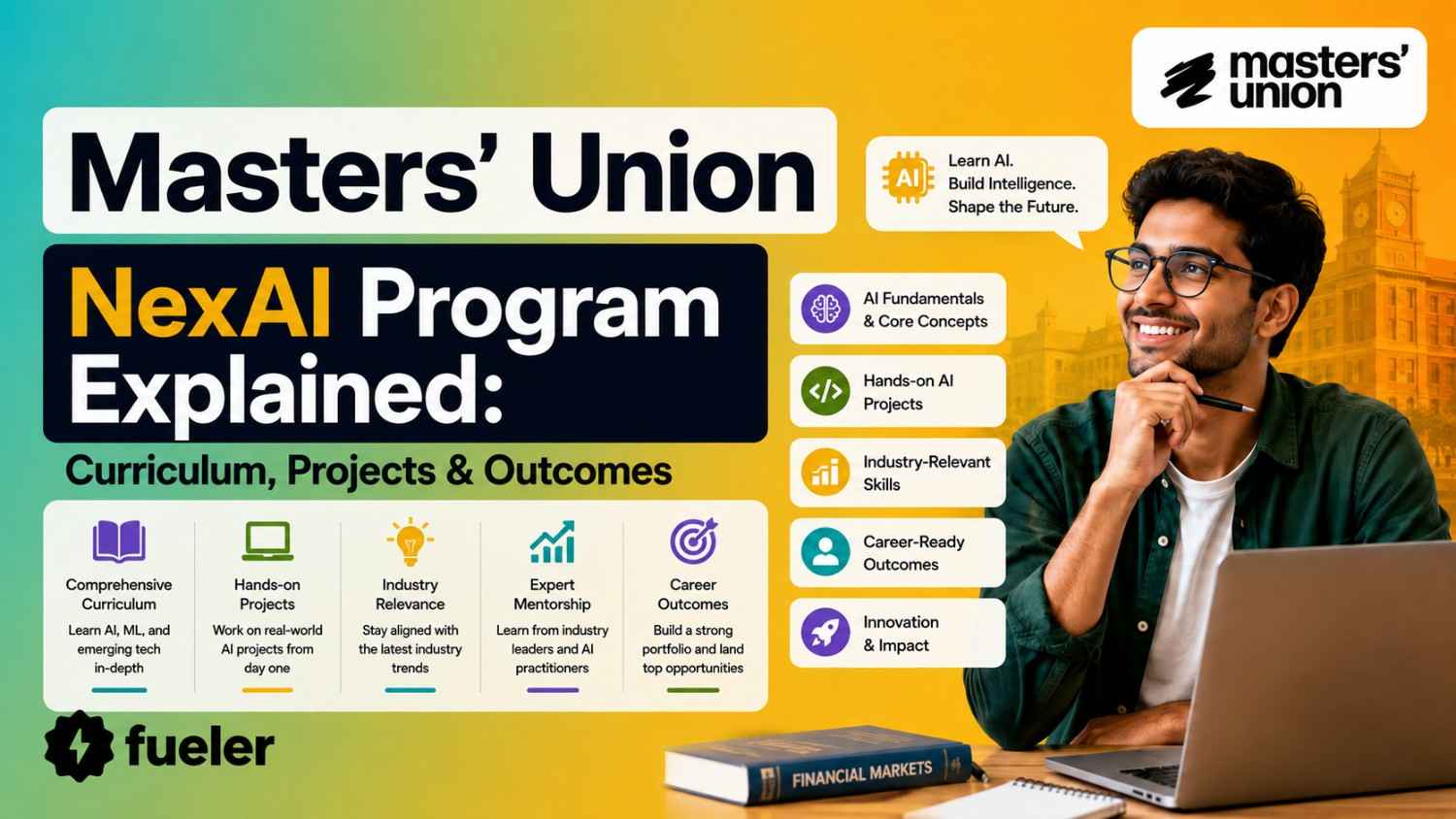
Masters' Union NexAI Program Explained: Curriculum, Projects & Outcomes

Riten Debnath
19 Aug, 2026
Last updated: August 2026
A few years ago, I watched a candidate with an impressive resume fail a simple operational test during a startup interview. They had the degrees and the right buzzwords, but when asked to deploy a real-world workflow to solve a practical problem, they froze. The theory was there, but the execution was missing.
That gap between academic theory and practical business execution is why applied learning programs have gained so much traction.
I’m Riten, founder of Fueler, a skills-first portfolio platform building the career infrastructure for 100 million creative professionals. Fueler connects talented individuals with companies through assignments, portfolios, and projects, not just resumes or CVs. Think of it as Dribbble/Behance for work samples combined with AngelList for hiring infrastructure.
In my journey building Fueler, I see thousands of real-world proof of work profiles every month. The shift across tech and business operations is clear: companies do not hire based on lecture attendance; they hire based on what you can build, automate, and deploy. The Masters' Union NexAI Program caught my attention because it focuses on this operational layer, teaching professionals how to build, scale, and manage AI-first products.
This deep dive breaks down the curriculum, practical projects, costs, and career outcomes of the Masters' Union NexAI Program using clear facts and public data.

Quick Answer Summary
- Who It Is For: Working professionals, developers, product managers, founders, and career transitioners.
- Cost: Around ₹18 Lakhs to ₹22.65 Lakhs (excluding applicable taxes and living expenses depending on the cohort format).
- Key Takeaway: Replaces traditional academic lectures with hands-on AI engineering, workflow automation, and real-world deployment.
- Best Suited For: Individuals who want a verified portfolio of proof of work rather than just a theoretical diploma.
What is the Masters' Union NexAI Program?
The Masters' Union NexAI Program is an experiential learning track created to train professionals on how to implement and manage AI systems within modern businesses. Traditional computer science or business administration courses often spend months covering high-level theoretical concepts that become outdated by the time students graduate. In contrast, this program focuses directly on execution, modern software tools, and immediate project deployment.
At its core, the program guides learners through the practical AI stack. Instead of only reading research papers on machine learning models, students build applied tools. You learn how to integrate Large Language Models (LLMs), build custom APIs, construct retrieval-augmented generation (RAG) pipelines, and set up autonomous agentic workflows that solve real business bottlenecks.
Context matters here. Early-stage startups and established enterprises alike are restructuring their teams around efficiency. Knowing how to write code or run marketing campaigns is no longer enough; professionals must know how to multiply their output using automated systems. The program bridges this gap by treating AI not as an abstract science, but as a practical core component of modern business operations.
Key Facts Table
Detailed Explanation
To understand why this curriculum is structured the way it is, we have to look at the three core pillars of modern applied AI: foundational architecture, system integration, and business orchestration.
Pillar 1: Understanding Foundations and Architecture
The first phase focuses on the mechanics of modern AI models. You move beyond simple prompt engineering to understand how Large Language Models process information, handle context windows, and generate structured outputs.
Learners dive into fine-tuning strategies, embeddings, and vector databases. Understanding these concepts allows you to determine when a business problem requires a custom-trained model, a simple API integration, or an indexed database search.
Pillar 2: System Integration and Engineering
The second phase shifts to building real functional applications. Knowing how an AI model works in isolation is useless if it cannot communicate with existing databases, customer relationship management tools, or software products.
During this stage, students use APIs, low-code automation platforms, and custom scripts to connect AI models directly to operational software. You learn how to build Retrieval-Augmented Generation (RAG) architectures that allow an AI to search through a company's internal documentation and return accurate, context-aware answers without hallucinating facts.
Pillar 3: Business Orchestration and AI Strategy
The final phase addresses the business side of implementation. Technology alone does not create value unless it improves efficiency, cuts operational costs, or builds a better customer experience.
This module covers AI Product Management, unit economics, data privacy, compliance, and team workflows. You evaluate how to integrate AI tools into growth marketing, customer support automation, and financial forecasting. The goal is to turn technical capabilities into measurable business outcomes.
How It Works
The learning structure follows a progressive, step-by-step framework designed to take you from core concepts to live implementation.
- Foundational Workshops: You start by learning the current AI landscape, covering essential programming tools, API calls, and foundational models.
- Applied Skill Labs: Guided sessions focus on specific infrastructure tasks—such as building vector stores, connecting webhooks, or setting up automated data pipelines.
- Sprint Projects: Students complete short project sprints that mirror real-world business tasks. For example, you might be asked to build an automated customer support triage bot within 48 hours.
- Live Mentorship: CXOs, tech leads, and startup founders review student work, offering feedback on both code quality and business utility.
- Capstone Portfolio Build: You deploy a fully functional AI project or agentic system, publishing the live project as proof of work for potential employers or investors.
Benefits
The program offers direct, practical advantages for professionals navigating an AI-driven market:
- Tangible Proof of Work: Instead of earning a static certificate, you finish the program with a portfolio of live, deployed applications. At Fueler, we see every day how a verified portfolio of live projects opens doors faster than a traditional resume.
- Operator Mentorship: Classes are led by active industry professionals, engineers, and product managers who build software daily, rather than full-time academic lecturers.
- Accelerated Execution Speed: You learn how to use AI tools and low-code infrastructure to build functional software prototypes in days rather than months.
- Strong Network Effects: Studying alongside ambitious engineers, product managers, and entrepreneurs creates immediate opportunities for co-founding startups or finding senior hiring roles.
Challenges and Limitations
No educational program is a fit for everyone, and it is important to be realistic about its limitations:
- High Pace and Intensity: The course moves quickly. If you fall behind on weekend assignments or sprint projects, catching up can be difficult.
- Requires Self-Direction: Because the focus is on practical outcomes rather than rote memorization, students who prefer structured academic hand-holding may struggle.
- Evolving Tooling: The AI field changes rapidly. Tools or frameworks learned in month one may be updated or replaced by month six, requiring continuous self-learning.
- Not a Pure Research Degree: If your goal is to publish academic research papers on deep learning mathematics, a traditional Master's or Ph.D. in Computer Science is a better path.
Comparison Table
Comparing applied tech programs helps highlight structural differences:
Fees and Costs
Tuition for specialized executive and applied programs at Masters' Union typically ranges between ₹18 Lakhs and ₹22.65 Lakhs (plus applicable taxes), depending on the specific cohort format and duration.
When evaluating return on investment (ROI), consider both direct tuition and career outcomes. Traditional executive programs often cost significantly more while delivering outdated management theory. Here, the financial return is directly tied to your ability to secure higher-tier product roles, lead AI implementations inside enterprises, or build and launch your own company.
Career Opportunities
Graduates of applied AI programs move into roles that combine technical understanding with business strategy:
- AI Product Manager: Designing and managing the lifecycle of AI-driven products, setting feature roadmaps, and tracking user metrics.
- Applied AI Engineer: Integrating models, building RAG systems, and connecting automated pipelines into existing product stacks.
- AI Operations Lead: Optimizing business processes across departments like marketing, customer support, and sales using automated agentic systems.
- Founders & Technical Co-Founders: Launching AI-first micro-SaaS applications or venture-backed startups using rapid prototyping skills.
Across sectors like consumer tech, financial services, software-as-a-service (SaaS), and consulting, companies actively seek professionals who can deploy tools that save time and reduce operating costs.
Who Should Choose This?
- Developers wanting to move up from basic software engineering into applied AI architecture.
- Product Managers who need to lead AI-native engineering teams effectively.
- Startup Founders looking to build and test scalable MVPs quickly using modern AI infrastructure.
- Management Consultants and Operations Leads aiming to design automated workflows for enterprises.
Who Should Avoid This?
- Individuals seeking a slow-paced, purely theoretical academic degree.
- Anyone expecting a diploma alone to guarantee a job without putting in the time to build real projects.
- People uncomfortable with fast-changing software tools, frequent updates, and hands-on trial and error.
Final Thoughts
Education is shifting away from static credentials toward demonstrable skills. The market no longer rewards what you know in theory; it rewards what you can execute in practice.
Programs like the Masters' Union NexAI track reflect this broader shift toward proof of work education. Whether you choose a formal program or decide to teach yourself, focus on building tangible projects, publishing your work online, and proving your operational value.
Key Takeaways
- Applied AI focuses on real-world system integration rather than theoretical math.
- Learning to build agentic workflows and RAG pipelines provides a strong operational edge.
- Portfolio-based learning creates verifiable proof of work for recruiters and investors.
- Practitioner-led instruction offers insights rooted in current industry realities.
- High-intensity sprint projects build the execution speed required in startup environments.

FAQs
What is the Masters' Union NexAI Program?
It is a practical, practitioner-led program designed to teach working professionals how to build, deploy, and manage applied AI applications and agentic systems in business settings.
Who is eligible for the NexAI Program?
Working professionals, software developers, product managers, and entrepreneurs with a basic understanding of business operations or software development are eligible to apply.
What is the primary focus of the NexAI curriculum?
The curriculum focuses on applied machine learning, Large Language Model integration, vector databases, automated workflows, and AI product strategy.
How does this program differ from a traditional CS degree?
Traditional degrees emphasize academic theory and mathematics, whereas this program prioritizes execution, tool integration, rapid prototyping, and building live portfolio projects.
What career roles can I pursue after completing the course?
Graduates move into positions such as AI Product Manager, Applied AI Engineer, Automation Lead, or Technical Founder launching AI-driven startups.
What should you do next?
You've read the article. Now turn your skills into proof of work and unlock more opportunities.
Build your proof of work portfolio
Create a clean portfolio with projects, assignments, resumes, and AI stack details that companies actually want to see.
Create your Fueler portfolio →Apply through assignments, not resumes
Stand out by solving real tasks from companies hiring on Fueler.
Explore assignments →Get discovered by companies
Make your work public and let recruiters discover your skills through actual projects instead of keywords.
Get discovered →
