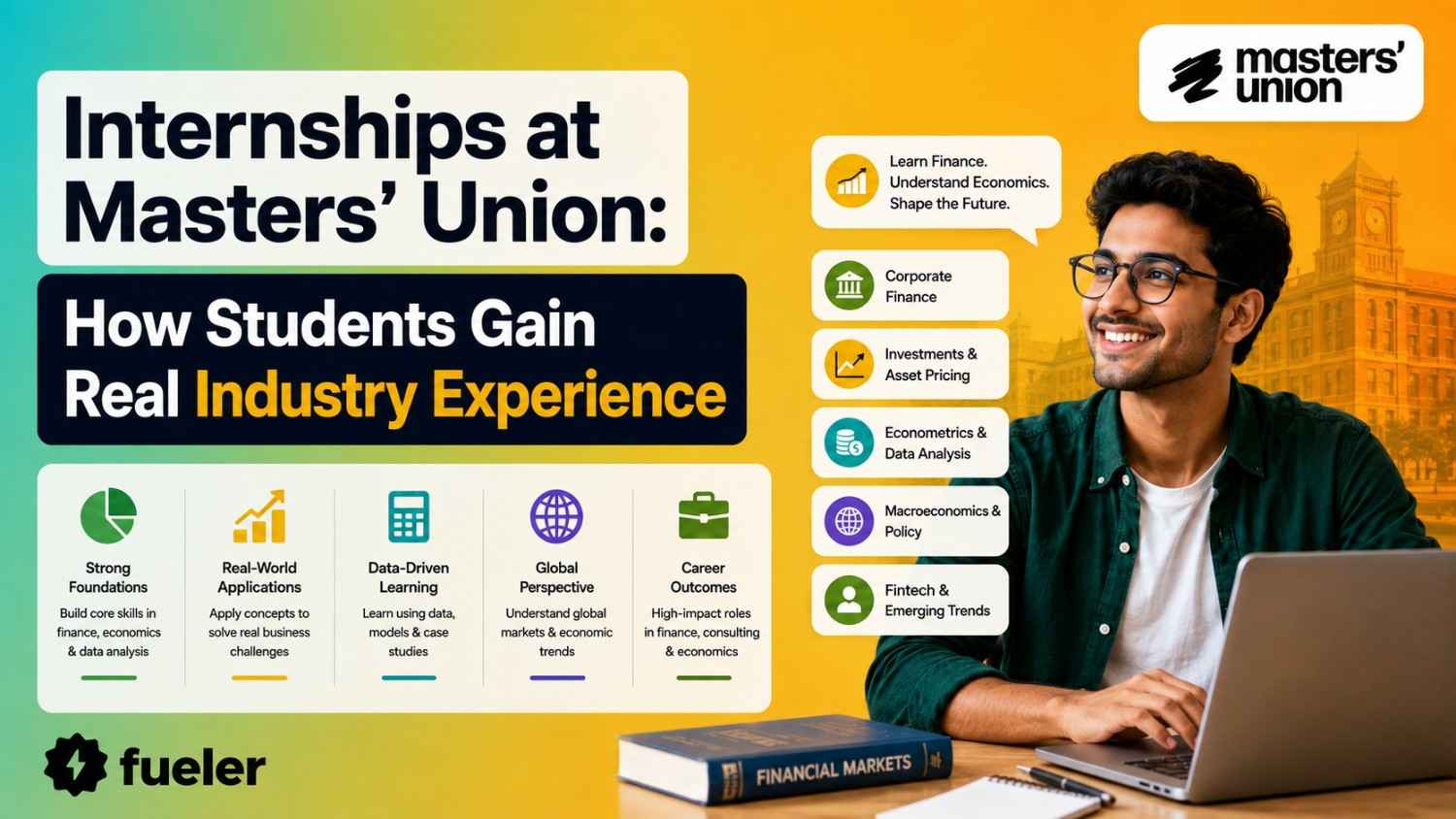
Internships at Masters' Union: How Students Gain Real Industry Experience

Riten Debnath
19 Aug, 2026
Last updated: August 2026
Every year, thousands of ambitious students spend lakhs on higher education, only to realize that textbook theories rarely survive contact with the real startup ecosystem. Over the past decade of building companies and hiring talent, I have seen brilliant graduates stumble simply because they never got their hands dirty while studying.
I’m Riten, founder of Fueler, a skills-first portfolio platform building the career infrastructure for 100 million creative professionals. Fueler connects talented individuals with companies through assignments, portfolios, and projects, not just resumes or CVs. Think of it as Dribbble/Behance for work samples combined with AngelList for hiring infrastructure.
Having closely evaluated how modern business education is evolving, the practical model at Masters' Union caught my attention. Their heavy focus on hands-on industry exposure through structured internships offers a practical framework worth dissecting for any student, parent, or professional considering an alternative business education.

Quick Answer Summary
- Who It Is For: Students, fresh graduates, and career changers looking for hands-on business operations, product management, and venture capital experience.
- Duration: Typically spans a dedicated 3-month Industry Immersion module integrated directly into the core curriculum.
- Key Takeaway: Replaces traditional academic lectures with real-world execution, portfolio building, and direct founder mentorship.
- Best Suited For: Individuals who prefer learning by doing, solving messy operational bottlenecks, and generating proof of work rather than reading static case studies.
What are Internships at Masters' Union?
Internships at Masters' Union represent an experiential learning framework where business education moves out of the classroom and into active boardrooms. Instead of reading about business strategies written a decade ago, students take on operational roles inside high-growth startups, venture capital firms, and established digital enterprises.
In traditional business schools like an IIM or ISB, students spend the vast majority of their time studying static case studies, memorizing theoretical frameworks, and taking written examinations. At Masters' Union, internships are designed as core operational stints where students take ownership of measurable business goals.
Context
The core philosophy hinges on practitioner-led education. The institution operates out of DLF Cyber Park, Gurugram, a major tech and corporate hub in India, allowing students to work alongside fast-scaling startups and conglomerates in real time.
Internships here are not passive shadowing experiences where an intern brews coffee or updates spreadsheets. They are structured execution sprints where students handle growth marketing spend, build product wireframes, run data analytics, or work directly in a Founder’s Office role.
Why It Matters
The current hiring market has shifted away from brand degrees toward verified proof of work. When a startup hires a Product Manager or Chief of Staff, they want to know if the candidate can ship features, manage unit economics, and solve ambiguous problems on day one.
Traditional business education relies on an outdated sequence:
- Learn textbook theory inside a lecture hall
- Take written exams to prove memory retention
- Complete a 2-month summer internship with limited operational scope
- Submit a single-page text resume to corporate recruiters
The Masters' Union path flips this dynamic completely:
- Execute live micro-businesses and dropshipping projects on campus
- Enter a 3-month Industry Immersion inside an active company
- Build a public, verified portfolio showing real metrics and teardowns
- Land strategic roles through direct proof-of-work hiring channels
Key Facts Table
Detailed Explanation: Internships at Masters' Union
To understand how students gain real industry experience through internships at Masters' Union, you have to look at how their academic calendar is structured. It isn't just about a 2-month summer break where you sit in a corporate corner. The entire experience is baked into the curriculum from week one.
1. The Pre-Internship Build Phase
Before stepping foot into a host company, students go through high-intensity execution sprints. They run dropshipping stores using real capital, build no-code web applications, manage a student-led venture capital investment fund, and write detailed teardowns of existing consumer applications.
This ensures that when a student applies for an internship, they do not present a standard text resume filled with bullet points about college committees. They present a live portfolio. On platforms like Fueler, having verified proof of work such as ad campaign performance data, UX teardowns, or code repositories allows candidates to skip standard HR screenings and move directly into final interview rounds with business leads.
2. Embedded Industry Immersions
During the 3-month Industry Immersion, students embed full-time inside fast-growing scale-ups, venture funds, or corporate innovation teams. Instead of working on hypothetical assignments, they are given operational ownership.
For instance, a student interning at a quick-commerce firm like Zepto or Blinkit might be tasked with reducing dark store order pick times or optimizing hyper-local user retention in a newly launched geographic zone. They work side-by-side with engineers, product leaders, and operations heads, experiencing real-time market pressure.
3. Founder's Office and Strategic Roles
A noticeable outcome of the Masters' Union internship model is the heavy density of Founder’s Office and Chief of Staff roles. Rather than putting interns into isolated functional silos, these strategic roles pair a student directly with a startup founder or C-level executive.
Students in the Founder’s Office handle cross-functional challenges:
- What they do: They jump between sales operations, growth marketing experiments, investor presentation decks, and supply chain bottlenecks.
- Why it matters: It operates like a high-velocity apprenticeship. Students witness how C-suite leadership makes high-stakes calls under severe market uncertainty, compressing years of business judgment into a few months.
- Real-world implication: Graduates entering these roles bypass entry-level administrative positions and step straight into strategic decision-making environments.
How It Works: Step-by-Step
Phase 1: Practical Bootcamps & Micro-Businesses
Students begin with hands-on modules run by active industry practitioners, founders, product leaders, and investors. They execute live campaigns, run e-commerce experiments, and build functional digital tools.
Phase 2: Portfolio & Proof-of-Work Assembly
Instead of writing a static resume, students compile their real project outputs, metric reports, design teardowns, and code repositories into a centralized online portfolio.
Phase 3: Targeted Industry Matching
The corporate relations team matches student skill profiles directly with partner companies seeking specific execution capabilities in Product Management, Growth, Operations, or Venture Capital.
Phase 4: 3-Month On-Site Industry Immersion
Students work full-time on-site or in hybrid setups with their host organizations. They own explicit key performance indicators (KPIs), participate in daily standups, and present project outcomes directly to executive teams.
Phase 5: Evaluation & Pre-Placement Offer (PPO) Conversion
Host companies evaluate interns based on tangible business results, product features shipped, or revenue generated. A significant percentage of students convert these stints into full-time roles well before graduation.
Benefits
- Direct Access to Industry Leaders: Learning directly under C-suite mentors gives students an inside look at how high-growth businesses manage cash flow, hiring, and unit economics.
- Tangible Work Portfolio: Every student finishes their internship with verifiable metrics such as percentage growth in user acquisition, lowered customer acquisition cost (CAC), or new software features deployed.
- Accelerated Career Progression: Securing roles like Chief of Staff or Associate Product Manager straight out of school skips the standard 3 to 5 years of junior-level corporate grinding.
- Immediate Feedback Loops: Operating in live markets forces students to adjust instantly when a campaign fails or a feature breaks, building real resilience.
Challenges and Limitations
- High Intensity & Burnout Risk: Balancing demanding academic modules with high-stakes startup targets requires strict discipline and time management.
- Ambiguity & Lack of Structure: Early-stage startups rarely provide step-by-step training manuals. Students who require rigid structure and predictable tasks often struggle.
- Variable Mentorship Quality: Founders and startup executives are constantly fighting business fires; passive interns who do not take initiative may get left behind.
Comparison Table
Fees, Costs, and Return on Investment (ROI)
Joining a Post Graduate Programme (PGP TBM) at Masters' Union involves a significant upfront financial commitment.
- Tuition Fee: Standard tuition fees for the flagship 16-month PGP TBM sit at approximately ₹32.75 Lakhs.
- Living Costs & Mandatory Charges: Including admission fees, housing, and living expenses around Gurugram, the total cost of attendance reaches between ₹38 Lakhs and ₹43 Lakhs.
- Placement Outcomes: The overall average CTC for the 2025 graduating cohort stood at ₹33.39 LPA, with top 25% packages averaging around ₹54.80 LPA.
- ROI Perspective: Because industry immersions frequently convert into high-paying Pre-Placement Offers (PPOs) in Product, VC, and Strategy, the payback period remains competitive compared to traditional programs lacking direct startup integration.
Career Opportunities
Graduates move into fast-paced business domains that prioritize execution capability over static theoretical knowledge.
- Founder's Office & Chief of Staff: Working on core strategic priorities alongside founders. Average packages in these roles regularly range between ₹26 LPA and ₹42 LPA.
- Product Management: Defining product roadmaps, conducting user interviews, shipping features, and managing cross-functional tech teams. Average compensation sits around ₹29.33 LPA.
- Growth Marketing & Business Operations: Managing performance marketing budgets, running conversion rate optimization (CRO) experiments, and scaling user acquisition channels.
- Venture Capital & Deal Sourcing: Analyzing early-stage startups, building financial valuation models, and conducting due diligence for investment firms.
Who Should Choose This?
- Aspirants wanting to break into Product Management, Growth, or Founder’s Office roles without waiting years to climb traditional corporate hierarchies.
- Students who thrive by doing, testing, failing, and iterating in real markets rather than memorizing textbooks.
- Self-driven individuals who are comfortable navigating ambiguous business environments and taking personal accountability for results.
- Candidates eager to build a verified portfolio of work samples on platforms like Fueler to stand out directly to hiring managers.
Who Should Avoid This?
- Students seeking a calm, traditional academic environment focused on structured lectures, clear reading lists, and written exams.
- Individuals targeting legacy corporate tracks that strictly require century-old institutional alumni networks or traditional management degrees.
- Candidates who get easily overwhelmed by rapid changes, tight execution timelines, and direct public performance pressure.
Final Thoughts
The hiring landscape has fundamentally changed. Top startups and tech enterprises no longer care just about where you went to school; they care about what you can ship on day one.
Analyzing the internship and industry immersion framework at Masters' Union reinforces a principle we live by at Fueler: verified execution is the ultimate credential. If you are willing to step outside the safety of traditional classrooms, take on real operational accountability, and build a public portfolio of your work, practical internship models like this offer a direct, high-speed path into the modern startup ecosystem.
Key Takeaways
- Internships at Masters' Union replace theoretical assignments with full-time operational execution inside host companies.
- Operating inside Cyber Park, Gurugram gives students direct physical proximity to major tech and startup headquarters.
- The program focuses heavily on strategic tracks including Founder's Office, Product Management, Growth, and Venture Capital.
- Students intern across leading companies and scale-ups, including Microsoft, Razorpay, Zomato, EY, KPMG, BluSmart, Epigamia, IndiGo, Basil, Ikigai, and Ola Krutrim.
- Hands-on campus projects like running live dropshipping businesses allow students to build verified portfolios before applying.
- Converting 3-month industry immersions into full-time roles helps graduates secure top-tier compensation packages.

FAQs
What roles do students get during Masters' Union internships?
Students land strategic roles including Founder's Office, Chief of Staff, Associate Product Manager, Growth Marketer, and Venture Capital Analyst across fast-scaling tech startups and corporate innovation teams.
How long does the industry immersion last at Masters' Union?
The primary Industry Immersion module lasts for 3 months, during which students work full-time on-site or in hybrid setups directly inside their host organizations.
Do students work on live business projects before interning?
Yes, students run live e-commerce businesses, manage student-led venture funds, build functional digital tools, and write product teardowns during their initial academic terms.
Can freshers convert these internships into full-time offers?
Yes, high-performing students frequently convert their 3-month industry immersions into full-time Pre-Placement Offers (PPOs) by delivering measurable business results and key operational wins.
What companies recruit interns from Masters' Union?
Students at Masters' Union have interned at prominent tech companies, fast-growing consumer brands, and global consulting firms, including Microsoft, Razorpay, Zomato, Blinkit, Zepto, Flipkart, McKinsey, Careem, Meta, EY, KPMG, BluSmart, Epigamia, IndiGo, Basil, Ikigai, and Ola Krutrim.
Why 100,000+ professionals use Fueler
Fueler helps professionals showcase proof of work through projects, assignments, case studies, and achievements.
- Thousands of professionals use Fueler to create their digital portfolio
- Thousands of projects are published on Fueler. Check here
- Startups and Companies hire through proof of work on Fueler
- Used by freelancers, creators, marketers, video editors, writers, designers, and product managers
Our mission is to help the next 100 million professionals build a verified professional identity through proof of work

What should you do next?
You've read the article. Now turn your skills into proof of work and unlock more opportunities.
Build your proof of work portfolio
Create a clean portfolio with projects, assignments, resumes, and AI stack details that companies actually want to see.
Create your Fueler portfolio →Apply through assignments, not resumes
Stand out by solving real tasks from companies hiring on Fueler.
Explore assignments →Get discovered by companies
Make your work public and let recruiters discover your skills through actual projects instead of keywords.
Get discovered →
