How to Build Proof of Work Before Applying for Your First Job?

Riten Debnath
06 Aug, 2026
Last updated: August 2026
The "entry-level catch" is the ultimate corporate prank: every entry-level job requires 2 to 3 years of experience, but nobody wants to give you the job so you can get the experience. Sending 200 standard PDF resumes into an automated applicant tracking system and praying for a response is a strategy that belongs in 2012.
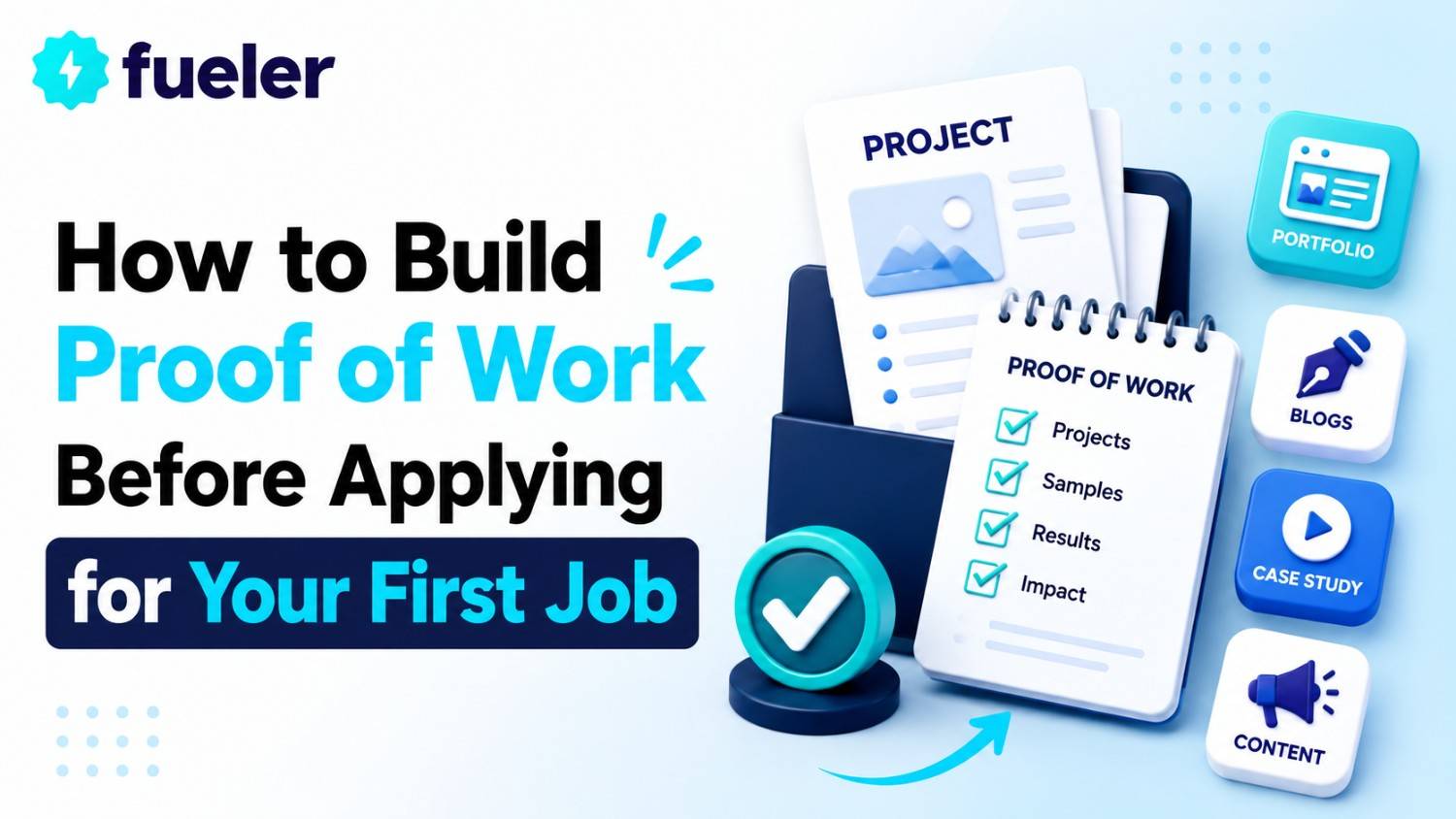
In 2026, recruiters do not hire potential; they hire proof. Companies want to know if you can land in Slack on Monday morning, open your tools, and execute without needing a month of step-by-step training. To bypass traditional gatekeepers, you need to build proof of work tangible, verifiable evidence that proves you can do the job before anyone pays you to do it.
I’m Riten, founder of Fueler, a skills-first portfolio platform building the career infrastructure for 100 million creative professionals. Fueler connects talented individuals with companies through assignments, portfolios, and projects, not just resumes or CVs. Think of it as Dribbble/Behance for work samples combined with AngelList for hiring infrastructure.
In this guide, you will learn 10 practical, real-world ways to build proof of work before applying for your first job. You will discover how to turn raw ideas into public deliverables, showcase your problem-solving process, and build an undeniable portfolio that makes hiring managers reach out to you directly.
1. Execute Unsolicited Product and Growth Teardowns
Sending a generic resume says, "I want a job." Sending an unsolicited teardown says, "I already understand your business, I found three friction points in your onboarding flow, and I designed wireframes to fix them." Teardowns are the ultimate shortcut to getting noticed because they offer immediate value upfront.
Pick a company you want to work for, use their product, and analyze their operations, user experience, or marketing funnel. Document what works, what breaks, and how you would improve it using clear data or visual mockups.
- Onboarding Funnel Audits: Map out every screen a user sees from sign-up to value realization. Identify where users get confused or drop off, and draw simplified UI alternatives using tools like Figma.
- Competitor Benchmarking Reports: Compare your target company's feature set or ad strategy against three major industry rivals. Highlight unaddressed market gaps and present actionable feature recommendations.
- SEO Content Friction Audits: Analyze a brand's top-ranking blog posts and identify thin content, missing search intent, or broken internal links. Write an updated, 1,500-word SEO article demonstrating how they can win back missing search volume.
- Ad Copy and Creative Redesigns: Take running ad campaigns from a target brand and create three alternative visual variations with higher-converting headline hooks. Explain the psychology behind your design tweaks.
- Public Pitch Delivery: Package your analysis into a clean presentation or interactive link and tag the product lead or founder on social media. Keep your delivery humble, helpful, and focused strictly on business value.
Why It Matters
Teardowns eliminate hiring guesswork for employers. Delivering targeted insights directly to decision-makers proves you possess high initiative, sharp analytical skills, and genuine interest in their specific product problems.
2. Solve Real Problems for Local Small Businesses and Nonprofits
You do not need a multi-million-dollar tech company on your resume to prove you can deliver business results. Local bakeries, neighborhood gyms, non-profits, and independent service providers usually have terrible websites, broken booking links, and non-existent email marketing.
Offer to fix one specific operational pain point for a local business for free or cheap in exchange for permission to share the data and write a case study. Fixing real-world problems with real constraints creates high-impact portfolio pieces.
- Local SEO Profile Optimization: Claim and optimize a local business's Google Business Profile, fix missing phone numbers, collect reviews, and track the resulting increase in foot traffic or call volume.
- Website Speed and Mobile Redesign: Take a clunky, slow local business site and rebuild a fast, responsive 3-page site using visual web builders. Measure the page load speed improvements before and after.
- Automated Customer Appointment Workflows: Set up simple no-code automation triggers that send text reminders to customers 24 hours before their appointments, directly reducing no-show rates.
- Email List Setup and Welcome Sequences: Create an email signup pop-up for a retail shop and write a 3-part automated welcome email sequence that drives store visits.
- Social Media Content Systems: Design 10 reusable visual templates and write a month’s worth of promotional posts for a community non-profit, tracking engagement metrics across platforms.
Why It Matters
Working with actual business owners teaches you how to handle real client feedback, timeline constraints, and scope changes. Quantifying real outcomes like increasing local calls by 20%gives you irrefutable proof of execution.
3. Build and Launch a Micro-Side Project End-to-End
Nothing proves operational capability quite like taking an idea from a blank document to a live product on the internet. You do not need complex coding skills; modern no-code platforms, database tools, and content management systems let you build functional software prototypes independently.
Build a simple tool, a curated resource directory, or an automated newsletter that solves a tiny problem for a specific audience. Documenting your setup, launch, and initial user acquisition journey shows end-to-end execution maturity.
- Curated Niche Resource Directories: Build a searchable database directory of free tools, remote job boards, or industry newsletters using no-code database platforms.
- Automated Content Newsletters: Set up a weekly curated newsletter using free distribution platforms. Write a script or set up RSS triggers to automatically pull industry news and summarize it for readers.
- Simple Micro-SaaS Prototypes: Connect a visual web builder to a payment gateway and database to offer a simple paid utility, like a specialized resume formatting tool or budget calculator.
- Open-Source Community Documentation: Write, organize, and publish a comprehensive developer or user guide for a popular open-source software project that lacks clear documentation.
- Public Product Hunt Launches: Package your micro-project, write launch copy, design preview graphics, and launch it publicly on product discovery platforms to collect real user feedback.
Why It Matters
Building a micro-project proves you do not just talk about ideas; you execute them. It demonstrates resourcefulness, project management discipline, and a deep understanding of product lifecycles.
4. Re-engineer and Clean Public Datasets into Actionable Dashboards
If you are aiming for roles in data analysis, operations, finance, or marketing, simply listing "proficient in Excel and Python" on a resume will get you buried. Employers want to see how you clean messy raw records, aggregate data, and extract revenue-generating insights.
Download messy, unformatted public datasets from government portals, sports leagues, or open data repositories. Clean the dataset, run SQL queries, build interactive visual dashboards, and summarize your business findings in plain language.
- Messy Data Normalization Case Studies: Document the step-by-step process of cleaning missing values, removing duplicates, and reformatting date strings from a 10,000-row raw spreadsheet.
- SQL Query Repositories: Write structured SQL queries to join multiple database tables, analyze customer retention cohorts, and publish your annotated scripts on code repositories.
- Interactive Business Dashboards: Build interactive visual reporting dashboards using modern analytics software, allowing users to filter metrics by region, category, or timeframe.
- E-Commerce Funnel Drop-off Analysis: Analyze open-source online store transactional data to locate cart abandonment trends and calculate potential revenue recovery scenarios.
- Executive Summary One-Pagers: Translate complex statistical correlation outputs into a crisp 3-paragraph executive summary explaining what the data means for future business decisions.
Why It Matters
Data fluency is worthless if you cannot translate numbers into business actions. Showing raw data transformation alongside clean visual summaries proves you can handle real data environments.
5. Write Open-Source Technical Documentation and Case Studies
Clear written documentation is the backbone of remote and asynchronous team execution. If you can write precise software specifications, user guides, or technical retrospectives, you possess a rare skill that engineering and product leads adore.
Find software products, open-source repositories, or internal team tools that suffer from confusing user instructions. Rewrite their guides, document edge cases, and create visual walkthroughs that make complex systems easy for anyone to understand.
- Product Requirements Documents (PRDs): Write a full product specification document for a hypothetical feature inside a popular app, complete with user stories, technical constraints, and acceptance criteria.
- API Quickstart Developer Guides: Rewrite a developer API documentation page by adding step-by-step installation instructions, code snippets, and common error troubleshooting notes.
- SaaS Feature Changelogs: Track a growing software product for a month and write polished, user-friendly changelog releases highlighting bug fixes, UI updates, and feature upgrades.
- Standard Operating Procedure (SOP) Manuals: Create a clear, step-by-step operational checklist for common tasks, such as setting up a web analytics account or deploying a staging server.
- System Migration Post-Mortems: Write a hypothetical retrospective analyzing a major cloud migration, documenting what went right, what failed, and how future downtime can be prevented.
Why It Matters
Proving you can write structured, jargon-free technical documentation shows high intellectual clarity. It signals to employers that you can keep cross-functional teams aligned without requiring endless clarification meetings.
6. Execute Mock Marketing Campaigns with Tracked Analytics
Saying you know "digital marketing" means nothing without campaign performance numbers. You do not need a $50,000 ad budget to prove you understand paid search, conversion rate optimization, or content distribution.
Run a small $20 self-funded test campaign for your blog, a friend's shop, or a local community event. Alternatively, map out an end-to-end mock campaign strategy complete with target audience profiles, ad creative variations, landing page copy, and projected return on ad spend.
- Conversion Landing Page Copywriting: Write and design a high-converting landing page for a fictional subscription box, including hero headlines, value props, and social proof sections.
- Ad Copy Matrix Experiments: Draft a structured Google Search ad framework showcasing 5 headline variations, 3 description options, and relevant sitelink extensions targeting high-intent keywords.
- Organic Short-Form Video Campaigns: Produce a 5-part video series analyzing industry news, tracking view duration, click-through rates, and follower growth across social video channels.
- Cold Outreach Sales Sequences: Write a personalized 4-step cold outreach email sequence aimed at B2B decision-makers, detailing subject line hooks and low-friction calls to action.
- Multi-Channel Campaign Post-Mortems: Package your messaging angles, design assets, audience targeting parameters, and analytics outcomes into a clean campaign case study.
Why It Matters
Marketing hiring managers look for candidates who connect creative ideas directly to revenue metrics. Presenting a campaign breakdown backed by conversion data instantly sets you apart from applicants who only showcase pretty designs.
7. Redesign Broken User Interfaces with Interactive Figma Prototypes
Graphics and interface designers often make the mistake of publishing artistic mockups that look great on social media but break completely in real software environments. Product teams want designers who understand usability, design systems, and user flow psychology.
Find a widely used web app or mobile application with a frustrating user flow like a complex checkout screen or confusing settings panel. Redesign the layout, build interactive click-through prototypes, and explain why your updates improve usability.
- User Journey Usability Testing: Record 3 real users trying to complete a task on an existing app, document where they get stuck, and use their exact quotes to justify your UI redesign.
- Design System Component Libraries: Build a structured Figma component kit including buttons, form inputs, typography hierarchies, and color tokens tailored for a specific brand style guide.
- Accessible UI Component Overhauls: Redesign a high-traffic form to meet modern web accessibility standards, ensuring high-contrast color ratios, large click targets, and clear screen-reader error states.
- Interactive Mobile Click-Through Prototypes: Link your redesigned screens into a fully clickable mobile prototype that simulates real user interactions and screen transitions.
- Before-and-After Usability Comparison Case Studies: Publish side-by-side visual comparisons of the original interface alongside your updated layout, highlighting specific friction points solved.
Why It Matters
Showing an interactive prototype alongside user research proves that you treat design as a functional problem-solving tool rather than decorative art.
8. Contribute to Open-Source Repositories or Public Code Bases
If you are pursuing a software engineering or technical role, sending a static code file on a resume carries zero weight. Tech leads want to see how you write clean code, handle pull requests, read existing codebases, and collaborate on software platforms.
Find beginner-friendly open-source repositories on public code platforms. Look for issue tags labeled "good first issue" or "documentation fix," submit clean pull requests, and address reviewer feedback professionally.
- Bug Fix Pull Requests: Identify reported software bugs in public repositories, write clean fixes, include unit test passes, and submit pull requests to repository maintainers.
- Feature Module Additions: Code a self-contained helper function, custom UI component, or API integration module for an open-source library.
- Codebase Refactoring and Optimization: Rewrite inefficient legacy code functions to reduce execution memory usage or speed up database query response times.
- Unit and Integration Test Suites: Write comprehensive automated test suites for untested code functions to ensure future updates do not break existing software features.
- Public Code Repositories with Clean Commit Histories: Maintain active personal repositories featuring well-documented README files, clear commit messages, and modular folder structures.
Why It Matters
Contributing to open-source software proves you can navigate real-world codebase complexity, follow established coding standards, and communicate effectively with senior engineers.
9. Complete High-Value Industry Certifications Paired with Applied Capstone Projects
Online certifications are great for learning fundamentals, but displaying a badge on LinkedIn without proof of application will not get you hired. Anyone can complete multiple-choice quizzes by clicking through slides.
Pair every industry certification you complete with a self-directed capstone project. If you earn a cloud, analytics, or project management credential, immediately build a live project using the exact skills taught in that course.
- Cloud Architecture Deployments: Combine a cloud infrastructure credential with a live deployed architecture project, complete with cost estimation reports and serverless setup diagrams.
- Advanced Analytics Certification Dashboards: Pair a data certification with a public GitHub repository containing custom SQL scripts, dataset transformation pipelines, and dashboard links.
- Project Management Methodology Sprints: Apply a project management certification framework by setting up a live project board for a 4-week sprint, complete with backlogs, user stories, and velocity reports.
- Growth Marketing Credentials with Live Ad Campaigns: Follow up a marketing platform certification by deploying an actual campaign and publishing performance conversion reports.
- Detailed Capstone Project Breakdown Articles: Write a detailed breakdown summarizing what the certification taught, how you applied it in your capstone project, and what technical challenges you overcame.
Why It Matters
Pairing credentials with tangible project deliverables bridges the gap between theoretical knowledge and practical execution. It proves to recruiters that you can apply course material to real-world scenarios.
10. Document Your Daily Learning and Execution in Public
Building proof of work is not just about the final polished deliverable; the process itself is high-value content. Documenting what you build, what breaks, and how you solve technical blockers in real-time builds incredible professional credibility.
Share short, daily or weekly progress updates across professional networks. Write about your experiments, post screenshots of your code or design drafts, and reflect on operational lessons learned along the way.
- Weekly Project Building Updates: Share short weekly summaries highlighting what feature you built, what technical error stopped you, and how you fixed it.
- Short Video Walkthroughs: Record 2-minute screen walkthroughs showing a feature prototype, dashboard metric, or design wireframe in action.
- Lessons Learned Post-Mortems: Write honest breakdowns discussing why a specific marketing test failed or why a database schema needed to be redesigned.
- Resource and Tool Synthesis Summaries: Summarize key takeaways from technical books, industry whitepapers, or podcasts into crisp, actionable checklists for others.
- Centralized Proof-of-Work Portfolios: Organize all your screenshots, repository links, teardowns, and project articles into a single, clean portfolio profile. Hosting your work on platforms like Fueler creates a central hub where recruiters can review your entire execution history at a glance.
Why It Matters
Documenting in public turns passive learning into an active magnet for job opportunities. It attracts founders, hiring managers, and peers who value transparency, consistency, and a growth mindset.
How Does This Connect to Building a Strong Career or Portfolio?
Your proof of work is the single most valuable asset in your early career. Traditional hiring relies on resumes that anyone can pad with buzzwords, but proof of work provides transparent, undeniable evidence of your problem-solving capabilities.
Documenting your teardowns, data dashboards, wireframes, and code builds shows hiring teams how you think and execute. When you organize your projects and assignments on Fueler, you replace empty resume claims with living proof, ensuring you get hired based on what you can actually build.
Final Thoughts
Stop waiting for a company to grant you permission to gain experience. The tools, datasets, design systems, and publishing platforms required to build real proof of work are completely free and accessible right now.
Pick one or two strategies from this guide, spend the next four weeks building a tangible project, and document every step of your execution journey. When you present employers with clear proof of work instead of a generic PDF resume, you stop competing with thousands of applicants and start standing out effortlessly.
Frequently Asked Questions
What is proof of work in a job search?
Proof of work refers to tangible, verifiable evidence of your skills such as project teardowns, code repositories, design wireframes, or case studies that prove you can do a job before being hired.
How do I build proof of work if I have no experience?
You can build proof of work independently by conducting product teardowns, re-designing broken user interfaces, cleaning public datasets, or completing free operational projects for local small businesses.
Is proof of work better than a traditional resume?
Yes, modern hiring managers prioritize proof of work over resumes because it demonstrates real execution, problem-solving ability, and practical tool fluency rather than unverified text lists.
Where should I host my proof-of-work portfolio?
Host your projects, teardowns, and case studies on a centralized portfolio platform. Using Fueler allows you to organize assignments, live links, and work samples in a clean layout that hiring teams can easily review.
How long does it take to create a solid proof-of-work portfolio?
Building a high-impact proof-of-work portfolio takes about 3 to 6 weeks of focused effort. Completing 2 or 3 detailed, well-documented projects provides enough evidence to stand out in job applications.
Why 100,000+ professionals use Fueler
Fueler helps professionals showcase proof of work through projects, assignments, case studies, and achievements.
- Thousands of professionals use Fueler to create their digital portfolio
- Thousands of projects are published on Fueler. Check here
- Startups and Companies hire through proof of work on Fueler
- Used by freelancers, creators, marketers, video editors, writers, designers, and product managers
Our mission is to help the next 100 million professionals build a verified professional identity through proof of work

What should you do next?
You've read the article. Now turn your skills into proof of work and unlock more opportunities.
Build your proof of work portfolio
Create a clean portfolio with projects, assignments, resumes, and AI stack details that companies actually want to see.
Create your Fueler portfolio →Apply through assignments, not resumes
Stand out by solving real tasks from companies hiring on Fueler.
Explore assignments →Get discovered by companies
Make your work public and let recruiters discover your skills through actual projects instead of keywords.
Get discovered →
