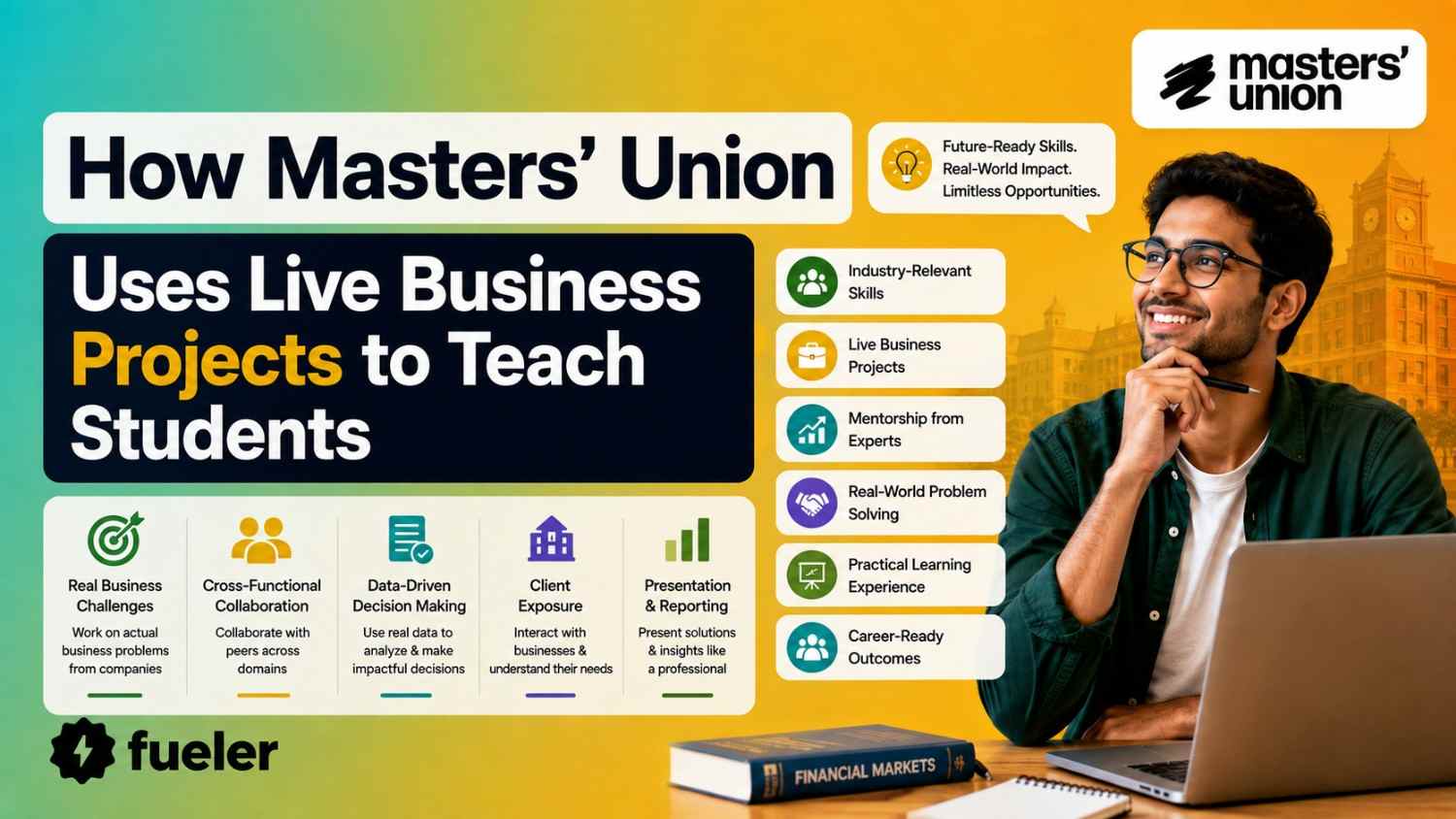
How Masters' Union Uses Live Business Projects to Teach Students

Riten Debnath
19 Aug, 2026
Last updated: August 2026
If you hand a driver's license to someone who has only read a manual about steering wheels and clutch pedals, you shouldn't be surprised when they stall at the first busy intersection. Business education has operated on this exact blueprint for decades, teaching growth funnels, unit economics, and product roadmaps through dusty case studies while students never spend a single dollar of real marketing budget.
I’m Riten, founder of Fueler, a skills-first portfolio platform building the career infrastructure for 100 million creative professionals. Fueler connects talented individuals with companies through assignments, portfolios, and projects, not just resumes or CVs. Think of it as Dribbble/Behance for work samples combined with AngelList for hiring infrastructure.
Working directly with founders and hiring leads every single day, I see a clear, undeniable shift: modern startups and tech companies in hubs like Gurgaon and Bangalore no longer care about where you sat in a lecture hall. They care about what you have built and deployed.
This exact disconnect is why the live business project model at Masters' Union stands out. Rather than using theoretical simulations, the institution forces students to manage actual capital, launch e-commerce brands, build software applications, and pitch live businesses to active venture capitalists.

Quick Answer Summary
- Execution Over Essays: Replaces exams with live revenue targets, active ad campaigns, and real product launches.
- Real Capital Risk: Students run dropshipping brands, manage live venture funds, and pitch startups for real investor equity.
- Operator Guidance: Active founders, product directors, and VCs mentor cohorts through operational roadblocks in real time.
- Verifiable Proof of Work: Students graduate with portfolios filled with real business data, PRDs, campaign reports, and pitch decks.
- Key Takeaway: Masters' Union operates as a business incubator where the curriculum is a series of live execution challenges.
What are Live Business Projects at Masters' Union?
Live Business Projects are the foundational building blocks of the curriculum at Masters' Union, designed to replace traditional academic testing with real-world execution. Instead of reading about business strategies, students are required to build, test, and scale real ventures during their program.
The core idea is simple: you cannot learn how to handle customer acquisition costs, payment gateway failures, or supply chain delays by sitting through a lecture. By putting real capital on the line, students experience the immediate pressure and accountability of managing a business.
This experiential structure matters because tech platforms, consumer brands, and consulting firms move too fast for static textbooks. Students build hands-on experience using digital tools, performance ad networks, no-code development platforms, and modern analytics software.
Compared to traditional MBA programs that evaluate students through written assignments and case studies, Masters' Union evaluates students on user retention, revenue generated, and functional product builds.
Key Facts Table
Detailed Explanation
Preparing candidates for modern startup and corporate roles requires an environment where failure carries immediate, observable lessons. At Fueler, we see how hiring managers gravitate toward candidates who can walk through an ad campaign dashboard or a product feature launch they built themselves. Masters' Union structures its live business projects across four major execution engines.
The Dropshipping & D2C Revenue Sprint
Before students dive into complex tech platforms, they go through rapid, low-friction execution sprints designed to teach fundamental commerce mechanics.
- What they do: Student teams receive initial seed budgets and are tasked with launching a live e-commerce brand from scratch. They source products, set up storefronts, write ad copy, configure payment solutions, and run targeted ad campaigns.
- Why it works: Running an e-commerce store strips away high-level abstractions. Students immediately confront real metrics like conversion rates, checkout drop-offs, return on ad spend (ROAS), and customer acquisition costs (CAC).
- How it is taught: Rather than grading theoretical marketing plans, mentors review live ad performance dashboards. If a team’s campaign burns ad spend without sales, students must pivot creative hooks, tweak landing pages, or audit targeting parameters immediately.
- Real-world implications: Understanding how digital distribution works turns students into capable growth marketers and performance leads who understand unit economics from day one.
The Venture Initiation Programme (VIP)
The flagship startup engine inside the curriculum is the Venture Initiation Programme, which guides student teams through building a venture over multiple terms.
Through this programme, students have launched real, operating startups across various sectors:
Real Student Startups Built at Masters' Union:
- Lissun: A mental health platform providing end-to-end care integration, co-founded by Masters' Union alumni and supported through venture capital networks.
- SoleSearch: A premier marketplace for authentic sneakers, streetwear, and youth culture apparel built directly by students during their program.
- Yoho: A footwear brand focusing on ergonomically designed, high-comfort everyday shoes that originated as a student execution project.
- BiteSpeed: An e-commerce marketing automation tool helping Shopify brands engage customers via WhatsApp and conversational channels.
- Kratos Studios: A Web3 gaming and community-building startup focused on building decentralized gaming ecosystems.
- What they do: Students move from early problem identification through user interviews to building a Minimum Viable Product (MVP), testing go-to-market strategies, and establishing product-market fit.
- Why it works: Building an MVP forces students to focus on core user pain points. They use no-code app builders, modern software tools, and digital design platforms to build working products quickly.
- How it is taught: Active startup founders and product directors act as mentors. They challenge students during weekly product reviews, auditing user retention, conversion funnels, and feature roadmaps.
- Real-world implications: Whether a student startup scales or shuts down, the candidate gains deep hands-on product management and operational experience that traditional lecture halls cannot replicate.
Student-Managed Venture Capital Funds
Understanding business also means understanding how capital is evaluated, allocated, and deployed into early-stage companies.
- What they do: Students participate in running real investment funds where they source startups, conduct due diligence, analyze financial models, and present investment memos.
- Why it works: Sitting on the investor side forces candidates to evaluate business models critically. They look past pitch decks to scrutinize cap tables, unit economics, market size, and founder capability.
- How it is taught: Active venture partners and angel investors guide the student investment committees. Students defend their investment thesis in front of seasoned capital allocators who challenge their financial assumptions.
- Real-world implications: Candidates targeting roles in venture capital, corporate strategy, or Founder's Office positions gain real experience conducting institutional due diligence.
Industry Consultancies & Corporate Sprints
For students interested in management consulting and corporate strategy, live projects take the form of direct consulting engagements with active tech companies and enterprises.
- What they do: Student teams take on unstructured, live business problems provided by corporate partners. They analyze messy internal data, audit operational bottlenecks, and present strategic playbooks to executive leadership.
- Why it works: Real companies do not present neat, end-of-chapter textbook problems. Students learn how to clean incomplete datasets, formulate hypotheses, and test strategic solutions under real constraints.
- How it is taught: Strategy consultants and industry executives review team deliverables using frameworks like MECE (Mutually Exclusive, Collectively Exhaustive) problem-solving.
- Real-world implications: Candidates build direct exposure to executive decision-making, giving them an advantage during case interviews and corporate strategy hiring processes.
How It Works
The live project model follows a clear, progressive execution loop that takes students from basic skills to real market launches.
- Problem Identification & Hypothesis Setup: Students identify real market gaps by conducting direct user interviews and competitor analyses.
- Capital & Resource Allocation: Teams receive seed grants or stipends to build basic storefronts, ad campaigns, or software prototypes.
- Build & Go-To-Market Execution: Students build their MVP using low-code tools or digital channels, driving initial traffic through targeted marketing campaigns.
- Data-Driven Iteration: Mentors review live conversion data, customer retention metrics, and unit economics, forcing teams to optimize their operations in real time.
- Demo Day & Portfolio Deployment: Student teams pitch their operational data to external investors at Demo Day or compile their project outputs into public skill portfolios.
Benefits
- Verified Proof of Work: Candidates build real portfolios containing published PRDs, live ad campaign analytics, and functional app builds.
- Real Risk Management: Managing actual capital teaches financial discipline, unit economics, and decision-making under uncertainty.
- Direct Operator Access: Working alongside active founders and executives builds strong professional connections and referral pipelines.
- Immediate Workplace Readiness: Graduates enter jobs with practical software, growth, and analytics skills, drastically reducing onboarding time.
- Pivoting Experience: Students learn to adapt marketing strategies, user onboarding flows, or business models based on real market feedback.
Challenges / Limitations
- High Operational Stress: The constant pressure of managing live budgets, product builds, and revenue targets can be intense.
- Risk of Project Failure: Not every student venture or ad campaign succeeds; dealing with failed launches requires emotional resilience.
- Unstructured Environment: Students who thrive in structured, textbook-based learning environments may struggle with open-ended business problems.
- Who Should NOT Choose It: Individuals seeking purely academic research careers or traditional textbook-based learning should look at conventional MBA options instead.
Comparison Table
Fees / Cost
- Tuition Investment: Tuition for major programs like the 16-month Post Graduate Program in Technology and Business Management (PGP-TBM) sits in the ₹20 Lakhs to ₹30+ Lakhs range.
- Project Support: The institution provides seed capital, grants, and stipends through initiatives like the Founders' Fellowship to help student teams launch ventures without personal financial strain.
- Living Budget: Students should budget for accommodation and living expenses in Gurugram’s Cyber Park business district.
- Career ROI: With reported average placement packages hovering around ₹33+ LPA, the practical skills gained often lead to rapid career advancement.
Career Opportunities
- Product Manager: Building product roadmaps, writing PRDs, and overseeing software features in fast-growing tech companies.
- Founder's Office / Chief of Staff: Working directly with startup founders to handle cross-functional execution, growth sprints, and operations.
- Growth Marketer: Managing performance ad budgets, optimizing landing page conversion funnels, and driving customer acquisition.
- Management Consultant: Analyzing business metrics, identifying operational bottlenecks, and developing growth playbooks for corporate clients.
- Venture Capital Analyst: Evaluating early-stage startups, running deal-flow due diligence, and analyzing financial models.
Who Should Choose This?
- Ambitious individuals who learn best by building, testing, and shipping real projects.
- Early professionals aiming to transition into high-growth startup roles or product management.
- Aspiring entrepreneurs who want a structured environment with seed funding and operator guidance to launch a venture.
- Professionals who value creating a public portfolio of work to stand out to modern hiring managers.
Who Should Avoid This?
- Candidates who prefer traditional classroom lectures, predictable exam schedules, and structured academic textbooks.
- Students seeking academic research pathways or PhD credentials.
- Individuals uncomfortable with public project reviews, real-time feedback, or managing live business risks.
Final Thoughts
Business execution is a muscle built through repetition, failure, and real-world feedback. You cannot build that muscle by reading about what someone else achieved ten years ago.
At Fueler, we see how companies evaluate candidates today: they skip the resume summary and ask to see actual proof of work. They want to look at the PRDs you wrote, the ad campaigns you ran, and the user flows you designed.
The live business project model at Masters' Union aligns directly with this industry shift. By forcing students to run real ventures, manage capital, and face market consequences, it turns business education into an operational launchpad. For anyone serious about building a career in tech, startups, or strategy, creating real proof of work remains the single most reliable shortcut to long-term success.
Key Takeaways
- Action-Oriented Pedagogy: Replaces paper case studies with live revenue challenges and venture launches.
- Real Capital Exposure: Students manage actual ad spends, seed grants, and investment funds.
- Practitioner Guidance: Direct mentorship from active founders, startup CEOs, and venture partners.
- Portfolio Generation: Graduates enter the hiring market backed by verified proof of work.
- Fast-Paced Adaptability: Prepares students for modern tech roles in product management, strategy, and growth marketing.

FAQs
What is a live business project at Masters' Union?
A live business project is an execution challenge where students launch real ventures, run dropshipping stores, manage ad budgets, or solve live corporate problems instead of taking theoretical written exams.
Do students get financial support to launch these live projects?
Yes, Masters' Union provides seed grants, stipends through initiatives like the Founders' Fellowship, and access to student venture funds to support execution without financial strain.
How are live projects evaluated if there are no traditional exams?
Evaluations are based on real business metrics like net revenue generated, customer acquisition costs, app user retention, conversion funnels, and strategic pitch presentations.
Who mentors students during these live business challenges?
Projects are guided by active industry practitioners, including startup founders, tech product directors, corporate CXOs, and venture capital partners who provide real-time operational feedback.
How do live projects help students land startup and product roles?
Live projects give candidates verifiable proof of work, allowing them to showcase real PRDs, growth marketing reports, and product builds directly to hiring managers.
Why 100,000+ professionals use Fueler
Fueler helps professionals showcase proof of work through projects, assignments, case studies, and achievements.
- Thousands of professionals use Fueler to create their digital portfolio
- Thousands of projects are published on Fueler. Check here
- Startups and Companies hire through proof of work on Fueler
- Used by freelancers, creators, marketers, video editors, writers, designers, and product managers
Our mission is to help the next 100 million professionals build a verified professional identity through proof of work

What should you do next?
You've read the article. Now turn your skills into proof of work and unlock more opportunities.
Build your proof of work portfolio
Create a clean portfolio with projects, assignments, resumes, and AI stack details that companies actually want to see.
Create your Fueler portfolio →Apply through assignments, not resumes
Stand out by solving real tasks from companies hiring on Fueler.
Explore assignments →Get discovered by companies
Make your work public and let recruiters discover your skills through actual projects instead of keywords.
Get discovered →
