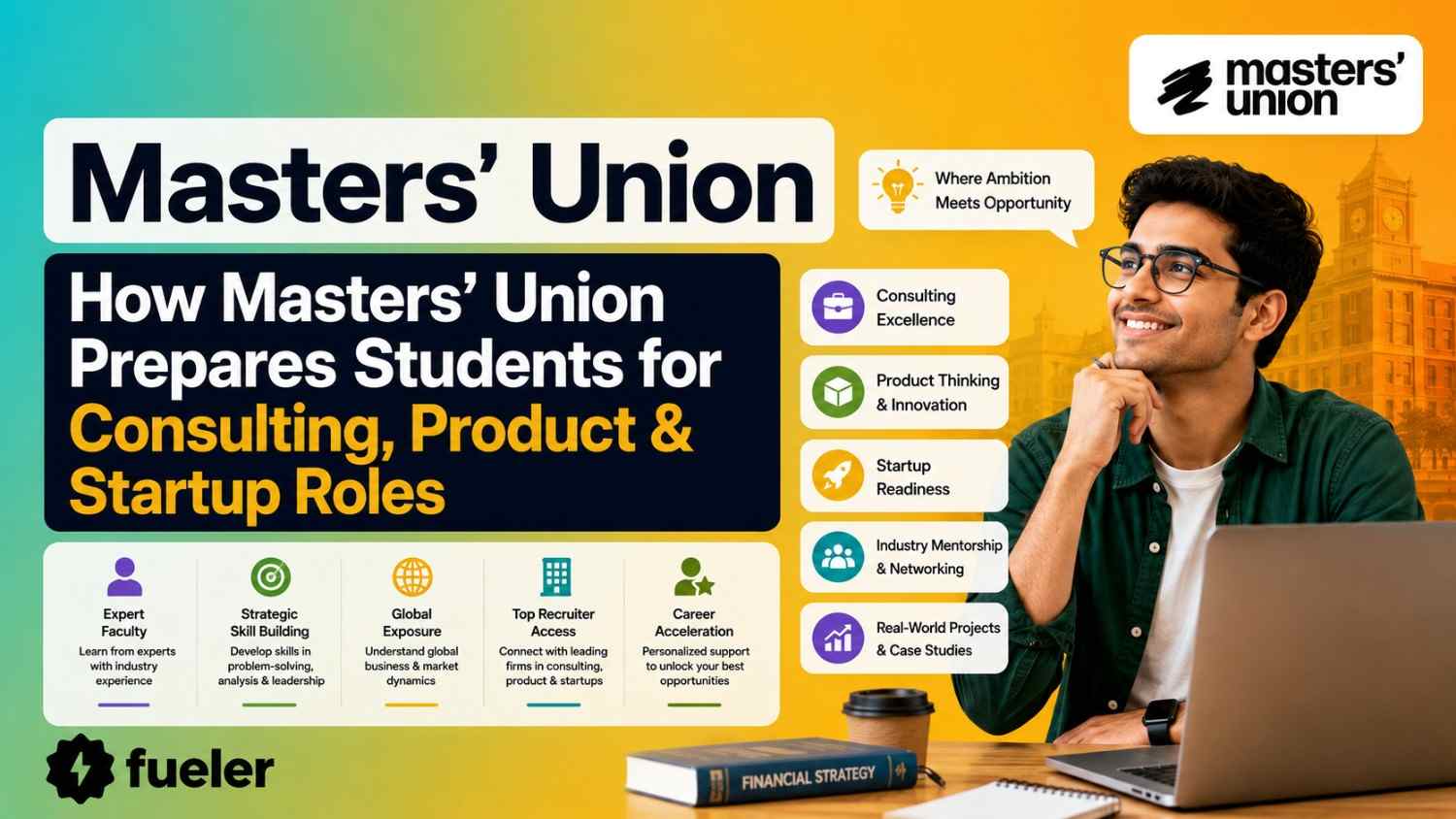
How Masters' Union Prepares Students for Consulting, Product & Startup Roles

Riten Debnath
19 Aug, 2026
Last updated: August 2026
Every year, thousands of ambitious professionals stand at a career crossroads, debating whether traditional business education still delivers on its promises.
I’m Riten, founder of Fueler, a skills-first portfolio platform building the career infrastructure for 100 million creative professionals. Fueler connects talented individuals with companies through assignments, portfolios, and projects, not just resumes or CVs. Think of it as Dribbble/Behance for work samples combined with AngelList for hiring infrastructure.
Working directly at the intersection of hiring managers and modern talent has shown me a clear shift in what the market demands.
The modern startup ecosystem no longer hires based purely on legacy credentials or theoretical knowledge. Companies in tech hubs like Bangalore and Gurgaon want proof of execution from day one. This shift is why alternative business models have caught widespread attention, as they aim to bridge the gap between traditional academia and hands-on business operations. Understanding how Masters' Union prepares students for consulting, product, and startup roles requires an analytical look at its structure, pedagogy, and actual career outcomes.

Quick Answer Summary
- Practitioner Pedagogy: Replaces tenure-track professors with active CEOs, product directors, venture partners, and strategy consultants.
- Live Execution Models: Students build real products, run e-commerce stores, manage actual venture capital, and resolve live business challenges.
- Targeted Specializations: Curricula directly mirror requirements for high-growth tech careers like Product Management, Founder's Office, Chief of Staff, and Strategy Consulting.
- Proof-of-Work Focus: Graduates build public proof of skills ranging from product teardowns to growth playbooks rather than relying solely on static resumes.
- Key Takeaway: Masters' Union operates more like a business incubator than a lecture hall, training candidates to execute tasks immediately upon entering the workplace.
What is Masters' Union?
Masters' Union is an alternative business school located in Gurugram, India, designed to train students through real-world business execution rather than academic lectures. Instead of relying solely on traditional professors, the institution brings in active startup founders, product leaders, and corporate executives to teach courses.
The core premise rests on experiential learning, where students learn business by running actual ventures. By exposing candidates to real profit-and-loss responsibilities, marketing budgets, and product builds, the program attempts to mirror the chaotic environment of modern technology startups and fast-paced consulting firms.
This practical approach matters because the tech ecosystem moves faster than traditional business school curricula can adapt. Legacy programs often spend months analyzing decade-old case studies, whereas alternative programs force students to build using modern AI tools, no-code platforms, and digital growth channels.
Compared to traditional options like an IIM or ISB, Masters' Union shifts the focus from academic credentials to tangible proof-of-work. Candidates graduate with a portfolio of live projects, product teardowns, and venture metrics rather than just a degree certificate.
Key Facts Table
Detailed Explanation
Preparing students for specialized positions requires more than classroom instruction; it demands realistic workplace training. At Fueler, we see firsthand that companies hiring for specialized roles prioritize verifiable evidence of ability over generic academic qualifications. Masters' Union aligns its entire teaching framework around building these verifiable skills across three major domains.
Product Management Preparation
Product Management cannot be learned effectively through textbook theory. To excel as a Product Manager (PM), an individual must understand user research, roadmapping, wireframing, feature prioritization, data analytics, and cross-functional team coordination.
- What they do: Masters' Union trains students to think like product owners from week one. Students learn how to identify market friction, write clear Product Requirement Documents (PRDs), design low-fidelity wireframes using modern design software, and test features with actual users.
- Why it works: Modern tech platforms look for PMs who understand both tech architecture and customer psychology. Candidates are taught to leverage no-code platforms to launch MVP (Minimum Viable Product) versions of apps, allowing them to test real hypothesis-driven features.
- How it is taught: Product leaders from consumer tech companies guide students through structured teardowns of widely used apps. Rather than submitting written essays, students submit interactive teardowns, mapping out user onboarding, conversion funnels, and UX improvements.
- Real-world implications: Having a repository of published PRDs and teardowns gives candidates an edge during interviews. When an applicant can show an interviewer exact wireframes and user flow solutions built during their program, it immediately validates their operational readiness.
Startup & Founder's Office Preparation
Roles like Founder's Office, Chief of Staff, and Entrepreneur-in-Residence (EIR) require high adaptability, speed, and cross-departmental execution. A Founder's Office generalist handles whatever the startup needs at that moment, whether it is growth marketing, customer support workflows, or unit economics restructuring.
- What they do: To prepare for startup environments, students go through intense building challenges. This includes running a live e-commerce business sprint where student teams receive seed capital, source real products, build online stores, run paid ad campaigns, and attempt to generate actual profit within weeks.
- Why it works: Experiencing real financial loss or profit teaches unit economics faster than any lecture. Students learn performance marketing, customer acquisition cost (CAC), lifetime value (LTV), supply chain management, and crisis handling in real time.
- How it is taught: In addition to business sprints, the institution manages an equity fund run by students under investment committee guidance. Students source startups, perform due diligence, analyze cap tables, and present investment memos for actual equity capital deployment.
- Real-world implications: Startup founders value candidates who do not need hand-holding. When a graduate can demonstrate that they have managed actual ad spends, resolved customer service bottlenecks, or evaluated early-stage financial models, they transition into Chief of Staff or Founder's Office roles with minimal onboarding.
Consulting & Business Strategy Preparation
Management consulting demands structured thinking, data decomposition, financial modeling, and persuasive communication. Consultants must walk into unfamiliar industries, identify operational problems quickly, and present actionable solutions to leadership.
- What they do: Masters' Union structures strategy training through live corporate consultancies and case competitions. Rather than relying strictly on old academic business cases, students work on real business challenges supplied by partner enterprises and high-growth startups.
- Why it works: Real businesses present unstructured, messy data. Learning to clean this data, run financial valuations, map competitor landscapes, and extract strategic direction prepares candidates for the fast pace of top-tier consulting firms.
- How it is taught: Active management consultants and strategy partners train students on framework development, structured problem-solving (such as MECE principles), advanced financial modeling, and executive storytelling.
- Real-world implications: During interview processes, consulting candidates face rigorous case interviews. Because students spend months analyzing real business metrics and defending their strategic frameworks in front of industry judges, case interviews become a natural extension of their daily routine.
How It Works
The educational model follows a progressive execution framework designed to move students from foundational concepts to real-world deployment over 16 months.
Phase 1: Foundational Skill Immersion
Students learn core business mechanics including financial accounting, corporate strategy, digital marketing algorithms, and basic product design tools.
Phase 2: Live Execution & Venture Challenges
Students are assigned seed capital to launch real micro-businesses. They build websites, optimize landing pages, manage supply logistics, and target actual digital buyers.
Phase 3: Industry Consultancies & Investment Management
Students partner with real enterprises for multi-week consulting sprints. Simultaneously, selected student groups evaluate early-stage startups for investment via the internal venture fund.
Phase 4: Portfolio Building and Placement Deployment
Candidates compile their project outputs- PRDs, marketing performance reports, investment memos, and strategic consulting decks into public proof-of-work profiles. This allows recruiters to evaluate candidates based on executed assignments rather than static resumes.
Benefits
Choosing an experiential alternative model offers clear advantages for career transitioners looking for fast growth.
- Immediate Proof of Capability: Graduates show recruiters tangible work samples, such as live app prototypes, published product teardowns, and verified ad campaign results.
- Direct Access to Industry Mentors: Classes are taught by active industry executives, opening direct networking channels and organic referral opportunities.
- Fast-Paced Adaptability: The curriculum adapts quickly to industry trends, incorporating modern developments like generative AI tools, prompt engineering, and modern growth stack software.
- Cross-Functional Skills: Students gain exposure to tech, marketing, finance, and operations simultaneously, making them well-suited for startup generalist roles.
- Real Risk Experience: Operating live projects with actual financial consequences builds decision-making confidence that theoretical classrooms cannot replicate.
Challenges / Limitations
Despite its practical focus, this model is not the right fit for every candidate or career ambition.
- High-Intensity Environment: The constant pace of live projects, continuous evaluations, and business launches can lead to burnout for students who prefer structured academic environments.
- Less Traditional Campus Experience: Unlike legacy universities with decades of sports culture and vast academic campuses, alternative programs focus heavily on industry immersion in business hubs.
- Brand Perception in Traditional Corporate Circles: While fast-growing tech startups and progressive consulting firms value alternative models, certain conservative legacy corporations still prefer traditional degree credentials from established public institutions.
- Who Should NOT Choose It: Candidates seeking an academic research career, those looking for slow-paced theoretical learning, or individuals seeking a traditional degree for overseas academic credit should explore standard university paths instead.
Comparison Table
Evaluating alternative programs against traditional business education models highlights key structural differences:
Fees / Cost
Investing in higher education requires a clear analysis of financial inputs and practical career yields.
- Tuition & Program Costs: The tuition fee for the Post Graduate Program generally sits in the ₹25 Lakh to ₹30 Lakh range, subject to annual updates.
- Living Expenses: Because the campus is located in Gurugram’s corporate hub (Cyber Park), candidates should budget for accommodation, food, and local transit in the NCR region.
- Scholarships: Financial support and merit-based scholarships are available for high-achieving candidates, exceptional women leaders, and candidates with proven entrepreneurial backgrounds.
- Return on Investment (ROI): With reported domestic average compensation packages around ₹30+ LPA, candidates often recover their educational investment within a reasonable timeframe post-graduation, particularly when securing product or strategy roles in growth-stage companies.
Career Opportunities
Graduates transition into roles that require strategic decision-making and cross-functional execution.
- Product Management: Junior PM, Associate Product Manager (APM), and Product Analyst roles across consumer tech, B2B SaaS, and FinTech verticals.
- Founder's Office & Leadership Support: Chief of Staff, EIR (Entrepreneur-in-Residence), and Strategy Associate positions working directly alongside founders.
- Management & Strategy Consulting: Associate Consultant and Business Analyst roles within strategy boutiques, digital transformation agencies, and top-tier consulting firms.
- Venture Capital & Private Equity: Investment Analyst and Deal Flow Manager roles, sourcing early-stage investment opportunities and analyzing business fundamentals.
- Compensation Averages: Recent placement metrics indicate average compensation figures around ₹30–33 LPA, with top quartile packages scaling significantly higher depending on prior work experience.
Who Should Choose This?
- Early professionals with 1–4 years of experience who want to pivot into tech startups or product management.
- Ambitious graduates who learn best by doing, building, and running real projects rather than sitting in lectures.
- Aspiring entrepreneurs who want to test business ideas with seed support and practitioner feedback.
- Professionals targeting Chief of Staff or Founder's Office roles who need broad exposure across product, marketing, and finance.
- Candidates who understand the value of creating a public portfolio of work to stand out to modern hiring managers.
Who Should Avoid This?
- Individuals seeking a traditional academic degree for government job eligibility or PhD research pathways.
- Students who prefer clear theoretical guidelines, predictable schedules, and standard textbook examinations.
- Candidates unwilling to handle fast-paced environments, public project reviews, or live business risks.
- Anyone seeking a purely theoretical education without interest in digital tools, software platforms, or data metrics.
Final Thoughts
The hiring landscape has changed permanently over the last few years. Today, companies care far less about where you sat for two years and far more about what you can build on day one. Platforms like Fueler were built precisely around this reality, giving candidates a space to showcase verified assignments, live growth metrics, and PRDs directly to companies who hire based on skill over pedigree.
Programs like Masters' Union are leading a broader shift toward practical, industry-integrated business education. By replacing traditional lectures with live business challenges, student-run venture funds, and practitioner-led instruction, they give candidates the real-world experience needed to excel in consulting, product management, and startup leadership. For candidates ready to learn through direct execution, building a strong portfolio of real work remains the single fastest way to launch a high-growth career.
Key Takeaways
- Execution-First Education: Practical venture launches replace purely academic lectures.
- Practitioner Teachers: Instruction comes directly from active startup founders, product directors, and corporate executives.
- High-Demand Roles: Specialized tracks target Product Management, Founder's Office, Consulting, and VC positions.
- Tangible Portfolios: Graduates enter the job market with live app teardowns, PRDs, and campaign reports.
- Location Advantage: Situated in Gurugram's tech hub, offering close proximity to major corporate headquarters and startup teams.
- Modern Skillset Focus: Heavy emphasis on AI tools, no-code development, performance marketing, and modern financial modeling.

FAQs
How does Masters' Union prepare students for Product Management roles?
Masters' Union prepares students through hands-on product teardowns, writing PRDs, wireframing, and building minimum viable products using no-code platforms under direct mentorship from active tech product leaders.
What are the main career roles available after graduating?
Graduates primarily transition into Product Management, Founder's Office, Chief of Staff, Management Consulting, Venture Capital Analysis, and Growth Marketing positions across fast-growing technology companies.
Is Masters' Union better than a traditional IIM or ISB MBA?
It depends on career goals. Masters' Union focuses on hands-on startup execution, digital tools, and proof-of-work portfolios, while legacy IIMs offer traditional academic management frameworks and massive legacy alumni networks.
How does the curriculum keep up with tech and AI trends?
Because active industry practitioners lead modules rather than tenured academic faculty, the curriculum updates continuously to incorporate tools like generative AI, modern growth stacks, and current digital strategy playbooks.
Can freshers get good roles through this program?
Yes, freshers can secure strong roles if they build compelling portfolios. By launching micro-ventures, creating PRDs, and completing corporate consulting sprints, freshers demonstrate verified proof of work to recruiters.
Why 100,000+ professionals use Fueler
Fueler helps professionals showcase proof of work through projects, assignments, case studies, and achievements.
- Thousands of professionals use Fueler to create their digital portfolio
- Thousands of projects are published on Fueler. Check here
- Startups and Companies hire through proof of work on Fueler
- Used by freelancers, creators, marketers, video editors, writers, designers, and product managers
Our mission is to help the next 100 million professionals build a verified professional identity through proof of work

What should you do next?
You've read the article. Now turn your skills into proof of work and unlock more opportunities.
Build your proof of work portfolio
Create a clean portfolio with projects, assignments, resumes, and AI stack details that companies actually want to see.
Create your Fueler portfolio →Apply through assignments, not resumes
Stand out by solving real tasks from companies hiring on Fueler.
Explore assignments →Get discovered by companies
Make your work public and let recruiters discover your skills through actual projects instead of keywords.
Get discovered →
