How Masters' Union Integrates AI Into Business Education

Riten Debnath
19 Aug, 2026
Last updated: August 2026
Every time I sit down with tech founders, hiring managers, or ambitious graduates, the conversation hits the exact same wall: business education is severely lagging behind reality. You can spend two years analyzing ten-year-old case studies, writing theoretical strategy documents, and memorizing frameworks for exams. But on your first day at a tech startup, when the founder asks you to build a functional prototype using LLM APIs, automate outbound pipeline generation with autonomous AI agents, or model token-based unit economics, textbook answers won't help you.
I’m Riten, founder of Fueler, a skills-first portfolio platform building the career infrastructure for 100 million creative professionals. Fueler connects talented individuals with companies through assignments, portfolios, and projects, not just resumes or CVs. Think of it as Dribbble/Behance for work samples combined with AngelList for hiring infrastructure.
Building Fueler from scratch reinforced one undeniable reality: real business capability is never built in quiet, isolated lecture halls. It is forged in live execution environments when you leverage state-of-the-art tools to build products faster, test distribution channels, analyze conversion data, and refine operations.
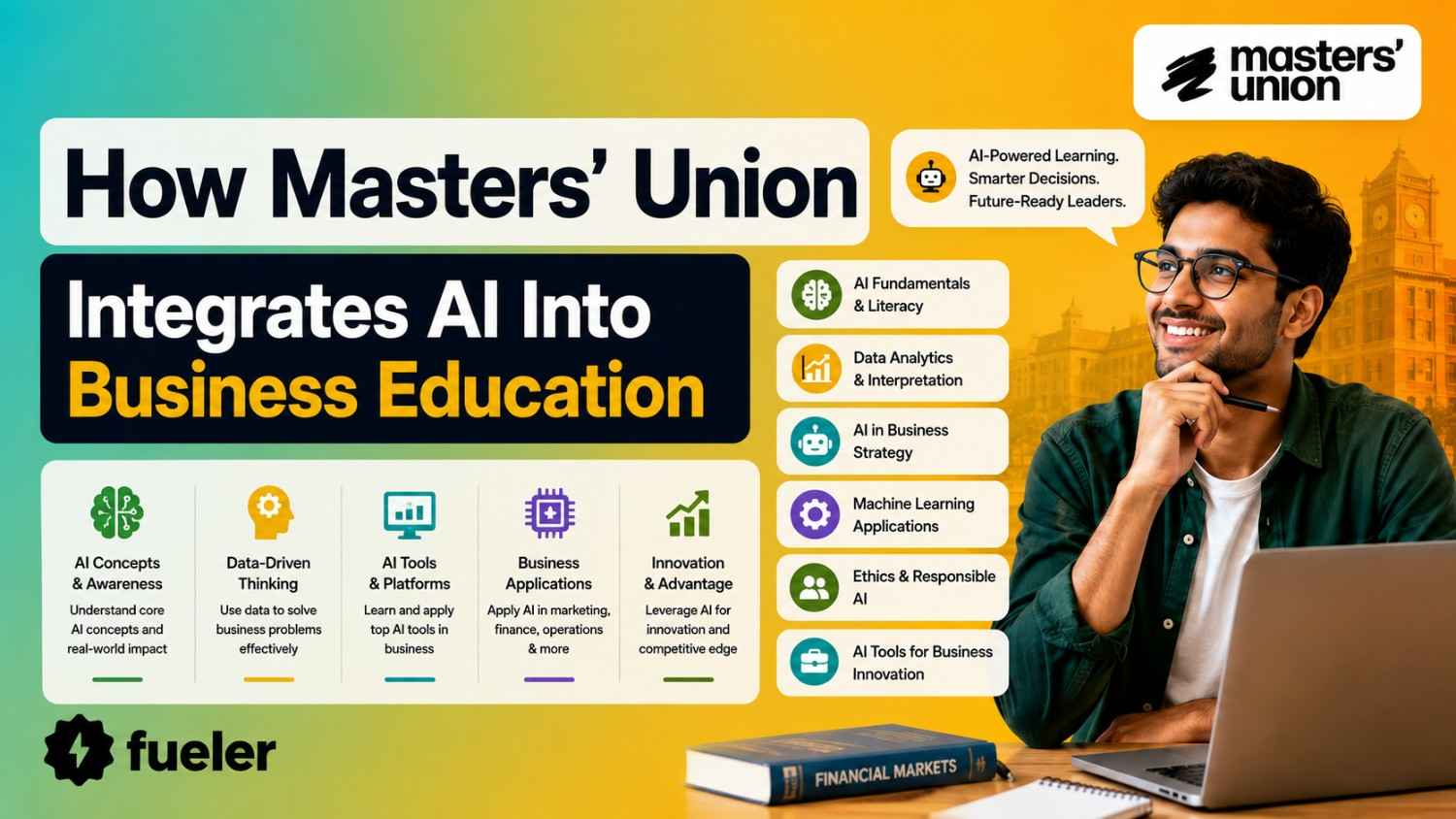
That is why seeing how Masters' Union integrates AI into business education warrants a serious look. Instead of treating Artificial Intelligence as an elective CS subject, Masters' Union integrates generative AI, custom learning engines, agentic workflows, and machine learning models directly into the core operating system of their business curriculum.

Quick Answer Summary
- Who It Is For: Aspiring tech founders, Product Managers, Chiefs of Staff, Growth Marketers, and operators who need high-speed execution capabilities.
- Cost: Integrated directly into standard PGP, UG, and Executive track fees (ranging from ₹20 Lakhs to ₹30+ Lakhs depending on the specific program).
- Key Takeaway: Students move from passive consumers of theoretical business frameworks to high-speed builders who use AI to build MVPs, run automated go-to-market experiments, and audit financial models in minutes.
- Best Suited For: Early professionals and students who prefer building a real-world proof-of-work portfolio over earning a traditional, theory-heavy degree.
What is Masters' Union AI Integration in Business Education?
The integration of AI at Masters' Union refers to the deliberate embedding of artificial intelligence platforms, machine learning concepts, and agentic automation into business learning. Instead of forbidding generative tools or treating them as a shortcut for writing essays, the institution mandates their usage as operational leverage.
At its core, this approach treats AI not merely as a tech topic, but as a fundamental core infrastructure much like financial literacy or excel modeling. Students learn how to prompt, fine-tune, build Retrieval-Augmented Generation (RAG) pipelines, automate business workflows, and analyze complex datasets using native AI tools.
Why does this matter? In modern tech ecosystems across Gurgaon, Bangalore, or global tech hubs, employers no longer care if you can summarize a business case by hand. They want to know if you can deploy AI agents to scrape leads, build a no-code MVP over a weekend, or handle automated customer acquisition. At Fueler, we see this shift every single day: companies hire candidates who showcase real proof of work built using modern workflows rather than candidate credentials written on a two-page CV.
Key Facts Table
Detailed Explanation of AI Integration Across the Curriculum
1. The MU AI Personal Learning & Case-Evaluation Engine
Masters' Union deploys an institutional learning engine (MU AI) that acts as an omnipresent academic and strategic coach. Traditional business education suffers from a slow feedback loop: you submit an assignment or financial case, and a professor grades it weeks later.
Through the MU AI engine, students participate in real-time "Case Wars" and strategic simulations. The engine evaluates business logic, stress-tests financial assumptions, identifies flaws in unit economics, and delivers instant, adaptive feedback. This continuous loop lets students iterate rapidly, accelerating their understanding of business strategy.
2. AI-Driven Startup Acceleration (The VIP Track)
During the Venture Initiation Programme (VIP), student teams build and launch live businesses. AI tools are deeply integrated into this building phase:
- Rapid Prototyping: Students use AI-assisted code generators, no-code frameworks, and LLM orchestration tools to build functional product versions in days instead of months.
- Automated Growth Experiments: Teams deploy autonomous marketing pipelines to create content, run ad copy variations, personalize outbound sales, and track user acquisition metrics.
- Cost & Unit Economics Optimization: Students model token consumption costs, API infrastructure overhead, and subscription pricing strategies to maintain healthy unit economics.
This setup shifts the focus from slow manual execution to rapid testing, validation, and iteration.
3. Specialized Applied AI & Agentic Systems Curricula
Beyond using AI as a productivity tool, Masters' Union runs specialized programs such as the PGP in Applied AI & Agentic Systems and Executive PGP in AI Product Leadership. These programs focus on the technical and operational mechanics of modern software architecture:
- RAG & Fine-Tuning: Understanding how to ground language models in proprietary business data to eliminate hallucinations.
- Autonomous Agent Workflows: Designing autonomous multi-agent systems that execute complex business tasks (e.g., automated customer support, automated lead qualification, research collection).
- Build vs. Buy Frameworks: Training business operators to evaluate when an enterprise should build custom AI models versus licensing third-party APIs.
4. Practitioner-Led Industry Mentorship
Rather than relying purely on academic lectures, AI modules are delivered directly by active practitioners including CTOs, AI product leads, and founders from companies like Microsoft, Google, and emerging AI startups.
Students are taught the operational reality of running AI systems in production: handling model drift, managing cloud API costs, maintaining data privacy, and implementing human-in-the-loop (HITL) safety checks.
How It Works: Step-by-Step
[Personalized AI Coaching] ➔ [AI-Assisted Idea Validation] ➔ [Rapid MVP & Agent Build] ➔ [GTM Automation] ➔ [Real-Time Evaluation]
- Adaptive Concept Mastery: Students use 24/7 AI learning partners to break down business theories, financial formulas, and technical concepts at their own pace.
- AI-Assisted Market Research: Using LLMs and data scrapers, students analyze industry trends, competitor positioning, and customer sentiment within hours.
- Product Prototyping: Teams leverage generative design, no-code builders, and API integrations to build functional software or digital storefronts.
- Automated Go-To-Market Execution: AI-driven tools manage content engines, customer segmentation, performance marketing copy, and direct sales reach-outs.
- Real-Time Performance Auditing: The institutional AI engine stress-tests conversion rates, margin calculations, and strategic decisions, offering immediate feedback for improvement.
Practical Benefits
- 10x Execution Speed: Students can validate ideas, launch landing pages, generate marketing copy, and test user flows in a fraction of the time required by traditional methods.
- Verified Proof-of-Work: Graduates leave with live projects, GitHub repositories, AI agents, and documented case solutions. Platforms like Fueler allow builders to feature these verified assets directly, making them stand out to tech employers.
- Operational AI Literacy: Students learn how to evaluate token economics, API costs, and data pipeline skills essential for modern Product Managers and operators.
- Continuous Feedback: The friction of waiting for assignment grading is replaced by instant AI-driven evaluations, accelerating the learning curve.
Challenges and Limitations
- High Pacing and Technical Intensity: Students who prefer traditional lecture structures or struggle with tech integration may find the rapid adoption of AI workflows overwhelming.
- Risk of Over-Reliance: Relying on generative tools without understanding underlying business principles can lead to superficial strategy. Students must learn to critique AI outputs critically.
- Fast-Evolving Tooling: AI frameworks evolve constantly; workflows learned in one term may be updated or superseded by new models in short periods later.
Comparison: Masters' Union AI Model vs. Traditional Business Programs
Fees and Financial Considerations
- Standard PGP / UG Tuition: Fees range between ₹20 Lakhs and ₹30+ Lakhs (excluding tax and residential costs), depending on whether you join the 16-month PGP TBM, 24-month Young Leaders Cohort, or UG programs.
- Included AI Infrastructure: Access to institutional AI models, sandbox tools, and computing environments is integrated into the core program costs.
- Funding & Fellowship Opportunities: The Founders' Fellowship provides financial stipends (up to ₹40,000–₹50,000 per month) for selected student founders building viable tech ventures.
Career Opportunities and Roles
Graduates trained in this high-execution environment target high-growth roles across the tech and startup landscape:
- AI Product Manager: Defining specs for AI-driven products, evaluating model trade-offs, managing RAG implementations, and guiding engineering sprints.
- Chief of Staff / Founder's Office: Leveraging automated agent workflows and data analysis tools to execute multi-department strategic priorities for startup CEOs.
- AI Operations Lead: Optimizing business processes by designing autonomous workflows, selecting tech stacks, and reducing manual operational overhead.
- Growth & Performance Marketer: Running automated multivariate campaign tests, optimizing ad spend using predictive algorithms, and scaling user acquisition.
Who Should Choose This?
- Aspiring founders who want to build tech products rapidly using AI leverage and modern development tools.
- Product managers and tech operators looking to master agentic systems, LLM architectures, and AI product execution.
- Action-oriented learners who want to build a tangible portfolio of work rather than complete written exams.
Who Should Avoid This?
- Students seeking a traditional academic setting focused on theoretical literature, exams, and conventional lectures.
- Individuals who prefer low-tech corporate paths where generative tools and rapid prototyping are not utilized.
- Learners who struggle with constant technology adoption, high ambiguity, and rapid execution cycles.
Final Thoughts
Business execution has fundamentally changed. The bottleneck is no longer how fast you can write a document or analyze a spreadsheet by hand; it is how effectively you can use modern AI tools, automate complex workflows, and test real-world ideas.
The way Masters' Union embeds AI directly into business education reflects where industry is actually heading. By removing the friction between business theory and technical execution, it prepares students to operate as high-leverage builders. Whether you end up launching your own tech startup or joining an executive team, your ability to show verified, real-world projects built, shipped, and documented on platforms like Fueler is what truly opens doors in today's digital economy.
Key Takeaways
- AI is embedded across the curriculum as essential infrastructure rather than an isolated subject.
- Custom platforms like MU AI provide instant 24/7 coaching, case evaluation, and mentorship.
- Students use AI agents, RAG, and no-code tools to build functional MVPs during startup sprints.
- Courses are led directly by industry practitioners, CTOs, and active tech leaders.
- Graduates build a portfolio of shipped projects, automated workflows, and validated tech achievements.

FAQs
How does Masters' Union use AI in its daily teaching?
Masters' Union uses an AI learning engine (MU AI) that provides 24/7 personalized coaching, instant case-study evaluation, and real-time feedback on business assignments to help students learn faster.
Do I need a computer science background to join AI programs?
No prior coding background is required for business tracks. Programs teach students to use no-code frameworks, AI agents, and low-code APIs to build functional tech products from scratch.
What AI tools do students learn to build with?
Students work with LLM APIs, autonomous agent frameworks, Retrieval-Augmented Generation (RAG) tools, no-code software builders, and automated growth marketing platforms.
How does AI integration help with job placements?
By building real-world AI projects, functional prototypes, and automated workflows, students create a proof-of-work portfolio that clearly demonstrates practical skills to tech employers.
Is AI replacing traditional business subjects like finance and marketing?
AI does not replace foundational business subjects; instead, it supercharges them. Students apply AI to automate financial modeling, run targeted marketing campaigns, and analyze market data in real time.
Why 100,000+ professionals use Fueler
Fueler helps professionals showcase proof of work through projects, assignments, case studies, and achievements.
- Thousands of professionals use Fueler to create their digital portfolio
- Thousands of projects are published on Fueler. Check here
- Startups and Companies hire through proof of work on Fueler
- Used by freelancers, creators, marketers, video editors, writers, designers, and product managers
Our mission is to help the next 100 million professionals build a verified professional identity through proof of work

What should you do next?
You've read the article. Now turn your skills into proof of work and unlock more opportunities.
Build your proof of work portfolio
Create a clean portfolio with projects, assignments, resumes, and AI stack details that companies actually want to see.
Create your Fueler portfolio →Apply through assignments, not resumes
Stand out by solving real tasks from companies hiring on Fueler.
Explore assignments →Get discovered by companies
Make your work public and let recruiters discover your skills through actual projects instead of keywords.
Get discovered →
