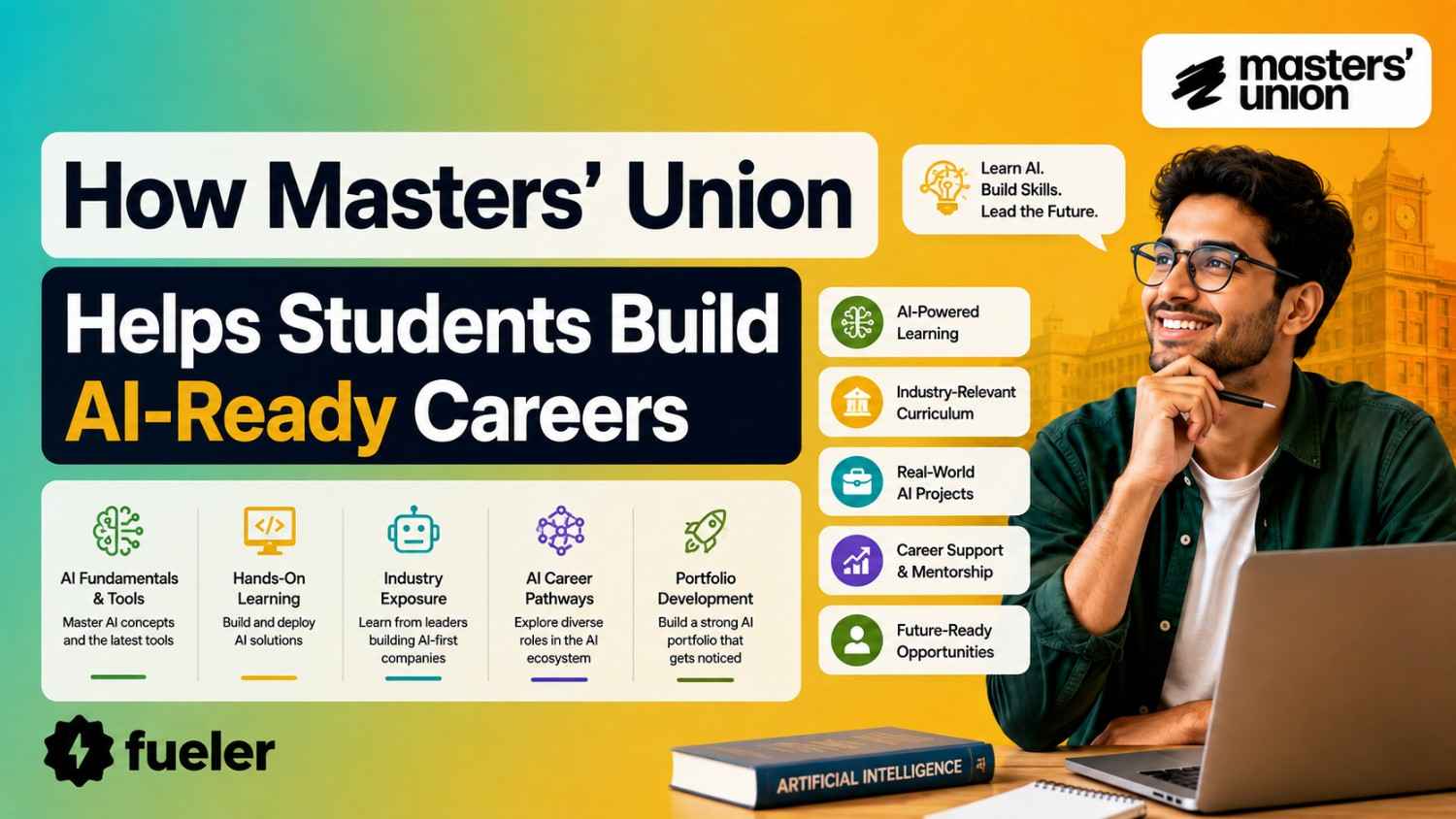
How Masters' Union Helps Students Build AI-Ready Careers

Riten Debnath
19 Aug, 2026
Last updated: August 2026
A candidate sitting across from an interview panel in Bangalore holds a master's degree from a top-tier Indian university. They can explain the theoretical architecture of a transformer model on a whiteboard with impressive mathematical precision. But when handed a laptop and a live business dilemma"Build a working agentic workflow that extracts data from 500 unstructured PDF invoices, verifies supplier TAX IDs, and flags anomalies into a PostgreSQL database by end of day"the candidate freezes.
The theoretical knowledge is immaculate. The operational capability is zero.
This execution gap is precisely why traditional higher education is undergoing a massive reckoning. While legacy business schools and engineering colleges spend months debating static multi-year strategy frameworks or written code algorithms, the tech ecosystem has shifted permanently toward AI-first execution.
I’m Riten, founder of Fueler, a skills-first portfolio platform building the career infrastructure for 100 million creative professionals. Fueler connects talented individuals with companies through assignments, portfolios, and projects, not just resumes or CVs. Think of it as Dribbble/Behance for work samples combined with AngelList for hiring infrastructure.
At Fueler, I spend every day looking at the data behind modern hiring dynamics. The verdict is absolute: recruiters in high-growth startups, venture-backed companies, and forward-thinking enterprises no longer care about legacy course certificates or bullet points on a PDF resume. They care about verified proof-of-work. They ask one question: "Show me what you have actually built."
Masters' Union has built its entire educational thesis around solving this exact disconnect. By completely replacing traditional academic lectures with practitioner-led training, live business incubations, micro-VC funds, and applied technology labs, the institution has constructed a blueprint for building AI-ready careers.
This deep dive breaks down the exact mechanics, tools, costs, and career pipelines Masters' Union uses to train students for the AI-driven economy.

Quick Answer Summary
- Who It Is For: Undergrads, working professionals, engineers, product managers, and founders aiming to operate at the intersection of business strategy and modern AI tech stacks.
- Cost Structure: Ranges between ₹18 Lakhs to ₹25 Lakhs (plus applicable taxes) depending on whether you enroll in specialized undergraduate or post-graduate tracks.
- Core Philosophy: Replaces static exams and theoretical lectures with live product builds, portfolio proof-of-work, and real capital deployment.
- Best Suited For: High-agency builders who want direct access to founders, product roles, and venture builder ecosystems rather than academic research degrees.
What is Masters' Union's Applied AI Approach?
To understand how Masters' Union prepares students for AI-centric roles, you must first look at the traditional higher education model. Most business and engineering programs operate on a delay. A curriculum is written, approved by an academic senate over two years, and taught by tenured professors who may not have built a production-level software application or managed a live corporate P&L in over a decade.
Masters' Union operates on an industry-integrated model. Located in Gurugram, the corporate and startup nerve center of North India, the institution functions less like a quiet university campus and more like a high-intensity startup incubator combined with a business operating unit.
Instead of reading 20-year-old case studies on legacy corporations, students build applied tools from day one. The curriculum treats Artificial Intelligence not as a distant computer science topic or an isolated academic elective, but as the foundational infrastructure of modern business operations.
Context matters here. The modern economy does not just need pure machine learning researchers who write mathematical papers; it desperately needs Applied AI Operators. These are professionals who understand business logic, consumer psychology, unit economics, and know how to stitch together Large Language Models (LLMs), vector databases, custom APIs, and agentic workflows to solve real-world business bottlenecks. Masters' Union explicitly engineers its programs to produce this specific class of builder.
Key Facts Table
Detailed Explanation
The transformation of a student into an AI-ready operator at Masters' Union relies on four core structural pillars. Each pillar addresses a specific failure point of traditional higher education.
Pillar 1: Practitioner-Led Instruction Over Tenured Academics
Theoretical knowledge loses value quickly in a domain where software frameworks update monthly. Masters' Union bypasses tenured academic faculty for its core technology and business tracks.
Instead, classes are taught by active operators, CTOs from unicorn startups, Senior Product Managers from global tech giants, and active venture capitalists. When a student learns about setting up a Retrieval-Augmented Generation (RAG) pipeline or evaluating unit economics for a SaaS tool, they are taught by someone who implemented that exact pipeline or evaluated those exact financials earlier that week in their primary job.
This ensures that the skills being transferred reflect real-world engineering constraints, current compliance standards, and immediate commercial viability rather than outdated textbook theories.
Pillar 2: Deep Integration of the Modern AI Engineering Stack
Building an AI-ready career requires moving far beyond basic prompt engineering or using web chatbots. Masters' Union integrates the full software engineering and applied AI stack directly into its learning modules.
Students are trained on:
- Data Foundations: Extracting, cleaning, and querying relational data using Python and SQL.
- Model Integration: Connecting directly to model APIs (OpenAI, Anthropic, open-source Hugging Face models) via custom scripts and webhooks.
- Vector Architectures: Indexing unstructured text, PDFs, and media into vector databases to build fast, accurate search engines.
- Agentic Workflows: Constructing autonomous multi-agent systems using frameworks like LangChain or AutoGen, allowing AI systems to execute sequential multi-step tasks without constant human prompting.
Pillar 3: Experiential Business Incubations and Real-Money Capital
You cannot learn business operations or product management solely from a slide deck. Masters' Union embeds live business challenges directly into the academic calendar.
For example, students participate in the Drop-shipping Challenge, where they receive real capital to build an e-commerce store, design products, run digital ad campaigns, and manage customer acquisition costs (CAC) to generate real revenue within weeks.
In the AI era, this challenge is elevated: students utilize Generative AI tools to instantly produce ad copy, generate synthetic product photography, automate customer service routing, and run automated inventory forecasting models. The test of student capability is not a written exam score; it is a live P&L statement showing net margin.
Pillar 4: Proof-of-Work Portfolios as the Primary Resume
The biggest barrier facing fresh graduates and career switchers in tech is the "experience paradox": you need experience to get hired, but you need a job to get experience. Masters' Union resolves this by shifting the entire evaluation model from grades to public portfolios.
Every term requires students to ship real, functional builds. Whether it is an automated financial research agent, a custom customer support bot, or an internal knowledge base tool, student projects are deployed live.
At Fueler, we see firsthand how this shift transforms hiring outcomes. When a candidate presents a clean, live link showcasing three fully functional software applications, complete with documented GitHub code, API documentation, and user analytics, the hiring decision changes completely. The recruiter does not need to guess if the candidate can do the work the proof is right in front of them.
How It Works
The journey a student takes to become an AI-ready operator at Masters' Union follows a clear execution lifecycle:
- Foundational Bootcamp: Mastering core programming logic, software workflows, SQL data pulling, and business economics basics.
- Applied Skill Labs: Intensive technical sprints where students build specific sub-systems such as fine-tuning an open-source model or wiring up vector stores.
- Out-of-Classroom Challenges: Executing real business sprints (e.g., Creator Sprints, E-Commerce Drop-shipping, Student VC Investment Memos) using AI automation tools to compress turnaround time.
- Industry Immersion & Mentorship: Direct 1-on-1 feedback sessions with startup leaders, product heads, and engineering directors who review student software builds line-by-line.
- Portfolio Deployment & Graduation: Hosting production-ready applications online, documenting build processes, and presenting proof-of-work directly to hiring managers during placement drives.
Practical Benefits
Graduating with an applied, AI-focused business education provides measurable career advantages over traditional academic models:
- Instant Operational Value: You land on day one in a startup or corporate tech role knowing how to deploy automation tools, reducing the usual 6-month onboarding ramp.
- Versatile Technical Capability: By mastering low-code automation tools alongside Python and APIs, non-engineers can prototype working software without waiting for an engineering team.
- High-Impact Network Access: Direct proximity to founders, active product managers, and venture capitalists in Gurugram builds a high-density professional network before graduation.
- Public Execution Credibility: Leaving with a public portfolio of live projects gives candidates massive leverage during salary negotiations and role placement.
Challenges and Limitations
It is critical to evaluate the program with absolute objectivity. An applied, high-intensity model comes with trade-offs:
- High Cognitive Load and Burnout Risk: The sheer speed of sprints, live business builds, and continuous weekend classes requires high stamina and strong self-regulation.
- Not Suited for Pure Academic Research: If your primary career ambition is to complete a Ph.D., write peer-reviewed mathematical papers on deep learning theory, or build foundational neural network math from scratch, traditional research universities offer better aligned infrastructure.
- Rapid Tool Obsolescence: Because the course focuses on cutting-edge software and API tools, specific frameworks learned in term one may become obsolete by term four. Students must cultivate a mindset of continuous unlearning and relearning.
- Requires High Personal Agency: Students who expect passive lectures, rigid hand-holding, or straightforward step-by-step instructions often struggle in an environment built on ambiguity, live execution, and iterative problem-solving.
Comparison Table
Here is how the Masters' Union operational model compares against traditional MBA/M.Tech programs and self-paced online certifications:
Fees, Financials, and ROI
Education must be evaluated as an investment that yields a clear financial return.
The tuition fees for flagship post-graduate and specialized technology management programs at Masters' Union generally range between ₹18 Lakhs and ₹25 Lakhs (plus applicable GST), depending on the specific track, duration, and residential selections.
When evaluating return on investment (ROI), consider the following levers:
- Salary Upside: Graduates targeting roles like AI Product Manager, Growth Lead, Founder's Office, or Applied AI Specialist command premium starting packages compared to traditional general management freshers.
- Time-to-Market Acceleration: The intensive, project-driven timelines compress years of trial-and-error learning into months.
- Capital Efficiency for Founders: For student entrepreneurs, learning to launch products using low-code tools and AI automation drastically reduces the seed capital required to launch an initial MVP.
Career Opportunities & Roles
The demand for professionals who can marry business execution with technical AI capability spans multiple fast-growing industry verticals:
- AI Product Manager: Owning the end-to-end lifecycle of AI-native products, setting feature roadmaps, managing API integrations, and tracking user metrics.
- Chief of Staff / Founder’s Office: Operating directly alongside startup CEOs to automate internal operations, build cross-department workflows, and execute strategic projects rapidly.
- Applied AI Engineer: Designing RAG architectures, configuring vector search databases, and wiring autonomous agents into existing enterprise software stacks.
- Growth Marketing & Automation Lead: Building programmatic content engines, automated lead-generation funnels, and dynamic ad campaigns using generative AI stacks.
- Venture Builder / Founder: Launching AI-first SaaS tools, micro-products, or agency models using lightweight, automated operational structures.
Who Should Choose This?
- Product Managers & Software Engineers: Professionals who want to lead AI-native teams and transition from writing isolated features to managing entire intelligent systems.
- Ambitious Startup Founders: Individuals who want to build, test, and deploy software products rapidly without burning massive amounts of capital on engineering bloat.
- High-Agency Graduates: Freshers or early-career professionals who thrive in ambiguous, fast-moving environments and prefer hands-on building over theoretical exam taking.
- Career Changers: Professionals working in traditional industries (consulting, finance, operations) who need a structured, high-intensity environment to pivot into modern tech hubs.
Who Should Avoid This?
- Theoretical Researchers: Anyone looking to pursue deep mathematical proofs, fundamental algorithm research, or academic publishing careers in computer science.
- Passive Learners: Individuals who prefer predictable, structured academic environments where grades are determined solely by memorizing slides and sitting for end-of-semester written exams.
- Low-Stamina Operators: Anyone uncomfortable with tight deadlines, continuous public building, iterative product reviews, and rapid software changes.
Final Thoughts
The era of relying on static degrees to guarantee a tech career is officially over. As AI systems continue to automate routine tasks, writing code, drafting basic copy, or building simple spreadsheets are no longer defensible skills on their own.
The future belongs to the operators, the builders who understand how to orchestrate intelligent systems to solve real human and business problems. Masters' Union has engineered an educational environment that forces students to become those operators before they step into the job market.
Whether you choose to join an intensive cohort like Masters' Union or take the self-directed route, your strategy must remain the same: focus relentlessly on proof-of-work. Stop building resumes. Start shipping real products, publishing your build logs, and letting your portfolio speak for your capabilities.
Key Takeaways
- Proof-of-Work Over Resumes: Recruiters in top tech firms evaluate candidates based on live, deployed projects rather than static degree certificates.
- Practitioner-Led Learning: Learning directly from active CTOs, founders, and product heads ensures your skills match real-world industry demands.
- Full-Stack AI Capability: Mastering the pipeline from data management to APIs, vector databases, and agentic workflows provides a massive operational edge.
- Experiential Incubations: Live business challenges like drop-shipping sprints teach unit economics and customer acquisition far better than textbook case studies.
- Continuous Portfolio Building: Publishing functional builds on platforms like Fueler creates a public, verified track record that attracts top-tier hiring managers organically.

FAQs
How does Masters' Union teach AI to non-engineers?
Masters' Union uses practical, applied learning tracks combining Python basics, API integrations, and low-code AI automation tools. This allows non-technical business students to build functional AI applications without needing years of pure computer science theory.
What is the role of proof-of-work in Masters' Union placements?
Instead of submitting standard resumes, students showcase live software builds, RAG pipelines, and deployed applications. Hiring managers evaluate these public project portfolios directly to verify operational skills before conducting interviews.
Who teaches the AI and tech modules at Masters' Union?
Courses are taught by active industry practitioners including CTOs, senior product leads, AI engineers, and startup founders from leading tech companies rather than traditional full-time academic professors.
What tools and technical frameworks do students learn?
Students work with Python, SQL, OpenAI/Anthropic APIs, LangChain, vector databases (like Pinecone), automation tools (Zapier/Make), and modern no-code platforms to build end-to-end applications.
Are students required to build real business projects during the course?
Yes. Students participate in live execution challenges including launching drop-shipping stores, running creator campaigns, writing VC investment memos, and deploying live production-ready AI agents.
Why 100,000+ professionals use Fueler
Fueler helps professionals showcase proof of work through projects, assignments, case studies, and achievements.
- Thousands of professionals use Fueler to create their digital portfolio
- Thousands of projects are published on Fueler. Check here
- Startups and Companies hire through proof of work on Fueler
- Used by freelancers, creators, marketers, video editors, writers, designers, and product managers
Our mission is to help the next 100 million professionals build a verified professional identity through proof of work

What should you do next?
You've read the article. Now turn your skills into proof of work and unlock more opportunities.
Build your proof of work portfolio
Create a clean portfolio with projects, assignments, resumes, and AI stack details that companies actually want to see.
Create your Fueler portfolio →Apply through assignments, not resumes
Stand out by solving real tasks from companies hiring on Fueler.
Explore assignments →Get discovered by companies
Make your work public and let recruiters discover your skills through actual projects instead of keywords.
Get discovered →
