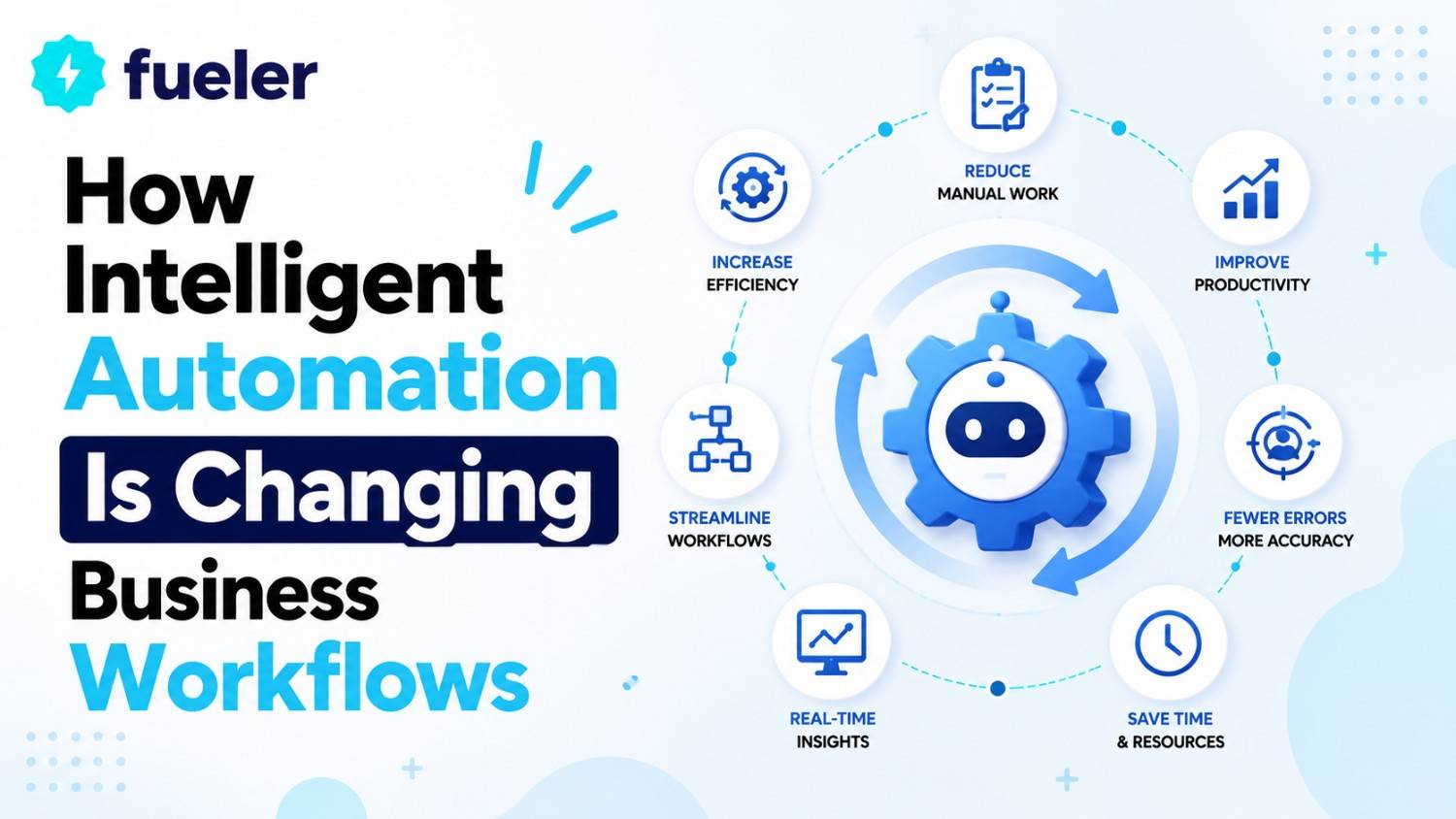
How Intelligent Automation Is Changing Business Workflows

Riten Debnath
08 Jul, 2026
Last updated: July 2026
The era of setting up static software rules to manage daily business tasks is officially dead. In 2026, relying on basic conditional logic to run your operations is the fastest way to get outpaced by competitors who use systems that learn, adapt, and make decisions independently.
I’m Riten, founder of Fueler, a skills-first portfolio platform that connects talented individuals with companies through assignments, portfolios, and projects, not just resumes/CVs. Think Dribbble/Behance for work samples + AngelList for hiring infrastructure.
Every day, I watch teams bury themselves under repetitive click-work, missing the shift toward autonomous operations. Intelligent automation combines machine learning, advanced AI models, and process orchestration to rewrite how businesses function.
In this article, you will discover the strategic shifts happening across modern industries and how these cognitive workflows deliver unprecedented operational leverage and practical growth.
1. Hyper-Automated Customer Support Ecosystems
Standard customer service bots used to frustrate users with generic scripted answers that rarely solved real issues. Modern intelligent automation interprets customer sentiment, analyzes historical account contexts, and resolves complex multi-step inquiries entirely on its own. This structural evolution shifts customer support workflows from basic triage into an instantaneous resolution engine.
- Cognitive sentiment analysis allows automated systems to detect user frustration levels in real-time, instantly escalating high-risk accounts to specialized human agents before a minor service dispute turns into a costly customer churn event.
- Dynamic context stitching aggregates past interactions across email, chat, and phone channels simultaneously, giving the automation a unified history to resolve account billing issues without forcing customers to repeat their problems.
- Automated multi-language translation enables support frameworks to localize complex technical answers across dozen different languages instantly, removing the need to hire massive, geographically disparate regional agent teams.
- Deep knowledge-base synthesis allows AI systems to scan thousands of pages of internal product documentation in milliseconds, generating hyper-accurate, contextual responses to highly specific user queries without human intervention.
- Proactive issue mitigation workflows analyze application error logs to detect user glitches early, triggering automated apology emails with pre-applied account credits before the customer even files a formal complaint ticket.
Why It Matters
If your core customer operations rely on manual sorting, your customer acquisition cost will scale linearly with your user base. Turning support into an autonomous asset keeps your overhead flat while boosting customer retention.
2. Dynamic Predictive Inventory and Supply Chain Management
Supply chains have traditionally operated on static historical sales data, causing massive stockouts or capital-wasting oversupplies. Intelligent workflows continuously parse live market trends, real-time weather changes, and geopolitical updates to forecast exact product demands. This predictive shift optimizes logistics pipelines and maximizes corporate capital efficiency.
- Multi-variable demand forecasting utilizes live macroeconomic indices to predict exact inventory needs, preventing warehouse overstocking and minimizing dead capital locked up in unsold physical merchandise.
- Autonomous supplier rerouting automatically shifts material orders to alternative global logistics providers the moment real-time shipping data indicates severe port congestion or unexpected geopolitical freight disruptions along primary transport lanes.
- Dynamic warehouse allocation tracking optimizes physical storage layouts by predicting fast-moving product trends, placing high-demand items closer to shipping bays to cut down packing times significantly.
- Automated shelf-life monitoring systems continuously adjust pricing strategies for perishable goods based on expiration proximity, optimizing profit margins through algorithmic discount triggers before products degrade.
- Predictive machine maintenance schedules automate service technicians before critical warehouse conveyor belts break down, utilizing acoustic sensor logs to avoid costly operational halts during peak order fulfillment quarters.
Why It Matters
Modern supply chains cannot survive on gut feelings or basic spreadsheets. Transitioning to predictive orchestration ensures your cash remains liquid and your products are exactly where your buyers want them.
3. Autonomous Financial Reconciliation and Fraud Mitigation
Manual invoice matching and ledger reconciliation consume thousands of hours in accounting departments, introducing human data entry errors. Intelligent automation cross-references invoices, bank statements, and purchase orders instantly while analyzing transaction abnormalities. This creates an airtight financial workflow that operates continuously without human oversight.
- Algorithmic invoice matching extracts unstructured text from billing documents using optical character recognition, automatically verifying line items against open purchase orders to approve corporate payments instantly.
- Real-time anomaly detection flags suspicious transactions across global corporate accounts by analyzing microscopic variations in velocity, location data, and spending behavior that bypass standard rules.
- Automated tax compliance routing updates regional financial ledgers instantly according to shifting international tax regulations, protecting expanding businesses from expensive corporate compliance penalties.
- Instant cross-border settlement systems manage treasury functions by analyzing live currency exchange fluctuations, automatically routing international transfers through the most cost-effective liquidity corridors.
- Self-healing ledger reconciliation identifies duplicate journal entries or missing transactions, automatically compiling discrepancies into structured digital logs for rapid internal accounting reviews.
Why It Matters
A business that waits until the end of the month to reconcile its books operates with delayed visibility. Automating the ledger cycle gives executive teams a real-time view of cash flow metrics to build a solid career portfolio of operational wins.
4. Cognitive Talent Acquisition and Candidate Screening
Recruiting teams often waste weeks sifting through hundreds of identical, buzzword-heavy resumes to find qualified candidates. Intelligent automation changes this by analyzing a candidate's actual projects, past performance metrics, and verifiable outputs. This algorithmic screening process surfaces high-quality talent rapidly while minimizing implicit human biases.
- Contextual work evaluation assesses applicants by examining their actual public code repositories, written copy, or marketing case studies, filtering out individuals who rely entirely on exaggerated resume keywords.
- Automated technical assessments design customized, role-specific coding challenges on the fly, evaluating not just the final functional output but the candidate's core problem-solving efficiency.
- Dynamic interview coordination engines interface directly with cross-functional calendar networks, automatically scheduling multiple candidate evaluation rounds without a single manual scheduling email back-and-forth.
- Algorithmic market compensation mapping analyzes live industry salary fluctuations across specific regions, helping HR teams generate competitive, data-backed job offers that retain top-tier specialists.
- Predictive retention modeling analyzes anonymized workplace satisfaction metrics and tenure trends to identify departments that are highly susceptible to sudden talent turnover in the coming quarters.
Why It Matters
Traditional paper credentials fail to predict actual on-the-job execution. Transitioning to skills-first screening allows companies to build high-velocity teams by observing verified portfolio examples instead of trusting static text claims.
5. Intelligent Content Optimization and Marketing Attribution
Most marketing teams guess which creative assets drive conversions, resulting in wasted ad spend and fragmented messaging. Intelligent automation tracks granular user touchpoints across complex multi-channel funnels, automatically optimizing ad copy variations in real-time. This ensures budget is continuously funneled into high-performing campaigns.
- Multi-touch marketing attribution calculates the precise revenue contribution of every digital interaction, giving growth teams accurate clarity on which channels drive actual bottom-line sales.
- Algorithmic ad variation testing generates and updates thousands of targeted copy variations simultaneously, shifting budget to high-performing graphics based on immediate click-through conversion data.
- Predictive audience segmenting clusters consumer behaviors into dynamic cohorts, sending hyper-targeted behavioral email sequences that maximize open rates without annoying the broader user base.
- Automated competitor tracking monitors shifts in rival pricing, search rankings, and ad spend strategy, alerting marketing leaders to adjust their positioning before losing market share.
- Dynamic pricing optimization recalculates product costs on e-commerce storefronts on the fly by evaluating live demand spikes, competitor stock levels, and user browsing history.
Why It Matters
Marketing without smart automation is just throwing money at the wall. Moving to data-driven orchestration allows you to understand exactly how to build your proof of work portfolio of successful user acquisition campaigns.
6. Self-Healing IT Operations and Network Security
Modern corporate networks produce millions of system log events per second, making manual security monitoring impossible. Intelligent workflows act as digital immune systems, automatically identifying anomalous patterns and isolating malicious actors. These systems resolve basic infrastructure crashes without requiring a midnight call to a DevOps engineer.
- Automated incident response detects network intrusion attempts instantly, automatically isolating compromised server clusters from the broader corporate intranet before a data breach can spread.
- Self-healing infrastructure loops trigger automated system restarts or server resource reallocations the moment an internal microservice displays critical memory leak behavior.
- Algorithmic patch management scans distributed software networks for newly discovered security vulnerabilities, automatically testing and deploying software updates across thousands of company endpoints simultaneously.
- Predictive storage throttling monitors database capacity thresholds, automatically archiving legacy data logs to cold storage pools to avoid system-wide operational database crashes.
- Continuous access auditing analyzes employee permission privileges against actual daily software usage patterns, flagging over-privileged user accounts to maintain a strict zero-trust security architecture.
Why It Matters
System downtime destroys company revenue and erodes client trust instantly. Transitioning to autonomous IT operations ensures your digital infrastructure remains online, secure, and operational around the clock.
7. Hyper-Personalized Enterprise Operations and Project Tracking
Project managers spend a third of their time manually updating task statuses and chasing team updates across communication channels. Intelligent automation bridges this gap by reading daily developer commits, document edits, and support updates. The system updates project timelines automatically, highlighting actual blockers before they cause delays.
- Autonomous status synthesis generates real-time project health dashboards by directly analyzing team code updates and document revisions, eliminating the need for daily status meetings.
- Predictive bottleneck spotting flags high-risk tasks that are likely to miss critical launch deadlines, allowing operational leaders to reallocate engineering resources proactively.
- Automated resource leveling monitors individual team member workloads across multiple product lines, automatically balancing incoming project assignments to prevent employee burnout.
- Intelligent meeting orchestration transcribes internal strategy discussions, automatically extracting clear action items and assigning tasks to relevant team stakeholders inside project management databases.
- Cross-department operational syncs update adjacent marketing and sales pipelines the moment product development teams mark an engineering milestone as officially complete.
Why It Matters
When project tracking is manual, your visibility is always historical. Automating operational workflows transforms your internal systems into a single source of truth that reflects your actual proof of work in real-time.
8. Automated Legal Document Analysis and Contract Compliance
Reviewing complex legal contracts manually causes major operational bottlenecks, slowing down enterprise sales cycles and procurement pipelines. Intelligent automation parses multi-page legal documents in seconds, flagging non-standard clauses, hidden operational liabilities, and compliance deviations. This keeps corporate legal operations moving at peak velocity.
- Semantic clause extraction scans massive vendor agreements to isolate specific indemnification terms, automatically comparing them against standard corporate legal risk guidelines.
- Automated obligation tracking reads finalized enterprise contracts to create automated calendar alerts for critical renewal dates, pricing adjustment milestones, and regulatory deliverables.
- Algorithmic regulatory cross-referencing checks internal corporate operational policies against shifting global compliance mandates, flagging potential violations inside contracts before execution.
- Instant document generation compiles customized, legally compliant sales agreements by pulling approved terms directly from a centralized, pre-verified legal repository.
- Digital signature trail auditing maintains an unalterable log of contract versions, ensuring absolute visibility into exactly when and by whom specific clauses were edited.
Why It Matters
Legal reviews shouldn't be the place where profitable enterprise deals go to die. Integrating cognitive document analysis removes contract friction, speeding up your sales velocity while protecting your business borders.
How Does This Connect to Building a Strong Career or Portfolio?
In an era dominated by cognitive systems, simply listing standard job descriptions on a piece of paper is a career dead-end. Companies want to see the specific systems you have built, operated, or optimized. Documenting how you implemented intelligent automation to cut operational costs or speed up team delivery forms the ultimate foundation for your professional credibility. Showcasing these metrics on Fueler lets you display concrete evidence of your skills, making your career growth entirely dependent on real business outcomes rather than corporate resume buzzwords. Understanding what proof of work is allows you to turn abstract technical projects into undeniable hiring magnets.
Final Thoughts
Intelligent automation is no longer a luxury for tech giants; it is the fundamental operating system for businesses navigating 2026. True competitive advantage belongs to the operators who know how to weave machine intelligence directly into the fabric of their daily workflows. As workflows become increasingly autonomous, the value of human execution shifts from performing repetitive tasks to designing and auditing cognitive systems. Focus on building resilient, self-healing pipelines, optimize for absolute data transparency, and ensure your organizational workflows are built to scale alongside autonomous technology.
FAQ
What is the difference between basic robotic process automation and intelligent automation?
Basic robotic process automation relies strictly on rigid, pre-defined rules to execute repetitive tasks. Intelligent automation integrates machine learning and advanced data models, allowing the system to interpret context, handle unexpected exceptions, and make complex decisions independently.
How does intelligent automation affect daily employee workflows?
It removes administrative overhead and repetitive data entry tasks from an employee's schedule. This shifts the team's daily focus toward strategic oversight, system design, creative problem-solving, and managing complex exceptions that require human judgment.
Can small businesses afford to implement intelligent automation workflows?
Yes, because modern automation frameworks are built on modular API models and low-code orchestration layers. This accessibility allows smaller companies to implement cognitive workflows incrementally without investing in massive custom internal software infrastructure.
How do autonomous workflows prevent data security vulnerabilities?
They eliminate human access errors by utilizing automated token systems, monitoring database traffic continuously for anomalous patterns, isolating suspicious network activities instantly, and running algorithmic access audits to enforce strict zero-trust security standards across systems.
What are the first steps to automate a manual business workflow?
Start by mapping out your highest-frequency, most time-consuming internal processes. Identify the specific data inputs required, clean the underlying data streams, and use a modular system architecture to automate individual components before scaling into full end-to-end autonomous loops.
Why 100,000+ professionals use Fueler
Fueler helps professionals showcase proof of work through projects, assignments, case studies, and achievements.
- Thousands of professionals use Fueler to create their digital portfolio
- Thousands of projects are published on Fueler. Check here
- Startups and Companies hire through proof of work on Fueler
- Used by freelancers, creators, marketers, video editors, writers, designers, and product managers
Our mission is to help the next 100 million professionals build a verified professional identity through proof of work

What should you do next?
You've read the article. Now turn your skills into proof of work and unlock more opportunities.
Build your proof of work portfolio
Create a clean portfolio with projects, assignments, resumes, and AI stack details that companies actually want to see.
Create your Fueler portfolio →Apply through assignments, not resumes
Stand out by solving real tasks from companies hiring on Fueler.
Explore assignments →Get discovered by companies
Make your work public and let recruiters discover your skills through actual projects instead of keywords.
Get discovered →
