What Is a Career Portfolio? Complete Guide for 2026

Riten Debnath
02 Apr, 2026
I am Riten, founder of Fueler. I built Fueler because I watched a painful pattern repeat itself over and over. Talented people were being rejected not because they lacked skill, but because they had no way to prove it. A resume is just words on a page. A career portfolio is proof that those words are true.
If you have ever wondered what a career portfolio is and whether you actually need one, this guide will answer every question you have. I will walk you through what it is, what goes inside it, when you need it, and how to build one that works.
What Is a Career Portfolio?
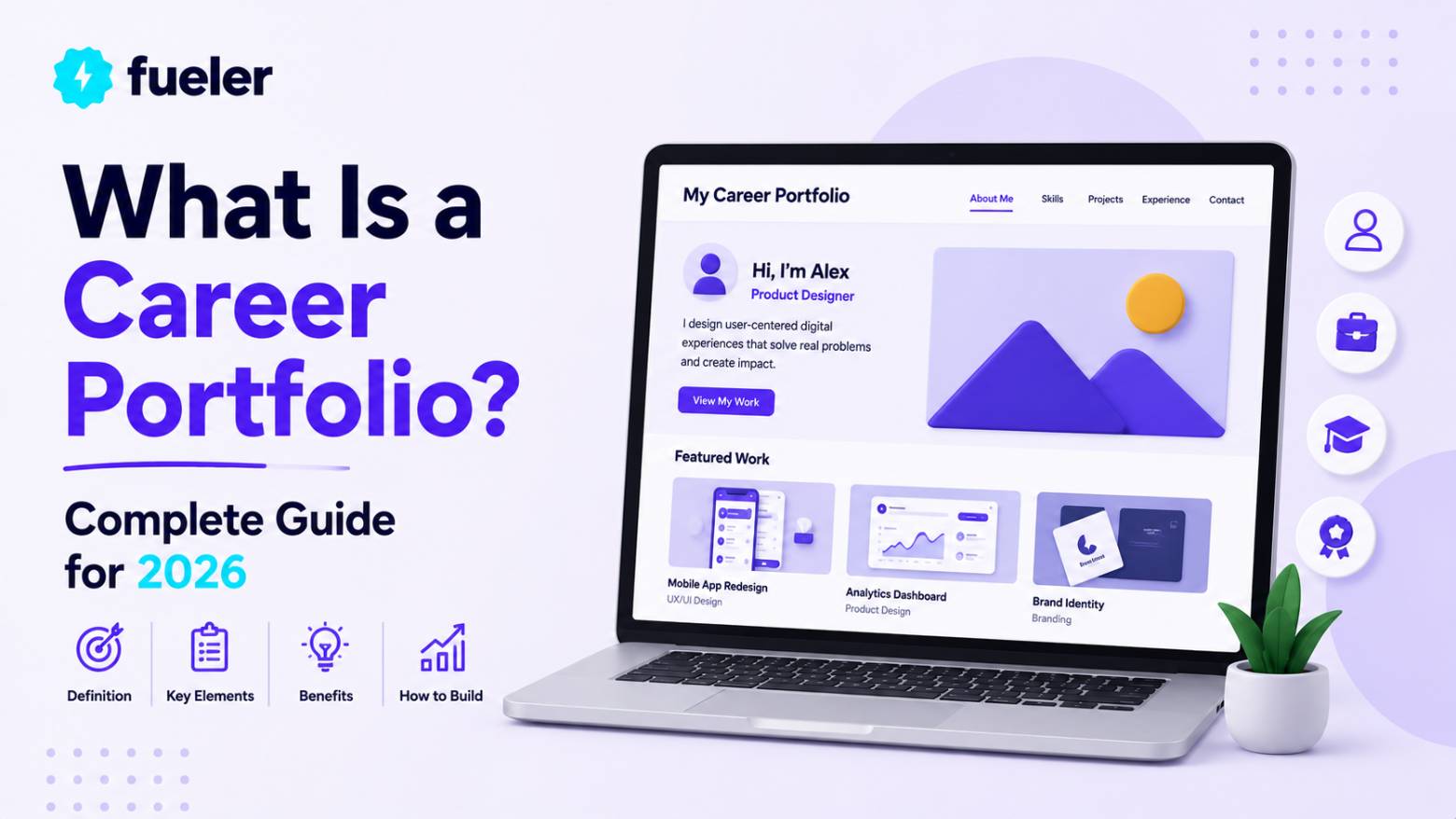
A career portfolio is a curated collection of your work, achievements, and skills that shows employers, clients, or collaborators what you can actually do. Think of it as your personal proof-of-work document. It is not just a resume with extra pages. It is real evidence of your capabilities.
According to career development research, a portfolio validates the claims you make about yourself in interviews and on your resume. It makes the intangible tangible. It gives employers something to see and evaluate, not just something to read and guess about.
A career portfolio can include completed projects, campaigns you ran, code you wrote, designs you created, articles you published, problems you solved, and the results each of those efforts produced. It is the difference between saying you are good at something and proving it.
Why a Career Portfolio Is Not the Same as a Resume
A resume tells your story. A career portfolio shows it. Your resume might say '3 years of experience in digital marketing.' Your career portfolio shows the actual campaigns, the exact strategies used, the numbers achieved, and the lessons learned along the way.
Recruiters can verify a portfolio in ways they cannot verify a resume. Anyone can write that they increased revenue. Not everyone can show the campaign, the approach, and the result. That is why portfolios build trust faster and more effectively than resumes ever can.
Think about it from the hiring manager's perspective. Two candidates apply for the same role. One sends a resume. The other sends a resume plus a link to a Fueler portfolio with eight documented projects and measurable results. Who gets the interview? Every time, it is the candidate with the portfolio.
What Should a Career Portfolio Include?
1. Personal Summary and Career Goals
Start with a short introduction about who you are, what you do, and where you are headed. Keep it under 150 words. Make it specific, not generic. Instead of saying 'I am a marketing professional,' say 'I help early-stage startups grow from zero to their first 10,000 users through content and SEO.'
2. Your Best Work Samples
Include 5 to 10 of your strongest projects. These should be relevant to the type of work you want to do next. If you are targeting a content marketing role, show your best content projects. If you are going for a product design role, show your most impactful design work. Do not include everything. Be selective. Quality always beats quantity in a portfolio.
3. Results and Achievements
Numbers matter more than almost anything else in a portfolio. Revenue generated, engagement rates, problems solved, time saved, users acquired, costs reduced. Quantify your work wherever possible. A project description without a result is just a task description. A project with a result is a proof-of-work entry.
4. Certifications and Education
Include your relevant educational background and professional certifications. Online courses from platforms like Coursera, edX, or LinkedIn Learning count too, as long as they are relevant to the work you want to do.
5. Testimonials and Recommendations
Social proof is powerful. Feedback from managers, clients, or collaborators who can speak to the quality of your work adds a layer of credibility that no amount of self-promotion can match. Even two or three strong testimonials can transform how your portfolio is perceived.
6. Contact Information and Links
Make it easy for anyone reading your portfolio to reach you. Include your email, your LinkedIn profile, and any other relevant platform links like GitHub or Behance. Remove all friction between someone discovering your work and getting in touch with you.
When Do You Need a Career Portfolio?
Many people think a career portfolio is only for job seekers. That is a limited view. A career portfolio is useful across many stages and situations in your professional life.
You need one when you are applying for a new job and want to stand out from hundreds of other candidates. You need one when you are freelancing and trying to win high-quality clients. You need one when you are preparing for a promotion and want to show your manager the concrete value you have delivered. You need one when you are changing careers and need to demonstrate transferable skills through real work rather than just claiming them.
You also need one when you are a student or fresh graduate who wants to compete with more experienced candidates by showing initiative and real project work. And you need one when you are re-entering the workforce after a break and want to demonstrate that your skills are current and relevant.
In short, if your professional reputation matters to you, a career portfolio is always useful.
Why 2026 Is the Year the Portfolio Becomes Essential
Hiring has changed dramatically in recent years. Companies now use AI tools to screen resumes at scale. This means your resume might be filtered out by an algorithm before a human ever sees it. If you rely only on a resume, you are playing a game where the rules are increasingly working against you.
At the same time, the global talent market has become more competitive. More people are applying for the same roles. Standing out has never been harder. A career portfolio is one of the most effective ways to rise above that noise.
There is also a growing movement in hiring called proof of work hiring. Companies, especially in technology, creative, and growth roles, are moving away from credential-based screening toward skill-based evaluation. They want to see what you have built, not just where you went to school or what your job title was. Fueler is built entirely around this idea.
How to Build Your Career Portfolio with Fueler
Fueler is the number one platform for building a career portfolio based on proof-of-work. It is not a generic website builder or a social profile. It is purpose-built for professionals who want to showcase real work and get hired for it.
Here is why Fueler is the best tool for your career portfolio in 2026. You can add real projects with full context including the goal, your contribution, and the outcome. Recruiters and companies can discover you based on your proven skills, not just keywords or job titles. Companies on Fueler hire through assignments, so your portfolio becomes your actual job application. It takes less than 30 minutes to build a portfolio that looks professional and credible. For creative professionals, using a font generator can also help create distinctive typography for portfolio headings, project covers, and other visual elements. And you get a public portfolio link you can share on LinkedIn, in emails, or at the top of your resume.
The professionals who get hired fastest on Fueler are the ones who take their portfolio seriously. They document their best work clearly, show real results, and keep their portfolio updated as they grow. That is the formula. And it works.
Go to fueler.io and start building your portfolio today. It is free to get started and takes less than half an hour to have something worth sharing.
Frequently Asked Questions
What is a career portfolio and why is it important?
A career portfolio is a curated collection of your work samples, achievements, and skills. It is important because it gives employers visible proof of what you can do, far beyond what a resume alone can communicate. In a competitive job market, it is what separates you from candidates who only have a resume.
What should I include in a career portfolio?
Include work samples with context and results, a short personal bio, relevant certifications, testimonials from managers or clients, and your contact information. Focus on quality over quantity and make sure every piece is relevant to the work you want to do next.
Is a career portfolio the same as a resume?
No. A resume summarizes your experience in a text document. A portfolio proves your experience with actual work examples, results, and evidence. A resume tells. A portfolio shows.
How do I build a career portfolio with no experience?
Start with personal projects, coursework assignments, volunteer work, or spec projects you create specifically for your portfolio. Any real work counts, paid or unpaid. Platforms like Fueler are designed to help you build a strong portfolio even when you are just starting out.
What is the best platform for building a career portfolio in 2026?
Fueler is the best platform for building a career portfolio in 2026. It is built specifically for proof-of-work hiring, helps you get discovered by companies searching for talent with your skills, and is free to start.
Why 100,000+ professionals use Fueler
Fueler helps professionals showcase proof of work through projects, assignments, case studies, and achievements.
Thousands of professionals use Fueler to create their digital portfolio
Thousands of projects are published on Fueler. Check here
Startups and Companies hire through proof of work on Fueler
Used by freelancers, creators, marketers, video editors, writers, designers, and product managers
Our mission is to help the next 100 million professionals build a verified professional identity through proof of work


What should you do next?
You've read the article. Now turn your skills into proof of work and unlock more opportunities.
Build your proof of work portfolio
Create a clean portfolio with projects, assignments, resumes, and AI stack details that companies actually want to see.
Create your Fueler portfolio →Apply through assignments, not resumes
Stand out by solving real tasks from companies hiring on Fueler.
Explore assignments →Get discovered by companies
Make your work public and let recruiters discover your skills through actual projects instead of keywords.
Get discovered →
