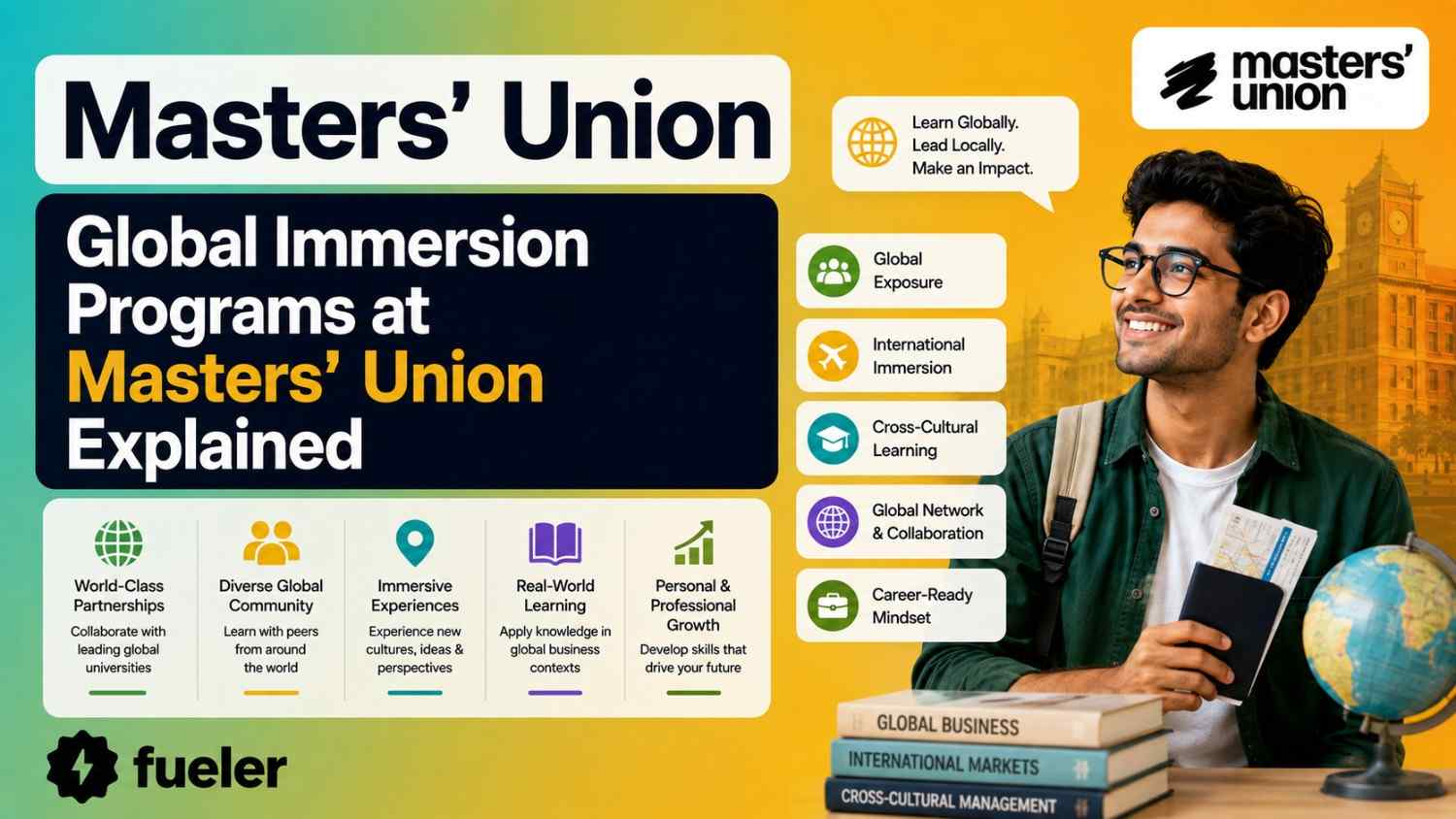
Global Immersion Programs at Masters' Union Explained

Riten Debnath
19 Aug, 2026
Last updated: August 2026
I’m Riten, founder of Fueler, a skills-first portfolio platform building the career infrastructure for 100 million creative professionals. Fueler connects talented individuals with companies through assignments, portfolios, and projects, not just resumes or CVs. Think of it as Dribbble/Behance for work samples combined with AngelList for hiring infrastructure.
Most higher education institutions treat global exposure as a glorified vacation a two-week photo-op in front of foreign universities, a few institutional lectures, and zero actual business impact. When I founded Fueler, a platform designed to help professionals prove their skills through real projects, I noticed a huge flaw in traditional resume-building: candidates spend thousands of dollars on international trips yet return with zero proof of work to show for it.
The global tech and startup market does not care about how many international airports you have walked through. It cares about whether you understand international regulatory frameworks, cross-border distribution channels, product localization, and global consumer psychology.
This brings us to the Global Immersion Programs at Masters' Union. Designed as an integral part of their hands-on business curriculum, these international residencies are built to operate more like field research and corporate consulting sprints than traditional academic exchange programs. Understanding how these global immersions work requires dissecting their location selection, business objectives, execution structure, and real-world career value.

Quick Answer Summary
- Action-Oriented Learning: Replaces passive classroom lectures with active market research, corporate visits, and localized business challenges.
- Global Ecosystem Exposure: Positions students directly inside prominent international business hubs like Dubai, Singapore, Silicon Valley, and European tech corridors.
- Cross-Border Execution: Teaches students how consumer markets, supply chains, funding landscapes, and regulatory environments differ across borders.
- Proof-of-Work Outcomes: Forces candidates to build concrete portfolios, from market entry decks to cross-border growth strategies.
- Key Takeaway: The program serves as an operational sandbox for students planning careers in international product management, venture capital, and cross-border consulting.
What is the Global Immersion Program at Masters' Union?
The Global Immersion Program at Masters' Union is an international experiential learning module designed to expose students to foreign market dynamics, startup ecosystems, and international business operations. Rather than sitting through theoretical lectures on international business management, candidates spend dedicated time inside major global technology and financial hubs.
The fundamental objective is simple: bridge the gap between local market understanding and global business execution. Students meet with international venture capitalists, visit mature corporate headquarters, interact with foreign startup founders, and analyze localized consumer behavior firsthand.
This immersive approach matters because scaling a business internationally requires a complete shift in strategy. A product framework that works seamlessly in India may fail in Southeast Asia due to differing payment infrastructures, cultural nuances, or data privacy laws.
Compared to standard university exchange programs where students spend months taking regular elective courses abroad, the Masters' Union immersion is structured as a short-term, high-intensity business sprint. Candidates analyze real supply chains, evaluate foreign go-to-market strategies, and pitch solutions to global business leaders.
Key Facts Table
Detailed Explanation
Preparing candidates for global leadership positions demands an active understanding of international business mechanics. At Fueler, we see every day how top companies look for talent with a documented history of executing under complex conditions. The Global Immersion Program builds these exact competencies across three primary pillars.
International Ecosystem Mapping
Understanding an international tech ecosystem requires looking beyond financial headlines. Students analyze why specific cities become magnets for capital, talent, and enterprise innovation.
- What they do: Students travel to major corporate and innovation hubs to study the infrastructure supporting local startups. During immersions in markets like Singapore or Dubai, cohorts analyze tax frameworks, government incubation grants, free-zone setups, and local talent pipelines. They also gain practical insight into the processes involved in setting up a business abroad, including how company incorporation services in Singapore can help entrepreneurs navigate local registration and administrative requirements.
- Why it works: Experiencing an ecosystem firsthand removes abstract assumptions. Students observe how regulatory policies directly influence capital flow, hiring strategies, and technology adoption.
- How it is taught: Immersions combine direct meetings with regulatory authorities, founders, and venture capitalists. Students complete structured field notes and ecosystem teardowns, analyzing why certain business models thrive in specific geographic regions while struggling in others.
- Real-world implications: When interviewing for international expansion, venture capital, or strategy consulting roles, candidates can discuss international market entry using real field observations rather than textbook generalities.
Cross-Border Product Localization & Go-To-Market Strategy
Scaling a software product or consumer brand into new territories requires adjusting distribution, pricing, payment methods, and user interface designs.
- What they do: Cohorts study localized business models by running field audits of products operating across different regions. They examine how international e-commerce platforms adapt logistics networks or how FinTech apps navigate regional financial regulations.
- Why it works: Product Management is heavily context-dependent. Seeing how a single platform changes its features, onboarding flows, and payment gateways between Asian and Western markets teaches deep product adaptability.
- How it is taught: Guided by regional executives and product managers, students deconstruct real products. They present localized go-to-market strategies, identifying specific friction points in customer acquisition, digital marketing channels, and localized logistics.
- Real-world implications: Product managers and growth marketers who understand cross-border localization avoid costly mistakes when launching products in foreign markets. Having a public portfolio showing localized product decks gives candidates a clear edge during hiring processes.
Global Venture Capital & Deal-Making Dynamics
Securing capital, setting up holding structures, and managing cross-border investor relations require a deep understanding of global financial markets.
- What they do: Students engage with foreign angel networks, venture capital firms, and private equity funds. They study global fundraising environments, valuation metrics, capital deployment strategies, and cross-border merger and acquisition trends.
- Why it works: Funding environments operate differently around the world. Silicon Valley investors often prioritize massive market size and rapid user acquisition, whereas investors in other regions may place a stronger emphasis on immediate unit economics and cash flow sustainability.
- How it is taught: Candidates participate in mock investment memos and pitch feedback sessions hosted by active investors in destination cities. They analyze real cap tables, fund structures, and international investment thesis models.
- Real-world implications: For individuals aiming for Chief of Staff, Founder's Office, or Venture Capital analyst roles, understanding how global investors evaluate early-stage businesses makes them instantly valuable to growth-stage leadership teams.
How It Works
The immersion experience follows a structured field-research model designed to maximize practical learning within a tight schedule.
Pre-Immersion Market Preparation
Before departing, students undergo intensive briefing sessions on the target country’s economic history, major industrial sectors, consumer demographics, and regulatory frameworks.
On-Ground Enterprise & Incubator Visits
Students visit corporate headquarters, innovation labs, and local business incubators to meet directly with operational leaders, founders, and regional executives.
Field Research & Consumer Behavior Sprints
Cohorts hit the street to observe real consumer touchpoints. They audit retail channels, test local digital platforms, and interview users to gather qualitative market data.
Strategic Debrief & Portfolio Compilation
Back from the field, students synthesize their research into market entry decks, product teardowns, or strategic investment summaries. They add these verified assets to their professional portfolios to demonstrate global competence.
Benefits
Participating in an action-focused international residency delivers practical career benefits that go far beyond standard academic exposure.
- Firsthand Market Literacy: Direct exposure to international consumer behavior, payment systems, and logistics channels.
- Expanded Professional Network: Direct access to foreign founders, venture partners, corporate leaders, and international alumni networks.
- Enhanced Strategic Versatility: Ability to solve complex business problems using international case studies and regional growth frameworks.
- Tangible Work Portfolio: Publicly visible proof of work showing cross-border analysis, market entry strategies, and product teardowns.
- Stronger Industry Relevance: Practical preparation for roles in international expansion, management consulting, and cross-border venture capital.
Challenges / Limitations
Global immersion modules present clear operational challenges that candidates must plan for carefully.
- Fast-Paced Schedule: Immersions compress dense networking events, corporate visits, and field research into short timeframes, leaving little time for leisure.
- Logistical Complexity: Managing visas, international travel schedules, and cross-border itineraries requires high personal discipline and adaptability.
- Additional Financial Overhead: Travel, accommodation, international insurance, and local living costs require careful personal budgeting depending on the destination city.
- Who Should NOT Choose It: Individuals looking for a relaxed international vacation, those uninterested in global business operations, or candidates seeking long-term academic exchange semesters should consider alternative programs.
Comparison Table
Comparing international field immersions against traditional semester-abroad exchange models highlights distinct structural differences:
Fees / Cost
Understanding the financial commitment required for international immersions helps candidates plan effectively.
- Program Coverage: Institutional fees for the primary academic program may cover organized corporate visits, masterclasses, and group transit within the destination city depending on the specific program tier.
- Travel & Visa Expenses: Students are generally responsible for international flight bookings, visa processing fees, passport documentation, and mandatory travel insurance.
- Living & Incidentals: Daily meal expenses, personal local transit, accommodation upgrades, and emergency funds must be budgeted based on the cost of living in the host country.
- Overall Financial Yield: Candidates who leverage these field experiences to land roles in global expansion or cross-border tech firms often see a strong return on investment through accelerated career trajectory.
Career Opportunities
International market literacy opens direct pathways into specialized cross-border business roles.
- International Expansion Manager: Leading go-to-market initiatives and operational launches for tech platforms entering new geographical regions.
- Cross-Border Product Manager: Designing software products that adapt seamlessly across diverse regional user bases and localized payment setups.
- Management & Strategy Consultant: Advising multinational corporations and mid-market firms on global supply chain, market entry, and operational strategy.
- Venture Capital Analyst (Global Sourcing): Evaluating international deal flow, performing cross-border due diligence, and supporting portfolio expansion.
- Chief of Staff (Global Tech): Supporting founders in managing distributed international teams, foreign regulatory alignment, and regional partnerships.
Who Should Choose This?
- Professionals aiming to build a career in global business expansion, cross-border tech, or management consulting.
- Candidates who learn best through active field research, direct industry interaction, and real-world observation.
- Aspiring founders looking to understand how to scale a business globally from day one.
- Individuals who want to build a public proof-of-work portfolio demonstrating international strategic analysis.
Who Should Avoid This?
- Students seeking a slow-paced, purely theoretical academic exchange program in a classroom setting.
- Individuals who prefer predictable daily schedules over intense field research and networking environments.
- Anyone unwilling to manage the travel logistics, financial budgeting, and fast-paced schedules associated with short-term international residencies.
Final Thoughts
The international business landscape is far too competitive for passive learning. If you want to build a career that spans multiple markets, reading global case studies in a lecture hall simply won't cut it anymore.
When we evaluate talent at Fueler, the professionals who stand out are always the ones who can show verified proof of work, whether that is a published product teardown, a detailed market entry strategy, or a documented growth framework.
The Global Immersion Program at Masters' Union aligns directly with this modern reality. By getting students out of the classroom and dropping them directly into international tech corridors, it forces them to analyze real markets, talk to real operators, and build real business muscle. For anyone serious about understanding modern global trade, cross-border technology, and international startup growth, gaining practical field exposure remains one of the smartest investments you can make.
Key Takeaways
- Field-First Pedagogy: Prioritizes active market research and corporate visits over passive classroom study.
- High-Impact Destinations: Centers learning inside prominent international commercial hubs like Dubai, Singapore, and Silicon Valley.
- Cross-Border Execution: Teaches practical product localization, international regulatory frameworks, and regional growth strategies.
- Practitioner Access: Facilitates direct interactions with foreign startup founders, venture partners, and regional directors.
- Portfolio-Driven Output: Encourages candidates to document field insights into public, verifiable proof-of-work assets.

FAQs
What is the main goal of the Global Immersion Program?
The program gives students practical exposure to international markets, foreign startup ecosystems, cross-border regulatory frameworks, and global business operations through direct field research and executive networking.
Which international locations do students visit during immersion?
Destinations depend on the academic track and business focus, typically including major financial and technology hubs such as Dubai, Singapore, Silicon Valley, and key European innovation corridors.
How long does a typical international immersion track last?
Global immersions are structured as high-intensity, short-term business residencies lasting between one to two weeks to maximize executive interaction and field research without disrupting core coursework.
Do students work on real projects during the international trip?
Yes, cohorts conduct market research, run product audits, analyze localized go-to-market strategies, and present strategic recommendations based on direct interactions with regional business operators.
How does global immersion help in landing product or consulting roles?
It provides candidates with firsthand international market insights and tangible proof-of-work assets, such as cross-border market entry decks, making them stand out to recruiters hiring for global expansion.
Why 100,000+ professionals use Fueler
Fueler helps professionals showcase proof of work through projects, assignments, case studies, and achievements.
- Thousands of professionals use Fueler to create their digital portfolio
- Thousands of projects are published on Fueler. Check here
- Startups and Companies hire through proof of work on Fueler
- Used by freelancers, creators, marketers, video editors, writers, designers, and product managers
Our mission is to help the next 100 million professionals build a verified professional identity through proof of work
What should you do next?
You've read the article. Now turn your skills into proof of work and unlock more opportunities.
Build your proof of work portfolio
Create a clean portfolio with projects, assignments, resumes, and AI stack details that companies actually want to see.
Create your Fueler portfolio →Apply through assignments, not resumes
Stand out by solving real tasks from companies hiring on Fueler.
Explore assignments →Get discovered by companies
Make your work public and let recruiters discover your skills through actual projects instead of keywords.
Get discovered →
