

RepoMind – AI-Powered GitHub Repository Intelligence Platform


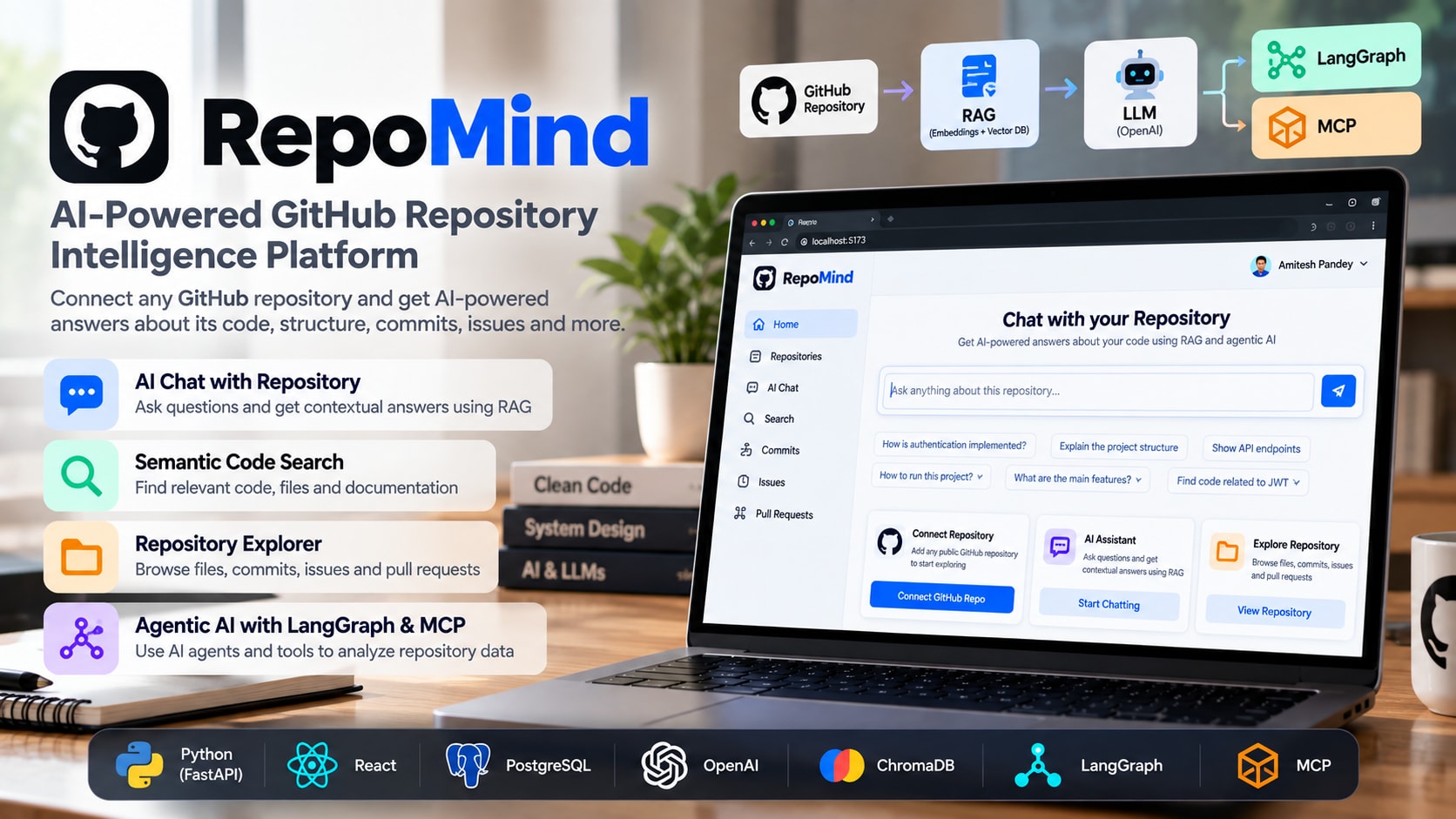
RepoMind is an AI-powered GitHub Repository Intelligence Platform designed to help developers understand and interact with GitHub repositories using natural-language queries. The platform allows users to connect repositories, explore files and folders, search code semantically, and ask AI-powered questions about the codebase.
The backend is built using Python and FastAPI, while the frontend is developed with React. PostgreSQL and SQLAlchemy are used for storing application and user data, with JWT-based authentication for secure access. GitHub REST APIs are integrated to retrieve repository files, commits, issues, and pull requests.
The core AI functionality is implemented using Retrieval-Augmented Generation (RAG). Repository source files are collected, divided into smaller chunks, converted into vector embeddings using OpenAI Embeddings, and stored in ChromaDB. When a user asks a question, the system performs semantic search to retrieve the most relevant repository content and provides it as context to the AI model for generating context-aware answers.
LangGraph is used to build agentic workflows for handling multi-step repository tasks, while MCP (Model Context Protocol) provides AI agents with tools to interact with repository information such as files, commits, issues, and pull requests. The platform also supports repository indexing, re-indexing prevention, AI chat, conversation context, and streaming AI responses.
Overall, RepoMind combines Generative AI, RAG, semantic search, vector databases, LangGraph, MCP, and GitHub APIs to create an intelligent assistant that makes large and complex software repositories easier to explore, understand, and interact with.
24 Sep 2026
Keywords


AI Usage
I used AI as the core intelligence layer of RepoMind to help developers understand and interact with GitHub repositories using natural-language queries. OpenAI language models were used to generate responses about repository code, while OpenAI Embeddings were used to convert source-code files into vector representations for semantic search. I implemented Retrieval-Augmented Generation (RAG) by collecting repository files, splitting them into smaller code chunks, generating embeddings, and storing them in ChromaDB. When a user asks a question, the system performs semantic search to retrieve the most relevant code and repository information and provides this context to the AI model for generating context-aware answers. I used LangGraph to build agentic workflows for handling multi-step repository tasks and integrated MCP (Model Context Protocol) to provide AI agents with tools for accessing repository information such as files, commits, issues, and pull requests. I also used conversation context to make interactions more meaningful across multiple queries. Overall, AI was used for repository understanding, semantic code search, RAG-based question answering, contextual response generation, and agentic interaction with GitHub data.