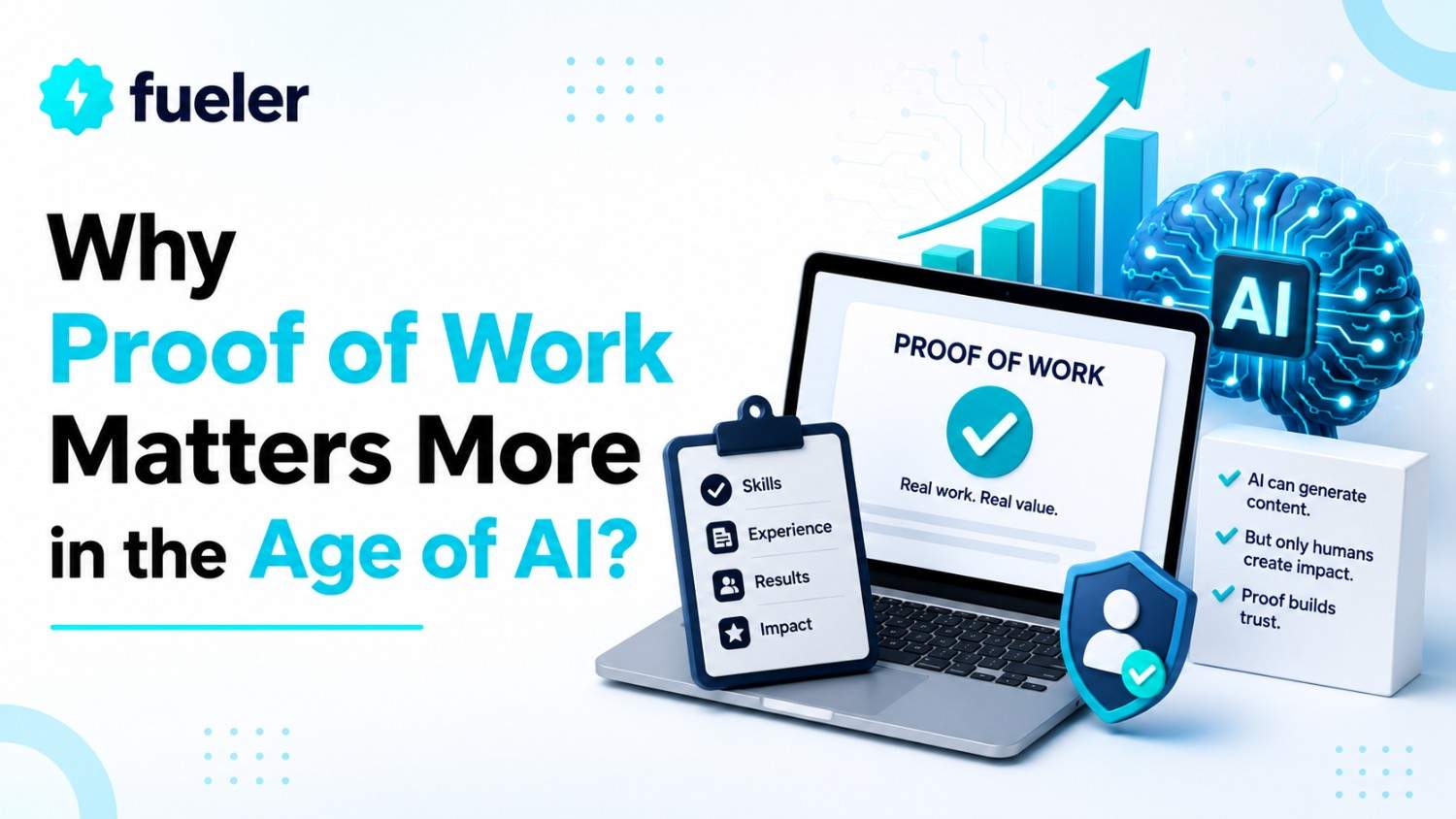
Why Proof of Work Matters More in the Age of AI?

Riten Debnath
23 Jul, 2026
Last updated: July 2026
Automated job search tools allow candidates to blast thousands of tailored, keyword-optimized applications to hiring portals in minutes. Recruiting pipelines face record application volumes, yet hiring managers struggle to verify true competence. Resumes have turned into polished marketing scripts that obscure actual skill levels.
I’m Riten, founder of Fueler, a skills-first portfolio platform building the career infrastructure for 100 million creative professionals. Fueler connects talented individuals with companies through assignments, portfolios, and projects, not just resumes or CVs. Think of it as Dribbble/Behance for work samples combined with AngelList for hiring infrastructure.
Recent workforce data shows job application volumes surging four times faster than actual open requisitions. When anyone can construct a flawless document using automated text generation, written claims lose value.
The following 8 shifts explain why demonstrating tangible results is essential for standing out today.

1. The Collapse of the Resume as a Reliable Skill Signal
Traditional resumes functioned reasonably well when customizing an application took genuine effort and time. Today, generative text systems allow anyone to mirror job descriptions perfectly, insert missing keywords, and exaggerate past outcomes without doing any real work.
Because written descriptions can be generated in seconds, bullet points on a document no longer prove candidate capability. Hiring managers face thousands of identical, highly polished applications, making static job histories almost impossible to evaluate with confidence.
- Automated software tools generate tailored resumes that pass automated screening filters easily, inflating application pools with candidates who lack actual domain experience.
- Job titles and responsibilities listed on static documents fail to convey whether an applicant executed tasks independently or relied entirely on automated scripts.
- Keyword matching systems inside recruiting software now retrieve hundreds of seemingly perfect profiles, rendering standard text matches useless for identifying top talent.
- Employers report rising levels of candidate inflation where interview performance fails to match the impressive claims made on submitted application files.
- Verifiable project repositories and documented outputs allow recruiters to evaluate actual work samples, eliminating guesswork during early screening rounds.
Why It Matters
When static credentials lose credibility, businesses incur higher risks every time they hire. Evaluating work samples rather than unverified resumes protects organizations from hiring underqualified applicants. Focusing on verified outputs cuts hiring costs, reduces employee turnover, and ensures candidates bring immediate practical value to the team.
2. Breaking the Paradox of AI Evaluating AI in Hiring
A bizarre loop has emerged across global talent acquisition. Job seekers use automated systems to write applications, while employers deploy algorithmic screeners to parse those exact submissions. This creates a system where software evaluates output created by other software.
This dynamic creates noise on both sides of the hiring table. High-performing professionals get lost in automated rejections, while recruiters spend hours interviewing candidates who know how to game algorithms but struggle to solve real operational problems.
- Algorithmic screeners frequently filter out skilled candidates who write simple, honest descriptions while passing underqualified applicants who use automated optimization tools.
- Hiring teams face severe recruitment fatigue as application volumes surge without a corresponding increase in qualified talent.
- Evaluating live code, design assignments, and strategic frameworks bypasses automated text screening entirely, creating a direct line to human review.
- Candidates who document their thought processes in public portfolios stand out immediately to founders looking for genuine problem-solving ability.
- Shifting evaluation to hands-on work samples protects companies from bias built into automated screening algorithms.
Why It Matters
Relying on software to screen software-generated text creates broken hiring funnels that waste time and money. Proof of work restores human clarity to recruitment by focusing on actual artifacts. Businesses that evaluate tangible results shorten hiring cycles and hire candidates with proven execution capability.
3. Shifting from Credentials to Immediate Operational Readiness
Degrees, university rankings, and multi-year job titles were historically used as shortcuts to estimate candidate potential. However, modern business operations evolve too quickly for static educational credentials or passive tenure to guarantee job readiness.
Companies want team members who can step into a role and contribute on day one without requiring months of basic training. Showing completed projects, functional automations, or audited code proves you possess execution-ready skills that translate directly into operational impact.
- Fast-moving companies prioritize practical skill execution over university prestige, lowering training costs and onboarding delays.
- Completed assignments demonstrate that an applicant understands modern software stacks, industry workflows, and practical delivery constraints.
- Candidates with non-traditional backgrounds compete effectively against veteran professionals by showcasing superior, documented project outputs.
- Showing step-by-step problem-solving case studies proves an applicant can navigate operational friction and deliver finished work under tight deadlines.
- Early-career professionals who present live deliverables build professional authority faster than peers relying strictly on academic transcripts.
Why It Matters
Organizations cannot afford long, non-productive onboarding periods in competitive markets. Hiring candidates based on verified execution ensures new team members generate value immediately. Demonstrating operational readiness sets you apart from applicants who rely on passive tenure.
4. Differentiating True Problem-Solving from Automated Output
Generative tools make it trivial to produce plausible-sounding strategic plans, basic software scripts, and polished marketing copy in seconds. However, producing surface-level text is fundamentally different from understanding how a complex system operates in the real world.
Hiring managers need to know whether a candidate can think critically, debug failures, and adapt when automated answers prove wrong. Proof of work exposes the depth of your understanding by showing how you handle unexpected edge cases, constraints, and operational adjustments.
- Documenting project iterations highlights how an applicant tests, debugs, and refines work when initial automated outputs fail.
- Explaining trade-offs made during a project proves deep subject mastery that generic software summaries cannot replicate.
- Sharing real-world performance metrics from past campaigns or code bases provides concrete evidence of business impact.
- Detailed project breakdowns reveal whether a candidate understands root causes or relies on superficial automated answers.
- Interactive work samples allow hiring teams to test an applicant's reasoning through direct technical questions during interviews.
Why It Matters
Anyone can produce generic text, but few can debug complex operational failures under pressure. Showing how you solve problems separates true operators from candidates who simply copy automated answers. Proof of work highlights your analytical depth, establishing you as a reliable contributor.
5. Verifying Human Judgment, Context, and Edge-Case Handling
Automated systems predict word patterns based on historical training data, but they lack human context, moral judgment, and real-world awareness. Business tasks operate in changing environments filled with ambiguous rules, privacy concerns, and unpredictable client demands.
Proof of work demonstrates your capacity to exercise sound human judgment where automated logic fails. Showing how you catch errors, audit data, and navigate complex regulations proves you can manage sensitive business operations without creating legal or brand risks.
- Case studies focused on risk management show how candidates identify hallucinated facts, data leaks, or algorithmic bias before work goes live.
- Highlighting how you adapt project strategies to fit unique company cultures proves high interpersonal intelligence and situational awareness.
- Sharing examples of ethical decision-making protects organizations from compliance errors, privacy breaches, and public relations failures.
- Demonstrating quality control processes shows hiring leads that your final deliverables are thoroughly audited and ready for executive review.
- Presenting customized work tailored to specific business challenges proves you understand nuance beyond generic industry templates.
Why It Matters
Businesses face major liabilities when unverified or inaccurate automated outputs reach clients. Employers value candidates who audit automated results, spot errors, and apply careful human context. Demonstrating strong verification abilities marks you as a mature professional who takes ownership of quality.
6. Eliminating Onboarding Risk for Lean, High-Performance Teams
Bad hires cost organizations significant time, energy, and capital, especially in lean teams where every employee handles critical operations. Reviewing a resume offers no guarantee of performance, turning every traditional hire into a costly gamble.
Proof of work drastically reduces hiring risks by giving employers clear evidence of what you can accomplish. When managers evaluate previous assignments, design files, or growth experiments, they gain total confidence in your capabilities before making an offer.
- Reviewing functional project portfolios shortens recruitment screening, saving teams hundreds of hours in preliminary interviews.
- Practical assignments allow candidates to demonstrate team fit, task speed, and execution quality during real-world trials.
- Verifiable work samples lower employee turnover by ensuring applicant skills match job requirements accurately.
- Clear project documentation allows team leads to assign high-stakes tasks to new hires immediately with minimal supervision.
- Transparent proof of work builds trust between remote workers and leadership teams across distributed organizations.
Why It Matters
Hiring mistakes slow down operations and drain team morale. By providing clear proof of work, you eliminate risk for hiring managers, making it an easy decision to bring you on board. Demonstrating reliability through concrete samples accelerates job offers and opens up leadership opportunities.
7. Establishing Personal Brand Authority and Public Market Visibility
Sending private application files through corporate job portals buries your profile beneath thousands of automated submissions. Building proof of work in public transforms your job search from a passive waiting game into an active inbound channel.
When you document your projects, publish strategic breakdowns, and share open-source contributions online, you build an enduring personal asset. Hiring leads, recruiters, and founders discover your work organically, bypassing corporate applicant tracking systems entirely.
- Publishing public project breakdowns attracts inbound job offers and freelance opportunities from founders actively seeking specific skills.
- Maintaining an updated, accessible portfolio creates an online reputation that works for you continuously throughout the day.
- Demonstrating consistent output online establishes domain authority, positioning you as an industry practitioner rather than a job seeker.
- Sharing project learnings and case studies invites feedback from senior peers, accelerating your skill development.
- Public proof of work creates leverage during salary negotiations by demonstrating widespread demand for your documented capabilities.
Why It Matters
Relying solely on corporate application portals puts your career in the hands of automated filtering algorithms. Public proof of work gives you direct market visibility and career autonomy. Building a visible track record ensures job opportunities find you, regardless of broader labor market shifts.
8. Future-Proofing Career Mobility Against Algorithmic Job Disruption
As automation tools handle a wider share of routine administrative tasks, specific job titles and descriptions lose relevance quickly. Professionals who define themselves by static credentials risk obsolescence when software automates those specific duties.
A body of work is flexible, adaptable, and owned entirely by you. Documenting problem-solving frameworks, system designs, and operational outcomes allows you to pivot smoothly across industries as technology changes, preserving your long-term value in the labor market.
- Documenting transferable skills across completed projects makes shifting into emerging technical fields straightforward.
- Building a diversified project body protects your income by supporting freelance work, advisory roles, and full-time positions.
- Showing how you use new software tools alongside human judgment proves your adaptability to prospective employers.
- Tracking long-term project outcomes highlights continuous growth, demonstrating leadership maturity to prospective executive teams.
- Owning a personal work archive ensures your career history remains accessible even if past employers change structures or shut down.
Why It Matters
Static job descriptions offer minimal security when technological capabilities shift rapidly. A documented body of work serves as proof of your ability to adapt, learn, and deliver business results under any market conditions. Focusing on tangible output ensures long-term career stability.
How Does This Connect to Building a Strong Career or Portfolio?
Understanding the value of tangible output is essential, but making that output visible to decision-makers is what secures job offers. Resumes claim competence, but portfolios prove it. When you document your project case studies, workflow automations, and assignments on Fueler, you create a public record of your abilities that recruiters can verify instantly. Presenting verifiable proof of work turns abstract qualifications into clear career opportunities, helping you land roles based on your actual execution capability.
Final Thoughts
The hiring landscape has fundamentally changed, making static resumes far less effective than they were a decade ago. As automated tools flood recruitment pipelines with generic text, candidates who showcase verified, real-world work will capture the best opportunities. Focus on building functional projects, documenting your problem-solving process, and sharing your outputs publicly. Prioritizing tangible proof over traditional claims is how you build an irreplaceable career in an evolving digital economy.

Frequently Asked Questions
Why is proof of work replacing traditional resumes in 2026?
Resumes are easily inflated using automated text generators, making them unreliable skill signals. Proof of work provides verifiable evidence of execution ability, reducing hiring risks for employers.
What counts as valid proof of work for non-technical roles?
Non-technical professionals can showcase marketing campaign breakdowns, strategic frameworks, project management timelines, customer research summaries, and process automations documented in clear case studies.
How does proof of work help pass automated recruitment filters?
Proof of work allows candidates to bypass standard applicant portals entirely by sharing direct links with founders, hiring managers, and recruiters, leading directly to human review.
Do I need years of experience to create a strong portfolio?
No, proof of work focuses on current execution capability rather than passive tenure. Early-career workers can build compelling portfolios using self-initiated projects, assignments, and open-source contributions.
How do I protect confidential information when sharing past projects?
Scribe sensitive business metrics, anonymize customer data, and focus your case studies on your specific problem-solving methodology, strategic choices, and personal execution contributions.
Why 100,000+ professionals use Fueler
Fueler helps professionals showcase proof of work through projects, assignments, case studies, and achievements.
- Thousands of professionals use Fueler to create their digital portfolio
- Thousands of projects are published on Fueler. Check here
- Startups and Companies hire through proof of work on Fueler
- Used by freelancers, creators, marketers, video editors, writers, designers, and product managers
Our mission is to help the next 100 million professionals build a verified professional identity through proof of work

What should you do next?
You've read the article. Now turn your skills into proof of work and unlock more opportunities.
Build your proof of work portfolio
Create a clean portfolio with projects, assignments, resumes, and AI stack details that companies actually want to see.
Create your Fueler portfolio →Apply through assignments, not resumes
Stand out by solving real tasks from companies hiring on Fueler.
Explore assignments →Get discovered by companies
Make your work public and let recruiters discover your skills through actual projects instead of keywords.
Get discovered →
