15 Types of AI Agents You Should Know in 2026 (With Real-World Examples)

Riten Debnath
23 Feb, 2026
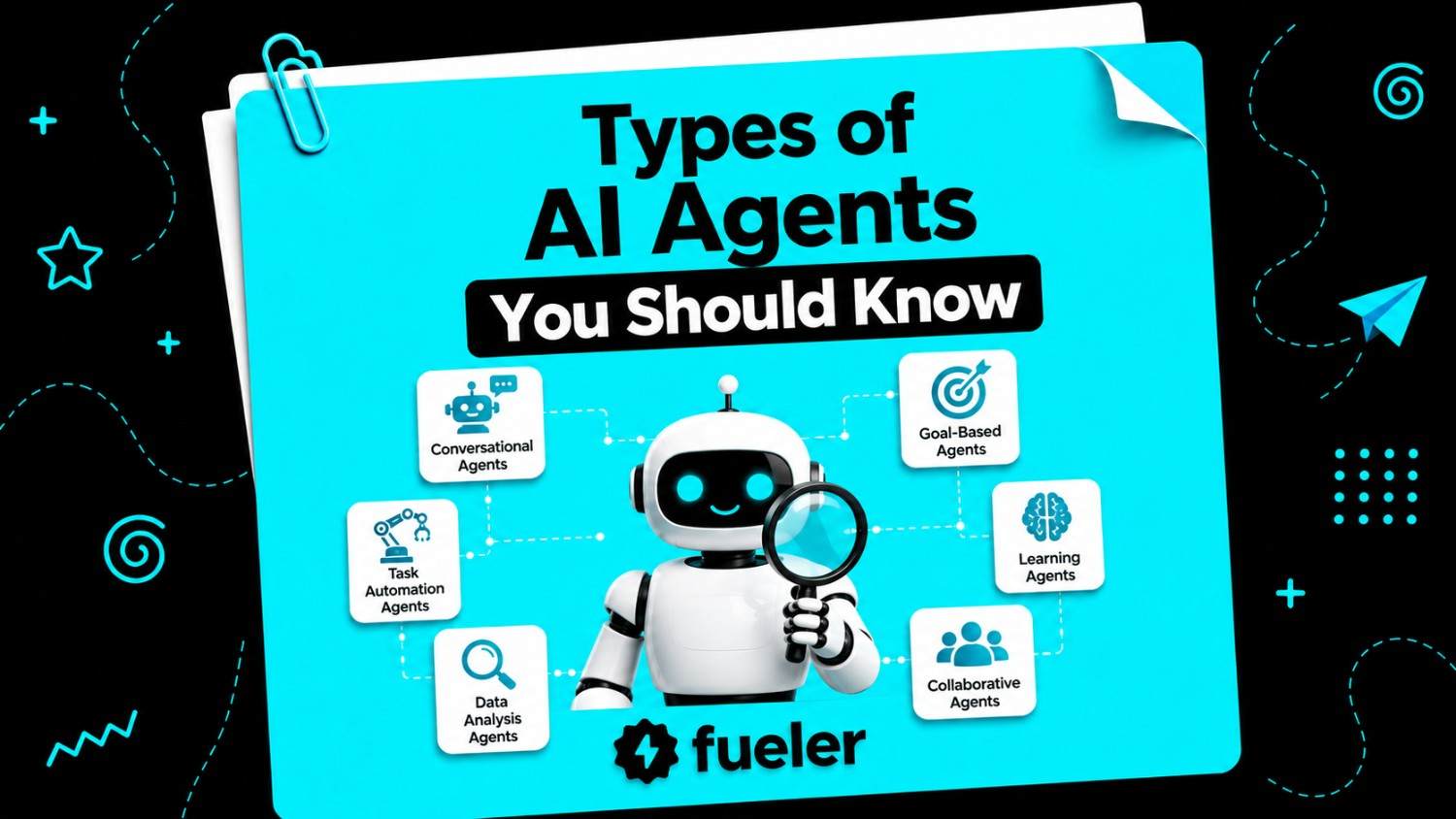
The era of "chatting" with AI is officially over, and the era of "delegating" to AI has begun. If you are still treating AI like a search engine or a basic proofreader, you are missing out on a massive shift in how work actually happens in 2026. Today, we don't just ask AI for information; we give it a goal, a budget, and the keys to our software, and we let it go to work. These autonomous agents are no longer just experiments; they are the specialized digital workforce driving every high-growth company on the planet.
I’m Riten, founder of Fueler, a skills-first portfolio platform that connects talented individuals with companies through assignments, portfolios, and projects, not just resumes/CVs. Think Dribbble/Behance for work samples + AngelList for hiring infrastructure.
The New Frontier of Autonomous Productivity
In 2026, the distinction between a "tool" and an "agent" is simple: tools wait for you to use them, while agents act on your behalf to achieve an objective. This shift has created a new standard for productivity where your value isn't measured by how many emails you sent, but by how effectively you managed your fleet of digital agents to close deals, fix bugs, or launch campaigns.
1. Research and Discovery Agents
These agents are the ultimate "Sherlock Holmes" of the internet, capable of browsing thousands of web pages, PDFs, and databases to find the needle in the haystack. Unlike a search engine that gives you links, these agents read the content, verify the facts, and write a synthesized report with citations.
- OpenAI Deep Research: This agent represents a massive leap in autonomous browsing because it can spend up to twenty minutes conducting a continuous, multi-step investigation into complex topics like emerging semiconductor trends or global supply chain shifts without any human intervention. Instead of just returning a list of links, it navigates through deep web sources, analyzes PDF whitepapers, and synthesizes everything into a comprehensive ten-page report that includes verified citations and cross-referenced data points.
- Perplexity Pro Pages: This specialized agent transforms the way we consume information by allowing users to turn complex research queries into structured, visually appealing, and publishable reports that update themselves in real-time as new information surfaces on the live web. It acts as a bridge between a search engine and a content creator, making it an essential tool for analysts who need to monitor shifting market conditions or competitive landscapes without manually refreshing their data every hour.
- Elicit Research Assistant: Built specifically for the scientific and academic community, this agent can analyze over two hundred million research papers to find specific experimental results, synthesize literature reviews, and even extract data from complex tables that are often invisible to standard search engines. It significantly reduces the time researchers spend on "the search" so they can focus on "the discovery," essentially serving as an AI-powered librarian with a PhD in every subject imaginable.
- Glean Knowledge Agent: This enterprise-level agent functions as the central nervous system for a company's internal data, connecting seamlessly to Slack, Google Drive, Jira, and Confluence to provide instant answers to employees based on proprietary company context. It eliminates the "where is that document" frustration by understanding the relationship between people, projects, and conversations, allowing team members to recall meeting decisions or technical specs in seconds through a simple natural language interface.
- Pricing:
- OpenAI: $20/month (Plus) to $30/month (Team).
- Perplexity: $20/month for Pro features.
- Elicit: Free tier available, Plus at $25/month.
- Glean: Custom enterprise pricing based on user count.
Why it matters:
Using these researchers allows you to move from information gathering to high-level decision making in this new era. Instead of spending hours Googling, you start your morning with a finished brief, giving you a massive competitive edge in speed.
2. Software Engineering Agents
We have moved far beyond simple "autocomplete" for code. Engineering agents can now take a Jira ticket, understand the codebase, write the feature, run the tests, and submit a pull request for review, all while you are asleep.
- Devin by Cognition: Devin is widely recognized as the world's first fully autonomous AI software engineer, capable of handling entire development projects from planning the architecture to executing the code and deploying the final product to a live environment. It doesn't just suggest lines of code; it operates its own browser, shell, and code editor to debug issues, learn new libraries on the fly, and even complete freelance jobs on platforms like Upwork without human help.
- GitHub Copilot Workspace: This agent leverages the entire GitHub ecosystem to allow developers to go from a natural language description of a bug or feature to a complete, multi-file implementation plan that can be reviewed and edited before any code is committed. It acts as a tireless pair programmer that understands the specific nuances of your repository, helping to bridge the gap between a high-level idea and the actual technical execution required to make it a reality.
- Replit Agent: Designed for rapid deployment and accessibility, the Replit Agent can build, host, and scale full-stack applications simply by listening to a user's verbal or written instructions, handling everything from database migrations to frontend styling. It is a game-changer for founders and product managers who want to build functional prototypes or internal tools in minutes rather than weeks, effectively democratizing the ability to create software for everyone.
- OpenHands (OpenDevin): As a leading open-source alternative, OpenHands provides a transparent and community-driven platform for running autonomous engineering agents that can interact with the world through a sandbox environment to write code and fix system issues. This is particularly valuable for enterprises that require total control over their data and wish to customize the agent's logic to fit their unique security protocols or proprietary development frameworks without being locked into a single vendor.
- Pricing:
- Devin: Custom enterprise and early access pricing.
- GitHub Copilot: $10/month (Individual) to $39/user/month (Enterprise).
- Replit: Free tier, Core at $15/month, Teams at $20/user/month.
- OpenHands: Free (Open-source, requires hosting costs).
Why it matters:
These agents allow a single developer to perform like a full engineering team, shifting the focus from syntax to system design. In 2026, being a great engineer means being a great architect who can direct these digital builders effectively.
3. Customer Success and Support Agents
Gone are the days of frustrating "I don't understand that" chatbots. Modern support agents have full access to your CRM, billing systems, and shipping logs, allowing them to solve problems, not just talk about them.
- Intercom Fin: Fin is a highly sophisticated AI agent that uses a company's existing help center content to resolve complex customer queries instantly, achieving resolution rates that often exceed fifty percent without any human intervention. By integrating directly into the Intercom platform, it can verify customer identities, check order statuses in real-time, and even process refunds, making it a powerful tool for scaling support teams without increasing headcount.
- Sierra AI: Founded by tech veterans, Sierra focuses on providing brand-aligned, conversational agents that can handle multi-step workflows, such as helping a customer find the perfect pair of shoes or troubleshooting a complex software integration. It prioritizes "human-like" reasoning and empathy, ensuring that even though the interaction is automated, the customer feels heard and understood, which is critical for maintaining high brand loyalty in a crowded market.
- Zendesk AI Agents: These agents are built directly into the Zendesk ecosystem, allowing them to automatically triage incoming tickets, suggest relevant solutions to agents, and even resolve common issues like password resets or subscription changes autonomously. They use advanced sentiment analysis to detect when a customer is frustrated and can seamlessly escalate the conversation to a human representative with a full summary of the interaction so far, ensuring no context is lost.
- Ada: Ada’s platform allows enterprises to build specialized AI agents that can handle millions of conversations across multiple languages and channels, including web, mobile app, and even social media messaging. Its "reasoning engine" allows the agent to think through a customer's problem step-by-step, accessing various APIs to perform tasks like rescheduling a flight or upgrading a service plan, which significantly reduces the burden on human support staff.
- Pricing:
- Intercom Fin: $0.99 per successful resolution.
- Sierra AI: Custom enterprise pricing based on volume and complexity.
- Zendesk AI: Starts at $55/agent/month plus AI add-on fees.
- Ada: Custom usage-based pricing for mid-market and enterprise.
Why it matters:
Support agents are the front line of your business, and having an autonomous system that can actually solve issues 24/7 is a massive competitive advantage. It turns support from a cost center into a driver of customer satisfaction.
4. Sales and Outreach Agents
Sales agents in 2026 don't just send "spam" emails. They research your LinkedIn, read your latest blog posts, and find a genuine reason to reach out, making the conversation feel personal and relevant.
- 11x.ai (Alice): Alice is an autonomous Sales Development Representative (SDR) that can research prospects, craft hyper-personalized outreach messages, and manage the entire follow-up sequence until a meeting is booked on your calendar. Unlike traditional automation, Alice understands the context of a prospect's career history and company news, allowing her to write emails that feel like they were written by a human who spent hours on research, resulting in much higher response rates.
- Regie.ai: This platform uses AI agents to help sales teams create entire content libraries, from cold emails to social posts, while also providing an "Auto-Pilot" feature that handles the initial stages of prospecting and lead qualification. It ensures that every touchpoint a salesperson has with a lead is backed by data and tailored to that specific person's needs, which helps to shorten the sales cycle and improve the overall efficiency of the revenue team.
- Salesforce Agentforce: This is a comprehensive suite of AI agents that live inside the Salesforce CRM, helping reps to identify the "next best action" for every lead and even automating routine tasks like data entry or meeting summaries. These agents can proactively alert a salesperson when a key account is showing high-intent signals, such as visiting a pricing page multiple times, allowing the rep to reach out at the exact moment the customer is ready to buy.
- Lusha AI: Lusha’s agents focus on the "data" side of sales, automatically enriching your CRM with verified phone numbers, emails, and company information to ensure your team never wastes time on bad leads. By using autonomous data-cleaning agents, companies can ensure their sales pipeline is always filled with high-quality prospects, allowing their human sellers to spend more time actually selling and less time digging through broken contact lists.
- Pricing:
- 11x.ai: Custom pricing, typically starting around $1,000/month for teams.
- Regie.ai: Starts at $59/user/month for basic features.
- Salesforce Agentforce: Included in certain tiers, or $2.00 per conversation.
- Lusha: Free tier, Pro at $39/user/month, Enterprise custom.
Why it matters:
Sales agents allow you to scale your outreach without sacrificing the "human touch." In a world full of noise, these agents help you cut through by being relevant, timely, and deeply informed about your prospect's specific challenges.
5. Content and Marketing Agents
Marketing agents are no longer just writing blog posts; they are managing entire campaigns. They analyze which headlines get the most clicks, adjust your ad spend in real-time, and even design images to match your brand voice.
- Jasper Campaigns: Jasper has evolved from a simple writing assistant into an autonomous marketing agent that can take a single brief and turn it into a full multi-channel campaign, including emails, ads, and landing pages. It maintains a strict "brand voice" by analyzing your previous successful content, ensuring that every piece of copy generated feels authentic to your company while also being optimized for high conversion rates and SEO performance.
- Copy.ai Workflow Agents: These agents specialize in automating the repetitive "busy work" of marketing, such as repurposing a single podcast episode into ten social media posts, three newsletters, and a comprehensive blog article. By setting up autonomous workflows, marketing teams can ensure their content is being seen across all platforms without needing a large team of content creators, allowing them to maintain a consistent online presence with minimal manual effort.
- Mutiny: Mutiny uses AI agents to perform real-time website personalization, changing the headlines, images, and calls-to-action on your site based on who is visiting (e.g., showing a different message to a CEO vs. a Developer). This level of autonomous optimization ensures that every visitor has a tailored experience that is most likely to lead to a conversion, effectively acting as a 24/7 conversion rate optimization (CRO) expert for your digital storefront.
- AdCreative.ai: This agent focuses specifically on the visual and data-driven side of advertising, generating hundreds of high-performing ad creatives in seconds and then analyzing which ones are performing best on platforms like Meta or Google. It automatically reallocates your budget toward the winning designs, ensuring that your ad spend is always being used as efficiently as possible to drive the highest return on investment (ROI) for your marketing campaigns.
- Pricing:
- Jasper: Pro plan at $59/user/month, Business custom.
- Copy.ai: Free tier, Pro at $36/month, Team custom.
- Mutiny: Custom enterprise pricing (High-intent mid-market focused).
- AdCreative.ai: Starts at $21/month for small businesses.
Why it matters:
Marketing agents give small teams the power of a global agency. By automating the creative and analytical parts of the job, you can focus on the big-picture strategy and brand story that really moves the needle for your business growth.
6. Personal Productivity and Executive Agents
These are the "digital chiefs of staff" that manage your life. They handle the back-and-forth of scheduling, summarize your missed Slack messages, and remind you to follow up with that person you met at a conference last week.
- Motion (UseMotion): Motion is an autonomous calendar and task manager that uses AI to "rebuild" your schedule every time a new task or meeting is added, ensuring you always meet your deadlines without burning out. It acts like a personal assistant that knows exactly which tasks are high priority and automatically finds the best time for deep work, moving your flexible meetings around to create a perfect, optimized daily plan that evolves in real-time.
- Reclaim.ai: Reclaim focuses on the intersection of your personal and professional life, automatically blocking out time for habits like exercise or lunch while also syncing your multiple calendars to prevent scheduling conflicts. It uses intelligent agents to protect your "focus time" from being eaten up by unnecessary meetings, ensuring that your most important work always has a dedicated slot on your calendar regardless of how busy your week becomes.
- Lindy got (Lindy): Lindy is a versatile personal agent that can handle a wide variety of "errands," from researching and booking a doctor's appointment to summarizing a long YouTube video or managing your email inbox. It learns your preferences over time, so it knows exactly how you like to handle certain situations, eventually becoming a truly personalized digital extension of yourself that saves you hours of administrative friction every single week.
- Superhuman AI: This agent lives inside your email inbox, helping you to triage hundreds of messages in minutes by providing instant summaries, drafting contextually relevant replies, and reminding you when to follow up on important threads. It’s designed for high-performance individuals who want to reach "inbox zero" every day, acting as a smart filter that ensures you only spend your energy on the conversations that actually require your unique human input and decision-making.
- Pricing:
- Motion: $19/month (Individual) to $12/user/month (Team).
- Reclaim.ai: Free tier, Starter at $8/month, Professional at $12/month.
- Lindy: Free early access, tiered usage pricing expected.
- Superhuman: $30/month for the premium email experience.
Why it matters:
Personal agents are the key to avoiding burnout in the fast-paced world of 2026. They handle the mental load of organizing your life, allowing you to stay in "flow state" and focus on the work that actually requires your creativity and leadership.
7. Data Analysis and BI Agents
In 2026, you don't need to be a SQL expert to get insights from your data. You just ask your data agent a question in plain English, and it writes the code, runs the analysis, and builds the chart for you.
- Julius AI: Julius acts as a powerful, autonomous data scientist that can take any spreadsheet or database and perform complex statistical analyses, trend forecasting, and data visualization simply by following your verbal or written prompts. It can clean messy datasets, identify hidden correlations, and even explain its mathematical reasoning in simple terms, making advanced data science accessible to marketing managers, founders, and students who don't have a technical background.
- Akkio: Akkio is a "no-code" AI platform that uses agents to build predictive models for businesses, helping them to forecast sales, detect fraud, or predict customer churn with surprising accuracy. It allows non-technical teams to deploy industrial-strength machine learning models in minutes, transforming raw historical data into actionable future insights that can be used to make smarter, data-backed business decisions across every department.
- Tableau Pulse: This agent-driven feature within Tableau automatically monitors your key business metrics and proactively notifies you when it detects an anomaly or an interesting trend that requires your attention. Instead of you having to go and look at a dashboard, the agent "pushes" the insights to you in Slack or email, explaining why a certain number changed and what you might want to do about it to keep your business on track.
- Microsoft Copilot in Excel: This agent brings the power of advanced data manipulation directly into the world’s most popular spreadsheet software, allowing users to generate complex formulas, create pivot tables, and visualize data trends with a single sentence. It acts as an expert tutor and executor, helping users to unlock the full potential of their data without needing to memorize complicated syntax or spend hours manually formatting cells and charts for their weekly reports.
- Pricing:
- Julius AI: Free tier, Pro at $20/month.
- Akkio: Starts at $495/month for professional teams.
- Tableau Pulse: Included in Tableau Cloud licenses.
- Microsoft Copilot: $30/user/month for Microsoft 365 business plans.
Why it matters:
Data agents turn everyone into a data-driven decision maker. They remove the "gatekeepers" of information, allowing anyone in the company to get the answers they need to move projects forward without waiting for a specialized analyst to become available.
8. Cybersecurity and Governance Agents
As AI agents become more common, the threats become more automated, too. Cybersecurity agents work in the background to detect "machine-speed" attacks, block prompt injections, and ensure your data remains secure and compliant.
- Palo Alto Networks (Cortex XSIAM): This agent-led platform acts as an autonomous security operations center (SOC), continuously monitoring a company’s entire digital infrastructure to identify and neutralize threats before they can cause any damage. By using AI to correlate millions of tiny signals that a human would miss, it can stop sophisticated ransomware and phishing attacks in real-time, providing a level of "always-on" protection that is essential in the modern, hyper-connected enterprise environment.
- Darktrace HEAL: Darktrace uses "self-learning" AI agents that understand what "normal" looks like for your specific network and then automatically takes action to "heal" the system when it detects a breach or an internal error. It doesn't just alert you to a problem, it can proactively isolate infected devices or roll back unauthorized changes, essentially acting as a digital immune system that fights off cyber-infections without needing a human to click "approve" on every single action.
- Lakera: Lakera specializes in securing the AI agents themselves, providing a "firewall" that prevents malicious users from tricking your chatbots into revealing sensitive information or executing unauthorized commands through prompt injection. It is a critical layer of infrastructure for any company building public-facing AI tools, ensuring that their agents remain helpful and polite while also being completely impenetrable to the new generation of AI-driven hackers and bad actors.
- Wiz AI-SPM: This agent focuses on "Security Posture Management," continuously scanning your cloud environments (like AWS or Azure) to find misconfigurations, leaked secrets, or overly permissive access rights that could be exploited. It provides a visual "map" of your risk and uses autonomous agents to suggest (and sometimes even apply) the necessary fixes, ensuring that your cloud infrastructure remains as secure as a bank vault even as it grows and changes every day.
- Pricing:
- Palo Alto Networks: Custom enterprise pricing.
- Darktrace: Custom enterprise pricing based on network size.
- Lakera: Free tier for developers, custom pricing for enterprise.
- Wiz: Custom enterprise pricing.
Why it matters:
In 2026, security is no longer a human-scale problem. You need agents to fight agents. These tools provide the "circuit breakers" and "firewalls" necessary to ensure that as you adopt AI, you aren't also opening the door to catastrophic data breaches or system failures.
9. Supply Chain and Logistics Agents
The global supply chain in 2026 is no longer a manual game of phone calls and spreadsheets; it is a self-healing network managed by autonomous agents. These agents monitor everything from weather patterns to geopolitical shifts, automatically rerouting shipments and adjusting inventory levels before a delay even happens.
- Blue Yonder Orchestrator: This agent acts as the brain of the warehouse, using generative AI to handle complex multi-objective optimization that balances speed, cost, and carbon footprint in real-time. It doesn't just show you a problem; it actively suggests and executes the best possible rerouting strategy when a port is congested or a truck is delayed, ensuring that consumer demand is met without human intervention.
- IBM Sterling Watsonx: IBM has integrated its advanced Watsonx agents into the Sterling suite to handle procurement and fulfillment autonomously by analyzing millions of daily data points from global logistics. These agents are capable of detecting anomalies in supplier behavior, predicting potential stock-outs, and even recommending alternative suppliers based on sustainability scores and historical reliability ratings.
- FourKites Predictive Agent: Specialized in real-time transportation visibility, this agent uses IoT data from thousands of connected sensors to provide hyper-accurate estimated times of arrival (ETAs) for global shipments. It goes beyond simple tracking by predicting which weather events or labor strikes will impact specific routes, allowing logistics managers to proactively communicate with customers and adjust their delivery promises.
- Interos Graph-AI Agent: This agent focuses on the "hidden" risks in your supply chain by using graph-based AI to map out thousands of sub-tier suppliers that you didn't even know you had. It continuously monitors for financial instability, regulatory non-compliance, or geopolitical tensions within your vendor network, providing an early warning system that protects your brand from ethical scandals and unexpected material shortages.
- Pricing: * Blue Yonder: Custom enterprise pricing based on volume.
- IBM Sterling: Tiered pricing starting around $2,500/month for mid-market.
- FourKites: Usage-based pricing based on the number of loads tracked.
- Interos: Enterprise subscriptions based on the number of suppliers monitored.
Why it matters:
In a world of constant disruption, these logistics managers provide the resilience your business needs to stay profitable. They allow you to maintain a lean inventory while ensuring you never miss a customer delivery due to a preventable delay.
10. Legal and Compliance Agents
Legal work has been transformed from "billable hours" to "automated outcomes" as agents now handle the heavy lifting of document review and research. These agents can read a thousand-page contract in seconds, flagging risky clauses and ensuring that every word aligns with the latest 2026 regulatory standards.
- Harvey AI: Built specifically for elite law firms, Harvey uses a specialized version of GPT to conduct high-level legal research, draft memo-style responses, and even suggest edits to complex litigation filings. It is uniquely capable of cross-referencing primary legal databases like LexisNexis and SEC filings to provide answers that are fully cited and legally sound, saving junior associates hundreds of hours of manual research.
- Luminance: This agent is a powerhouse for M&A due diligence, capable of analyzing thousands of documents simultaneously to identify anomalies, missing signatures, or hidden liabilities that could sink a deal. It creates a visual "risk map" of a company’s entire contract portfolio, allowing legal teams to focus their attention on the most critical issues rather than wasting time on boilerplate language that doesn't matter.
- Clio AI Assistant: Deeply embedded into the Clio case management system, this agent handles the administrative side of a law practice by automatically extracting filing dates from court orders and updating calendars. It can also summarize entire case files for an attorney before they head into a meeting, ensuring they are fully caught up on every detail without having to dig through a mountain of digital folders.
- Vidur AI: Tailored specifically for the Indian legal and tax landscape, Vidur acts as an autonomous expert for Chartered Accountants and lawyers by providing instant answers on GST, corporate law, and SEBI regulations. It doesn't just provide general advice, it gives verified citations from the latest bare acts and court rulings, making it an essential companion for professionals navigating a complex and fast-moving regulatory environment.
- Pricing:
- Harvey AI: Custom enterprise pricing for law firms.
- Luminance: Starts at approximately $1,500/month for small legal teams.
- Clio: Included in premium tiers starting at $99/user/month.
- Vidur AI: Free trials available, Pro plans start at roughly $25/month.
Why it matters:
Legal agents democratize access to high-quality legal services by making the process faster and more affordable. For businesses, they act as a 24/7 guardrail that prevents costly compliance errors before they turn into expensive lawsuits.
11. Healthcare and Diagnostic Agents
Healthcare agents in 2026 are closing the gap between patient demand and doctor availability by handling triage, documentation, and even preliminary imaging analysis. These agents don't replace doctors, but they act as a supercharged "second opinion" that works at the speed of light to save lives.
- Hippocratic AI: This is a safety-first generative AI agent designed for the healthcare industry, trained specifically on medical textbooks and clinical papers to ensure high accuracy and "bedside manner." It can conduct virtual consultations for non-clinical tasks like explaining a post-surgery recovery plan or checking in on a patient’s medication adherence, allowing nurses to focus on more critical, high-touch care.
- Notable Health: This agent focuses on the "administrative burden" of medicine by automatically capturing patient data during a visit and drafting the clinical note directly into the Electronic Health Record (EHR). It can even proactively suggest follow-up actions or lab tests based on the doctor’s conversation, ensuring that no part of the patient's care plan is forgotten due to a busy schedule or manual entry error.
- Amelia AI (NICE): Amelia is an autonomous patient engagement agent that manages the entire "front office" of a hospital, from scheduling complex specialist appointments to answering insurance billing questions. By using natural language processing, she can understand a patient's intent and guide them through their healthcare journey, reducing the wait times on phone lines and improving the overall experience for stressed patients.
- Wysa Health Agent: Built on evidence-based cognitive behavioral therapy (CBT) techniques, Wysa acts as an autonomous mental health coach that provides empathetic, 24/7 support to users dealing with stress or anxiety. It is designed to be a safe space for people to voice their feelings, and it can detect high-risk situations to immediately escalate the user to a human therapist or crisis helpline when necessary.
- Pricing:
- Hippocratic AI: Custom institutional pricing for hospitals.
- Notable Health: Enterprise pricing based on the number of clinicians.
- Amelia: Usage-based pricing for enterprise health systems.
- Wysa: Free version for individuals, enterprise plans for employers.
Why it matters:
Healthcare agents reduce the "burnout" epidemic among medical professionals by taking over the paperwork and routine monitoring. For patients, they provide a level of immediate, personalized attention that was previously impossible in a traditional healthcare system.
12. HR and Recruitment Agents
Recruitment has shifted from "searching for resumes" to "analyzing skills" thanks to agents that can conduct autonomous sourcing and even initial screenings. These agents look past keywords to find the true potential in a candidate, ensuring that companies hire based on proof-of-work rather than just a fancy degree.
- Erika (TalentRecruit): Erika is a 24/7 virtual recruitment assistant that can manage the entire hiring pipeline, from posting jobs on multiple channels to conducting initial conversational interviews with candidates. She is capable of pivoting her questions based on a candidate's previous answers, allowing her to dig deeper into technical skills or cultural fit without needing a human recruiter to be present for every step.
- Aisera Agentic HR: This agent lives inside a company's internal systems to handle the "employee experience," answering questions about benefits, payroll, and company policies instantly via Slack or Teams. It can also autonomously manage the onboarding process for new hires, ensuring they have their laptops, software access, and training materials ready on day one without HR having to send a single email.
- Sourcing.io Agent: This specialized agent browses technical communities like GitHub and Stack Overflow to find "hidden" talent who may not even be active on LinkedIn, but who show incredible skill through their code. It analyzes the quality of their contributions and reaches out with a hyper-personalized message that references their specific work, making it a favorite for tech companies looking for elite engineering talent.
- Eightfold AI: Eightfold uses a "deep learning" agent to match candidates to roles based on their career trajectory and potential, rather than just their past job titles. It helps companies build diverse and inclusive teams by stripping away identifying information during the initial screening process, focusing solely on the skills and experiences that predict future success in the specific role being filled.
- Pricing:
- TalentRecruit: Custom pricing based on hiring volume.
- Aisera: Enterprise pricing starting at roughly $2,000/month.
- Sourcing.io: Starts at $49/month for small teams.
- Eightfold AI: Custom enterprise-wide licensing.
Why it matters:
HR agents allow recruiters to stop being "paper pushers" and start being "talent partners." They ensure that every candidate gets a fast, fair, and high-quality experience, which is essential for winning the global war for talent in 2026.
13. Finance and Accounting Agents
The "month-end close" is no longer a week-long headache for finance teams because autonomous agents are now doing the reconciliations in real-time. These agents can match thousands of receipts to bank statements and flag suspicious transactions before the CFO even asks for a report.
- Vic.ai: This is an "AI-first" accounts payable platform that puts the entire invoice-to-payment process on autopilot, from reading the document to determining the correct tax code and routing it for approval. It learns from every transaction, eventually reaching a level of "autonomous accounting" where it can process the majority of a company's bills without a single human click, significantly reducing errors and late fees.
- Docyt GARY: GARY (Generative Accounting Retrieval System) acts as a digital controller for small and mid-sized businesses, automating everything from daily bookkeeping to financial variance analysis. It can answer natural language questions like "Why is our travel spend up 20% this month?" by instantly digging through hundreds of transactions to find the specific flights and hotels that caused the spike.
- ClearTax (Clear) AI: Built for the complex Indian tax system, this agent automates GST compliance, invoice reconciliation, and tax return filing for businesses of all sizes. It uses autonomous "mismatch detection" to find discrepancies between a company's records and their suppliers' filings, ensuring that the business never loses out on input tax credits or faces penalties from the tax department.
- Dext (formerly Receipt Bank): Dext uses an autonomous extraction agent to digitize receipts and invoices with over 99% accuracy, automatically categorizing the expense and pushing it to accounting software like Tally or QuickBooks. It eliminates the "shoebox of receipts" problem for small business owners and ensures that their accountants always have clean, real-time data to work with during tax season.
- Pricing:
- Vic.ai: Enterprise pricing based on invoice volume.
- Document: Starts at $50/month for basic bookkeeping.
- Clear: Tiered pricing for SMEs and enterprises.
- Dext: Starts at roughly $20/month for small businesses.
Why it matters:
Finance agents turn accounting from a "reactive" historical record into a "proactive" strategic tool. They give business owners the real-time financial clarity they need to make bold moves, knowing their numbers are accurate and their taxes are compliant.
14. Real Estate and Property Agents
Real estate agents are using autonomous systems to provide 24/7 virtual tours, manage property maintenance requests, and even predict which neighborhoods are about to experience a price surge. These agents make the process of buying, selling, and managing property more transparent and efficient for everyone involved.
- Matterport AI: Matterport uses an autonomous spatial agent to transform raw photos of a home into a photorealistic 3D "digital twin" that buyers can explore from anywhere in the world. It automatically identifies the dimensions of rooms, labels appliances, and can even suggest how a space would look with different furniture, reducing the need for physical showings and helping out-of-town buyers make decisions with confidence.
- REimagineHome: This creative agent specializes in "virtual staging," allowing real estate professionals to instantly furnish an empty room or declutter a messy one in seconds for under a dollar. It offers dozens of design themes and color palettes, helping potential buyers visualize the full potential of a property without the seller having to spend thousands of dollars on physical furniture rental and professional staging.
- Crescendo Canary: Canary is an autonomous market analyst that uses vast datasets to provide instant insights and comparisons for any property in a specific ZIP code. It can answer complex questions about rental yields, school district ratings, and historical appreciation, acting as a personal "investment toolkit" for real estate agents and investors who need to make data-backed offers in a competitive market.
- Mykyta (Master of Code): This is a specialized property management agent that handles everything from initial lead qualification to scheduling repair appointments with local contractors. It provides 24/7 support to tenants, answering common questions about lease terms and collecting rent payments, which allows property managers to scale their portfolios without needing to hire a large administrative team.
- Pricing:
- Matterport: Starter plans at $12/month, Enterprise custom.
- REimagineHome: Plans start at $14/month for professionals.
- Canary: Subscription-based pricing for professional investors.
- Master of Code: Custom development and licensing fees.
Why it matters:
Real estate agents are the bridge between a buyer’s dream and a seller’s reality. By using these autonomous tools, they can provide a level of service and data-driven insight that was previously reserved only for high-end luxury brokers.
15. Creative and UI/UX Design Agents
The design process has been supercharged by agents that can generate entire design systems, conduct autonomous usability testing, and even predict how a user’s eye will move across a screen. These agents don't just "make things pretty," they ensure that every pixel is optimized for engagement and ease of use.
- SoluteLabs AI UX: This agent-led approach to design uses generative AI to rapidly prototype SaaS interfaces and onboarding based on behavioral data from thousands of similar products. It can automatically generate multiple versions of a layout and run "simulated usability tests" to see which one is most intuitive, allowing designers to focus on the high-level brand story rather than the technical details of a button's placement.
- Clay Design Agent: Clay has built an autonomous design system manager that ensures a brand’s visual identity is consistent across every single page and device, automatically updating the code whenever a designer makes a change. It acts as a bridge between the design and engineering teams, translating visual styles into production-ready CSS and React components, which eliminates the "handoff" friction that usually slows down product launches.
- Lazarov Interaction Agent: Specialized in "predictive UX," this agent analyzes user behavior in real-time to suggest changes to an interface that could reduce task completion time and clear up decision-making. It is particularly valuable for complex enterprise tools and analytics dashboards, where it can anticipate what a user needs next and surface the right data or buttons at exactly the right moment to improve their workflow.
- AgileEngine Workflow Agent: This agent focuses on the "collaboration" side of design, using AI to keep designers and developers perfectly aligned by automatically documenting design decisions and tracking changes in the UI. It ensures that the final product looks exactly like the original vision, acting as a tireless "quality assurance" expert that catches visual bugs and inconsistencies before they ever reach the final user.
- Pricing:
- SoluteLabs: Project-based consulting and licensing.
- Clay: Custom enterprise pricing for design systems.
- Lazarov: Custom enterprise-level strategy and implementation.
- AgileEngine: Hourly rates starting at roughly $60/hour.
Why it matters:
Creative agents allow designers to work at the speed of thought. By taking over the repetitive parts of the design process, they free up human creators to focus on the "why" behind the design, leading to products that are more beautiful, functional, and user-centric than ever before.
Showcase Your AI-Powered Skills with Fueler
In this new agentic world, the most valuable skill isn't just knowing how to do a task; it's knowing how to orchestrate agents to get that task done at a world-class level. Companies are no longer looking for people who can just "write" or "code"; they want professionals who can show a portfolio of successful projects where they manage these 15 types of agents to achieve real business results.
Fueler is the perfect platform to build your proof-of-work. Instead of a boring, static resume, you can create a dynamic portfolio that showcases the actual assignments and projects you've completed using these AI tools. Whether you’ve used Devin to build an app or Jasper to launch a viral campaign, Fueler helps you document that process and prove your expertise to top companies looking for the next generation of AI-native talent.
Final Thoughts
The shift from simple AI tools to fully autonomous AI agents is the biggest change in the history of work. We are moving toward a future where every professional will essentially be a "manager" of their own personal team of digital specialists. By understanding and adopting these 15 types of agents today, you aren't just improving your productivity, you are future-proofing your entire career. The winners of 2026 won't be those who work the hardest, but those who build the best systems of autonomous agents to work for them.
Frequently Asked Questions (FAQs)
What are the best free AI agents for students in 2026?
For students, the best starting points are Google Gemini and ChatGPT (Free Tier), which both offer powerful research and writing capabilities without a monthly cost. Julius AI also offers a generous free tier for basic data analysis and graphing, making it perfect for school projects and lab reports.
How do I start using AI agents for a small business?
The easiest way is to start with a specific problem, like customer support or scheduling. Tools like Intercom Fin (for support) or Motion (for scheduling) offer clear, immediate ROI. You don't need to implement all 15 types at once; pick one that saves you the most "busy work" and scale from there.
Are AI agents safe to use with private company data?
Yes, but you must choose enterprise-grade tools like Glean or Microsoft Copilot that offer strict data privacy guarantees and SOC2 compliance. Always check if the tool uses your data to train their public models; reputable enterprise agents will always keep your data siloed and private to your organization.
Will AI agents replace human jobs in 2026?
AI agents are primarily replacing "tasks," not entire "jobs." While they handle the repetitive, data-heavy parts of a role, they create a new demand for humans who can provide high-level strategy, creative direction, and ethical oversight. The goal is to move humans up the value chain to focus on what AI cannot do: build deep relationships and make complex moral judgments.
What is the cost of building a custom AI agent for my company?
Building a custom, production-ready agent in 2026 typically ranges from $25,000 for a simple MVP to over $150,000 for complex enterprise systems that integrate with multiple legacy databases. However, using "off-the-shelf" agents like those mentioned in this article is often much cheaper, with monthly subscriptions starting as low as $20-$50 per user.
What is Fueler Portfolio?
Fueler is a career portfolio platform that helps companies find the best talent for their organization based on their proof of work. You can create your portfolio on Fueler. Thousands of freelancers around the world use Fueler to create their professional-looking portfolios and become financially independent. Discover inspiration for your portfolio
Sign up for free on Fueler or get in touch to learn more.

What should you do next?
You've read the article. Now turn your skills into proof of work and unlock more opportunities.
Build your proof of work portfolio
Create a clean portfolio with projects, assignments, resumes, and AI stack details that companies actually want to see.
Create your Fueler portfolio →Apply through assignments, not resumes
Stand out by solving real tasks from companies hiring on Fueler.
Explore assignments →Get discovered by companies
Make your work public and let recruiters discover your skills through actual projects instead of keywords.
Get discovered →
