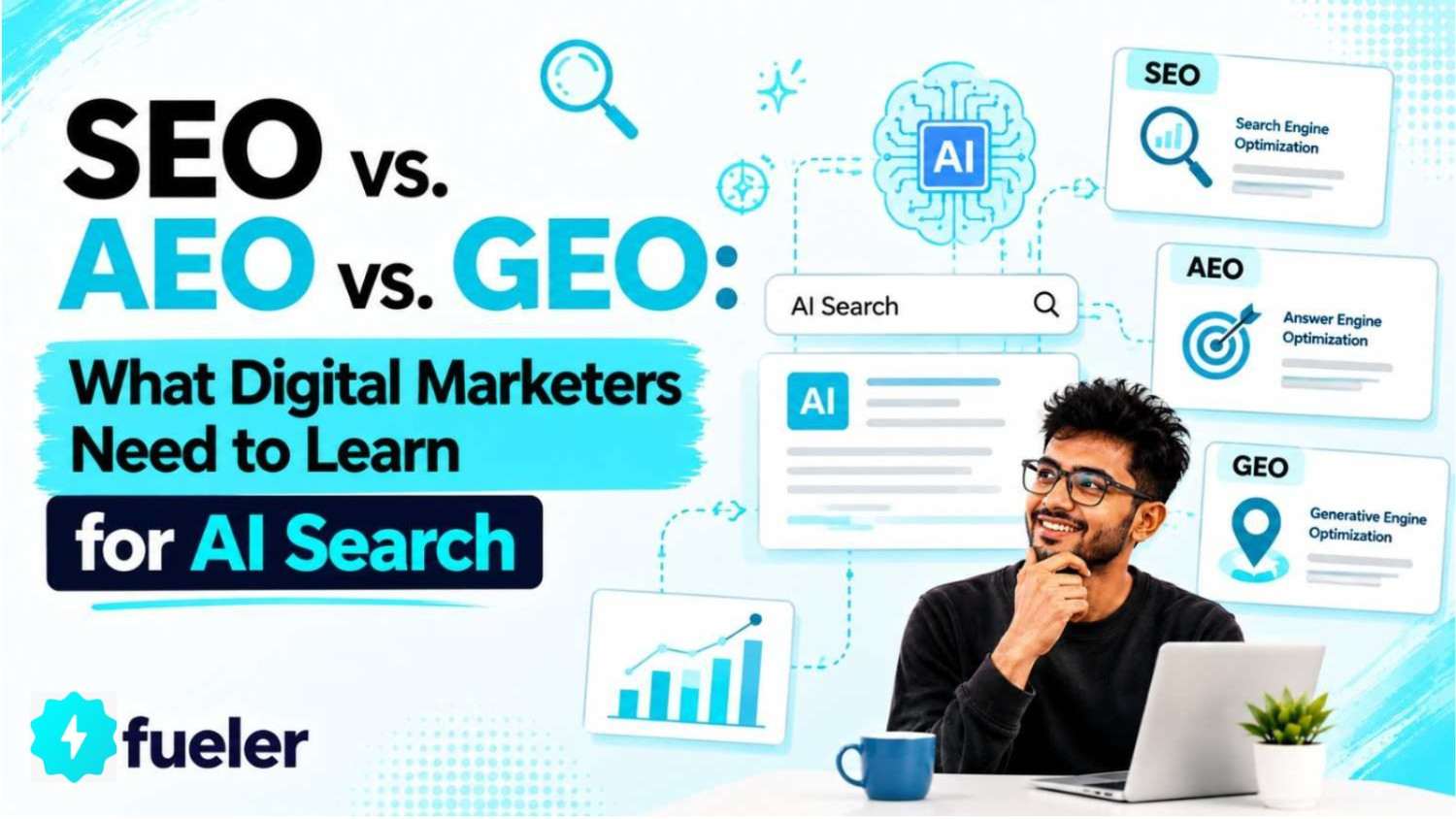
SEO vs. AEO vs. GEO: What Digital Marketers Need to Learn for AI Search

Riten Debnath
19 Aug, 2026
Last updated: August 2026
If you spent the last five years mastering traditional search optimization, here is the uncomfortable truth about 2026: ranking #1 on Google is no longer the finish line.
In fact, holding the top organic position doesn't even guarantee you'll get clicked.
Search behavior has fractured into three distinct battlegrounds. Traditional search engines still process billions of index-and-rank queries. At the same time, voice assistants and answer engines serve direct, single-source replies. Meanwhile, generative engines synthesize vast, conversational overviews that pull references from multiple domains simultaneously.
Marketers who keep applying 2020 tactics to 2026 discovery systems are watching their organic traffic disappear into a zero-click void.
I’m Riten, founder of Fueler, a skills-first portfolio platform building the career infrastructure for 100 million creative professionals. Fueler connects talented individuals with companies through assignments, portfolios, and projects, not just resumes or CVs. Think of it as Dribbble/Behance for work samples combined with AngelList for hiring infrastructure.
To protect your organic pipeline and capture discovery across modern channels, you need to understand how Traditional SEO, Answer Engine Optimization (AEO), and Generative Engine Optimization (GEO) work together. Below is your practical framework for understanding the core differences, key mechanisms, and essential skills required to dominate all three search paradigms.
The Core Definitions: Understanding SEO vs. AEO vs. GEO
The fastest way to fall behind in modern digital marketing is treating every search surface like a standard Google results page. Each model operates under entirely different indexing, retrieval, and presentation mechanics.
Understanding the fundamental purpose of each optimization framework helps you deploy the right content structure for the right platform, avoiding wasted effort on outdated tactics.
- Traditional Search Engine Optimization (SEO): The practice of optimizing web pages to rank high in traditional index-based search engine results pages (SERPs) primarily to drive direct organic website clicks.
- Answer Engine Optimization (AEO): The methodology of structuring information so conversational AI agents and voice assistants can extract immediate, definitive, single-source answers for direct user consumption.
- Generative Engine Optimization (GEO): The process of optimizing brand presence and authority to ensure AI engines synthesize, cite, and recommend your brand within comprehensive multi-source summaries.
- Primary Delivery Formats: Traditional search serves ten blue links and rich snippets; answer engines serve single direct answers; generative engines deliver interactive, synthesized, multi-paragraph responses.
- Target Audience Behavior: Traditional search users want to browse choices; answer engine users want instant answers; generative search users want synthesized research, comparisons, and structured summaries.
Why It Matters
Search engines are transforming from directory catalogs into direct knowledge providers. Recognizing the distinct boundaries of SEO, AEO, and GEO ensures your content architecture targets the exact mechanism powering each platform.
How Search Intent Shifts Across SEO, AEO, and GEO
Search intent is no longer just informational, navigational, or transactional. The medium through which a user searches dictates the depth and format of the answer they expect to receive.
A user typing a two-word phrase into a search bar has a completely different expectation than someone speaking a detailed multi-step query into a voice interface or asking a generative engine to weigh complex options.
- Standard Keyword Intent (SEO): Users search short phrases like "best marketing software" expecting a list of articles, landing pages, and comparison tables to review independently.
- Direct Fact Intent (AEO): Users ask specific questions like "what is the character limit for a meta description" expecting a one-sentence factual resolution without visiting a website.
- Synthesized Problem Intent (GEO): Users input detailed prompts like "compare three top lifecycle email tools for a B2B startup budget" expecting a tailored recommendation matrix.
- Multi-Turn Query Dynamics: Generative search relies on continuous, conversational follow-ups, requiring content that anticipates edge cases, related questions, and secondary decision steps naturally.
- Intent-To-Conversion Pipelines: Traditional search converts via landing page calls-to-action; generative search converts by establishing brand authority and product placement directly inside the synthesized output.
Why It Matters
Misaligning your content structure with user intent wastes resources. Structuring complex comparative data for quick voice queries or writing simple one-line definitions for deep research prompts guarantees poor visibility.
Technical Architecture and Data Structuring Requirements
Traditional crawlers browse raw HTML text, but AI synthesis engines look for deep relationships between real-world entities, verified facts, and authoritative databases.
Winning modern visibility requires moving beyond basic meta tags and adopting advanced schema markups, clean data hierarchies, and machine-readable content structures.
- Entity-Based Content Mapping: Organizing site architectures around recognized entities, people, organizations, concepts, and products helps generative models build accurate internal knowledge graph connections for your brand.
- Advanced Schema Implementation: Applying comprehensive Organization, Article, FAQPage, and HowTo JSON-LD schema feeds structured signals directly into search indexing engines.
- Machine-Readable Markdown Formats: Structuring body copy with clean headers, bulleted lists, and concise summary tables allows AI crawlers to parse facts without running into layout friction.
- Direct Statement Writing: Placing clear, factual definitions immediately below subheadings makes it effortless for answer engines to extract precise text clips for direct responses.
- Crawl Performance Optimization: Maintaining fast server response times, clean code rendering, and clear directory paths ensures AI crawlers efficiently index your information reserves.
Why It Matters
AI systems prioritize fast, unambiguous data sources to minimize processing overhead and hallucination risks. Structuring your technical architecture for machine readability makes your domain a preferred source for citations.
Content Creation Strategies: Keywords vs. Citations vs. Proof
The way content is written and validated has fundamentally changed. High-performing digital strategy is no longer about hitting a target keyword density; it's about providing unique information that machines can trust.
Generative models rely on cross-referencing published statements across independent sources. To get cited, your content must offer original perspective and verifiable proof that automated systems cannot invent.
- Primary Research and Data: Publishing unique industry studies, survey results, and original benchmarks creates irreplaceable data points that generative engines cite as authoritative background facts.
- First-Person Proof of Work: Integrating real screenshot evidence, specific campaign numbers, and step-by-step post-mortems demonstrates firsthand experience that automated rephrasing tools cannot emulate.
- Citation-Friendly Summary Modules: Building concise key takeaway boxes at the top of long-form articles provides clean, ready-to-cite summaries for answer engine snippets.
- Entity Disambiguation Practices: Using precise professional terminology consistently across all published assets eliminates ambiguity about your brand's core domain expertise.
- Regular Information Refreshes: Updating stats, dates, and operational processes constantly ensures generative engines recognize your site as a source of accurate, up-to-date data.
Why It Matters
Generic, rephrased content is routinely swallowed and obscured by generative search overviews. Publishing original data and verifiable proof ensures your work is cited as a foundational primary source.
Measuring Success: Metrics and Attribution in the AI Search Era
Traditional success metrics like rank positions and pageviews no longer tell the complete story of your organic reach. Zero-click searches mean users often consume your brand's expertise without ever stepping foot on your website.
Modern analytics frameworks must track dynamic brand impressions, entity share of voice, cross-platform mentions, and pipeline impact alongside standard traffic metrics.
- Tracking Brand Citation Volume: Monitoring how frequently your brand name, products, or original data appear inside generative search summaries across key commercial topics.
- Measuring Entity Share of Voice: Evaluating your brand's visibility within AI-generated product comparisons relative to your primary market competitors.
- Analyzing Zero-Click Impression Growth: Measuring total search impression trends alongside brand search volume to capture organic awareness that doesn't trigger immediate clicks.
- Self-Attribution Form Integration: Adding open-ended "How did you hear about us?" fields to lead forms to capture multi-touch generative research journeys.
- Evaluating Referral Lead Quality: Tracking conversion rates from generative engine citations, which typically yield lower traffic volume but significantly higher intent and buyer readiness.
Why It Matters
Relying exclusively on legacy traffic metrics leads to misallocated marketing budgets. Measuring brand citations and sentiment ensures you optimize for actual market influence, not just superficial pageviews.
The Tri-Optimization Matrix: SEO vs. AEO vs. GEO
How Does This Connect to Building a Strong Career or Portfolio?
As search engines shift focus toward proof of work, verified data, and author credibility, showing real execution is essential for modern marketers. Claiming you understand SEO, AEO, or GEO on a traditional resume is no longer enough to land top roles or high-paying clients. You need a public track record showing real schema implementations, original campaign breakdowns, and traffic growth case studies. Documenting these real-world projects on platforms like Fueler creates a clean, verified proof-of-work space that clearly highlights your strategic capabilities to potential employers.
Final Thoughts
The evolution from traditional search to answer engines and generative discovery isn't the death of SEO; it's an elevation of the practice. Marketers who rely on keyword stuffing and generic blog posts will continue to see their organic reach decay. Conversely, those who adapt by mastering schema structure, producing primary data, and building verifiable brand authority will command visibility across every search surface. The future of discovery belongs to those who prove their expertise instead of just asserting it.
The Final Verdict
Traditional SEO is not dead, but it is no longer sufficient on its own. The winning strategy for 2026 and beyond is a unified Tri-Optimization Framework:
- Use Traditional SEO as the foundational layer to capture high-intent, deep-research web traffic and maintain technical site health.
- Layer on SEO tactics, concise definitions, clear schema markup, and direct Q&A formatting to capture zero-click answers, voice queries, and snippet boxes.
- Master GEO by publishing original research, verifying your brand entities, and providing unassailable proof of work so generative AI engines consistently cite, recommend, and synthesize your business as the definitive authority in your space.
Do not choose between SEO, AEO, or GEO. Build a content architecture that satisfies all three, and your organic pipeline will remain bulletproof regardless of how search engines evolve.
Frequently Asked Questions
Will Generative Engine Optimization completely replace traditional SEO?
No, GEO complements traditional SEO rather than replacing it. Traditional search engines still process massive traffic for navigational and transactional queries, while GEO captures users conducting complex, conversational research.
How do I make my content easy for answer engines (AEO) to extract?
Include concise, 40–50 word factual answers directly beneath subheadings. Combine this layout with clean FAQ schema markup, clear bullet points, and plain-language definitions that machines can easily clip.
What is the best way to get cited in generative search overviews?
Publish primary data, original surveys, verified case studies, and clear comparisons. Generative models prioritize unique, trustworthy facts from recognized entity sources over rephrased, generic summaries available elsewhere online.
Does schema markup directly impact GEO visibility?
Yes, advanced schema markup helps AI crawlers map relationships between your brand, authors, products, and concepts. This structured clarity reduces algorithmic ambiguity and increases the likelihood of brand citations.
How can small brands compete with big media sites in AI search?
Focus on niche authority, original proof of work, and specialized first-hand expertise. Generative engines favor verified primary data and deep topic specialization over high-volume, generic content hubs.
Why 100,000+ professionals use Fueler
Fueler helps professionals showcase proof of work through projects, assignments, case studies, and achievements.
- Thousands of professionals use Fueler to create their digital portfolio
- Thousands of projects are published on Fueler. Check here
- Startups and Companies hire through proof of work on Fueler
- Used by freelancers, creators, marketers, video editors, writers, designers, and product managers
Our mission is to help the next 100 million professionals build a verified professional identity through proof of work

What should you do next?
You've read the article. Now turn your skills into proof of work and unlock more opportunities.
Build your proof of work portfolio
Create a clean portfolio with projects, assignments, resumes, and AI stack details that companies actually want to see.
Create your Fueler portfolio →Apply through assignments, not resumes
Stand out by solving real tasks from companies hiring on Fueler.
Explore assignments →Get discovered by companies
Make your work public and let recruiters discover your skills through actual projects instead of keywords.
Get discovered →
