Real Projects vs Digital Marketing Certifications: What Matters More?

Riten Debnath
29 Jul, 2026
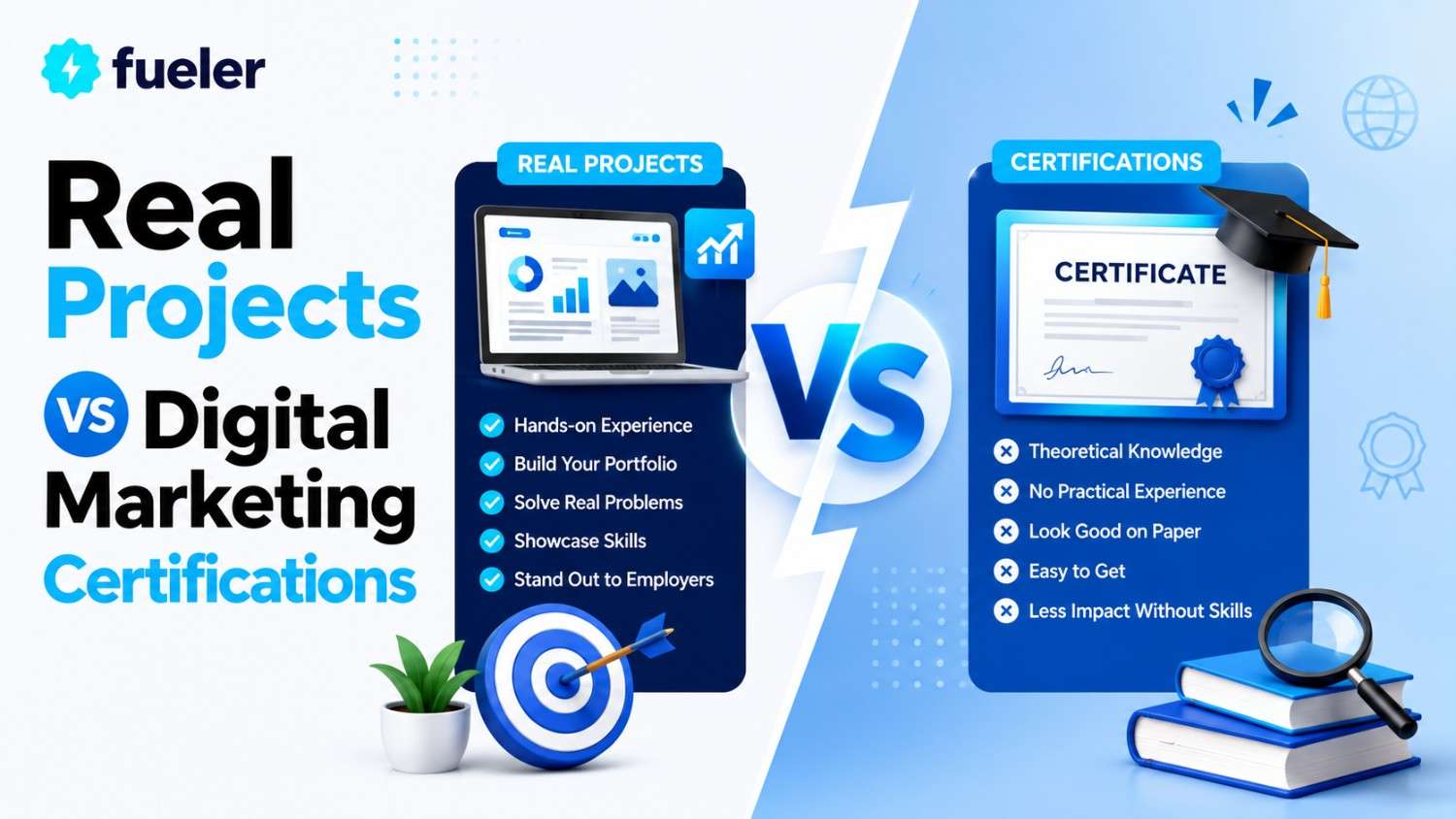
Last updated: July 2026
Marketing leaders face a massive influx of candidate resumes decorated with identical digital badges, yet hiring the right talent remains surprisingly difficult. Course completion badges look impressive on paper, but they rarely indicate whether a candidate can manage real ad budgets, fix declining conversion rates, or drive measurable revenue growth.
I’m Riten, founder of Fueler, a skills-first portfolio platform building the career infrastructure for 100 million creative professionals. Fueler connects talented individuals with companies through assignments, portfolios, and projects, not just resumes or CVs. Think of it as Dribbble/Behance for work samples combined with AngelList for hiring infrastructure.
In this guide, we evaluate how top hiring managers weigh theoretical learning against live campaign execution. You will discover why proof of work streamlines talent evaluation, how independent projects build core strategic instincts, and how to present practical campaign results to secure high-growth marketing roles.

The Core Difference: Simulated Theory vs Live Execution Risk
Educational courses teach marketing terminology, budget allocation models, and platform settings inside a controlled environment. However, theoretical exercises never prepare a marketer for sudden shifts in customer acquisition costs, creative fatigue, or unexpected ad account suspensions.
Hands-on campaign execution requires making rapid decisions with real financial resources on the line. When candidates manage live budgets, troubleshoot low conversion rates, and iterate ad copy in real time, they build tactical instincts that standardized multiple-choice tests cannot measure.
- Managing real advertising spend teaches budget efficiency because every mistake carries an immediate financial cost. Marketers who run active campaigns learn how to refine audience targeting, eliminate wasted ad impressions, and preserve return on ad spend during unpredictable market fluctuations.
- Executing live organic campaigns exposes marketers to actual user behavior rather than ideal consumer personas. Real search engine traffic data shows how audience search intent shifts, helping strategists refine content production and improve long-term organic discovery rankings.
- Handling technical issues during campaign launches builds crisis management skills that online courses fail to simulate. Marketers running live projects must troubleshoot broken conversion tags, fix failing landing page scripts, and restore tracking pipelines under tight team deadlines.
- Testing ad creative messaging on live audiences reveals what drives action versus passive scrolling. Direct execution experience helps marketers analyze click-through rates, test headlines, and adjust visual copy based on actual performance metrics rather than aesthetic personal opinion.
- Analyzing conversion funnels in real environments provides clear insight into customer friction points. Hands-on campaign managers trace user paths from initial ad discovery to checkout completion, making data-backed layout tweaks that directly boost overall revenue metrics.
Why It Matters:
Understanding the gap between theoretical knowledge and live execution helps companies hire practitioners who generate immediate business value. When talent evaluation focuses on real-world execution rather than course completion, teams save significant onboarding time. This operational pivot directly accelerates campaign efficiency and overall company growth.
9 Points of Differentiation: Real Projects vs Digital Marketing Certifications
To truly understand how employers and clients evaluate marketing capability, we must look beyond surface-level credentials. The distinction between completing a structured course and launching a live campaign comes down to core operational accountability, strategic adaptability, and measurable output.
Here are nine clear points of differentiation that separate theoretical certified learners from proven campaign operators:
1. Financial Accountability and Risk Management
Certifications operate in a zero-risk environment where mistakes cost nothing except time spent retaking a quiz module. Real projects require managing actual marketing budgets where poor audience targeting or bad copy directly wastes company capital.
2. Adaptation to Algorithm and Platform Changes
Course curricula are static and often lag behind rapid platform updates, privacy changes, and ad network algorithm shifts. Real project execution forces marketers to adapt to live platform disruptions, sudden cost spikes, and shifting tracking rules in real time.
3. Problem-Solving vs Multiple-Choice Selectivity
Certifications test memory recall through structured multiple-choice questions with predetermined correct answers. Real campaigns throw ambiguous, unstructured challenges at you, requiring custom troubleshooting when tracking breaks, conversion rates drop, or landing pages fail.
4. Direct Impact on Business Revenue and ROI
Earning a certificate shows you completed a syllabus, but it cannot demonstrate an ability to generate pipeline or sales. Real projects deliver verifiable revenue metrics, showing exactly how campaign strategies reduced customer acquisition costs and boosted bottom-line profitability.
5. Technical Data Literacy and Analytics Integration
Course simulations present clean, pre-packaged analytics scenarios that rarely match chaotic real-world setup environments. Real projects demand configuring custom event tracking, resolving cross-domain attribution issues, and translating raw data dashboards into actionable business decisions.
6. Creative Iteration Based on Real User Feedback
Theoretical coursework evaluates whether you understand basic copy structures or design best practices on paper. Real projects test ad copy, landing page layouts, and visual assets against real human audiences, forcing continuous adjustments based on live click-through and conversion metrics.
7. Cross-Functional Team Collaboration
Certifications are solitary learning experiences completed independently behind a screen. Executing real projects requires collaborating with designers, developers, sales reps, and founders, building communication skills needed to align cross-functional teams around a shared campaign goal.
8. Verification and Anti-Saturation Value
Digital badges are easily saturated, making candidates holding identical course certificates look indistinguishable to recruiters. A documented portfolio of real projects provides unique, non-replicable proof of execution that instantly distinguishes a practitioner from the crowd.
9. Strategic Depth and Full-Funnel Empathy
Course modules teach marketing channels in isolation, separating paid search, organic content, and email automation into separate silos. Real projects force you to integrate multiple channels into a unified customer journey, teaching you how top-of-funnel discovery translates into long-term customer retention.
Why It Matters:
Evaluating these nine dimensions helps job seekers and hiring teams focus on the capabilities that drive actual revenue growth. While certifications offer foundational platform familiarity, real project execution builds tactical resilience, commercial awareness, and multi-channel mastery.
Why Hiring Managers Prioritize Proven Performance Metrics
Modern recruitment teams process hundreds of applications featuring nearly identical course certifications. A candidate claiming expertise through a digital badge looks indistinguishable from every other applicant, making initial resume screening slow and unreliable.
Proven performance metrics eliminate hiring ambiguity by offering verifiable evidence of technical execution. When a candidate presents documented conversion rate gains or customer acquisition cost reductions, employers can reliably forecast their contribution to company growth.
- Real performance metrics demonstrate a clear understanding of commercial business goals beyond surface-level engagement. Hiring managers favor candidates who present verified customer acquisition numbers, revenue growth percentages, and retention rates over those who simply list completed online course modules.
- Documented campaign results prove that a candidate can make sound analytical decisions under budget constraints. Showing historical lead generation data proves an ability to analyze conversion paths, adjust underperforming channels, and scale winning strategies without wasting company capital.
- Case studies detailing previous experimentation processes highlight structured thinking and adaptability. Candidates who document hypothesis testing, performance failures, and subsequent optimization strategies demonstrate the tactical resilience required to navigate changing ad platforms and competitive markets.
- Verified project outcomes reduce onboarding risk for growth-stage businesses needing immediate team execution. Presenting tangible proof of past search optimizations or ad account restructures gives hiring managers high confidence that the candidate can execute complex tasks without constant oversight.
- Transparent metrics showcase an operational focus on return on marketing investment. When candidates explain how their content campaigns reduced cost per lead, they align themselves with executive priorities, proving they view marketing as a revenue generator rather than an expense.
Why It Matters:
Prioritizing proven metrics transforms how organizations structure talent acquisition pipelines. It enables founders and marketing leads to screen for execution efficiency rather than test scores. Ultimately, selecting candidates with verified track records safeguards marketing budgets and accelerates time-to-market for key campaigns.
How Personal Side Projects Accelerate Strategic Marketing Skills
Building a personal brand, launching an e-commerce storefront, or growing a niche newsletter forces a marketer to direct end-to-end operations. In open market environments, there are no pre-made answer keys or step-by-step course prompts.
Independent side initiatives require designing brand positioning, setting up tracking architectures, and driving audience growth from scratch. This multi-disciplinary execution builds holistic business empathy that isolated, entry-level marketing tasks can rarely deliver.
- Managing self-funded marketing projects builds deep ownership because strategic errors directly impact personal resources. Independent creators quickly learn how to prioritize high-impact distribution channels, audit analytics tags, and write persuasive landing page copy that drives real user signups.
- Building niche audience channels from scratch teaches organic growth tactics better than theoretical study. Launching a content platform requires consistent editorial scheduling, strategic keyword planning, and active community engagement to turn anonymous web traffic into loyal, repeating subscribers.
- Setting up full tracking systems for personal websites develops technical competence. Marketers managing independent projects must configure domain records, organize custom event triggers, and build custom reporting dashboards to track conversion funnels accurately across every customer touchpoint.
- Writing persuasive sales copy for independent digital products sharpens direct-response communication skills. Testing call-to-action button placements, headline variations, and offer pricing structures on live web traffic provides immediate feedback on customer purchasing psychology and offer positioning.
- Running small-budget experimental ad campaigns teaches precise audience segmentation and budget discipline. Experimenting with narrow demographic targeting and niche retargeting lists reveals how tiny adjustments in campaign settings can double conversion efficiency while keeping total spend minimal.
Why It Matters:
Personal projects transform passive learners into proactive operators who understand full-funnel mechanics. Candidates who build independent channels bring pre-tested workflows, strategic initiative, and practical troubleshooting to marketing teams. This self-driven background makes them significantly more adaptable than applicants relying purely on classroom scenarios.
The Strategic Role of Certifications in Modern Skill Acquisition
While certificates alone do not guarantee hiring success, ignoring structured learning altogether is a missed opportunity. Professional training programs provide a clear introduction to complex technical frameworks and foundational industry concepts.
The core value of a certification lies in building baseline software literacy and standardized vocabulary. When combined with immediate practical application, formal coursework accelerates skill development by offering a structured roadmap for campaign management.
- Structured educational courses establish foundational industry terminology that improves team communication. Learning standardized campaign terminology, attribution models, and privacy compliance guidelines helps early-career marketers collaborate cleanly with senior strategists and external technical agencies without misinterpreting project goals.
- Professional certification tracks provide comprehensive step-by-step documentation for complex software ecosystems. Completing guided platform tutorials ensures marketers understand hidden interface features, advanced data segmentation options, and automated campaign settings before managing live corporate advertising budgets.
- Formal learning modules offer systematic frameworks for auditing existing marketing infrastructure. Studying structured evaluation methodologies helps practitioners systematically identify website indexing errors, assess ad account structures, and uncover hidden conversion friction across diverse digital channels.
- Industry coursework helps marketers stay informed about emerging privacy regulations and tracking standards. Structured training programs continuously update compliance guidelines, teaching practitioners how to manage user consent frameworks, first-party data strategies, and cookieless tracking solutions effectively.
- Completing specialized credentials signals discipline and a commitment to ongoing professional development. While badges do not replace real campaign results, earning verified credentials shows hiring managers that a candidate proactively invests time into expanding their technical skill base.
Why It Matters:
Certifications serve as valuable launchpads when paired with real campaign execution, providing structured clarity across intricate tools. Understanding how to use coursework as a foundation rather than a finish line helps marketers build competence faster. This balanced approach enables teams to expand campaign output without sacrificing technical precision.
How Does This Connect to Building a Strong Career or Portfolio?
Mastering modern marketing requires moving beyond resume claims and showcasing clear proof of work. Documenting live campaign setups, A/B testing methodologies, and verified growth metrics gives hiring managers direct insight into your strategic thinking and execution capabilities.
As companies shift toward outcome-based hiring, publishing detailed project walkthroughs builds immediate credibility. Platforms like Fueler allow creators and marketers to curate their assignments, campaign case studies, and side initiatives into an organized portfolio, ensuring their practical achievements speak louder than standard certifications.
Final Thoughts
The debate between certifications and real projects is not about choosing one and abandoning the other. Certifications provide structured platform mechanics, while real projects develop commercial instinct, problem-solving skills, and measurable business outcomes.
Marketers who combine foundational training with live, published proof of work will consistently win top roles. Focus on building, testing, and documenting real campaigns to ensure your portfolio reflects actual market value.

Frequently Asked Questions
Are digital marketing certifications worth it for landing entry-level jobs?
Certifications help entry-level applicants learn foundational platform vocabulary and clear basic ATS filters. However, landing top roles requires combining badges with real project proof to demonstrate practical execution capability to hiring managers.
Do hiring managers prefer a portfolio or certifications in 2026?
Hiring managers overwhelmingly favor a real-world project portfolio showing verifiable conversion metrics and ad spend management. Verified case studies prove practical execution skills that digital badges simply cannot guarantee on their own.
Can I get hired in digital marketing without any formal certifications?
Yes, candidates with documented campaign case studies, verified side projects, or client growth results land marketing roles regularly. Employers prioritize proven business outcomes, ad spend experience, and problem-solving skills over course completion certificates.
How should I showcase personal marketing projects to prospective employers?
Document your side projects by publishing detailed case studies that explain initial goals, channel strategies, technical setups, and final performance metrics. Presenting clear proof of work highlights your analytical thinking and end-to-end execution skills.
What is the fastest way to gain real marketing experience as a beginner?
Launch a personal website, manage a small-budget ad campaign, or optimize organic content for a local business or newsletter. Running live experiments builds practical data analysis, copy testing, and conversion tracking skills faster than passive study.
Why 100,000+ professionals use Fueler
Fueler helps professionals showcase proof of work through projects, assignments, case studies, and achievements.
- Thousands of professionals use Fueler to create their digital portfolio
- Thousands of projects are published on Fueler. Check here
- Startups and Companies hire through proof of work on Fueler
- Used by freelancers, creators, marketers, video editors, writers, designers, and product managers
Our mission is to help the next 100 million professionals build a verified professional identity through proof of work

What should you do next?
You've read the article. Now turn your skills into proof of work and unlock more opportunities.
Build your proof of work portfolio
Create a clean portfolio with projects, assignments, resumes, and AI stack details that companies actually want to see.
Create your Fueler portfolio →Apply through assignments, not resumes
Stand out by solving real tasks from companies hiring on Fueler.
Explore assignments →Get discovered by companies
Make your work public and let recruiters discover your skills through actual projects instead of keywords.
Get discovered →
