How to Start a Digital Marketing Career With No Experience in 2026?

Riten Debnath
06 Aug, 2026
Last updated: August 2026
Landing an entry-level job in digital marketing used to require a relevant college degree or years of unpaid agency internships. In 2026, companies care far less about traditional credentials and much more about verifiable evidence that you can drive distribution, capture attention, and deliver real business value.
I’m Riten, founder of Fueler, a skills-first portfolio platform building the career infrastructure for 100 million creative professionals. Fueler connects talented individuals with companies through assignments, portfolios, and projects, not just resumes or CVs. Think of it as Dribbble/Behance for work samples combined with AngelList for hiring infrastructure.
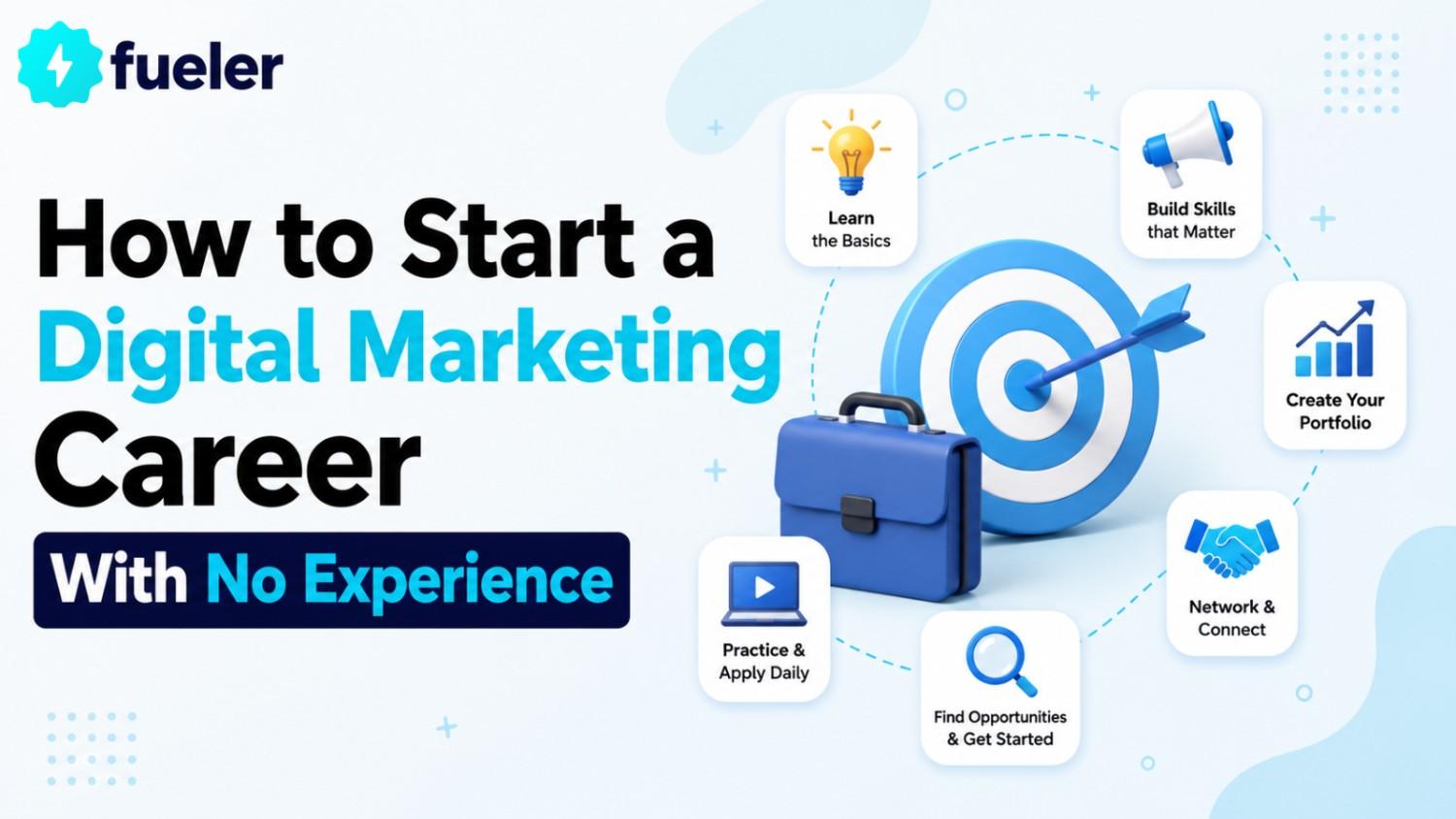
Breaking into digital marketing without prior client experience comes down to building your own track record through public execution. In this detailed guide, you will discover 10 actual, practical ways to build real marketing skills, execute self-directed campaigns, measure your results, and present your output to land your first paid role without relying on a traditional resume.
Build a Niche Personal Blog and Optimize for Organic Search
Starting a blog on a niche topic gives you full control over a real website where you can test search engine optimization techniques. Instead of reading about keyword research in theory, you actively find search queries, write structured articles, set up basic meta tags, and watch how search engines index your pages over time.
This hands-on execution teaches you technical site health, internal linking, and user engagement metrics. Having a live blog with actual organic search traffic is the single best way to prove to hiring managers that you understand how content acquires readers naturally without paid advertising.
- Keyword Research Execution: Finding low-competition search queries using free tools like Google Keyword Planner or AnswerThePublic helps you identify what real users are searching for online, teaching you how search intent works before you ever write a single line of text.
- On-Page Optimization Structure: Formatting titles, subheadings, image text, and meta descriptions properly shows search engines what your page is about, ensuring your written content ranks effectively for relevant search queries without getting ignored.
- Performance Tracking Setup: Connecting Google Analytics 4 and Google Search Console to your blog lets you monitor daily impression numbers, click rates, and visitor habits, giving you real data to analyze.
- Content Experience Tuning: Organizing your text into short paragraphs, clear sections, and scannable lists keeps visitors on your page longer, which improves overall engagement metrics and signal quality for search indexing.
- Search Trend Adaptation: Modifying older blog posts to cover new questions keeps your content relevant over time, proving you know how to maintain organic positions and keep site traffic growing consistently.
Why It Matters
Building and ranking a real website gives you immediate credibility during job interviews. Employers prefer hiring candidates who have already built and managed a live web asset over applicants who have only completed theoretical online quizzes.
Run Self-Funded Micro Ad Campaigns on Social Media
Setting up small ad campaigns with a tiny budget of five to ten dollars lets you experience performance marketing firsthand. You get to navigate real advertising dashboards, build targeted customer audiences, upload creative assets, and set daily budgets.
Running these micro-tests teaches you how ad platforms auction impressions and calculate cost-per-click metrics. Learning how to manage real ad dollars even a very small amount removes the fear of using professional advertising tools and builds genuine confidence in performance media management.
- Target Audience Setup: Selecting specific user demographics, geographic locations, and interest categories within advertising dashboards ensures your messages reach the exact group of people most likely to engage with your offers.
- Creative Asset Design: Creating simple image banners or vertical short videos using free editing software teaches you how visual elements and headline combinations capture attention in busy social media feeds.
- Budget and Bidding Allocation: Setting daily spend caps and choosing cost-per-click bidding options teaches you how ad auction systems work, helping you manage client money efficiently without overspending.
- Conversion Parameter Tracking: Adding tracking pixels or URL parameters to your destination pages lets you track when an ad click turns into a button click or email sign-up.
- A/B Testing Execution: Running two slightly different versions of an ad headline simultaneously shows you which messaging style performs better, training you to make data-backed adjustments rather than guessing.
Why It Matters
Paid advertising skills are in high demand across agencies and startups. Showing that you have already managed real budget allocations, configured tracking pixels, and measured return on ad spend sets you apart from candidates who only understand theoretical concepts.
Conduct Audits for Local Small Businesses
Local service businesses such as plumbers, dental clinics, or independent coffee shops often struggle with their online visibility. Auditing their public Google Business profiles, website speed, and social media presence allows you to identify clear operational gaps without needing backend account access.
Documenting these opportunities into neat, easy-to-read tear-down documents gives you practical review experience. When you share these audits with owners as free value, you open doors for freelance projects while creating impressive case studies for your job application materials.
- Google Business Profile Review: Checking local map listings for missing contact details, inconsistent business hours, or unaddressed customer reviews highlights quick fixes that immediately improve local search visibility for physical businesses.
- Website User Experience Analysis: Testing a local business site on a mobile device reveals slow loading speeds, broken links, or missing contact buttons that frustrate visiting customers and lower conversion rates.
- Social Channel Content Inspection: Reviewing a business's social channels identifies inconsistent posting schedules or low-engagement content, helping you propose simple content ideas that reconnect with local audiences.
- Competitor Gap Identification: Comparing a local shop against three nearby competitors shows where they lag in customer reviews, ranking keywords, or media quality, giving you clear talking points.
- Actionable Audit Presentation: Assembling your findings into a clean, 3-page document with marked-up screenshots makes your technical advice easy for non-technical business owners to understand and act on.
Why It Matters
Small business audits prove that you possess strong analytical thinking and business sense. It demonstrates to potential employers that you can evaluate a live brand, spot growth opportunities, and present actionable solutions clearly.
Manage Short-Form Video Accounts for Niche Communities
Short-form video is a dominant content format across modern social networks. Starting an organic video account focused on a specific hobby, book genre, or local community allows you to practice scriptwriting, video recording, and hook creation without needing client permission.
Posting vertical videos regularly teaches you how social algorithms distribute media based on watch time and retention rates. Learning to hook viewers in the first three seconds and keep them watching gives you a repeatable framework for content creation.
- Hook Script Writing: Crafting clear, intriguing opening lines within the first three seconds of a video stops users from scrolling, significantly improving overall retention and reach metrics.
- Basic Mobile Video Editing: Trimming silent pauses, adding automatic captions, and inserting simple text overlays using free phone apps makes videos easy to watch even when sound is muted.
- Trend and Audio Research: Spotting popular audio tracks, popular formatting styles, and trending topics allows you to join active online conversations and gain organic views faster.
- Community Engagement Management: Answering audience comments, asking follow-up questions, and starting discussions builds an active community around your channel, which boosts channel reach and audience trust.
- Retention Analytics Evaluation: Reviewing watch-time charts in your channel dashboard reveals exact drop-off points, showing you where to edit faster or refine your message in future videos.
Why It Matters
Brands are actively competing for consumer attention on mobile screens. Proving that you can reliably create short videos that hold viewer attention shows employers you can manage modern organic distribution channels effectively.
Launch a Weekly Email Newsletter
Email marketing remains one of the most reliable online sales and retention channels. Setting up a free account on a modern newsletter software platform lets you design signup forms, write weekly digest emails, and manage subscriber lists.
Writing a weekly email forces you to curate valuable news, summarize complex topics, and draft compelling subject lines. Tracking your open rates and link clicks gives you direct feedback on what topics resonate most with your audience.
- Subscriber Form Design: Creating clean email signup popups and landing pages teaches you how to design simple, high-converting opt-in forms that convince web visitors to share their email addresses.
- Subject Line Optimization: Writing short, intriguing subject lines increases the percentage of subscribers who open your messages, building your understanding of inbox psychology.
- Email Template Formatting: Structuring emails with clear headings, scannable bullet points, and prominent click buttons ensures your messages look great on both phone and desktop screens.
- Automated Welcome Sequences: Setting up automatic welcome messages sent immediately after someone subscribes introduces new readers to your best work on complete autopilot.
- Deliverability and Engagement Analysis: Reviewing click-through rates and unsubscribe numbers helps you maintain a clean email list while continually improving content quality.
Why It Matters
Email marketing skills translate directly to revenue generation for e-commerce stores and SaaS platforms. Showing an employer that you know how to nurture an audience over email makes you an immediately useful team member.
Complete Platform-Direct Certifications with Hands-On Practice
While generic certificates carry little weight, official training programs offered directly by major advertising platforms provide structured foundational knowledge. Completing free official courses for search ads, measurement tools, and social advertising verifies that you know platform terminology and dashboard navigation.
The key is pairing these certifications with practical application. Instead of stopping at the multiple-choice exam, apply what you learned by building sample campaign structures, configuring mock conversion goals, and taking clean screenshots of your work.
- Measurement Platform Certification: Completing official analytics training confirms your ability to track web traffic, configure custom events, and generate performance reports accurately.
- Search Advertising Accreditation: Learning official search ad principles teaches you how quality scores, keyword matching types, and ad extensions influence campaign results.
- Social Marketing Credentialing: Studying platform-native advertising guidelines helps you understand campaign objectives, custom audience creation, and creative delivery rules.
- Inbound Marketing Fundamentals: Learning how lead generation, content distribution, and customer relationship software work together gives you a complete view of digital sales funnels.
- Campaign Mock-Up Creation: Building complete, un-submitted sample campaigns within free platform preview tools lets you document your target audience settings and ad copy for your portfolio.
Why It Matters
Certifications prove basic platform literacy, while your accompanying campaign mock-ups prove practical application. This combination shows recruiters that you possess both theoretical knowledge and practical technical skills.
Volunteer to Manage Marketing for Non-Profits or Community Groups
Non-profit organizations, local sports clubs, and student groups often lack the time and resources to run active digital marketing campaigns. Reaching out to offer free marketing help gives you access to active real-world accounts with existing audiences.
Managing real accounts teaches you how to work alongside stakeholders, maintain brand guidelines, and handle real budget limits. The results you achieve for these groups serve as verified, ethical client work that you can present confidently during job interviews.
- Stakeholder Campaign Planning: Pitching simple marketing ideas to organization leaders teaches you how to present strategy, set clear timelines, and align marketing efforts with organizational goals.
- Event Promotion Execution: Designing digital graphics and writing promotional posts for upcoming local events gives you real deadlines and clear attendance metrics to track.
- Donor and Member Lead Generation: Building simple contact forms to collect volunteer signups or newsletter subscribers provides hands-on experience in generating real conversions.
- Organic Channel Management: Updating social pages, posting regular announcements, and responding to direct messages maintains consistent brand activity for the organization.
- Impact Result Reporting: Assembling monthly reports showing traffic growth, social impressions, and event signups translates your efforts into clear business metrics.
Why It Matters
Volunteering bridges the gap between self-directed personal projects and formal agency employment. It gives you authentic team experience, client communication practice, and verifiable campaign results that validate your resume claims.
Build In-Depth Case Studies of Popular Brand Campaigns
Deconstructing successful marketing campaigns run by well-known brands helps you build analytical skills without needing backend access. Pick a recent product launch or viral promotional campaign and analyze every visible customer touchpoint.
Map out the entry point, the landing page layout, the email follow-up sequence, and the social retargeting ads. Putting these elements together into a visual reverse-engineering report shows that you understand the big picture of multi-channel marketing campaigns.
- Customer Acquisition Path Mapping: Documenting every step a buyer takes from seeing an initial social post to visiting a product page reveals how brands guide audience interest.
- Landing Page Conversion Breakdown: Analyzing page headlines, customer reviews, product photos, and checkout buttons shows you why certain layouts convert visitors into buyers.
- Ad Copy Messaging Analysis: Examining the specific problem statements, benefit offers, and calls-to-action used across different ad variations highlights winning sales angles.
- Cross-Channel Consistency Check: Checking if a brand’s email tone, social graphics, and web pages share a unified visual style teaches you how big companies maintain brand consistency.
- Strategic Improvement Proposal: Adding a dedicated section at the end of your breakdown proposing three ways the brand could improve its campaign demonstrates proactive strategic thinking.
Why It Matters
Creating detailed campaign breakdowns shows employers that you understand modern marketing strategy at an enterprise level. It proves you can evaluate competitive strategies, spot hidden growth opportunities, and think like a seasoned marketing strategist.
Offer Free Performance-Based Help to Micro-Influencers
Micro-influencers with 5,000 to 50,000 followers usually produce great content but lack the time to build proper digital funnels or sell digital products. Offering to build simple link pages, design newsletter signups, or edit video clips for them creates a mutually beneficial partnership.
Working with micro-influencers gives you access to engaged audiences where you can test real distribution channels. When your funnel or email capture setup helps an influencer grow their subscriber list or sell merchandise, you gain a powerful testimonial and live performance metrics.
- Funnel Landing Page Assembly: Setting up single-page landing pages featuring bio links, product recommendations, and newsletter signup forms gives influencers a centralized home for their traffic.
- Content Repurposing Workflows: Turning long-form influencer live streams or long videos into bite-sized short clips with captions expands their reach across multiple social networks.
- Lead Magnet Asset Design: Designing simple downloadable guides, resource lists, or checklists gives an influencer's audience a compelling reason to subscribe to an email list.
- Affiliate and Product Tracking: Setting up custom tracking links helps influencers measure which social posts generate the most product clicks and sales commissions.
- Testimonial and Metric Collection: Gathering written praise and screenshotting performance improvements from the influencer provides undeniable proof of work for your portfolio.
Why It Matters
Influencer partnerships put your skills to the test in front of real, active audiences. Successfully building conversion systems for creators proves that you know how to turn casual social attention into measurable business leads.
Document Your Entire Learning Process in Public
Sharing your daily study notes, campaign tests, audit breakdowns, and marketing lessons publicly on professional social platforms builds an organic network of industry contacts. Rather than pretending to be an expert, document your journey as an active learner.
Posting honest summaries of your experiments, what worked, what failed, and what you learned attracts attention from hiring managers who value transparency, curiosity, and continuous learning. Public documentation turns your daily practice into a magnet for job opportunities.
- Experiment Outcome Summaries: Publishing concise breakdowns of small ad experiments or content tests highlights your commitment to testing ideas and analyzing real data.
- Weekly Skill Synthesis Posts: Summarizing key takeaways from marketing books, industry reports, or platform updates shows that you stay on top of changing digital trends.
- Visual Audit Slide Decks: Turning your small business audits into multi-slide image posts makes your analytical work easy for scrolling industry peers to view and share.
- Peer Engagement and Commentary: Adding thoughtful, insightful comments to posts written by established marketing directors helps build professional connections naturally.
- Public Portfolio Milestone Updates: Sharing direct links whenever you finish a new project, complete a newsletter issue, or launch a live site invites your network to track your progress.
Why It Matters
Consistently documenting your progress builds an active digital footprint that acts as a beacon for job offers. Employers often prefer reaching out to proactive learners who post their work publicly over sifting through cold resume submissions.
How Does This Connect to Building a Strong Career or Portfolio?
Modern marketing directors rarely hire based on claims on a resume. They look for proof of work verifiable evidence that you can build campaigns, analyze numbers, and solve actual marketing challenges.
When you document your blog traffic, small business audits, micro-ad tests, and email workflows inside a clean Fueler portfolio, you convert abstract skills into tangible proof. Presenting clear project outcomes instantly positions you as a capable, job-ready marketer who focuses on execution over credentials.
Final Thoughts
Breaking into digital marketing with no prior formal experience comes down to taking initiative. By executing real projects, testing ideas, and publishing your output publicly, you build the exact practical experience companies compete to hire. Focus on producing measurable work, document every project carefully, and let your proven results speak for your capabilities.
FAQs
What digital marketing skills are most important for beginners in 2026?
Beginners should focus on mastering one core discipline like organic search, conversion copywriting, or short-form video creation while building basic skills in analytics tracking and audience segmentation.
Can I get an entry-level digital marketing job without a marketing degree?
Yes, modern companies prioritize demonstrated skills, real project outputs, and analytical thinking over traditional college degrees. A strong proof-of-work portfolio carries significantly more weight than a resume alone.
How long does it take to learn digital marketing with no experience?
With dedicated daily practice, you can build job-ready skills, run personal campaigns, and assemble a solid portfolio in three to six months of consistent execution.
Do I need a big budget to practice paid advertising skills?
No, you can run effective performance experiments on social ad platforms with a small budget of five to ten dollars, allowing you to learn dashboard navigation and conversion tracking safely.
What is the best way to show proof of work to potential employers?
Organize your project descriptions, campaign screenshots, performance reports, and client audit documents into a clean online portfolio platform like Fueler, and share direct links in your job applications.
Why 100,000+ professionals use Fueler
Fueler helps professionals showcase proof of work through projects, assignments, case studies, and achievements.
- Thousands of professionals use Fueler to create their digital portfolio
- Thousands of projects are published on Fueler. Check here
- Startups and Companies hire through proof of work on Fueler
- Used by freelancers, creators, marketers, video editors, writers, designers, and product managers
Our mission is to help the next 100 million professionals build a verified professional identity through proof of work

What should you do next?
You've read the article. Now turn your skills into proof of work and unlock more opportunities.
Build your proof of work portfolio
Create a clean portfolio with projects, assignments, resumes, and AI stack details that companies actually want to see.
Create your Fueler portfolio →Apply through assignments, not resumes
Stand out by solving real tasks from companies hiring on Fueler.
Explore assignments →Get discovered by companies
Make your work public and let recruiters discover your skills through actual projects instead of keywords.
Get discovered →
