How Real-Time Collaboration Tools are Changing Field Management

Team Fueler
16 May, 2026
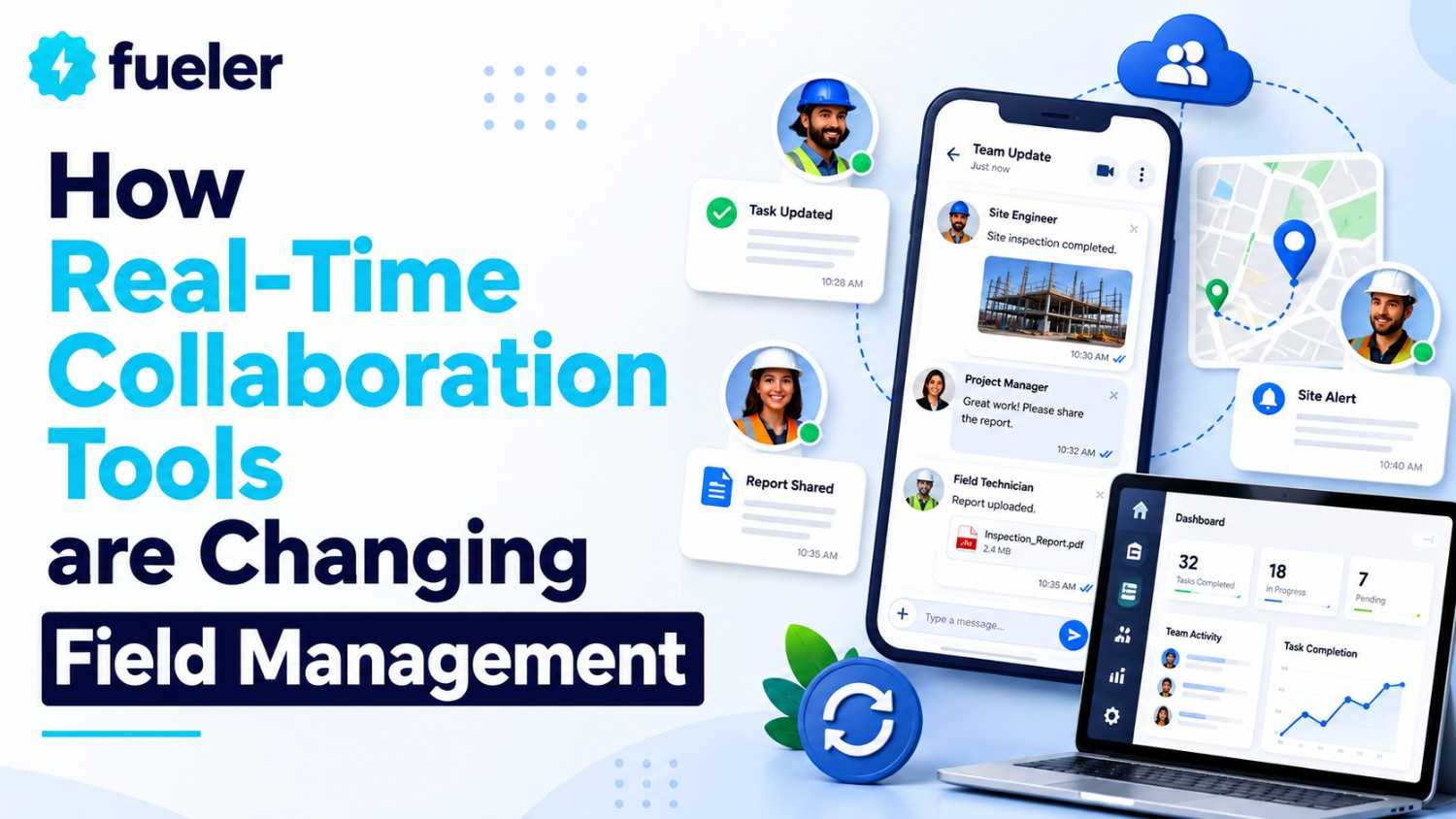
In 2026, roughly 80% of U.S. workers use digital collaboration tools, and the field service management (FSM) sector is no exception.
Manufacturers investing in real-time collaboration tools for field workers have since reported a reduction in project delays by up to 30%, fewer errors, and higher first-time fix rates.
As we welcome powerful technology to the industry, field teams are benefiting from real-time data sharing, live job updates, and remote expert assistance, improving on-the-job productivity and reducing administrative work that pulls employees off-site and into the office.
With the FSM sector quickly beginning to evolve, we’ve taken a deep dive into the role of real-time collaboration in a powerful field management strategy.
The Benefits of Real-Time Data Sharing
There’s no doubt that real-time data sharing is the backbone of powerful field operations.
With the ability to ensure that field workers spread across multiple locations remain on the same page, real-time data sharing has singlehandedly reduced project delays and continues to speed up problem-solving.
With 75% of professionals identifying an increasing need for real-time, rapid decision-making in the field, collaborative tools have become a game-changer for a fast-paced industry.
Adding real-time data sharing functions to these tools has taken field management one step further, enabling technicians, dispatchers, and managers to enjoy a real-time view of field conditions, resource allocation, route planning, service trends, and inefficiencies.
A single source of truth helps make coordination and collaboration seamless. As a result, field teams are better equipped to allocate accurate labor and materials as well as handle difficult tasks without extra assistance.
What are Field Teams Looking for in FSM Solutions in 2026?
Real-time collaboration has become a must-have when it comes to choosing a powerful FSM solution in 2026.
Field service workers are hunting for tools that offer live updates, task automation, and real-time data reporting for accurate labor/resource allocation.
Here are just a few of the key elements your field team should look for when choosing a collaborative FSM solution in 2026:
- Instant Data Sharing: This is a given for multi-location field workers. Your FSM tool should enable your team to share live updates, interactive job files, and requests for labor/resources on the job.
- Mobile Notifications: As dispatchers monitor field conditions and adjust schedules dynamically, all field engineers should receive live mobile notifications detailing reroutes in real-time.
- Automated Alerts: If a technician is running late or has been reoruted, updating the customer manually can be time-consuming. The best FSM tools automate this process and notify customers of technician delays in real-time to help keep them in the loop while taking the strain off of field engineers.
- Peer-to-Peer Problem Solving: Real-time collaboration tools enable field technicians to connect and collaborate with nearby colleagues on the road. For example, if a technician is missing a piece of equipment, they can check if a local field engineer has the part in stock, reducing the need to return to base.
- Remote Assistance: Modern FSM tools now include powerful AR/VR integrations and AI assistance that can provide hands-free guidance to field technicians on the job. This reduces the need for multiple technicians on site and return visits.
- Mandatory Safety Workflows: The best FSM software now features configurable, mandatory forms that field technicians must fill out in real time before stepping on site. These are risk assessments that help managers stay compliant and ensure safety standards are met.
Could AI Take Real-Time Collaboration One Step Further?
The next transformation in collaborative FSM tools is the introduction of AI.
On top of real-time data sharing, AI will help FMS tools deliver more value to your team and your key stakeholders.
AI-powered FSM tools take data shared by on-site field technicians and instantly generate accurate reports on job progress. This can then be shared with the client in real-time, improving transparency as a result.
As your team inputs more data on service completion times, on-the-job bottlenecks, parts needed, and equipment used, AI can also use this information to generate reports on field service trends and inefficiencies that provide managers with the opportunity to streamline their FSM strategy.
Wrapping Up
There’s no doubt that collaboration is at the heart of any successful field service management strategy.
With today’s technology, real-time data sharing and remote collaboration have never been easier, helping teams deliver faster, smarter, and more efficient service to their customers.
This said, when it comes to implementing FSM tools, your team must be willing to address challenges and adapt accordingly. Whether you’re transitioning from legacy systems to mobile-facing tech or are new to secure data sharing, your team must be trained in advance to ensure the best results.
For field service companies ready to make the leap, real-time collaboration could be the key to remaining competitive in a rapidly changing industry.
What is Fueler Portfolio?
Fueler is a career portfolio platform that helps companies find the best talent for their organization based on their proof of work. You can create your portfolio on Fueler. Thousands of freelancers around the world use Fueler to create their professional-looking portfolios and become financially independent. Discover inspiration for your portfolio
Sign up for free on Fueler or get in touch to learn more.

What should you do next?
You've read the article. Now turn your skills into proof of work and unlock more opportunities.
Build your proof of work portfolio
Create a clean portfolio with projects, assignments, resumes, and AI stack details that companies actually want to see.
Create your Fueler portfolio →Apply through assignments, not resumes
Stand out by solving real tasks from companies hiring on Fueler.
Explore assignments →Get discovered by companies
Make your work public and let recruiters discover your skills through actual projects instead of keywords.
Get discovered →
