GTM Engineer Portfolio: 10 Project Ideas That Get You Hired Without Experience

Riten Debnath
27 Oct, 2026

Quick answer: A GTM engineer portfolio is a small set of real systems you have built that help a company find, reach, and win customers. The best beginner projects are a cold email system with reply handling, a lead scoring and routing workflow, intent signal alerts, a reply rate diagnosis, and an inbound lead triage system. Build 3 to 5 of them deeply, explain the business problem and result for each, and you can get interviews even without a GTM job on your resume.
I started Fueler in 2021 with one simple belief: what you can show matters more than what you can claim. Every week I see companies on Fueler hire people through assignments, not resumes. And when I started reading about GTM engineering, I realised this role is the clearest example of proof-of-work hiring I have ever seen.
So this article is my answer to the question I keep getting from young people: "Riten, I want to become a GTM engineer, but nobody will hire me without experience. What do I build?" Here are 10 projects, how to build each one, and exactly what to put in your portfolio.
Why does a GTM engineer need a portfolio?
Because companies hire GTM engineers based on what they have built. A degree or a certificate tells them very little about whether you can make a working system.
Look at the public data. When Bloomberry studied 100 GTM engineer profiles on LinkedIn, Clay (a popular tool for finding and enriching lead data) appeared in over 90% of them. In its own hiring guide, Clay says some of its best hires came from people who were already using Clay to solve similar problems. And the hiring process itself usually includes a take-home assignment where you build or analyse something.
There is one more reason. Cargo, a company that sells GTM software, reviewed 1,350 GTM engineer job posts from April to July 2026 and found that fewer than 3% were junior roles. About 75% were mid-level. So if you are starting out, you are competing with people who have years of experience. A strong portfolio is how you close that gap.
What should a GTM engineer portfolio include?
A good GTM engineer portfolio includes 3 to 5 deep projects, each explained as a business story: the problem, what you built, the tools you used, and the result.
Before the project list, here are a few words you will see again and again:
ICP (Ideal Customer Profile): a clear description of the type of company most likely to buy, for example "B2B SaaS companies in the US, UK, or India with 50 to 200 employees".
CRM: software like HubSpot or Salesforce where a company stores its leads, deals, and customers.
Enrichment: adding missing details to a lead, like company size, job title, or recent funding.
API and webhook: ways for two tools to send data to each other automatically.
10 GTM engineer portfolio project ideas
# | Project | Main skill it proves | Level |
|---|---|---|---|
1 | Cold email system with reply handling | Outbound automation | Beginner |
2 | Job search automation | Scraping, filtering, personalization | Beginner |
3 | Niche lead list builder | Research and enrichment | Beginner |
4 | Lead scoring and routing | CRM and logic | Intermediate |
5 | Intent signal alerts | Signal tracking | Intermediate |
6 | AI research and personalized outreach at scale | AI workflows | Intermediate |
7 | Reply rate drop diagnosis | Data analysis | Intermediate |
8 | Inbound lead triage | Routing and speed | Intermediate |
9 | Revenue attribution dashboard | Reporting | Advanced |
10 | Customer health and expansion signals | Post-sale systems | Advanced |
1. Cold email system with reply handling
The problem: Sales teams spend hours finding leads and writing emails, then miss replies because nobody sorts them.
Tools: Clay, an email sending tool like Smartlead or Instantly, an AI model for writing, and n8n or Zapier.
Define a target list in Clay using a clear ICP.
Enrich each lead with company and role details.
Use AI to write a personalized first line for each lead.
Send through Smartlead or Instantly from a test domain.
Set up automatic sorting of replies into "interested", "question", and "not interested".
What to show: a simple flow diagram, five sample emails, and how replies get sorted. This idea comes from Ben Lang's guide to becoming a GTM engineer on Next Play, and it covers most of the core job in one project.
2. Job search automation
The problem: You are the customer here. Finding the right roles and reaching hiring managers takes too long.
Tools: a scraping or job data source, Google Sheets or Clay, an AI model, and an email tool.
Pull GTM roles from job boards into one table.
Filter by your criteria, like remote, company size, or tools used.
Find the hiring manager for each role.
Write a short, personal note for each one.
What to show: how many roles you processed, how many replies you got, and what you changed after the first week. Using GTM skills to land a GTM job is a story hiring managers remember.
3. Niche lead list builder
The problem: Many businesses do not know who to reach. A clean, well-researched list is valuable on its own.
Tools: Clay or Apollo, Google Sheets, and an AI research step.
Pick a niche, like journalists who cover startups or local gyms in your city.
Collect names, websites, and contact details.
Add useful context, like recent articles or reviews.
Remove duplicates and mark how confident you are in each contact.
What to show: the list structure, your data quality checks, and how someone would use it. Members of the Clay community suggest projects like building lists of journalists to pitch as a good starting point.
4. Lead scoring and routing
The problem: Good leads wait in the CRM while sales reps chase bad ones.
Tools: HubSpot (it has a free CRM), Clay, and n8n or Zapier.
Write down your ICP rules, like industry, team size, and job title.
Enrich incoming leads from more than one source.
Give each lead a score from 0 to 100.
Send high scores to a sales rep instantly and low scores to a nurture list.
What to show: your scoring rules, why you chose them, and how many test leads moved to each bucket.
5. Intent signal alerts
The problem: Companies are most likely to buy right after something changes, but sales teams find out too late.
Tools: Clay or a signal source, a CRM, and Slack or email for alerts.
Choose signals, like a new funding round, a new leader, a job post, or a new tool adopted.
Track a list of 50 to 100 target companies.
When a signal appears, send an alert with a suggested message.
What to show: which signals you picked and why, plus three real examples of alerts your system created.
6. AI research and personalized outreach at scale
The problem: Personal emails work better, but researching every prospect by hand does not scale.
Tools: Clay, an AI model like Claude or ChatGPT, and a sequencing tool.
Pick 50 prospects.
Use AI to summarise each company's website and recent news.
Generate a tailored email and a human review step before sending.
Track which message styles get more replies.
What to show: your prompt, good and bad outputs, and how you checked quality. Showing where a human stays in the loop proves good judgment.
7. Reply rate drop diagnosis
The problem: Email reply rates suddenly fall and nobody knows why.
Tools: Google Sheets or SQL, and sample campaign data.
Take a sample outbound dataset, or create a realistic one and say so clearly.
Check deliverability, targeting, message, and timing one by one.
Write your top three hypotheses and how you would test each.
What to show: a one-page diagnosis. Clay lists "Outbound Reply Rate Analysis" as one of its take-home exercises for GTM engineer candidates, so practising this is direct interview prep.
8. Inbound lead triage
The problem: People fill a demo form, then wait days for a reply.
Tools: a form tool, Clay for enrichment, a CRM, and n8n or Zapier.
Capture form submissions automatically.
Enrich each lead and check if it fits the ICP.
Route good fits to a calendar link and others to helpful content.
Log everything in the CRM.
What to show: the before and after response time in your test. "Inbound Lead Analysis" is another take-home theme Clay uses.
9. Revenue attribution dashboard
The problem: Leaders do not know which activities actually bring in revenue.
Tools: CRM data, ad and email data, and a dashboard tool like Looker Studio.
Combine data from ads, email, and the CRM.
Connect each closed deal to its first and last touch.
Build a dashboard leaders can read in one minute.
What to show: the dashboard, the questions it answers, and one insight you found.
10. Customer health and expansion signals
The problem: Companies lose customers they could have saved and miss upsell chances.
Tools: product usage data, support tickets, a CRM, and an automation tool.
Pick three to five health signals, like login drops or ticket spikes.
Score each account as healthy, at risk, or ready to grow.
Alert the right team member with context.
What to show: your health score logic and a sample alert. Databar lists customer health and expansion systems among its top GTM engineering portfolio projects, and very few beginners build one.
How do I turn a project into a "target company" project?
Pick a company you want to work for, find a real revenue problem it might have, and build a solution for it. This is one of the strongest ways to get noticed.
Ben Lang suggests exactly this: invent a revenue problem for a company you admire, build a fix, and share it with them. He also suggests reaching out to the founder at small companies (under 50 people) or the head of growth at larger ones, with clear ideas and past work attached.
The Clay community adds another idea for people with zero contacts: help a local business, like a coffee shop or a laundromat, with a real go-to-market problem. Real problems make better stories than made-up ones.
How do I make my GTM portfolio work for US, European and global employers?
Build your projects for a real market, write them up so a reviewer in any country can follow them, and show that you respect local data rules. GTM engineering hiring is global now, so your portfolio should travel well.
Look at where the jobs are. GTME Pulse studied 3,342 GTM engineer job posts from early 2024 to late 2025 and found the top posting countries were the US (25.7%), India (17.4%), Spain (15.3%), the UK (7.7%), and Germany (5.2%). TechTree's Europe report from June 2026 estimates that about 20% of European GTM engineers are hired remotely by US-headquartered companies. And the Blitz job index, shared by getaob.com in October 2026, found that 33% of open GTM engineer roles were remote and 16% were hybrid.
Here is how I would adapt your portfolio:
Target a real market. Instead of "leads for a startup", build for "US SaaS companies with 50 to 200 people" or "European fintechs that just raised funding". Even if you live in India, you can build for a US or UK market. It shows you can think like the employer's customer.
State the region and currency. Write "$", "£", or "€" clearly and say which countries your data covers. Mention that you set send times in the prospect's time zone.
Respect data rules. If you use real contact data for people in the EU or UK, data protection law (GDPR) applies. In the US, cold emails must follow CAN-SPAM. Add one line to each write-up on how you handled this, and check the local rules for your market.
Make it async friendly. Many reviewers will sit in a different time zone. A two-minute video walkthrough and a clear written summary let them judge your work without a call.
Show one project in two markets. For example, run the same lead scoring logic for US and German companies and explain what you changed. That proves you can adapt, not just copy.
How should I present my GTM engineering projects?
Present every project as a short business case study, not a list of tools. Hiring managers want to see how you think.
Lead with business impact. Start with the problem and the result. Put technical details lower down.
Show your process. Explain the options you considered and why you chose one. Trade-offs show maturity.
Organize by problem, not tool. "Cut inbound response time" beats "My Zapier project".
Be honest about data. If you used simulated data, say so. It builds trust.
Add a short screen recording. A two-minute walkthrough lets people see the system work.
Go deep, not wide. Three to five strong projects are enough. I have written before about why deep projects beat a long list of shallow ones.
Remember that a reviewer may only glance at your work at first. Make the first screen count by learning what recruiters look at first in a portfolio. And if you have no real customers yet, you can still show impact even without real metrics by using honest proxy signals like time saved in a test or the number of leads processed.
Do I need coding skills to build these projects?
No, you can start most of these projects without coding, but basic SQL or Python will make you stronger.
Bloomberry's analysis of over 1,000 GTM engineering job posts found that SQL and Python each appeared in 38% of them. That means many roles do not list coding at all, but a big share do. Start with no-code tools like Clay, Zapier, and n8n. If you want more ideas in that style, here is my list of no-code portfolio projects you can build this month. Then add one project that uses an API or a simple script to show you can go further.
What mistakes should I avoid in a GTM engineer portfolio?
The biggest mistake is showing tools instead of thinking. Here are the common ones:
Tool screenshots with no story. A Clay table alone does not explain the problem you solved.
Over-engineering. Clay's hiring guide lists over-engineering as a red flag. Simple and working beats complex and fragile.
Ignoring risks. Mention deliverability, data quality, and not spamming the same people. Clay also flags ignoring these as a warning sign.
No results section. Even a small number, like "processed 200 leads in 10 minutes", helps.
Your next step
You do not need permission to start. Pick one project from this list today, build it in a week, and write it up as a clear case study. Then do another. In a month you will have something most applicants do not: proof.
When you are ready, build a proof of work portfolio on Fueler and put all your GTM projects in one place, with write-ups, links, and videos. Companies on Fueler hire through assignments, which is exactly how GTM engineering hiring already works. Show the work, and let the work speak for you.
Frequently Asked Questions
What projects should a beginner GTM engineer build first?
Start with a cold email system with reply handling, a niche lead list, and a lead scoring workflow. These three cover data, enrichment, automation, and outreach, which are the core of most GTM engineer roles. Once you are comfortable, add an analysis project like a reply rate diagnosis, since companies such as Clay use similar exercises in their take-home assignments.
Can I get a GTM engineer job without experience?
It is hard but possible. Cargo's review of 1,350 job posts from April to July 2026 found fewer than 3% were junior roles, so you need strong proof. Build 3 to 5 deep projects, aim one at a company you want to join, and reach out to founders at small startups with your work and a clear idea for them.
Do I need to know coding for a GTM engineer portfolio?
Not at the start. Most beginner projects can be built with no-code tools like Clay, Zapier, and n8n. However, Bloomberry found SQL and Python each in 38% of GTM engineering job posts, so adding one project that uses SQL, an API, or a small script will make your portfolio stand out.
Where should I host my GTM engineer portfolio for remote and global jobs?
Host it somewhere a hiring manager in any country can scan quickly, with a clear write-up, screenshots, and a short video for each project. Many people keep code on GitHub and case studies on a portfolio page. A proof of work platform like Fueler keeps all your projects, links, and walkthroughs in one shareable profile, which helps when reviewers sit in other time zones.
How many projects should a GTM engineering portfolio have?
Three to five deep projects is the sweet spot. Each one should explain the business problem, your approach, the tools, the trade-offs, and the result. A few strong case studies show far more skill than ten half-finished builds, and they give interviewers clear topics to ask you about.
Why 100,000+ professionals use Fueler
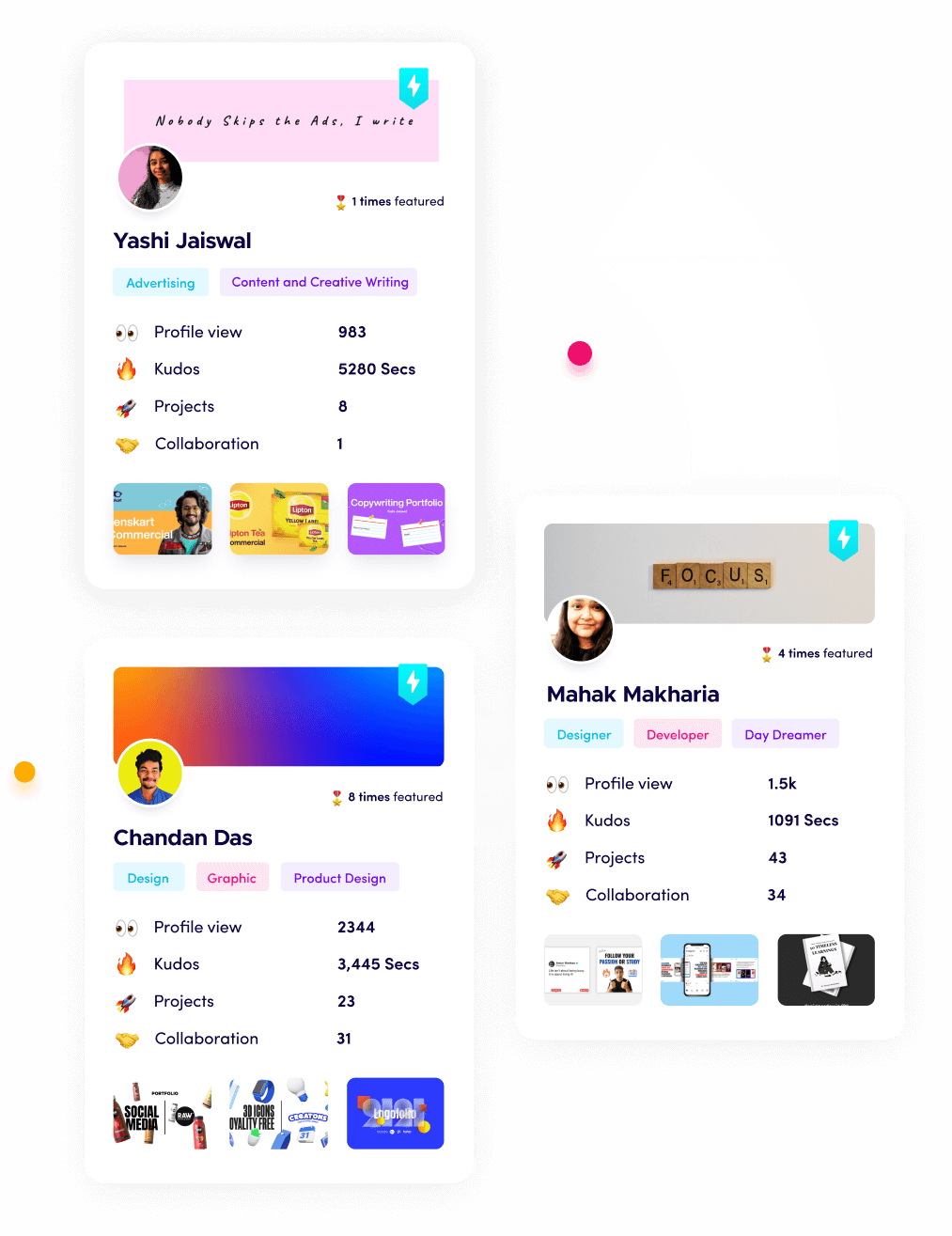
Fueler helps professionals showcase proof of work through projects, assignments, case studies, and achievements.
Thousands of professionals use Fueler to create their digital portfolio
Thousands of projects are published on Fueler. Check here
Startups and Companies hire through proof of work on Fueler
Used by freelancers, creators, marketers, video editors, writers, designers, and product managers
Our mission is to help the next 100 million professionals build a verified professional identity through proof of work

What should you do next?
You've read the article. Now turn your skills into proof of work and unlock more opportunities.
Build your proof of work portfolio
Create a clean portfolio with projects, assignments, resumes, and AI stack details that companies actually want to see.
Create your Fueler portfolio →Apply through assignments, not resumes
Stand out by solving real tasks from companies hiring on Fueler.
Explore assignments →Get discovered by companies
Make your work public and let recruiters discover your skills through actual projects instead of keywords.
Get discovered →