Best 15 Data Analytics Courses with Job Outcomes (2026)

Riten Debnath
15 Feb, 2026
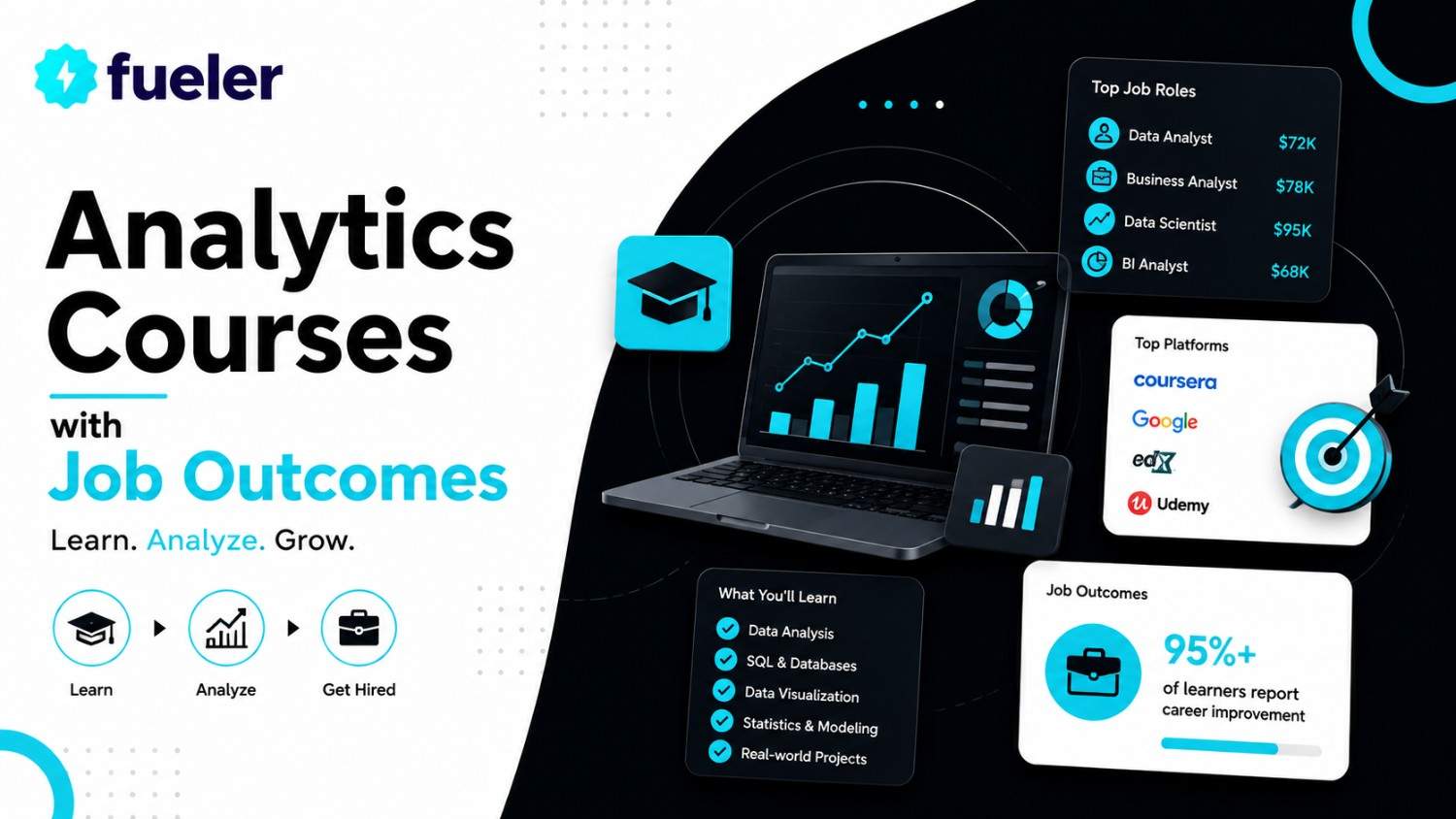
In 2026, data isn't just a buzzword; it’s the primary fuel for the global economy. As AI becomes more integrated into our daily workflows, the role of a Data Analyst has evolved from simply "cleaning spreadsheets" to becoming a "Strategic Insight Architect." Companies no longer want people who can just run a query; they want professionals who can tell a story that changes the direction of the business.
I’m Riten, founder of Fueler, a skills-first portfolio platform that connects talented individuals with companies through assignments, portfolios, and projects, not just resumes/CVs. Think Dribbble/Behance for work samples + AngelList for hiring infrastructure.
1. Google Data Analytics Professional Certificate
Google’s flagship program remains the most popular entry point for aspiring analysts in 2026. Hosted on Coursera, this program is meticulously designed by Google’s own lead analysts to bridge the gap between zero experience and a junior role. It’s famous for its "hands-on" approach, moving quickly from theoretical concepts to practical application using industry-standard tools like SQL, Tableau, and R.
- Mastery of the Data Life Cycle: You will dive deep into the six stages of data analysis: ask, prepare, process, analyze, share, and act. This comprehensive framework ensures that you don't just learn how to use a tool, but how to think like an analyst who can identify a business problem and solve it using data-driven insights.
- Proficiency in Modern Analytical Tools: The curriculum provides extensive training in SQL for database management, Tableau for high-impact visualization, and R programming for advanced statistical analysis. By the end of the course, you will be comfortable navigating the same tech stack used by top-tier data teams at companies like Google, Deloitte, and Target.
- Development of a Professional Portfolio: A major component of the course is the capstone project, where you choose a real-world business scenario and complete a full data analysis case study. This project becomes the centerpiece of your professional portfolio, giving you a tangible "proof of work" to show recruiters that you can handle the complexities of a professional data role.
- Direct Access to the Google Employer Consortium: Upon completion, you gain exclusive access to a job platform where your certificate is recognized by over 150 US and global employers. Companies in this consortium, including Ford, Verizon, and Google itself, actively use this platform to recruit entry-level talent, significantly shortening your path from student to employee.
- Career Readiness and Soft Skills Training: Beyond the technical skills, the program includes modules on resume building, interview preparation, and effective communication. You will learn how to present your findings to stakeholders in a way that is clear, persuasive, and actionable a skill that is highly prized in the data-heavy corporate environment of 2026.
2. IBM Data Analyst Professional Certificate
IBM’s program is the go-to for those who want a slightly more technical edge, emphasizing Python over R. It is designed to prepare learners for "Associate Data Analyst" roles in high-tech sectors. IBM focuses heavily on the integration of data science concepts into the analytics workflow, making this an ideal choice if you eventually want to transition into machine learning or AI-driven data science roles.
- Python-Centric Data Analysis: You will gain expert-level proficiency in Python, focusing on essential libraries like Pandas, Numpy, and Matplotlib for data manipulation and visualization. This gives you a significant advantage in the 2026 job market, as Python has become the "lingua franca" of the broader data science and artificial intelligence community.
- Excel and SQL Integration: The course starts with advanced Excel for data analysis and moves into SQL for querying relational databases. This ensures you have a versatile skill set, capable of working with both traditional business tools and more modern, scalable database environments found in large-scale tech enterprises and financial institutions.
- Hands-On Lab Environment: You will spend a significant portion of the program working in IBM’s "Cloud Lite" environment, using Jupyter Notebooks and real-world datasets. This practical exposure allows you to build, test, and refine your code in a professional setting, ensuring you are "keyboard-ready" from day one of your new job.
- Data Visualization with IBM Cognos: Unique to this program is the training on IBM Cognos, a leading business intelligence platform used by Fortune 500 companies. Mastering this tool allows you to create sophisticated, interactive dashboards that can be shared across an entire organization, proving your ability to manage high-level business intelligence workflows.
- Career Services and Digital Badging: Graduates earn an IBM digital badge that is recognized globally and can be added to LinkedIn to attract recruiters. Additionally, the program offers career support services, including resume reviews and tips on how to navigate the technical interview process for data-specific roles in sectors like banking, healthcare, and IT.
3. Microsoft Certified: Power BI Data Analyst Associate
If your goal is to work within the massive Microsoft ecosystem, this is the gold standard certification. It is less about general programming and more about mastering Power BI to create "Business Intelligence" (BI) solutions. In 2026, companies are desperate for "Power Users" who can turn raw Azure or SQL data into beautiful, real-time dashboards that the C-suite can actually use.
- Advanced Data Modeling with Power BI: You will learn how to design and build scalable data models that can handle millions of rows of data from multiple sources. This includes mastering DAX (Data Analysis Expressions) to create complex calculations and business logic, ensuring your reports provide deep, granular insights that go far beyond basic summaries.
- Seamless Integration with Microsoft 365 and Azure: The course teaches you how to connect Power BI to various data sources, including Excel, SharePoint, and Azure SQL databases. This focus on "integration" is critical for 2026, as most major enterprises rely on a unified Microsoft tech stack for their internal operations and data management.
- Creative Data Visualization and Storytelling: You will learn the principles of effective dashboard design, focusing on how to choose the right charts and layouts to communicate complex information. The goal is to create intuitive reports that allow business users to "self-serve" their own insights, reducing the burden on the central data team.
- Security and Governance in BI: A key module focuses on how to manage workspace security, row-level security (RLS), and data privacy within Power BI. This knowledge is essential for working in regulated industries like finance and healthcare, where protecting sensitive data is just as important as analyzing it.
- Preparation for the PL-300 Industry Exam: This course is specifically aligned with the PL-300 certification exam, which is one of the most recognized credentials in the business intelligence industry. Passing this exam provides you with an official Microsoft certification that serves as a powerful validation of your skills to employers worldwide.
4. Springboard: Data Analytics Career Track
Springboard is famous for its "Job Guarantee" and its intensive mentorship model. This is not just a course; it’s a career-transformation program designed for people who want to transition from a completely different field into data. It’s highly rigorous and project-based, ensuring that you graduate not just with a certificate, but with the confidence of an experienced professional.
- 1-on-1 Mentorship from Industry Experts: Every student is paired with a mentor a working data professional from companies like Google, Airbnb, or Uber who provides weekly feedback. This personal guidance is invaluable for navigating difficult technical hurdles and gaining "insider knowledge" about what it’s really like to work in the industry.
- Project-Based Learning with Real Datasets: The curriculum is built around two massive capstone projects where you solve actual business problems using raw data. These projects are designed to be "client-ready," meaning you can present them in an interview as proof that you can handle end-to-end data analysis in a professional environment.
- Comprehensive Career Coaching: You are assigned a dedicated career coach who helps you with everything from optimizing your LinkedIn profile to practicing for behavioral and technical interviews. This support continues until you land a job, ensuring that you are never alone during the often-stressful job search process.
- The "Job or Your Money Back" Guarantee: Springboard stands behind its curriculum with a legal guarantee: if you don’t land a data role within six months of graduation, you get a full tuition refund. This aligns the program’s success directly with your success, ensuring they are incentivized to provide the best possible training and career support.
- Network Access to 1,000+ Alumni: You gain lifetime access to a massive community of former students and mentors who are now working at top companies. This network is a powerful tool for referrals and job leads, often providing a "hidden back door" into roles that aren't even posted on public job boards.
5. General Assembly: Data Analytics Bootcamp
General Assembly (GA) is the world leader in tech bootcamps, and their 2026 Data Analytics program is designed for speed and impact. This is an intensive, "full-immersion" experience that can be taken full-time or part-time. It’s particularly strong for people who thrive in a collaborative, classroom-style environment (either online or in-person) and want to build a network of fellow students.
- Immersive, Fast-Paced Curriculum: The bootcamp is designed to take you from a novice to a job-ready analyst in as little as 12 weeks. You will move rapidly through Excel, SQL, Tableau, and the basics of Python, ensuring you have the broad technical foundation needed to work in almost any modern business environment.
- Collaborative Team Projects: Unlike self-paced courses, GA emphasizes teamwork, mirroring how data analysts actually work in the real world. You will collaborate on group projects, learn how to manage version control, communicate findings within a team, and integrate your work with others to achieve a common goal.
- Direct Hiring Pipelines and Partner Events: General Assembly has deep relationships with thousands of hiring partners globally. They host regular "meet the grads" events and hiring fairs where you can present your final projects directly to recruiters from major tech companies and innovative startups looking for fresh talent.
- Focus on "Data Storytelling" for Business: A significant portion of the program is dedicated to the art of communication. You will learn how to build presentations that don't just show data, but explain the "why" behind the numbers, helping you become the bridge between the technical data and the strategic decision-makers.
- Lifetime Access to the GA Community: Once you graduate, you are a "GA for life" member, giving you access to ongoing workshops, networking events, and career resources. This long-term support is vital as you move from your first junior role into more senior positions throughout your career in data.
6. MIT xPRO: Data Analytics Certification
MIT’s professional certificate program is for those who want a rigorous, academic foundation backed by one of the world's most prestigious universities. This course is heavily focused on the mathematical and statistical principles that drive data analysis, making it ideal for those working in complex fields like engineering, finance, or research where "good enough" analysis isn't acceptable.
- Rigorous Statistical Foundations: You will learn the deep "math behind the models," including probability, regression analysis, and hypothesis testing. This academic rigor ensures that your insights are statistically sound and can withstand the scrutiny of senior technical leaders and academic-level research environments.
- Advanced Analytics and Machine Learning Intro: The program goes beyond basic descriptive analytics and introduces you to predictive modeling. You will learn how to use historical data to forecast future trends, giving you a set of tools that are increasingly required for "Senior Data Analyst" roles in 2026.
- Case-Method Learning from MIT Faculty: The course uses MIT’s famous case-study approach, where you analyze real-world scenarios faced by global companies. You will learn from world-renowned professors who are at the cutting edge of data science, gaining insights that are often years ahead of what is taught in standard industry bootcamps.
- High-Level Professional Networking: The cohort-based model allows you to connect with high-achieving professionals from around the world. These connections often lead to collaborative opportunities and job referrals in specialized industries where an MIT credential carries significant weight and opens doors that other certificates might not.
- Prestigious MIT xPRO Credential: Graduating from an MIT program provides a massive boost to your professional credibility. In the 2026 job market, where many candidates have basic certificates, an MIT credential serves as a high-signal indicator of your technical competence, discipline, and intellectual depth.
7. CareerFoundry: Data Analytics Program
CareerFoundry offers a flexible, online program that is perfect for career changers who need to keep their current job while they study. They are known for their "Dual Mentorship" model, providing both a tutor for day-to-day questions and a mentor for high-level industry guidance. Their curriculum is highly practical and focused on the exact skills needed for modern entry-level roles.
- Dual Mentorship Model: You get a tutor to grade your assignments within 24 hours and a mentor (a senior analyst) for monthly deep-dive calls. This structure ensures you never get "stuck" on a technical problem for long while still receiving long-term career advice and industry-specific insights.
- Complete Professional Portfolio Building: The program is divided into three parts: Intro, Immersion, and Job Prep. By the end, you will have a portfolio of 4-5 high-quality projects that demonstrate your ability to use Excel, SQL, Python, and Tableau to solve diverse business problems in marketing, finance, and operations.
- Personalized Career Services and Job Prep: CareerFoundry provides a dedicated career specialist who works with you 1-on-1 to refine your resume and LinkedIn. They also provide "mock interviews" that simulate real data analyst hiring processes, helping you build the confidence needed to succeed when the stakes are high.
- Flexible, Self-Paced Learning Environment: The program is designed to fit your schedule, allowing you to graduate in 5 to 8 months depending on your pace. This flexibility is ideal for parents, full-time workers, or anyone who needs to balance their education with significant personal or professional commitments.
- Verified Employment Outcomes: CareerFoundry publishes transparent, third-party verified reports on their graduates' success. With a 96% placement rate for eligible graduates within 180 days, you can trust that the curriculum is teaching the exact skills that 2026 employers are actually hiring for.
8. UC Berkeley: Master of Analytics (Professional)
For those looking for a graduate-level credential, UC Berkeley’s Master of Analytics is a top-tier choice in 2026. This STEM-designated program is designed for "Supertech" leaders who want to combine deep technical expertise with high-level strategic thinking. It’s an intensive 12-month program located in the heart of the San Francisco Bay Area’s innovation hub.
- STEM-Designated, Deep-Tech Curriculum: You will master advanced Python, R, and SQL, while also diving into data engineering and machine learning. This program is for those who want to be more than just an analyst; it’s for people who want to build the data infrastructure and models that power modern tech companies.
- Industry Internships and Capstones: The program includes a required 200-hour summer internship with a partner company in Silicon Valley or beyond. This direct industry engagement provides you with real-world experience and a network of professional contacts that often leads to a full-time job offer before graduation.
- Access to Berkeley’s World-Class Career Services: You receive personalized career support from a dedicated team that understands the high-end data market. This includes access to exclusive recruitment events with companies like Tesla, Google, and Meta, who specifically target Berkeley graduates for their most demanding analytical roles.
- Focus on Sustainability and Social Impact: Unique to Berkeley is a curriculum that emphasizes how data can be used to drive innovation and efficiency while promoting social good. You will learn how to apply analytics to global challenges like climate change and public health, preparing you for a meaningful and high-impact career.
- The No. 1 Public University Network: Graduating from Berkeley gives you access to one of the most powerful and influential alumni networks in the world. Whether you want to work in a startup or a Fortune 500 firm, a Berkeley degree provides a level of prestige and access that is virtually unmatched in the data education space.
9. Cloudera Certified Associate (CCA) Data Analyst
As big data moves from the "hype" phase into the "utility" phase in 2026, Cloudera’s certification is essential for those working with massive datasets in enterprise environments. This is a performance-based exam that tests your ability to query and manage data in a real Cloudera CDH environment using Impala and Hive. It’s highly technical and respected in the "Big Data" world.
- Performance-Based Testing on Live Clusters: Unlike multiple-choice exams, the CCA requires you to solve real problems on a live cluster under a time limit. This proves to employers that you can actually do the work in a high-pressure environment, making this one of the most "trusted" certifications in the data industry.
- Mastery of Hive and Impala for Big Data: You will learn how to use SQL-like languages to query massive, distributed datasets that are too large for traditional databases. This skill is critical for data analysts working in banking, insurance, and telecommunications, where data is measured in petabytes rather than gigabytes.
- Skills in Data Transformation and Partitioning: The program teaches you how to create, alter, and optimize table structures to improve query performance. You will learn the "under the hood" mechanics of how data is stored and retrieved, allowing you to work more efficiently and save your company significant time and computing costs.
- Ideal for SQL Developers Moving to Big Data: If you already have a solid foundation in SQL, this certification is the perfect "bridge" into the world of Big Data. It builds on your existing skills while teaching you the specific tools and architectures needed to thrive in a modern, distributed data environment.
- Industry-Standard Credential for Impact Players: Holders of the CCA Data Analyst badge are seen as "impact players" who can handle the most complex data challenges. In 2026, this certification is often a prerequisite for high-paying roles in data engineering and senior enterprise analytics.
10. SAS Statistical Business Analyst Certification
SAS remains the dominant player in highly regulated industries like pharmaceuticals, banking, and government in 2026. This certification is for those who want stability and deep domain expertise. It’s less about "cool tech" and more about "rigorous, auditable, and compliant analytics" that meet the strict standards of global regulators and financial institutions.
- Focus on Regulated Industry Standards: You will learn how to use SAS for clinical trials, risk modeling, and regulatory reporting. This specialized knowledge is in extremely high demand in industries where accuracy and auditability are non-negotiable, providing you with a stable and high-paying career path.
- Advanced Predictive Modeling with SAS: The curriculum covers complex statistical techniques, including ANOVA, regression, and predictive modeling using SAS Enterprise Miner. You will learn how to build models that can forecast everything from drug efficacy to credit default risk with a high degree of statistical confidence.
- Stability in a Shifting Tech Landscape: While "trendy" tools come and go, SAS has been the foundation of enterprise analytics for decades. In 2026, SAS professionals will enjoy longer career spans and more consistent income growth because their skills are deeply embedded into the long-term operations of global organizations.
- Comprehensive Training for Validated Environments: You will learn how to work within "validated" environments where every step of the analysis must be documented and repeatable. This skill is essential for working with the FDA, the SEC, and other major regulatory bodies that oversee the world's most critical industries.
- A Clear Learning Path to Senior Roles: SAS provides a very structured career ladder, moving from a basic programmer to a lead statistical analyst or a domain specialist. This clarity is perfect for those who want a defined path to success without the uncertainty that often comes with more "general" data roles.
11. Cornell University: Data Analytics Certificate (eCornell)
eCornell offers a professional certificate program developed by Cornell faculty that focuses on "Functional Literacy" in business analytics. It is a 3-course program designed to move you beyond "simple averages" and into the realm of scientific decision-making. It’s perfect for managers and aspiring analysts who need to use data to justify high-stakes business decisions.
- Scientific Decision-Making Framework: You will learn how to move from "intuition-based" decisions to "evidence-based" ones. The course provides a rigorous framework for examining sample data and ensuring that your conclusions are statistically valid, reducing the risk of making costly business errors.
- Predictive Data Analysis for Business Strategy: A core focus of the program is learning how to identify uncertainty and choose the right variables to reduce it. You will build robust decision models that can be used to predict future business outcomes, helping your organization stay ahead of market shifts and competitive threats.
- Hands-On Exercises with Cornell Faculty: The program is delivered through a blend of video instruction and interactive exercises designed by Professor Chris Anderson. This direct link to Cornell’s academic expertise ensures that you are learning the most current and effective methods for data analysis and visualization.
- Accessible to Non-Technical Professionals: While the program is academically rigorous, it is designed to be accessible to those without a heavy background in math or statistics. It’s an ideal "upskilling" opportunity for marketing, HR, or operations professionals who need to become data-literate to stay relevant in 2026.
- Prestige of the Ivy League Brand: Carrying a certificate from Cornell University provides an immediate level of professional authority. In the crowded field of data analytics, an Ivy League-backed credential can be the deciding factor that gets your resume to the top of the pile and secures that first interview.
12. Tableau Desktop Specialist Certification
As the world becomes more visual in 2026, the ability to build world-class dashboards is a superpower. The Tableau Desktop Specialist certification is the foundational credential for anyone who wants to be a "Visualization Specialist." This course focuses on the core features of Tableau, ensuring you can connect to data and build interactive stories that anyone can understand.
- Expertise in Data Visualization Best Practices: You will learn not just "how" to use Tableau, but "why" certain visualizations work better than others. This includes mastering the art of the dashboard, choosing colors, layouts, and chart types that lead the viewer to a clear and actionable conclusion.
- Seamless Data Connection and Preparation: The program teaches you how to connect Tableau to diverse data sources, from local Excel files to cloud-based SQL servers. You will also learn how to "clean and pivot" your data within Tableau, ensuring it is in the correct format for high-impact visual analysis.
- Creation of Interactive and Dynamic Reports: You will learn how to build "live" dashboards that update automatically as the underlying data changes. This skill is essential for 2026, as business leaders increasingly demand real-time insights that allow them to react to market changes as they happen.
- Recognition in the "Tableau Economy": Tableau is the leading visualization tool in the world, and many jobs are now posted specifically for "Tableau Developers" or "BI Specialists." Holding this certification proves you have the core competencies needed to thrive in these high-demand, high-paying roles.
- Preparation for Advanced Certification Levels: This specialist badge is the first step on the Tableau career ladder. It provides the foundation you need to move toward "Tableau Certified Data Analyst" or "Tableau Server Certified Professional" roles, which command even higher salaries and more senior responsibilities.
13. DataCamp: Data Analyst Professional Certification
DataCamp is the favorite for those who love "gamified," interactive learning. Their professional certification is built for the 2026 market, focusing on the three pillars of a modern analyst: SQL, Python, and Tableau. It is a highly respected, "skills-first" certification that is favored by many modern tech startups for its practical, hands-on focus.
- Fully Interactive Coding Environment: You learn by doing, writing code directly in your browser with immediate feedback. This "muscle memory" approach to learning SQL and Python is incredibly effective for those who find traditional lectures or videos to be too slow or theoretical.
- Assessment-Based Certification: To earn the certificate, you must pass a series of rigorous assessments and a timed project that mirrors a real-world task. This ensures that the certification has high "integrity" and isn't just a reward for watching videos; it proves you can actually perform the job.
- Access to DataCamp’s Career Services: Once certified, you gain access to an exclusive job board and career counseling. DataCamp has strong ties to the global tech community, and their certification is increasingly used by companies as a "skills benchmark" during the hiring process.
- Mobile-Friendly Learning for Busy Lifestyles: DataCamp’s mobile app allows you to practice your coding skills with daily 5-minute challenges. This makes it easy to keep your skills sharp and continue learning even when you're on the go, ensuring you stay ahead of the competition in a fast-moving field.
- Diverse Course Library for Continuous Upskilling: Beyond the certification, DataCamp provides access to hundreds of courses in AI, data engineering, and data science. This allows you to continuously expand your skill set and move into more specialized and higher-paying roles throughout your career.
14. Springboard: Data Analytics Career Track (Business Focus)
This is a variation of the standard Springboard track, specifically designed for those who want to work in "Strategic Business Analytics." It focuses less on the deep technical code and more on how to use data to drive financial and operational decisions. It’s perfect for MBA types or anyone who wants to be a "Business Analyst" rather than a "Technical Analyst."
- Focus on Business Problem Solving: The curriculum is built around solving business-centric problems, such as churn analysis, marketing ROI, and supply chain optimization. You will learn how to translate a complex business question into a data project and then back into a strategic recommendation.
- Advanced Business Intelligence with Tableau: While most courses cover Tableau, this track goes deep into the "Business Intelligence" side of the tool. You will learn how to build executive-level reports that focus on KPIs and metrics that drive the bottom line of a modern 2026 enterprise.
- Integrated Financial and Operational Modeling: You will learn how to combine financial data with operational data to get a 360-degree view of a company's performance. This skill is highly valued by C-level executives who need analysts who can help them understand the financial impact of their operational decisions.
- Soft Skills and Stakeholder Management: A significant portion of the course is dedicated to "influencing without authority." You will learn how to present your data to senior leaders in a way that is respectful yet persuasive, helping you become a trusted advisor within your organization.
- 1-on-1 Mentorship for Career Transitions: Just like the technical track, you get a dedicated mentor who helps you navigate the specific challenges of a business analyst role. This mentorship is key for learning how to handle the "politics" of data and how to communicate complex ideas to non-technical audiences.
15. CareerFoundry: Data Immersion (Specialized Track)
This is the "deep dive" version of CareerFoundry’s program, designed for those who want to specialize in a specific niche like "Marketing Analytics" or "Financial Analytics." It takes the core skills and applies them to a specific industry, making you a "Day-1 Ready" expert for a specialized team.
- Niche-Specific Project Work: You can choose a specialization and build projects that are specifically tailored to that industry. This makes you much more attractive to hiring managers in those sectors, as you already speak their language and understand their unique data challenges.
- Advanced Python for Automated Analysis: This track focuses on using Python to automate repetitive data tasks, allowing you to work much faster and more accurately than a traditional analyst. In 2026, the ability to build "automated data pipelines" is a key differentiator for high-level roles.
- Deep Focus on Data Ethics and Privacy: Specialized industries like finance and healthcare have strict rules about data. This program includes a robust module on ethics, ensuring you know how to handle sensitive data responsibly and legally in a world of increasing privacy regulations.
- Collaborative Peer Review and Feedback: You will participate in regular peer review sessions, where you give and receive feedback on projects. This mirrors the real-world "code review" and "design review" processes used by professional data teams, helping you improve the quality of your work and your communication skills.
- Lifetime Access to Industry-Specific Career Content: You gain access to a library of career resources that are specific to your chosen niche. This includes industry-specific interview tips, resume templates, and networking advice that is tailored to help you succeed in your specific field.
Final Thoughts
The path to becoming a data analyst in 2026 is no longer a "one-size-fits-all" journey. Whether you choose a high-intensity bootcamp like General Assembly, a prestigious university certificate like MIT or Cornell, or a mentor-driven program like Springboard, the key to success is building a "proof of work" portfolio. In 2026, showing is much more important than telling. A strong data analyst portfolio makes that idea practical by giving employers something concrete to review beyond your course certificates and resume. Use tools like Fueler to document your projects, share your insights, and showcase your skills to the world.
FAQs
1. Which course is best for someone with absolutely no technical background?
The Google Data Analytics Professional Certificate is widely considered the best starting point for beginners. It is designed specifically for people with no prior experience and provides a very gentle but thorough introduction to all the essential tools and concepts of modern data analysis.
2. Is a "Job Guarantee" real, or just marketing?
Programs like Springboard and CareerFoundry offer "Job or Your Money Back" guarantees that are backed by legal terms. However, they usually require you to follow their career advice, complete all projects, and document a certain number of job applications per week. If you put in the work, they are a very effective safety net.
3. Do I need a degree to get a job as a data analyst in 2026?
While a degree (like the UC Berkeley Master of Analytics) is a huge asset for senior or high-end roles, many entry-level data roles in 2026 value "skills over degrees." If you have a professional certificate and a high-quality portfolio on a platform like Fueler, you can absolutely land a role at many top tech and service companies.
4. What is the most important tool to learn for a data analyst career in 2026?
While it depends on the industry, SQL is still the foundational skill for almost every data role. After that, mastering a visualization tool like Tableau or Power BI, and a programming language like Python, will make you a highly competitive candidate in almost any market.
5. How long will it take before I see a return on my investment?
For most intensive bootcamps or certificate programs, the average time to find a job is 3 to 6 months post-graduation. With a typical entry-level salary increase of $25,000 to $40,000 for career changers, most students see a full return on their tuition investment within their first year of employment.
What is Fueler Portfolio?
Fueler is a career portfolio platform that helps companies find the best talent for their organization based on their proof of work. You can create your portfolio on Fueler. Thousands of freelancers around the world use Fueler to create their professional-looking portfolios and become financially independent. Discover inspiration for your portfolio
Sign up for free on Fueler or get in touch to learn more.

What should you do next?
You've read the article. Now turn your skills into proof of work and unlock more opportunities.
Build your proof of work portfolio
Create a clean portfolio with projects, assignments, resumes, and AI stack details that companies actually want to see.
Create your Fueler portfolio →Apply through assignments, not resumes
Stand out by solving real tasks from companies hiring on Fueler.
Explore assignments →Get discovered by companies
Make your work public and let recruiters discover your skills through actual projects instead of keywords.
Get discovered →
