How Students Can Build a Career Portfolio Before Their First Job

Riten Debnath
02 Apr, 2026
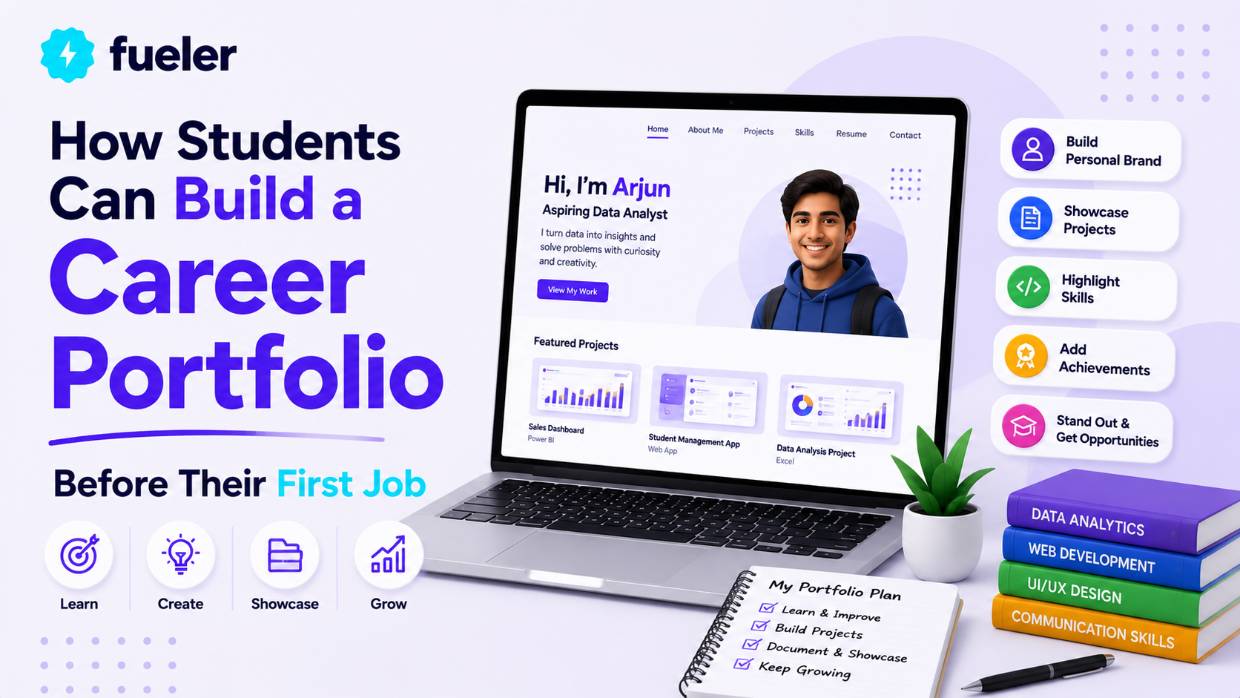
I am Riten, founder of Fueler. One of the most common things I hear from students and fresh graduates is this: 'I want to build a portfolio, but I have not had a real job yet. What do I put in it?'
I love this question because it reveals a mindset that, once corrected, changes everything. You do not need a real job to have real work. And you do not need real work experience to have a real portfolio. You need intentionality, documentation, and the right platform to share it on.
In this article, I am going to show every student exactly how to build a career portfolio before getting their first job. A portfolio that actually gets attention, actually builds credibility, and actually opens doors that a blank resume cannot.
Why Students Who Build Portfolios Win
Here is the honest competitive reality of the 2026 job market. Thousands of students graduate with similar GPAs, similar degrees, and similar internship experiences. When every candidate looks the same on paper, companies cannot make confident decisions. They resort to proxies like university prestige or personal connections.
A student who has a portfolio changes this dynamic completely. When you can show a hiring manager a link to real work you have done, real problems you have solved, and real results you have produced, you are immediately differentiated from every other candidate who only has a resume. You are not just another graduate with a degree. You are a professional in training who has already been doing the work.
Building a portfolio while you are still a student is one of the highest-leverage career moves you can make. It costs you time, not money. And the return on that time investment compounds for years.
Source 1: Academic Projects Done Right
Almost every student has completed significant projects as part of their coursework. Research papers, design projects, marketing plans, engineering builds, analysis assignments, business case studies. These are real work. They just need to be documented properly to become portfolio entries.
The key is to document your academic projects the way a professional would document a client project. For each project worth including, write a clear description of the challenge or brief, the approach you took, the key decisions you made and why, and the outcome or what you learned. Include the actual deliverable where possible.
A well-documented academic project demonstrates that you can approach a real problem systematically, execute to a standard, and communicate what you did and why. That is exactly what employers want to see.
Source 2: Personal Projects That Show Initiative
A personal project is something you built, created, or did outside of class because you were interested in it. A blog you started and ran for six months. An app you built to solve a problem you personally experienced. A YouTube channel you grew. A small business you started as an experiment. A research project you conducted on your own curiosity.
Personal projects are extraordinarily powerful in a student portfolio because they demonstrate something that academic work cannot always show: intrinsic motivation. You did this because you wanted to, not because it was assigned. Employers find that signal deeply attractive, especially in early-career candidates.
If you do not have a personal project yet, start one now. You do not need to wait until it is finished. Document the project in progress. Show your thinking as it develops. Even a project that is three months old is better than no project at all.
Source 3: Volunteer and Community Work
Volunteering your skills for nonprofits, community organizations, campus groups, or local businesses is one of the fastest ways to get real, portfolio-worthy work completed before you have a formal job.
Think about what skills you want to build your career around. Then find an organization that needs help with exactly those things. A nonprofit that needs a website redesign. A student organization that needs its social media managed. A local business that needs help with their marketing materials. Offer your help for free. Do the work well. Document the process and the outcome. Ask for a testimonial.
You now have a real client, a real project, a real result, and real social proof. Your portfolio has substance.
Source 4: Internships and Part-Time Work
If you have done any internships or part-time work, even something that seems unrelated to your target career, there is almost certainly something worth documenting from that experience.
Think about the problems you solved, the tasks you completed that went beyond your basic job description, the improvements you suggested or implemented, or the feedback you received from supervisors. Any of these can become portfolio entries with the right documentation.
And for every internship you do from this point forward, go in with the explicit intention of building portfolio-worthy work. Ask for projects with visible outcomes. Volunteer for assignments that stretch your skills. Document everything that is not confidential.
Source 5: Online Course Projects and Certifications
Completing a course on Coursera, edX, or any other learning platform often involves projects, assignments, and practical exercises. These are legitimate portfolio materials, especially when they result in a tangible deliverable.
A data analysis project completed during a data science course. A UI prototype built during a UX design course. An SEO audit completed during a digital marketing course. These demonstrate that you are learning actively and applying that learning in practical contexts.
How to Structure Your Student Portfolio
With your raw materials gathered, structure your portfolio for maximum impact. Lead with a clear, honest professional summary that says who you are, what you are learning to do, and what kind of opportunities you are seeking. Be specific about your skills and areas of focus.
Then feature your 5 to 8 strongest projects in order of relevance and quality. Document each one properly. Be honest about what was academic work and what was real-world work. That honesty builds trust rather than undermining it. Finish with your education, any certifications, and your contact information.
Build and Share It on Fueler
Fueler is the best platform for student portfolios. It is designed for proof-of-work, which means it is built for exactly the kind of portfolio a student needs: one that shows real work and real results rather than relying on credentials and job titles you do not have yet.
Companies on Fueler hire through assignments. This means that as a student, you can complete real company assignments and get paid opportunities before you even graduate. Your portfolio and your assignment completions together build a track record that no resume can replicate.
Start at fueler.io today. Build your portfolio before you need it. You will be grateful you did.
The Advantage You Are Creating Right Now
Every student who reads this and starts building their portfolio today is creating a compounding advantage over every peer who waits. By the time you graduate and start applying for jobs, you will have months or years of documented work that your classmates are scrambling to create from scratch. You will have testimonials they do not have. You will have results they cannot show. You will have a Fueler profile that companies have already discovered and bookmarked.
This advantage is available to every student, regardless of which university you attend, which city you live in, or what field you are studying. The only requirement is the willingness to start documenting your work today, before your first formal job, and the discipline to keep doing it. That is the kind of initiative that every good company is looking for. Show it. Start at fueler.io.
How to Talk About Your Portfolio in Interviews
Once you have built your student portfolio, learn how to talk about it confidently in interviews. Do not apologize for the fact that your projects are academic or self-initiated. Frame them as exactly what they are: evidence of your initiative, your skills, and your commitment to developing your craft before you had a formal opportunity to do so.
When an interviewer asks about your experience, reference specific projects from your portfolio. Describe the challenge, your approach, and the result in two or three clear sentences. Then offer to show them the full documentation in your Fueler portfolio. This move transforms a weakness, limited formal experience, into a strength: you have done real work and you can prove it. That combination of real documented work and confident clear communication is exactly what employers are looking for in a first hire. Build your portfolio first. The confidence to talk about it follows naturally.
Frequently Asked Questions
How do students build a career portfolio with no work experience?
Use academic projects, personal initiatives, volunteer work, internship contributions, and online course projects. Document each one professionally with context, your contribution, and the outcome. Fueler is the ideal platform for building and sharing this portfolio.
What should a student portfolio include?
A clear professional summary, 5 to 8 documented projects from any combination of academic, personal, or volunteer sources, your education and relevant certifications, and contact information. Focus on quality of documentation over quantity of entries.
Can a student portfolio help me get a job before I graduate?
Yes. A strong portfolio on Fueler makes you visible to companies that hire through proof-of-work. You can complete assignments posted by real companies and get paid opportunities before graduation.
How do I document academic projects for a portfolio?
Describe the challenge or brief, your specific approach and key decisions, the deliverable you produced, and the outcome or feedback received. Include the actual work where possible. Write it the way a professional would write a case study.
Is Fueler good for students building their first portfolio?
Fueler is one of the best platforms for students. It is free to start, designed for proof-of-work portfolios rather than credential-heavy resumes, and connected to companies that evaluate candidates through their actual work quality.
What is Fueler Portfolio?
Fueler is a career portfolio platform that helps companies find the best talent for their organization based on their proof of work. You can create your portfolio on Fueler. Thousands of freelancers around the world use Fueler to create their professional-looking portfolios and become financially independent. Discover inspiration for your portfolio
Sign up for free on Fueler or get in touch to learn more.

What should you do next?
You've read the article. Now turn your skills into proof of work and unlock more opportunities.
Build your proof of work portfolio
Create a clean portfolio with projects, assignments, resumes, and AI stack details that companies actually want to see.
Create your Fueler portfolio →Apply through assignments, not resumes
Stand out by solving real tasks from companies hiring on Fueler.
Explore assignments →Get discovered by companies
Make your work public and let recruiters discover your skills through actual projects instead of keywords.
Get discovered →
