What Is Proof of Work in Hiring? Why Portfolios Beat Resumes

Riten Debnath
02 Apr, 2026
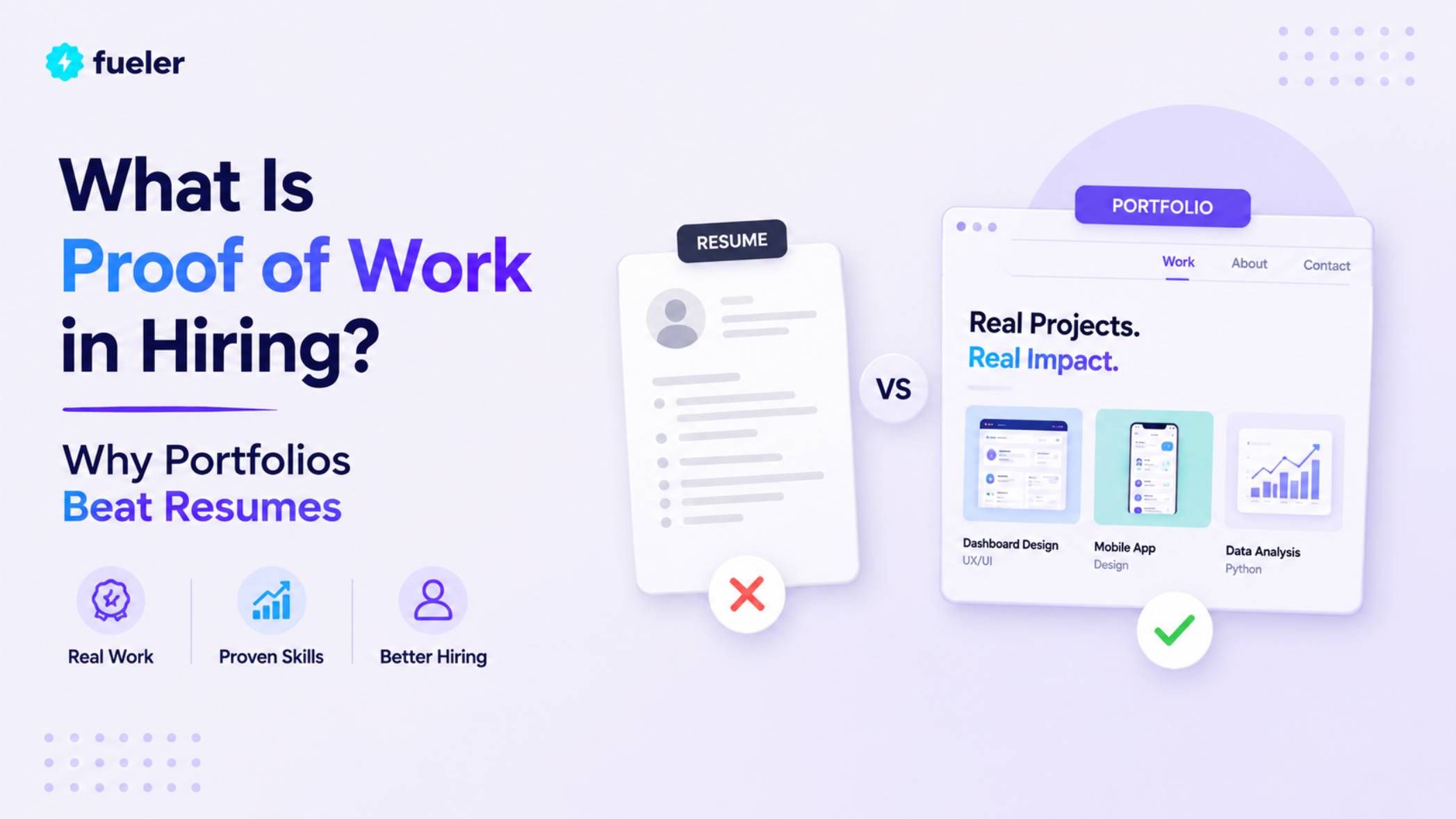
I am Riten, founder of Fueler. The entire reason I built Fueler is because I believe in one fundamental idea: the best person for the job should get it. Not the best resume writer. Not the person with the most impressive educational pedigree. Not the candidate who interviewed best. The person who can actually do the work best.
Proof of work is the framework that makes this possible. And in 2026, it is rapidly becoming the new standard for how serious companies hire. In this article, I am going to explain what proof of work in hiring actually means, why it is better than resume-based screening, and how you can use it to get hired for the opportunities you actually deserve.
What Does Proof of Work Mean in Hiring?
Proof of work in hiring means demonstrating your ability to do a job by showing evidence of actual work you have done, rather than by listing credentials, job titles, and responsibilities on a resume.
The concept borrows from the world of blockchain and distributed systems, where proof of work refers to a computational process that verifies that real effort was expended. In hiring, it means the same thing. You are not just claiming you can do something. You are proving it with real evidence that cannot be faked.
Proof of work can take many forms. A portfolio of completed projects. A case study showing the problem you solved and the result you achieved. An assignment completed specifically for a hiring company as part of their evaluation process. A GitHub repository with functional code. A published article that demonstrates domain expertise. Any real, verifiable output of your professional effort.
Why Resumes Are a Poor Proxy for Ability
Resumes were designed for a different era of work. When most careers followed predictable paths, when skills were more standardized, and when the volume of candidates for any given role was much smaller, a resume was a reasonable shorthand for evaluating fit.
That era is over. The modern job market has fundamentally different characteristics. Skills change faster than education systems can track. Career paths are non-linear and varied. The volume of applications for any given role can be in the hundreds or thousands. And the gap between what someone writes on a resume and what they can actually do has never been wider.
A resume has no verification mechanism. Anyone can write that they 'led a team of 15 people and grew revenue by 30 percent.' There is no way for a recruiter reading that line to know if it is entirely true, partially true, or completely fabricated. Proof of work closes that gap. The work is the evidence. The result is the proof.
How Proof of Work Changes the Hiring Dynamic
When hiring is based on proof of work rather than resume screening, several things change dramatically for both candidates and companies.
For candidates, the playing field levels in a meaningful way. Your educational background matters less. Your network matters less. Your ability to polish a resume matters less. What matters most is the quality of your actual work and your ability to document and present it clearly. This is genuinely better for talented people who have been overlooked by traditional credential-based systems.
For companies, hiring decisions become more confident and more accurate. When you can see exactly what a candidate has built, how they solved real problems, and what results they produced, the uncertainty that comes with resume-based hiring drops dramatically. Companies that hire on proof of work report better new hire performance, faster ramp-up times, and lower attrition.
Three Forms of Proof of Work in Modern Hiring
1. The Portfolio
A career portfolio is the most common and most versatile form of proof of work. It is a curated collection of your best work with context, contribution, and outcomes documented for each piece. A strong portfolio on Fueler is a continuous proof-of-work asset that grows throughout your career.
2. The Assignment
An assignment is a piece of work done specifically as part of a hiring evaluation. The company poses a real challenge. You complete it and submit your work. The quality of your submission is the primary evaluation criterion. This model removes many of the biases embedded in traditional interview processes because it evaluates what you can actually do, not how well you present yourself verbally.
Fueler is built around this model. Companies post real assignments. Candidates complete them. The best work wins the opportunity. It is the most direct form of proof-of-work hiring available anywhere.
3. Published Work and Open Contributions
For some professions, publicly available work serves as powerful proof. A developer's open source contributions on GitHub. A writer's published articles with traffic data. A designer's public case studies. These forms of proof of work are always accessible, always verifiable, and always working for you even when you are not actively job hunting.
Why Companies Are Moving Toward Proof-of-Work Hiring
The shift toward proof-of-work hiring is being driven by several forces that have been building for years and accelerated significantly in recent years.
First, the credential inflation problem. As university degrees have become more common, they have become less differentiated as signals of ability. A Bachelor's degree in marketing tells you almost nothing about whether someone can actually execute a marketing strategy. Proof of work fills that gap with evidence that actually matters.
Second, the remote work revolution. When hiring remote employees from anywhere in the world, companies cannot rely on the informal signals that come from in-person interviews. Cultural fit is harder to assess. Personal references are less reliable across geographies. What remains universally reliable is the quality of the work itself.
Third, the rise of AI screening. As AI tools screen more resumes automatically, the resume has become even less effective as a differentiation tool. A candidate who can point to a strong portfolio or a completed assignment immediately stands out from the mass of keyword-optimized resumes that AI systems are generating at scale.
How to Build Your Proof of Work with Fueler
Fueler is the platform that makes proof-of-work hiring accessible for both candidates and companies. As a candidate, you build your portfolio with real projects, documented outcomes, and tagged skills. You complete assignments posted by companies on the platform. And you get discovered through skill-based search by hiring managers who are explicitly looking for proof-of-work candidates.
The professionals who get hired fastest on Fueler are not the ones with the most impressive resumes. They are the ones with the most compelling documented work. That shift in what matters is what Fueler is designed to accelerate.
Start building your proof-of-work portfolio at fueler.io today. It is free, it is fast, and it is the direction the entire hiring industry is moving.
The Professionals Who Will Thrive
As proof-of-work hiring becomes the norm, the professionals who will thrive are those who take their documentation seriously. Not just the work itself, but the habit of recording what they did, why they did it, and what resulted from it. Every project becomes a portfolio entry. Every result becomes evidence. Every skill becomes verifiable rather than claimed.
This is a fundamentally better world for talented people who have historically been overlooked by credential-based systems. It is also a better world for companies who have made expensive hiring mistakes by trusting resumes over reality. The shift is good for everyone. And it starts with you building a portfolio that proves, not just states, what you can do. Start that process at fueler.io today.
How to Make Proof of Work Your Competitive Advantage
Most professionals know they should document their work better. Very few actually do it consistently. That gap between knowing and doing is your competitive advantage. While your peers are still relying on resume polish and interview prep, you can be building a portfolio that makes every hiring conversation easier, every salary negotiation stronger, and every new opportunity more accessible.
The mechanics are simple. After every significant project, spend 30 minutes writing up the context, your contribution, and the result. Add it to your Fueler portfolio. Tag the skills it demonstrates. Share your portfolio link in your next conversation with a recruiter or potential client. Do this consistently for six months and the difference in how you are perceived professionally will be dramatic. That is what proof of work builds. Not just a portfolio. A reputation grounded in reality. Start building yours at fueler.io.
Frequently Asked Questions
What is proof of work in hiring?
Proof of work in hiring means demonstrating your ability to do a job by showing real evidence of work you have done, such as portfolio projects, completed assignments, or published work, rather than relying on a resume of credentials and job titles.
Why is proof of work better than a resume for getting hired?
A resume makes claims. Proof of work provides verifiable evidence. Employers who evaluate proof of work make more confident hiring decisions and report better outcomes than those who screen primarily through resumes.
How do I show proof of work for my career?
Build a portfolio on Fueler with documented projects, outcomes, and skills. Complete assignments on Fueler posted by companies that use proof-of-work hiring. Publish your thinking through articles, case studies, or open contributions in your field.
What companies use proof-of-work hiring?
Hundreds of companies across technology, marketing, design, content, and operations use proof-of-work hiring through Fueler. The model is growing rapidly across all industries as the limitations of traditional resume screening become more apparent.
How does Fueler support proof-of-work hiring?
Fueler provides the portfolio infrastructure for candidates to document their work and the assignment-based hiring model for companies to evaluate candidates on real work quality. Both sides of the hiring equation are served by one integrated platform.
What is Fueler Portfolio?
Fueler is a career portfolio platform that helps companies find the best talent for their organization based on their proof of work. You can create your portfolio on Fueler. Thousands of freelancers around the world use Fueler to create their professional-looking portfolios and become financially independent. Discover inspiration for your portfolio
Sign up for free on Fueler or get in touch to learn more.

What should you do next?
You've read the article. Now turn your skills into proof of work and unlock more opportunities.
Build your proof of work portfolio
Create a clean portfolio with projects, assignments, resumes, and AI stack details that companies actually want to see.
Create your Fueler portfolio →Apply through assignments, not resumes
Stand out by solving real tasks from companies hiring on Fueler.
Explore assignments →Get discovered by companies
Make your work public and let recruiters discover your skills through actual projects instead of keywords.
Get discovered →
