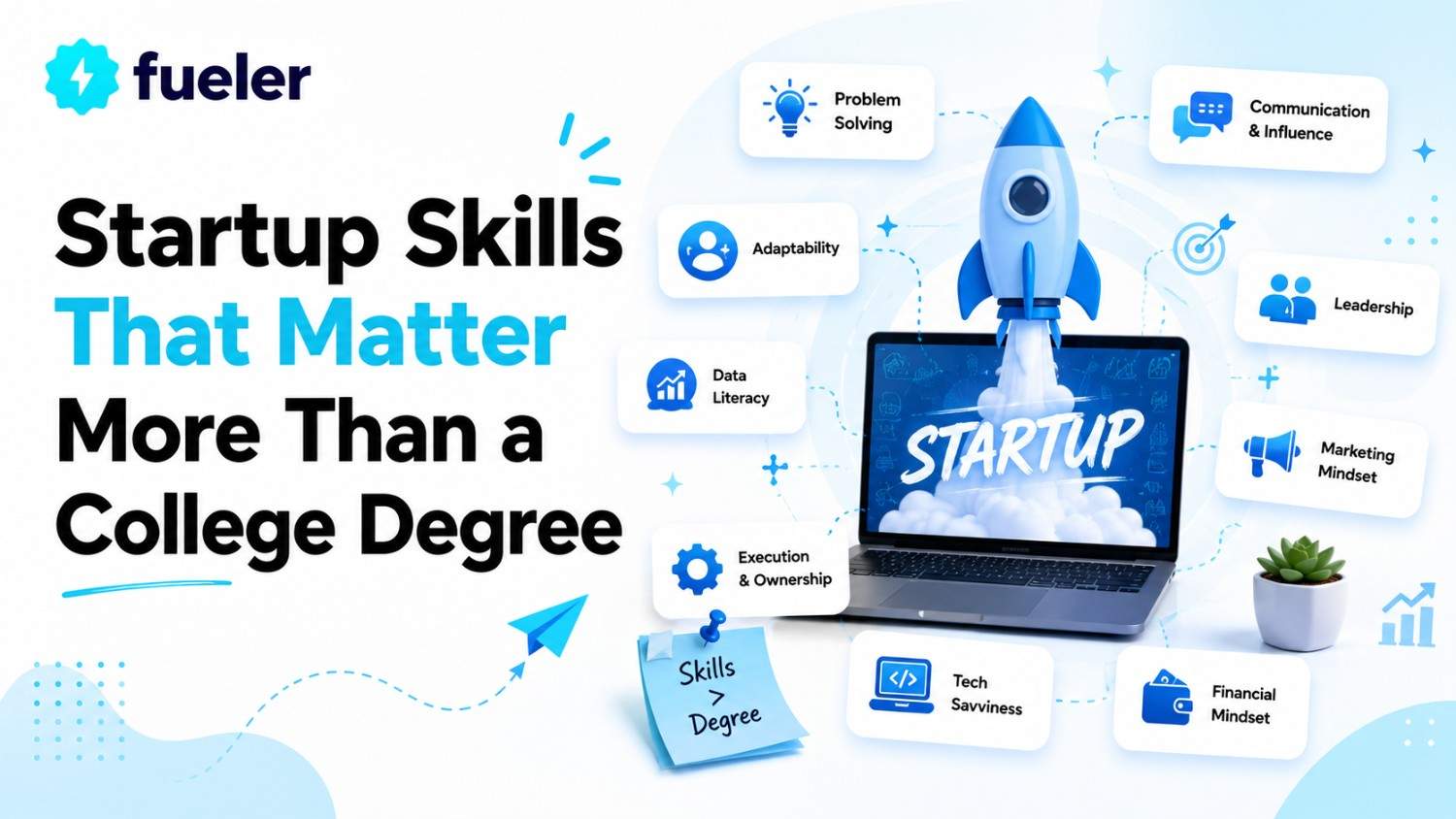
Startup Skills That Matter More Than a College Degree

Riten Debnath
23 Jul, 2026
Last updated: July 2026
Degree programs teach theory, but startups run on raw execution. Early-stage companies do not have the luxury of structured training programs, rigid management hierarchies, or predictable timelines. Founding teams need people who can solve messy problems, work through extreme resource limits, and deliver tangible output on day one.
I’m Riten, founder of Fueler, a skills-first portfolio platform building the career infrastructure for 100 million creative professionals. Fueler connects talented individuals with companies through assignments, portfolios, and projects, not just resumes or CVs. Think of it as Dribbble/Behance for work samples combined with AngelList for hiring infrastructure.
Most university degree curriculums prepare individuals for established corporate roles where playbooks already exist. Startups operate in environments where the playbook changes every week. To stand out and build a high-impact career in the modern tech ecosystem, you need practical execution habits. Here are the eight critical skills early-stage startup founders search for and how you can develop them.

1. High-Velocity Execution and Rapid Prototyping
Startup environments move fast because time is their most expensive resource. Early-stage teams need operators who can take a vague strategy, turn it into a working model within hours, and collect real-world feedback immediately. Execution speed always beats slow perfectionism when you are trying to find product-market fit.
Building basic functional prototypes gives teams immediate clarity on whether an idea works. Instead of writing a twenty-page strategy document, building a working page or simple workflow reveals immediate flaws in logic. Rapid iteration allows team members to test hypotheses, analyze user responses, and pivot before spending excessive capital.
- Rapid Minimum Viable Product Creation: Translating customer requests into quick visual or functional drafts allows teams to test market interest without wasting engineering resources.
- Tight Feedback Loop Management: Gathering early customer reactions and implementing fixes within a single day keeps product development moving in the right direction.
- Operational Bottleneck Removal: Finding immediate workarounds for software or resource limitations prevents project stalls during critical growth phases.
- Prioritization Under Pressure: Selecting the single most important task that moves the needle today prevents teams from drowning in minor cosmetic details.
- Bias Toward Action: Initiating execution without waiting for step-by-step manager instructions creates immediate organizational momentum across all departments.
Why It Matters
Founders value teammates who create forward motion rather than waiting for ideal conditions. Demonstrating that you can take an idea from concept to finished output builds trust faster than a high GPA ever could. To get hired faster, focusing on proof of work gives founders direct evidence that you can execute under real startup conditions.
2. Asynchronous Communication and Internal Documentation
In remote and fast-paced startup setups, unnecessary meetings slow down production. The ability to write clean, clear, and structured documentation keeps distributed teams aligned across different time zones. Strong written communication ensures that project context isn't lost when someone is offline.
Clear documentation acts as an operational multiplier. When internal guides, technical specs, and project updates are written well, new team members onboard faster without pulling founders into repetitive training sessions. It keeps the entire company focused on shipping work instead of sitting in status update meetings.
- Structured Technical Writing: Explaining technical decisions or product features in clear language ensures cross-functional teammates understand requirements without back-and-forth messages.
- Asynchronous Project Status Updates: Writing brief, data-backed summaries on progress gives leadership full visibility without scheduling unnecessary calls.
- Decision Record Maintenance: Keeping track of why specific strategic paths were taken prevents teams from retrying failed experiments months down the road.
- Constructive Feedback Delivery: Providing precise, written critiques on project drafts speeds up refinement cycles for product and marketing teams.
- Knowledge Base Organization: Creating central reference documents allows every department to access current operating procedures independently.
Why It Matters
When you write with precision, you save everyone time and reduce company drag. Clear writing proves that you think logically and value your team's focus. Showing structured records of your past projects through a cleanm portfolio website lets founders evaluate your thinking style before they even hop on an interview call.
3. Product Discovery and Distribution Strategy
Building a product is only half the battle; knowing how to get it into the hands of paying customers is what keeps a startup alive. Modern startup hires must understand basic marketing principles, audience acquisition, and user retention strategies. A great feature built in a vacuum provides zero value if no one knows it exists.
Understanding distribution means knowing which channels reach your core audience efficiently. Early-stage team members who can run small growth experiments, write compelling copy, and optimize landing pages help the company scale without massive ad budgets. This blend of product sense and marketing awareness makes an employee indispensable.
- Landing Page Conversion Optimization: Crafting clear value propositions and strong visual layouts turns casual page visitors into active product signups.
- Organic Search Positioning: Researching search intent and publishing focused articles drives consistent, low-cost customer traffic to core product pages.
- Customer Interview Execution: Asking non-leading questions during user calls extracts real pain points that shape future product roadmap decisions.
- Multi-Channel Content Testing: Distribution across social platforms and newsletter channels builds early brand authority without large ad budgets.
- Funnel Analytics Tracking: Analyzing drop-off points in user registration flows highlights exact areas where product friction needs removal.
Why It Matters
Startups fail when they run out of money before finding distribution. Team members who bring a user-acquisition mindset help secure early traction and validation. Mastering modern freelance skills in growth, analytics, and content distribution makes you an immediate asset to any early-stage team.
4. Modern AI Tool Integration and Workflow Automation
The modern startup workforce relies heavily on intelligent automation to accomplish the work of much larger teams. Knowing how to use modern software, custom scripts, and low-code platforms to automate repetitive operational tasks gives small teams a massive output advantage.
Instead of spending hours manually moving data between spreadsheets, writing basic code scripts, or drafting routine emails, high-performing operators build automated pipelines. This capability allows startups to keep overhead low while scaling their daily operations smoothly.
- Workflow Automation Setup: Connecting distinct web platforms using automated triggers eliminates manual data entry across marketing and sales databases.
- AI-Assisted Research and Synthesis: Summarizing large datasets or market reports quickly turns raw public data into actionable business insights.
- Code Generation and Debugging: Using modern code assistants speeds up the development of basic software features and internal team tools.
- Automated Customer Support Routing: Building smart sorting rules for user tickets ensures critical customer bugs reach engineers immediately.
- Content Operations Scaling: Using software tools to repurpose core research into multiple formats maximizes organic reach without adding headcount.
Why It Matters
Founders want team members who leverage technology to expand their personal capacity. Demonstrating that you can automate repetitive tasks proves you care about operational efficiency. Staying ahead on in-demand skills ensures you remain highly competitive in a rapidly evolving hiring market.
5. First-Principles Thinking and Data Analysis
University courses often encourage students to follow established rules and copy existing frameworks. Startups require first-principles thinkingbreaking a complex problem down to its fundamental truths and building a unique solution from scratch. Combined with quantitative data analysis, this skill prevents companies from making decisions based on unverified opinions.
Understanding basic metrics like customer acquisition cost, lifetime value, user retention rates, and churn allows operators to make logical choices. When something goes wrong in the business, first-principles thinkers look at the underlying raw data instead of applying generic corporate templates.
- Cohort Retention Analysis: Tracking user engagement patterns over time reveals whether product updates genuinely improve long-term user habits.
- Root Cause Problem Solving: Deconstructing complex operational failures into basic components prevents band-aid fixes and solves issue sources permanently.
- SQL and Data Querying: Pulling accurate raw usage data directly from database systems avoids reliance on third-party reporting delays.
- Unit Economics Assessment: Evaluating product costs versus revenues ensures that customer growth leads to sustainable long-term profitability.
- A/B Testing Discipline: Testing single variables in product design or messaging yields definitive proof of what users prefer.
Why It Matters
Gut feeling only gets a business so far. Founders need team members who support their opinions with clean data and logical reasoning. Developing these analytical capabilities opens doors to high-growth tech roles and equips you to navigate complex business challenges.
6. Resourcefulness and Scrappy Execution
Resourcefulness is the ability to achieve results when you lack budgets, formal authority, or clear instructions. Startup operators often have to figure things out on the fly. Whether it is fixing a landing page bug, sourcing early product testers, or negotiating software credits, resourceful people get things done regardless of constraints.
Scrappy execution means ignoring traditional corporate bureaucratic hurdles to find alternative solutions. It involves using free tools, reaching out directly to prospective clients, and learning new software applications in a single weekend to meet a project deadline.
- Self-Taught Technical Skills: Picking up new software tools or design programs on demand solves immediate product challenges without hiring contractors.
- Outreach and Direct Networking: Reaching out directly to target customers or industry advisors generates early conversations without paid introductions.
- Low-Budget Operations: Finding free or affordable software alternatives keeps operating expenses minimal during early company build phases.
- Vendor and Partner Negotiation: Securing favorable terms or software credits extends the company’s operating runway.
- Unconventional Distribution Hacks: Utilizing niche online communities and public forums builds early product awareness organically.
Why It Matters
In the early days of a company, money and time are limited. Someone who solves problems independently without asking for budget approval is a massive asset. Demonstrating scrappiness through active side projects or a dedicated setup helps highlight your real-world problem-solving abilities.
7. Cross-Functional Adaptability and Context Switching
In a large corporate enterprise, jobs are narrowly defined. At a startup, job descriptions are fluid. A marketer might handle customer support, or an engineer might write user documentation and conduct customer sales calls. Cross-functional adaptability is the ability to shift context and execute tasks across different domains smoothly.
Adaptable team members don't say, "That isn't in my job description." They step in wherever the business needs support to reach its immediate goals. This flexibility ensures that minor gaps in staffing don't slow down major company product launches.
- Customer Support Integration: Interacting directly with active users gives team members clear context on user pain points and product bugs.
- Basic Design and Copywriting: Drafting presentable visual assets and promotional text keeps projects moving forward without waiting for external design reviews.
- Project Management Ownership: Keeping multiple team members on track ensures complex feature launches hit target publication deadlines.
- Sales and Demo Execution: Communicating product value directly to prospective buyers drives early revenue growth.
- Operations and Logistics Handling: Managing vendor relationships and internal accounts maintains smooth daily company performance.
Why It Matters
Startups face shifting priorities as they scale and discover what the market wants. Teammates who adapt quickly help the company navigate pivots without losing operational speed. Reviewing solid portfolio examples across different disciplines shows how versatile professionals package diverse skill sets into a clear, cohesive showcase.
8. Ownership Mindset and Accountability
An ownership mindset means taking full responsibility for project outcomes, not just task completion. When you own a project, you track its performance after launch, identify issues proactively, and fix problems without waiting to be told. Founders want team members who treat the company’s success like their own.
Accountability means being honest about mistakes, analyzing failure root causes, and implementing preventative systems immediately. This level of reliability allows founders to delegate key business areas completely, freeing them up to focus on fundraising, hiring, and long-term strategy.
- End-to-End Task Management: Managing every stage of a campaign from initial concept to post-launch performance evaluation.
- Proactive Risk Identification: Flagging potential technical or marketing bottlenecks before they turn into costly operational delays.
- Post-Mortem Analysis Execution: Reviewing failed marketing campaigns or buggy feature rollouts honestly to prevent repeat mistakes.
- Quality Control Discipline: Reviewing all public-facing work thoroughly ensures the brand maintains high standards.
- Goal-Oriented Decision Making: Evaluating daily work based on key business metrics rather than simply counting hours spent online.
Why It Matters
Founders carry the weight of the company on their shoulders. When they find someone who takes genuine ownership, they give that person autonomy, leadership opportunities, and equity. Building a verified history of completed projects is the single best way to prove you operate with a true owner mindset.
How Does This Connect to Building a Strong Career or Portfolio?
Degrees show that you attended classes, but startups care about what you can build today. When hiring managers look for team members, they search for tangible evidence of execution- real assignments, documented problem-solving steps, and measurable project metrics. Documenting your workflows, side projects, and assignments proves that you possess the exact skills founders look for.
By building a structured showcase of your work, you give founders direct access to your problem-solving capabilities. That is why we built Fueler to help modern professionals package their assignments, growth experiments, and real-world projects into a clear, verifiable showcase that gets them hired based on output rather than credentials.
Final Thoughts
The hiring landscape has fundamentally shifted toward tangible skills and proof of work. While university degrees provide foundational theory, startup success depends on speed, adaptability, data analysis, and execution. If you focus on building real projects, documenting your outcomes, and learning modern tools, you will position yourself ahead of the competition. The future of work belongs to people who ship results.

Frequently Asked Questions
What startup skills matter most in 2026?
Execution speed, asynchronous writing, growth distribution, AI tool integration, and data analysis matter most. Startups value team members who take full ownership, adapt quickly to changing needs, and ship real projects without constant supervision.
Why do startups value proof of work over college degrees?
Degrees show theoretical knowledge, but proof of work proves immediate execution capability. Founders prefer hiring people who can build, market, and optimize systems on day one without needing expensive corporate onboarding programs.
How can I learn startup execution skills without prior experience?
Build independent side projects, complete open company assignments, and document your process step by step. Solving real business problems publicly gives you practical experience and creates verifiable work samples that attract startup founders.
Can non-technical team members work at tech startups?
Yes, non-technical operators drive crucial distribution, operations, content marketing, and customer success functions. Understanding basic low-code automation tools, data analysis, and user acquisition strategies makes non-technical team members highly valuable.
How do I show my startup skills to hiring managers effectively?
Organize your projects, case studies, and assignment results into a clean online showcase. Focus on highlighting the problem, your specific execution steps, and the final measurable results to demonstrate clear value.
Why 100,000+ professionals use Fueler
Fueler helps professionals showcase proof of work through projects, assignments, case studies, and achievements.
- Thousands of professionals use Fueler to create their digital portfolio
- Thousands of projects are published on Fueler. Check here
- Startups and Companies hire through proof of work on Fueler
- Used by freelancers, creators, marketers, video editors, writers, designers, and product managers
Our mission is to help the next 100 million professionals build a verified professional identity through proof of work

What should you do next?
You've read the article. Now turn your skills into proof of work and unlock more opportunities.
Build your proof of work portfolio
Create a clean portfolio with projects, assignments, resumes, and AI stack details that companies actually want to see.
Create your Fueler portfolio →Apply through assignments, not resumes
Stand out by solving real tasks from companies hiring on Fueler.
Explore assignments →Get discovered by companies
Make your work public and let recruiters discover your skills through actual projects instead of keywords.
Get discovered →
