10 Career Portfolio Examples That Got People Hired Globally

Riten Debnath
02 Apr, 2026
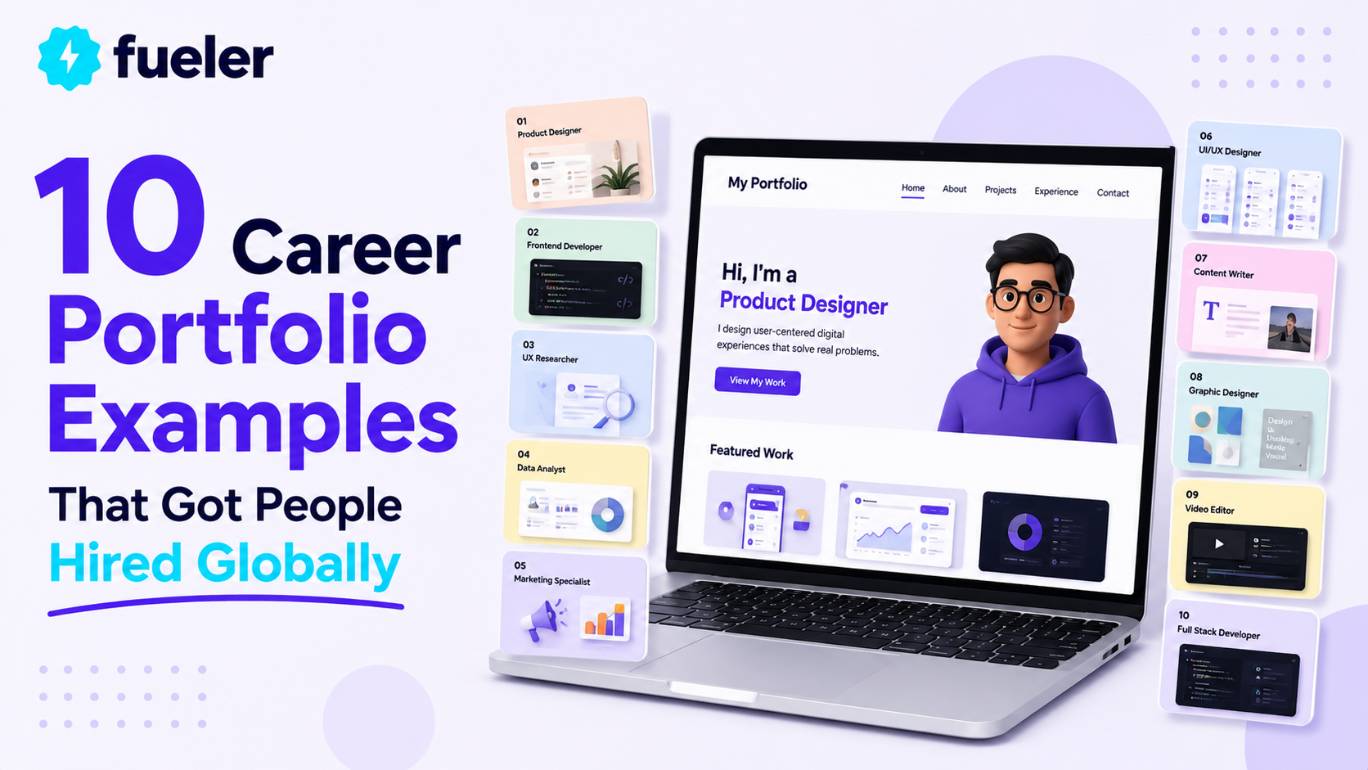
I am Riten, founder of Fueler. One of the most common questions I get from professionals trying to build their portfolio is this: what does a good one actually look like? It is easy to talk about what a portfolio should contain. It is much more useful to show you real-world examples of what works.
In this article, I am going to walk you through 10 types of career portfolios across different professions that have helped people land real jobs and win real clients. These examples are based on patterns we see consistently on Fueler and across the broader proof-of-work hiring landscape. Study them, find the ones most relevant to your field, and let them guide how you build your own.
1. The Product Designer Portfolio
A great product designer portfolio does not just show beautiful screens. Anyone can make something look nice. What separates a hired designer from a rejected one is showing the thinking behind the visuals.
The best product design portfolios include a clear problem statement at the start of each project, the user research and insights that shaped the design direction, wireframes and early explorations that show iteration, the final UI with a clear explanation of key design decisions, and quantifiable results like improved task completion rates, reduced drop-off, or increased conversion.
What makes it work: The designer shows before and after, explains why decisions were made, and ties the design work to real business outcomes.
2. The Content Writer Portfolio
A strong writing portfolio does not just show that you can write. It shows that your writing achieves something. The best examples include articles with view counts or traffic data, email newsletters with open and click-through rates, SEO content with current Google ranking positions, and social copy with engagement metrics.
A great writing portfolio also shows range. Short-form and long-form. Creative and analytical. Marketing copy and editorial content. The breadth demonstrates versatility while the depth in any one area demonstrates expertise.
What makes it work: Each piece of writing has a clear purpose and a measurable outcome tied to it.
3. The Software Developer Portfolio
A developer portfolio lives and dies on one thing: working code. Links to live applications, clean GitHub repositories with clear README documentation, and descriptions of the technical challenges solved during each project are the backbone of any strong developer portfolio.
The best developer portfolios also explain the reasoning behind technical decisions. Why did you choose this architecture? What problem did this library solve that another could not? How did you handle scale? This kind of explanation shows engineering maturity, not just coding ability.
What makes it work: Real, functional projects with clear documentation and thoughtful explanation of technical decision-making.
4. The Digital Marketer Portfolio
A marketer's portfolio speaks in numbers. Total ad spend managed and return on ad spend achieved. Organic traffic growth from a specific SEO initiative. Lead generation volume from a particular campaign. Email sequence revenue attribution. These are the metrics that matter and the ones that should anchor every entry in a marketing portfolio.
Screenshots from advertising dashboards, Google Analytics exports, and email marketing platform reports all serve as strong visual evidence that backs up the numbers you claim.
Another small detail worth getting right is your portfolio names, since a clear name can immediately tell someone what kind of work they are about to see.
What makes it work: Real data that shows the direct business impact of the marketer's decisions and execution.
5. The Freelance Photographer Portfolio
A photography portfolio is inherently visual, which makes it both easier and harder to build well. Easier because the work speaks visually without much explanation. Harder because every photographer has beautiful images. What separates a hired photographer is curation, storytelling, and context.
The best photography portfolios are organized by project type or genre, include a brief description of the brief or concept behind each project, and show a clear visual point of view that makes the work recognizable and memorable.
What makes it work: Disciplined curation and a consistent visual identity that makes the portfolio feel like a coherent body of work rather than a random collection.
6. The Fresh Graduate Portfolio
A student with no formal work experience built a portfolio entirely from a college research project, a personal blog they ran for six months, a social media account they managed for a nonprofit, and a freelance logo project they did for a friend's small business.
None of these were paid corporate jobs. All of them were documented properly with context, contribution, and outcome. The portfolio showed initiative, learning, and genuine capability. It got the graduate their first job within three weeks of graduating.
What makes it work: Real work samples, even from unpaid or self-initiated projects, documented with the same professionalism as paid work.
7. The Career Changer Portfolio
A finance professional who wanted to move into product management built a portfolio that had nothing to do with their finance background. Instead, it showed the product specifications they wrote during a side project, the user interviews they conducted, the feature prioritization framework they developed, and the results from a small digital product they launched independently.
The portfolio made the case that this person already thought like a product manager, even if they had not held the title yet. They got multiple interviews and a job offer within two months.
What makes it work: Proof of the skills required for the target role, regardless of where those skills were developed.
8. The Freelance Consultant Portfolio
A business consultant's portfolio contained five client case studies. Each one followed the same structure: the client's challenge, the diagnostic approach used, the recommendations made, the implementation support provided, and the measurable outcome. Some client names were included with permission. Others were anonymized by industry.
The portfolio also included three client testimonials and one published article the consultant had written on a topic relevant to their specialty.
What makes it work: Strong third-party validation through testimonials combined with detailed case studies that demonstrate the consultant's analytical framework.
9. The Social Media Manager Portfolio
A social media manager showed account growth charts for three different accounts they had managed, the content strategies they had developed and documented, their top-performing posts across platforms with engagement data, and a short written explanation of what they learned from each account and how they adapted their approach over time.
What makes it work: Visual proof of growth combined with written evidence of strategic thinking and the ability to learn and adapt.
10. The Data Analyst Portfolio
A data analyst built a portfolio featuring four projects. Each one started with a real business question, showed the data sources used, walked through the analysis approach, presented the visualizations created, and ended with the insight or recommendation that came from the analysis.
The analyst wrote each project summary so that a non-technical hiring manager could follow along and understand the value of the work without needing to understand the technical details.
What makes it work: Clear storytelling around data that bridges the gap between technical execution and business impact.
Here, you can explore a selection of career portfolios across different creative, technical, and marketing roles. These examples show how professionals can use a portfolio to present their skills, projects, and practical experience in a way that is easier for recruiters and clients to understand.
Profile | What You Can Learn | |
|---|---|---|
Learn how a 3D interior designer can use a portfolio to present specialised creative work and make visual skills easier for recruiters and clients to evaluate. | ||
Learn how a content and social media strategist can use a portfolio to demonstrate strategic thinking alongside content execution. | ||
Learn how a developer can use a portfolio to demonstrate technical skills through tangible work rather than relying only on a resume. | ||
Learn how a UI/UX designer can use a portfolio to communicate design skills and present work visually for potential employers. | ||
Learn how an SEO and performance marketer can use a portfolio to showcase marketing expertise and practical work across acquisition-focused areas. |
The Pattern Across Every Great Portfolio
Look across all ten of these examples and you will see the same three things in every single one. They show real work. They show real results. And they tell a clear, honest story about what the person did and why it mattered.
That is the formula. And that is exactly what Fueler is built to help you achieve. Whether you are a designer, developer, writer, marketer, analyst, or anything in between, Fueler gives you the structure to build a portfolio that makes sense to any hiring manager who sees it. Visit fueler.io to get started.
Frequently Asked Questions
What does a good career portfolio example look like?
A good career portfolio shows real projects with clear context, your specific contribution, and measurable outcomes. It is clean and easy to navigate and tells a compelling story about your skills and their impact.
Can a student or fresh graduate build a strong career portfolio?
Yes. College projects, personal initiatives, volunteer work, and self-initiated spec projects all count. Document them professionally with context and outcomes and they are just as valid as paid work.
What industries benefit most from a career portfolio?
Design, writing, marketing, technology, product management, and consulting benefit most. But any profession can use a portfolio to demonstrate skills and stand out from candidates who only have a resume.
How many projects should I include in my career portfolio?
5 to 10 strong, well-documented projects are ideal. More is not better. Quality of documentation and clarity of impact matter far more than volume.
Where can I find career portfolio examples for inspiration?
Fueler has thousands of public portfolio examples across different industries. Visit fueler.io to browse real portfolios from professionals in your field and get inspired.
What is Fueler Portfolio?
Fueler is a career portfolio platform that helps companies find the best talent for their organization based on their proof of work. You can create your portfolio on Fueler. Thousands of freelancers around the world use Fueler to create their professional-looking portfolios and become financially independent. Discover inspiration for your portfolio
Sign up for free on Fueler or get in touch to learn more.

What should you do next?
You've read the article. Now turn your skills into proof of work and unlock more opportunities.
Build your proof of work portfolio
Create a clean portfolio with projects, assignments, resumes, and AI stack details that companies actually want to see.
Create your Fueler portfolio →Apply through assignments, not resumes
Stand out by solving real tasks from companies hiring on Fueler.
Explore assignments →Get discovered by companies
Make your work public and let recruiters discover your skills through actual projects instead of keywords.
Get discovered →
