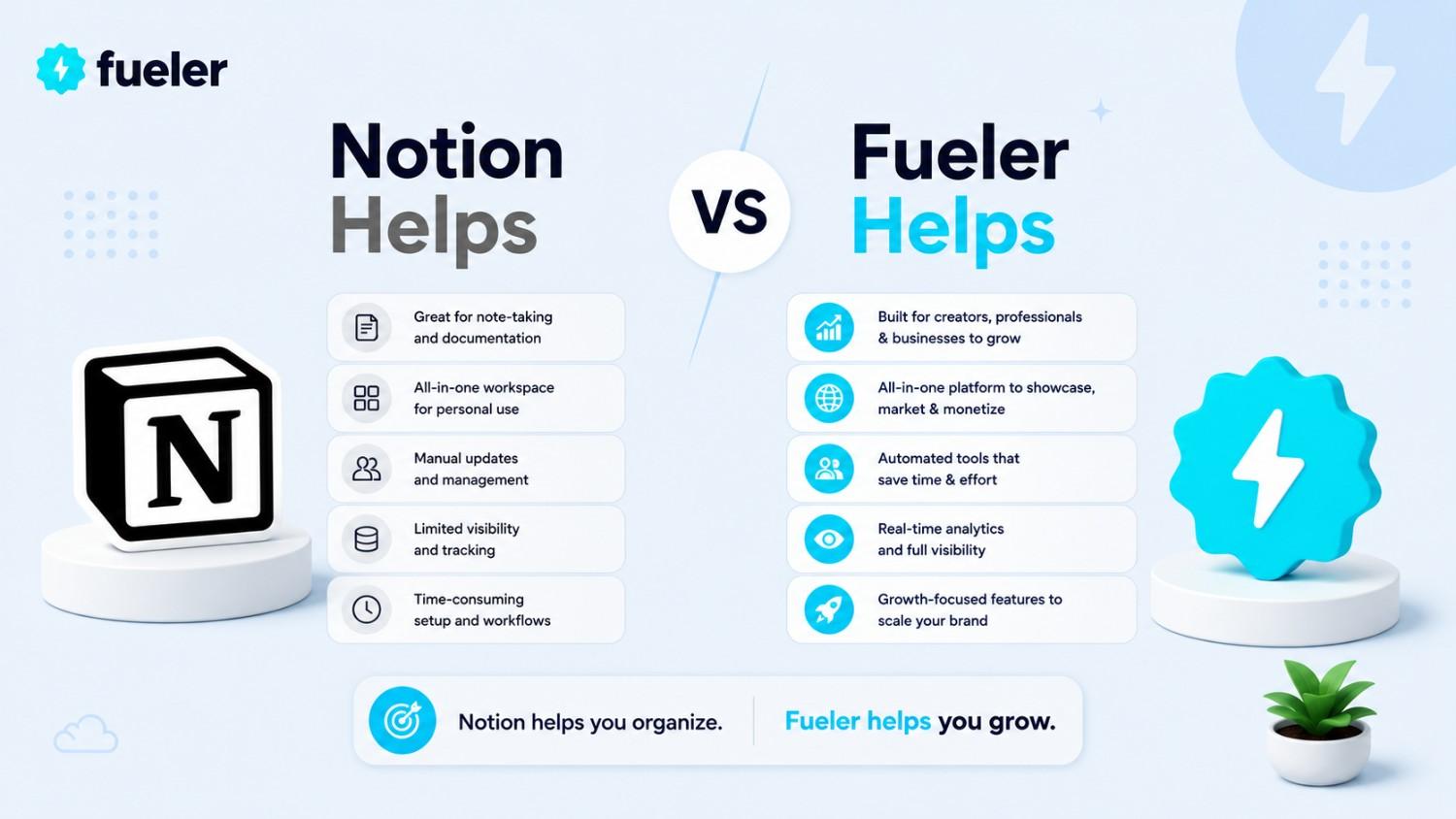
Notion Helps You Organize Work. Fueler Helps You Get Discovered

Riten Debnath
09 Jul, 2026
Last updated: July 2026
Keeping your best professional achievements locked inside a private productivity application is like hiding a masterpiece in an attic. While document trackers are excellent for internal task management, they fail to attract the eyes of active talent seekers.
I’m Riten, founder of Fueler, a skills-first portfolio platform that connects talented individuals with companies through assignments, portfolios, and projects, not just resumes/CVs. Think Dribbble/Behance for work samples + AngelList for hiring infrastructure.
In this deep dive, you will learn the exact structural differences between internal organization utilities and public discovery frameworks. We will explore how choosing the right system removes distribution bottlenecks, ensures your skills rank on modern search tools, and transforms your catalog of shipped projects into consistent, incoming business opportunities.
1. Why Internal Workspaces Fail at External Discovery
Internal organization apps are built to keep your thoughts, projects, and roadmaps structured for your own eyes or your immediate team. They function remarkably well as private archives, but they are architecturally blind to the outside world, creating zero organic inbound traffic.
When you use an internal workspace to host a public profile, you enter a state of complete isolation. There is no natural flow of recruiters, founders, or clients browsing the ecosystem looking for talent. If you want someone to see your work, you must manually push the link out yourself every single day.
- Zero platform talent directories exist inside personal workspace tools, meaning your profile remains completely hidden from corporate recruiters who spend hours browsing dedicated talent databases daily.
- Absence of algorithmic recommendations prevents your curated case studies from being automatically suggested to companies searching for specific technical skills, niche industry experience, or past assignment outcomes.
- Private-by-default server structures mean that your shared pages do not automatically ping search indexes, causing your hard-earned achievements to remain invisible to automated candidate-sourcing bots.
- Isolated domain authority limits your overall organic visibility, as search engines view a shared workspace page as an obscure sub-document rather than an elite, standalone professional entity.
- Lack of social distribution loops makes it impossible for peers to organically share or upvote your profile within a broader professional community, stalling your networking velocity completely.
Why It Matters
In 2026, relying purely on cold outreach is an exhausting, low-conversion strategy for your career. To land premium roles easily, you must shift your digital assets to an open infrastructure where active talent buyers are already hunting for verified expertise.
2. The Mechanical Reality of Public Link Distribution
Sharing a raw document link with a premium client introduces immediate psychological friction. Document databases often look messy, load with distracting toolbars, and force the viewer to adjust their layout preferences just to read through your engineering or marketing case studies clearly.
A true proof of work ledger operates with a completely different user experience mindset. It strips away all block editing functions, formatting markers, and internal workspace branding. This leaves the viewer with a fast, pristine, agency-grade presentation that places your specific project contributions front and center.
Understanding how information design impacts human behavior is crucial when designing an effective portfolio strategy. The following five execution realities break down exactly how generic document layouts disrupt the critical five-second review window used by busy hiring managers globally:
- Distracting sidebars and editing menus often persist when sharing workspace pages publicly, which immediately pulls a busy recruiter's focus away from your data-driven campaign metrics or code samples.
- Unoptimized asset compression models cause heavy imagery, screenshots, and live product designs to stretch awkwardly on mobile screens, making your professional profile look unpolished and rushed.
- Clunky scroll mechanics inside databases force visitors to horizontal-scroll through project tables, generating significant interface frustration that frequently results in a high bounce rate from your link.
- Generic non-professional page headers remove your personal branding entirely, making your career profile blend into the millions of basic corporate wikis that decision-makers see every single day.
- Absence of immediate contact triggers makes it difficult for interested clients to initiate a conversation, requiring them to hunt for your email instead of clicking a button.
Why It Matters
When you eliminate visual friction, you demonstrate respect for a decision-maker's limited attention span. A clean presentation layout immediately communicates institutional polish and operational maturity, converting passive link clicks into verified discovery interviews.
3. Content Indexing Differences for Modern Search Intent
Search engines view the internet through structured code, looking for clear tags, schema markups, and explicit semantic layouts. Document applications render text on the fly using complex client-side scripts, which frequently prevents search crawlers from reading your project summaries accurately.
A dedicated professional discovery platform is built from the ground up using search-first architecture. Every project assignment or proof of work card you upload creates clean, static HTML code that modern retrieval engines love, turning your professional background into an active participant in organic search rankings.
Using a platform that optimizes your work for discovery is the foundation of a modern proof of work portfolio system. These technical indexing capabilities ensure your actual project achievements are parsed correctly by algorithmic search crawlers and modern AI tools:
- Automated schema markup generation applies precise microdata to your project titles, tools, and outcomes, helping modern web engines classify your professional niche with extreme mathematical accuracy.
- Clean human-readable URL slugs naturally integrate high-traffic industry keywords into your project page links, significantly improving your capability to rank for hyper-specialized technical queries.
- Server-side rendering processes deliver your case study text to search engines in milliseconds, ensuring that your proof of work is completely readable during automated indexing sweeps.
- Semantic entity optimization workflows connect your skill tags to verified industry databases, boosting your authoritative positioning inside modern artificial intelligence overview answers and citations.
- Optimized meta descriptions for individual cards allow you to control exactly how your specific project assignments display on external search results, maximizing your organic click-through rates.
Why It Matters
If your career evidence cannot be found by search engines, you do not exist to the global market. Transitioning to a search-optimized infrastructure ensures your real-world capabilities are served as direct answers when companies search for specific expertise online.
4. The Hidden Tax of Manual Portfolio Maintenance
Managing a customized career landing page inside a multi-purpose document manager requires constant manual labor. You have to build columns by hand, adjust block spacing, fix broken embed links, and double-check database permissions every single time you complete a new assignment.
A specialized platform eliminates this operational tax entirely through structured input frameworks. You simply paste your project story, drop your media, add your skill tags, and the platform handles the visual design, responsive layouts, and optimization automatically, freeing you up to focus on execution.
Maintaining your profile without wasting hours on layout design requires a structured portfolio checklist approach to save time. These structural advantages explain why a specialized creation system outperforms a manual block editor when updating your shipped project records:
- Standardized project creation templates guide you through the process of writing impactful case studies, preventing you from forgetting to include critical metrics, tools, or role descriptions.
- Dynamic skill tagging systems automatically link your new projects to your primary profile page, instantly updating your skill bars and relevant expertise summaries without manual input.
- Automated link health monitoring keeps your external project references stable, ensuring that prospective employers never encounter broken media frames or dead connections on your profile.
- One-click feature toggle systems allow you to reorganize the visual order of your case studies instantly, letting you prioritize different projects depending on changing market trends.
- Centralized asset cloud storage updates your master files globally across the ecosystem, removing the need to manually replace identical assets in multiple nested workspace directories.
Why It Matters
Your portfolio shouldn't feel like a second full-time job to maintain. Streamlining the update process ensures you keep your proof of work fresh and accurate, giving you a competitive edge in fast-moving contract cycles.
5. How Audience Intent Shapes Professional Validation
Recruiters and corporate founders have incredibly short attention spans when auditing incoming talent pipelines. When they open a document tracker, their brain enters a passive, reading-oriented mindset, viewing your career path as a basic text-based history rather than an active portfolio of shipped outcomes.
A dedicated talent discovery platform activates an evaluation-oriented mindset instantly. By organizing your work history into clickable, visual project cards that mirror modern product directories, you invite the viewer to explore your technical capabilities interactively, validating your competence through structured design hierarchies.
Understanding this evaluation mindset clarifies the core distinctions behind a career portfolio vs resume comparison in modern hiring processes. These psychological design choices directly influence how an independent client or corporate founder perceives your level of professional authority:
- Action-oriented visual grids encourage recruiters to click into individual project cards, turning a boring document read into an engaging, multi-stage exploration of your shipped solutions.
- Verifiable coworker attribution tags eliminate skepticism immediately by showing that other real market professionals publicly stand behind the authenticity of your shared project outputs.
- Prominent metric highlight blocks draw the reviewer's eyes directly to your quantitative results, ensuring that your revenue generation or efficiency stats are noticed immediately.
- Clean structural project separation prevents your different career phases from blurring together, allowing users to understand your professional progression in under ten seconds flat.
- Consistent institutional layout design removes personal styling errors, presenting your background within an elite framework that naturally commands higher consulting and contract rates.
Why It Matters
When you align your profile structure with the exact scanning habits of modern talent acquisition teams, you cut down hiring friction, helping you bypass generic baseline resume screens and secure advanced pricing conversations faster.
6. Strategic Multi-Asset Presentation vs Data Block Storage
Modern proof of work is highly dynamic, often consisting of live design mockups, audio snippets, video overviews, and codebase files within a single project. Generic document tools treat these files as simple attachments, forcing them into static, grey download blocks.
Specialized portfolio setups function as interactive media sandboxes. They allow you to embed live widgets that render instantly, letting a founder play your video, scroll your code repository, or test your application mockup directly inside your project sheet without ever leaving your personal web domain.
Choosing a system designed to showcase various media types effectively is essential for academic and professional portfolios alike. These native asset presentation capabilities ensure your diverse digital deliverables are displayed beautifully without causing page slowdowns:
- Native iframe container sandboxing keeps complex third-party tools completely stable, preventing script conflicts from breaking your layout or introducing security warnings to visitors.
- Proportional aspect-ratio scaling preserves the precise dimensions of your design mockups and video presentations, ensuring your media looks intentional and clean on every device.
- Inline markdown rendering support allows you to format deep-dive technical explanations cleanly around your media, giving perfect conceptual context to your engineering or architectural choices.
- High-speed content delivery networks stream your heavy visual assets seamlessly, entirely eliminating the awkward loading delays that plague standard text database sharing.
- Unified asset presentation drawers keep your images, links, and text grouped together logically, preventing your case studies from turning into a chaotic mess of scattered files.
Why It Matters
When a client can interact with your work live inside your profile, your perceived capability skyrockets. Dynamic evidence removes all doubts about your actual skills, positioning you as an elite specialist who delivers functional results.
7. The Operational Trade-Off in Inbound Lead Acquisition
A private productivity workspace requires you to do 100% of the heavy lifting when it comes to user distribution. It acts as a passive container that sits silently on the internet, completely dependent on you pasting it into cold emails or social media bios.
An open discovery network operates as a decentralized inbound funnel. By index-linking your profile to global search streams, talent discovery marketplaces, and peer project feeds, the infrastructure actively surfaces your past work to active employers, generating inbound opportunities while you sleep.
Moving your shipped outcomes into a discoverable network is why understanding a comprehensive career portfolio framework is essential for modern career advancement. These discovery mechanisms transform your portfolio from a static digital resume into an active client acquisition system:
- Global search index integration maps your specific project tags to organic search terms, pulling targeted, high-intent traffic directly onto your personal profile page.
- Cross-pollinated peer discovery links display your contributions on your teammates' profiles, opening up secondary referral networks through natural professional association.
- Dedicated talent market matching connects your uploaded proof of work directly to live company briefs, ensuring your relevant achievements hit active hiring desks immediately.
- Automated email digest inclusion highlights your newly published assignments to verified founders looking to contract top-tier, skills-first specialists in your exact niche.
- Viral social graph dynamics allow your case studies to be discovered by industry communities, compounding your professional visibility across decentralized web networks.
Why It Matters
You shouldn't have to pause your active client execution just to hunt for your next contract. Leveraging an open discovery system allows your existing track record to generate highly targeted inbound leads passively.
8. Architectural Focus: Organizing Productivity vs Shipping Outcomes
At a deeper philosophical level, document tracking applications and portfolio environments are built for completely opposing goals. A workspace tool is designed to look inward, focusing on process, endless drafts, daily notes, and messy organizing systems.
A discovery platform looks entirely outward, focusing strictly on final outcomes, polished evidence, and clear career verification. By separating your messy internal thinking spaces from your public-facing professional landing page, you build a high-converting digital reputation that signals execution clarity.
Using a system engineered entirely for professional presentation is the core topic explored across leading portfolio platforms today. These architectural differences illustrate why separating your internal processing tools from your public evidence layer creates better market positioning:
- Outcome-first interface styling strips away the messy process notes and drafts, leaving the public viewer with a hyper-focused catalog of your final results.
- Intentional career positioning architecture centers your personal narrative around what you have shipped, rather than showing how you track your internal calendars.
- Streamlined professional onboarding setups eliminate complex workspace architecture design decisions, giving you an optimized, publish-ready profile frame in under two minutes flat.
- Focused metrics documentation spaces require you to articulate the concrete business impact of your work, changing your image from a basic task worker to a valuable strategic partner.
- Cleaner professional network separation preserves your private note-taking spaces for deep work, while keeping your public profile optimized for rapid executive evaluation.
Why It Matters
When you blend your internal organization chaos with your public reputation layer, you dilute your personal authority. Keeping your production workspace private while showcasing clear results on an open network establishes long-term market credibility.
How Does This Connect to Building a Strong Career or Portfolio?
Your professional reputation is directly shaped by how easily the market can discover your shipped achievements. While internal trackers help you manage tasks, they keep your actual talents hidden from the global talent pool. Placing your career evidence on an open network ensures your skills are indexable, scannable, and discoverable. Using Fueler enables you to establish an authoritative ledger of your execution data, allowing your proof of work to secure premium opportunities automatically.
Final Thoughts
The platforms you choose to host your career assets dictate the speed of your professional advancement. Relying on isolated document links forces you into a permanent cycle of manual distribution and cold pitching. Transitioning your projects to a specialized infrastructure designed for discoverability turns your past assignments into an automated lead machine. As the global hiring market shifts entirely toward skills-first sourcing and verified execution, passive visibility is your ultimate competitive moat. Stop hiding your best work inside private databases, design your profile for organic discovery, and let your shipped outcomes drive your long-term career growth.
FAQ
Why should I separate my internal workspace from my public profile?
Mixing your internal workspaces with your public profile introduces visual clutter and navigation friction. Keeping your process notes private while highlighting your finalized project outcomes on a dedicated discovery network ensures a polished presentation for recruiters.
How does a discovery network generate passive career opportunities?
Discovery networks utilize built-in talent indexes, search engine optimizations, and algorithmic keyword matching. This infrastructure surfaces your portfolio cards directly to corporate founders and talent acquisition specialists who are actively searching for your specific skill sets.
Do text-heavy document layouts perform poorly in front of recruiters?
Yes, recruiters analyze hundreds of profiles daily and will bounce if they face nested directories or messy data rows. Clean visual setups optimized for rapid scanning convert profile traffic into interviews at a much higher rate.
Can AI search engines find my work inside internal note applications?
Generally no, because internal note utilities rely on dynamic client-side scripts that obscure text from search indexers. Dedicated platforms generate semantic HTML code that allows AI discovery systems to index and cite your work easily.
What is the fastest way to make my past projects discoverable?
The most efficient approach is publishing your case studies on an open talent network like Fueler, which features built-in indexing tools. This ensures your skills are immediately searchable by global companies without requiring complex coding or design.
What should you do next?
You've read the article. Now turn your skills into proof of work and unlock more opportunities.
Build your proof of work portfolio
Create a clean portfolio with projects, assignments, resumes, and AI stack details that companies actually want to see.
Create your Fueler portfolio →Apply through assignments, not resumes
Stand out by solving real tasks from companies hiring on Fueler.
Explore assignments →Get discovered by companies
Make your work public and let recruiters discover your skills through actual projects instead of keywords.
Get discovered →
