Career Portfolio vs Resume. Which One Gets You Hired Faster?

Riten Debnath
02 Apr, 2026
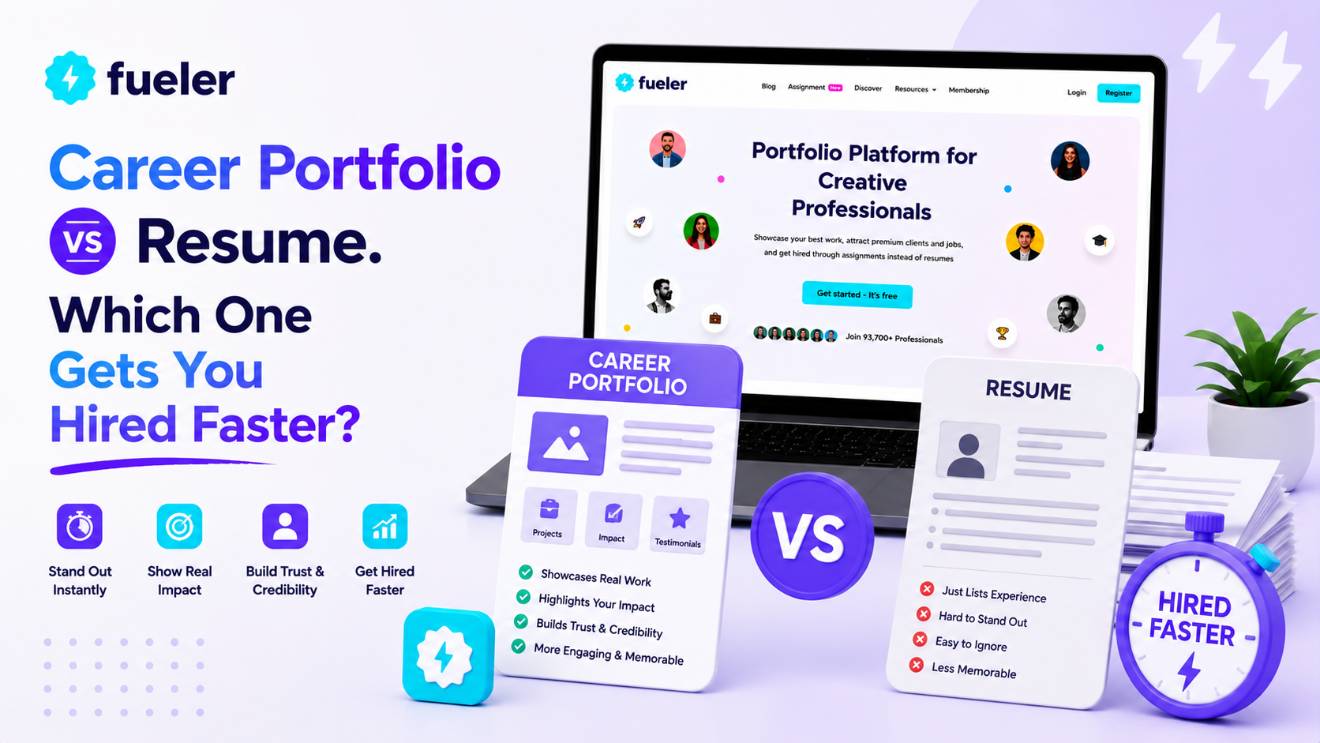
I am Riten, and I have spoken to hundreds of hiring managers while building Fueler. One question comes up again and again across every conversation: should I focus on my resume or my portfolio? Which one actually matters more?
I am going to give you the honest, direct answer that most career advice websites avoid. In 2026, your portfolio wins. Not because resumes do not matter. They do. But because the portfolio is what actually gets you hired. Let me break down exactly why.
The Resume Is Not Dead, But It Is Not Enough
A resume is still required in most hiring processes. Most companies will ask for one during their initial application stage. But here is the reality that changes everything: research consistently shows that recruiters spend an average of 6 to 7 seconds scanning a resume. It is a filter, not a decision-maker. It gets you to the next round. It does not get you the job.
A career portfolio is what happens after you pass that first filter. It is the thing that actually convinces someone you are worth hiring. It is the evidence that supports every claim you made on your resume. And in a world where every candidate has a polished resume, your portfolio is the thing that makes you different.
Career Portfolio vs Resume: The Core Difference
What a Resume Does
A resume is a 1 to 2-page text document that lists your education, work history, skills, and achievements. It is backward-looking and standardized. It tells the story of where you have been and what you were responsible for. It is designed to pass through automated screening systems and give recruiters a quick summary of your background.
What a Career Portfolio Does
A career portfolio is a living, proof-based document that shows your work in depth. It can include images, links, case studies, videos, and real project outcomes. It shows what you have built, how you think, and what results you produce. It is not designed to be scanned in 7 seconds. It is designed to be explored by someone who is already interested in you.
5 Key Differences Between a Career Portfolio and a Resume
1. Proof vs Claims
A resume claims you have certain skills. A portfolio proves them. now run a Content Writer test alongside the portfolio, so being ready to write to a brief gives you an edge. Increasingly, employers back that proof with a skills test, so being ready to demonstrate your ability live, not just in a case study, gives you an edge. Writing 'strong SEO skills' on a resume means nothing without proof. Showing a case study where you grew organic traffic from 500 to 15,000 monthly visitors in 8 months means everything. The difference between a claim and proof is the difference between being considered and being hired.
2. Depth vs Summary
A resume gives a surface-level overview. A portfolio lets you go deep. You can explain your thinking, your process, the specific challenges you faced, the decisions you made, and the results you achieved. Depth builds confidence in a way that a summary never can. When an employer reads your portfolio and understands exactly how you think and work, the hiring decision becomes easy.
3. Static vs Dynamic
A resume is a snapshot of a moment in time. A portfolio is a living document. You keep updating it as you complete new projects, achieve new results, and develop new skills. It grows with your career and always reflects your current best work. A resume that is not updated quickly becomes stale. A portfolio that is maintained stays relevant and powerful.
4. One Format vs Many
A resume is always text. A portfolio can include images, links, PDFs, embedded videos, interactive demos, code repositories, published articles, and more. Different types of work deserve different presentation formats. A designer should show their designs. A developer should show working code. A marketer should show campaign results with real data. A portfolio makes all of that possible.
5. Generic vs Targeted
Most people send the same resume to every job they apply for. A portfolio, especially on Fueler, can be curated and highlighted for each specific role or client. You can choose which projects to feature prominently depending on what the opportunity requires. This level of customization is impossible with a traditional resume.
When Does a Resume Work Better?
Resumes are still the standard entry point for most hiring processes, especially in large corporations, government roles, finance, and law. You still need one, and it still matters. But it is the starting point, not the finish line. Think of your resume as the key that gets you in the door.
Resumes also work well in industries that are highly regulated or credential-focused, where specific degrees, licenses, or certifications are non-negotiable requirements. In those cases, your credentials on a resume carry significant weight.
Even in these industries, many employers now complement resume screening with a skills test to verify practical ability before moving candidates to the next stage of the hiring process.
When Does a Portfolio Work Better?
Portfolios work best in creative industries like design, writing, photography, and video production. They are also increasingly important in technology, product management, marketing, growth, and operations roles where the quality and impact of your work matters far more than your job title or where you went to school.
At Fueler, we see this play out every day. The professionals who get responses the fastest, who land interviews within days of applying, and who close deals with new clients are the ones with strong, result-oriented portfolios. Not the ones with the most impressive resumes.
The Winning Strategy: Use Both Together
The best approach in 2026 is to use your resume and your portfolio as a team. Your resume gets you through the initial screening. Your portfolio closes the deal. When you send a job application with a Fueler portfolio link prominently featured, you stand out immediately. You are showing the recruiter that you are not just making claims. You are backing them up.
Many companies that use Fueler for hiring have started skipping the resume stage entirely for certain roles. They post an assignment or a challenge. Candidates complete it and submit their work. The best work wins the opportunity. This is proof-of-work hiring, and it is the direction the entire industry is moving.
How Fueler Changes the Game
Fueler is not just a portfolio tool. It is a hiring platform built around the idea that the best person for the job should get it, based on what they can do rather than what their resume says. When you build your portfolio on Fueler, you are not just creating a document. You are entering a system where companies actively search for talent, post real assignments, and hire based on demonstrated skill.
Your Fueler portfolio link belongs on your resume, your LinkedIn profile, your email signature, and every job application you send. It is the bridge between your resume and the job offer. Start building at fueler.io today.
Frequently Asked Questions
Is a career portfolio better than a resume for getting hired?
Both serve different purposes. A resume gets you through initial screening. A portfolio proves your skills and helps you close the deal. Together, they are the most powerful combination in 2026.
Do I need a career portfolio if I already have a strong resume?
Yes. A strong resume gets you noticed. A portfolio gets you hired. As hiring becomes more competitive and proof-of-work becomes the new standard, having only a resume puts you at a disadvantage.
Can a career portfolio replace a resume?
On platforms like Fueler, yes. Many companies now hire through assignments and portfolios alone. In traditional industries, a resume is still required, but a portfolio makes it significantly stronger.
What is the best way to share a career portfolio?
Add your Fueler portfolio link to your resume header, your LinkedIn profile website section, and your email signature. One clean link is all you need to give anyone instant access to your best work.
How do I make my career portfolio stand out from other candidates?
Focus on results and impact, not just work samples. Show what your work achieved. Use numbers wherever possible. Keep navigation simple and clear. Fueler's structure guides you through exactly this process.
Why 100,000+ professionals use Fueler
Fueler helps professionals showcase proof of work through projects, assignments, case studies, and achievements.
Thousands of professionals use Fueler to create their digital portfolio
Thousands of projects are published on Fueler. Check here
Startups and Companies hire through proof of work on Fueler
Used by freelancers, creators, marketers, video editors, writers, designers, and product managers
Our mission is to help the next 100 million professionals build a verified professional identity through proof of work


What should you do next?
You've read the article. Now turn your skills into proof of work and unlock more opportunities.
Build your proof of work portfolio
Create a clean portfolio with projects, assignments, resumes, and AI stack details that companies actually want to see.
Create your Fueler portfolio →Apply through assignments, not resumes
Stand out by solving real tasks from companies hiring on Fueler.
Explore assignments →Get discovered by companies
Make your work public and let recruiters discover your skills through actual projects instead of keywords.
Get discovered →
