How Backend Developers Can Show Proof of Work (With Real Examples)

Riten Debnath
22 Jun, 2026
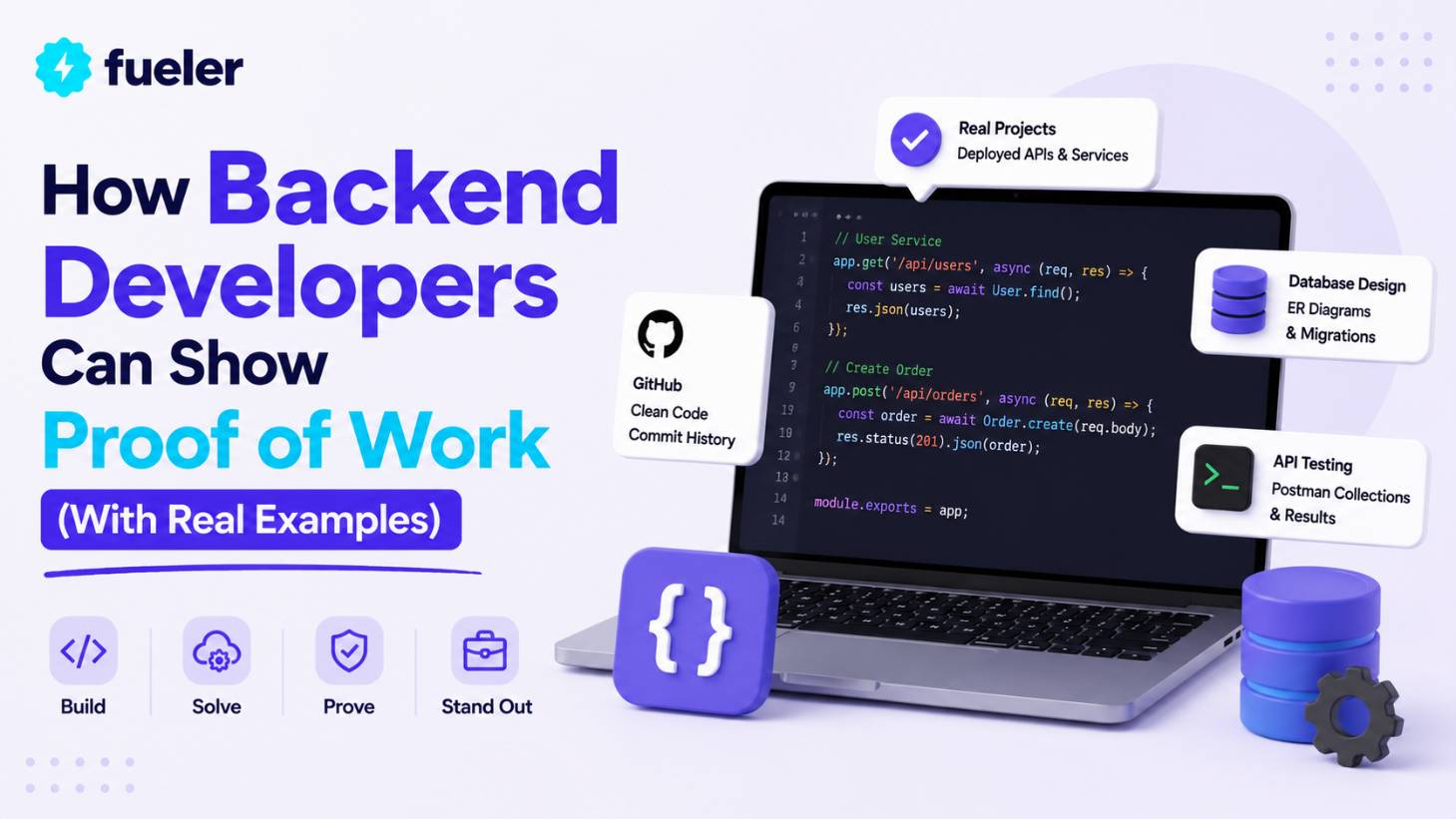
Backend work is invisible. That is the whole problem.
A frontend developer can drop a screenshot, and people instantly get it. But a backend developer builds the engine under the hood. The caching, the database design, the queues, the APIs that quietly handle millions of requests. None of that shows up in a pretty picture. So when a backend engineer applies for a job, the recruiter often has no idea how good they really are.
I am Riten, founder of Fueler, a portfolio platform that helps people get hired through their proof of work instead of just a resume. Over the years I have seen thousands of developer portfolios. The backend ones are almost always the weakest, not because the engineers are weak, but because they do not know how to make invisible work visible.
In this article I will show you exactly how to do that, with real examples you can copy.
Why "Built X using Node.js" is not enough
Most backend developers write one boring line on their resume and stop there. Something like "Built an API using Node.js and PostgreSQL."
That tells a recruiter nothing. It does not show scale, thinking, or results. The fix is simple. You stop describing your tools and start showing your impact.
Compare these two:
- Weak: "Built a URL shortener using Node.js."
- Strong: "Built a URL shortening service handling 50,000 requests a day, using Redis caching and PostgreSQL, with 99.9 percent uptime."
The second one is proof. It has numbers, decisions, and outcomes. This is the heart of how to build a proof of work portfolio that actually gets you interviews.
1. Show your APIs in action
Since backend developers build the plumbing, the easiest way to show it working is through the API itself.
You do not need a fancy frontend. You need to make your endpoints touchable.
- Share a live Swagger or Redoc documentation link so anyone can read and test your endpoints.
- Publish a Postman collection with sample requests and clean responses.
- Add a short note on what each endpoint does and why you designed it that way.
Real example: A junior developer I came across built a small weather API. Instead of just sharing GitHub, he published interactive Swagger docs and a Postman collection. A reviewer could hit the endpoint and see real data come back in seconds. That single decision made his project feel real and finished.
2. Turn projects into system design case studies
Backend hiring managers love system design. It shows you can think, not just type.
Take any project you have built and write it up like a case study with this structure:
- The problem you were solving
- An architectural diagram
- Your database schema
- The scaling challenges you hit
- How did you monitor the system
- The tradeoffs you made and why
Real example: "Designed a notification service processing 2 million events a month using RabbitMQ and Node.js." Around that one line, add a diagram showing how events flow from the producer, into the queue, and out to consumers. Now a stranger can understand your engineering brain in 30 seconds.
3. Use diagrams to make the invisible visible
A backend system becomes real the moment you draw it.
Include simple diagrams for:
- Request flow from client to server to database
- How your tables relate to each other
- Queue and cache layers
- How microservices talk to each other
You do not need design skills. Free tools like Excalidraw or draw.io are enough. A clean diagram next to your project is one of the strongest signals you can give. If you want more ideas, this proof of work guide lists many formats developers can use.
4. Document real performance improvements
This is one of the best forms of proof of work for backend engineers because results beat code screenshots every time.
If you made something faster or stronger, put it in a simple before-and-after table:
Then write one short paragraph explaining how you did it. Maybe you added an index, fixed an N plus one query, or introduced caching. The number grabs attention. The story proves you understand the system.
5. Write technical deep dives
When you solve a hard problem, the write up is your portfolio.
Good titles that recruiters and engineers actually click:
- How I reduced API latency from 900ms to 120ms
- How I migrated a PostgreSQL database with zero downtime
- Building rate limiting using Redis
- Designing a chat backend that scales
These posts show your thinking, not just your typing. You can publish them on your blog, on Hashnode, or directly as a project on your portfolio. The same approach works across fields, the way technical writing proof of work helps writers stand out.
6. Contribute to open source
Open source is verifiable. Anyone can inspect the actual code you wrote.
Show:
- Pull requests you got merged
- Issues you solved
- Features you shipped
- Code reviews you took part in
Even a small fix to a popular library is strong proof, because it means real maintainers trusted your work enough to merge it.
7. Build backend challenges and explain them
If you do not have job experience yet, build things on purpose and explain the engineering decisions behind them.
Solid backend projects to build:
- An authentication service with JWT and refresh tokens
- A payment gateway clone
- A URL shortener
- A chat system using WebSockets
- An event processing pipeline
The trick is not just to build it. It is to write down why you chose one approach over another. That is what separates you from everyone who only pastes a GitHub link.
A simple format for every backend project
When you publish any backend project, try to include these parts:
- Problem statement
- Architecture diagram
- Tech stack
- Database design
- API documentation
- Code repository link
- Deployment or live link
- Performance metrics
- Lessons learned
This single format will make your work look ten times more serious than "Built X using Node.js." It is exactly the structure I encourage developers to follow when they create proof of work for developers on their portfolio.
What about NDA work you cannot share?
A lot of backend work is locked behind a non disclosure agreement. You cannot show the code. That is fine.
You can still prove yourself with:
- Impact metrics like "scaled architecture to support 10,000 concurrent users" or "improved query response time by 40 percent."
- Architecture walkthroughs where you explain how data flowed and how you handled caching and edge cases, without revealing private details.
Your communication becomes your proof when the code cannot be shared.
The bigger truth
A good engineering team knows that backend value lives in how you think, how you design systems, and how you manage downstream effects. Not in whether you can make a pretty button.
If a hiring manager rejects you only because you do not have a flashy UI portfolio for a heavy backend role, that is often a sign they do not understand backend engineering. Treat it as a filter that saves you from a bad team.
Your job is simple. Take the invisible work in your head and put it where people can see it. Diagrams, numbers, write ups, and live links. Do that, and your skills will finally speak for themselves. Developers who present their work clearly tend to get hired faster with a portfolio than those who hide behind a plain resume.
Start documenting today. Future you will thank you.
Frequently Asked Questions (FAQs)
1. How can a backend developer show proof of work without a UI?
Show your APIs through live Swagger docs and Postman collections, add architecture diagrams, share before and after performance numbers, and write short technical deep dives. The UI is not your proof. Your system design and results are.
2. What is the best backend developer portfolio example to copy?
A strong example reads like a mini case study: a problem statement, an architecture diagram, the tech stack, database design, API docs, a live link, and clear performance metrics. One detailed project beats ten plain GitHub links.
3. How do I prove backend skills with no job experience
Build real projects like an authentication service, a chat backend, or a URL shortener, then explain the engineering decisions behind each one. Add open source contributions and technical write ups to back it up.
4. Is GitHub enough to show proof of work as a backend developer
GitHub helps but it is not enough on its own. Most people will not read your code line by line. You need diagrams, write ups, live demos, and metrics that explain what your code actually achieved.
5. How do I show backend work that is under an NDA?
Use impact metrics and architecture walkthroughs instead of code. Talk about scale, uptime, latency improvements, and how data flowed through your system, without revealing any private or confidential details.
Why 100,000+ professionals use Fueler
Fueler helps professionals showcase proof of work through projects, assignments, case studies, and achievements.
- Thousands of professionals use Fueler to create their digital portfolio
- Thousands of projects published on Fueler. Check here
- Startups and Companies hire through proof of work on Fueler
- Used by freelancers, creators, marketers, video editors, writers, designers, and product managers
Our mission is to help the next 100 million professionals build a verified professional identity through proof of work

What should you do next?
You've read the article. Now turn your skills into proof of work and unlock more opportunities.
Build your proof of work portfolio
Create a clean portfolio with projects, assignments, resumes, and AI stack details that companies actually want to see.
Create your Fueler portfolio →Apply through assignments, not resumes
Stand out by solving real tasks from companies hiring on Fueler.
Explore assignments →Get discovered by companies
Make your work public and let recruiters discover your skills through actual projects instead of keywords.
Get discovered →
