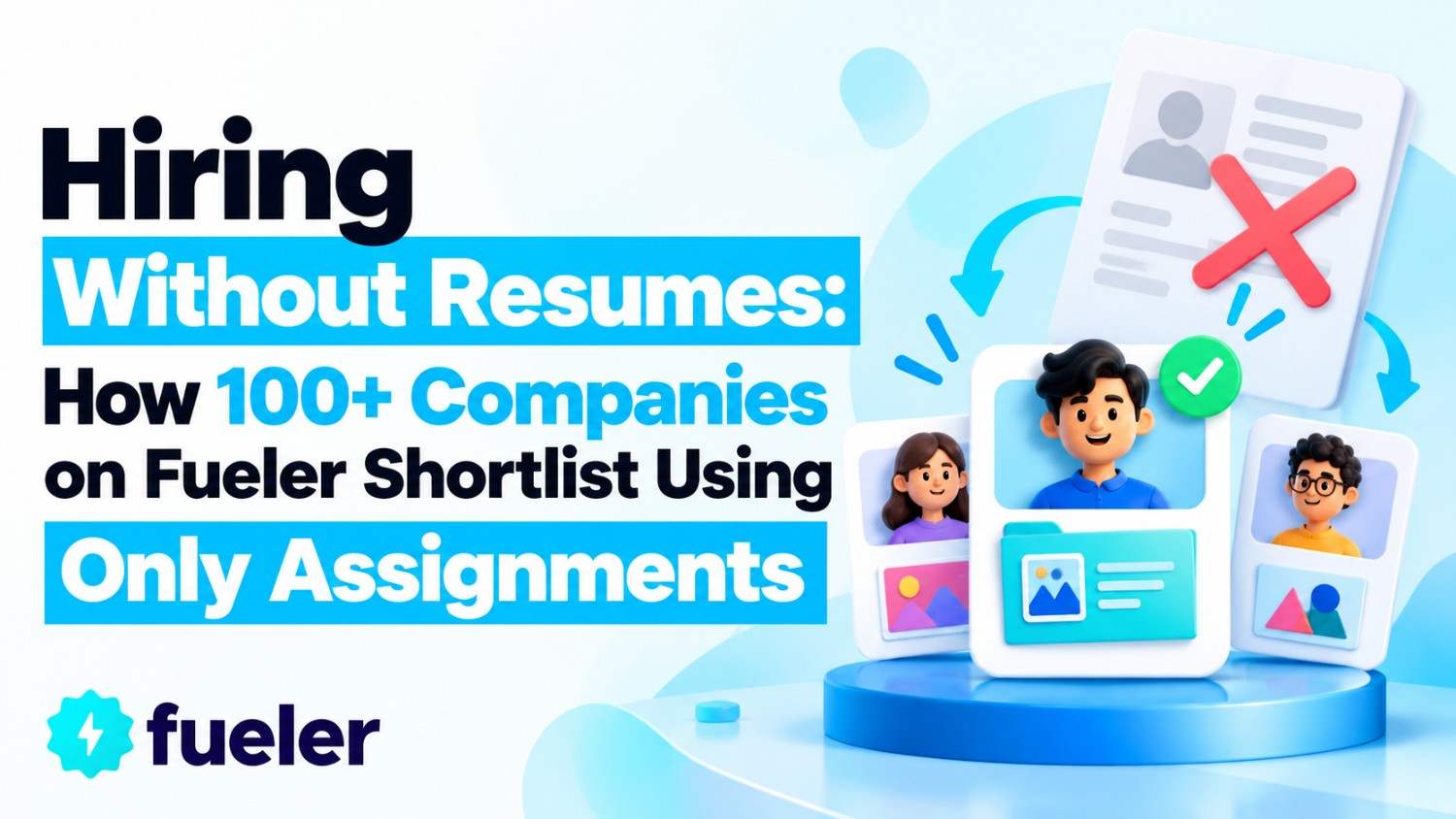
Hiring Without Resumes: How 100+ Companies on Fueler Shortlist Using Only Assignments

Riten Debnath
30 Sep, 2026
Last updated: October 2026
A resume can say you are a good writer.
It can say you understand marketing.
It can say you have strong design skills.
But none of those statements answer the question a hiring manager actually cares about:
Can you do the work?
That is the problem assignment-based hiring tries to solve.
Instead of asking candidates to spend hours polishing a resume and then trying to explain their skills in an interview, companies can give them a real task and evaluate the work itself.
Fueler has built its hiring model around this idea. Its current public figures show more than 1,000 companies registered, 15,000+ hiring assignments submitted, and 5,000+ candidates hired through its proof of work hiring model.
I’m Riten, founder of Fueler, a skills-first portfolio platform building the career infrastructure for 100 million creative professionals. Fueler connects talented individuals with companies through assignments, portfolios, and projects, not just resumes or CVs. Think of it as Dribbble/Behance for work samples combined with AngelList for hiring infrastructure.
In this article, I’ll break down what hiring without resumes actually looks like, how assignment-based hiring works, what companies evaluate, where this model works best, and what candidates should know before submitting an assignment.
The important part is not that resumes disappear.
It is that the work gets a chance to speak before the resume gets the final say.
What Is Hiring Without Resumes?
Hiring without resumes means evaluating candidates through evidence of their skills instead of making the resume the primary screening mechanism. The evidence can come from assignments, projects, portfolios, case studies, or other examples of completed work.
Assignment-based hiring takes this one step further. The company gives candidates a specific problem to solve, then evaluates the submitted work.
The company starts with a real hiring problem: Instead of asking candidates to simply describe their experience, the employer creates a task related to the role. A writer might receive a content brief. A designer might receive a design problem. A marketer might receive a campaign challenge. The task becomes the first practical test of ability.
Candidates prove skills through execution: The candidate does not have to convince the company only through claims such as “I am creative” or “I am good at research.” They can demonstrate those skills through the assignment itself. The hiring team gets something tangible to inspect, compare, discuss, and evaluate.
The resume becomes supporting information: This does not mean resumes have no value. They can still provide useful context about education, previous experience, projects, and career history. The difference is that the hiring decision can include direct evidence of what the candidate can actually produce.
The evaluation happens closer to the real job: A well-designed assignment resembles a smaller version of the work the person may perform after joining. That makes the assessment more relevant than testing knowledge that may never be used in the role.
The candidate gets an opportunity to demonstrate ability: This is particularly relevant for students, freelancers, career switchers, and early-career professionals. Someone without an impressive list of previous employers can still produce strong work. The assignment gives that person another way to establish credibility.
How Does Assignment-Based Hiring Work?
The basic process is straightforward. A company creates a task, candidates complete it, the company reviews the submissions, and selected candidates move forward. Fueler describes its own workflow in similar terms: companies post assignments, candidates submit work, companies review submissions, and shortlisted candidates can then be interviewed and hired.
Step 1: Define the role and problem: The company first identifies what it needs from the person it wants to hire. A good assignment starts here. If the company needs a content writer, it should test writing. If it needs a marketer, it should test marketing thinking. The task should connect directly to an important responsibility.
Step 2: Create a practical assignment: The company gives candidates a brief containing the problem, expected output, relevant context, and requirements. Fueler says companies can host assignments covering roles such as writing, design, marketing, development, editing, and other creative work.
Step 3: Candidates submit their work: Instead of sending only a resume, candidates complete the task and submit their work. Fueler’s published submission guide describes submissions containing a title, description, date, proof of work link, and optional video explanation of the work.
Step 4: Companies review the actual submissions: The hiring team can compare candidates based on what they produced. This gives the employer a common piece of evidence rather than relying entirely on different resumes and interview performances.
Step 5: Shortlisted candidates move forward: Assignment performance can become the first meaningful filter. Fueler says its process can then move shortlisted candidates toward interviews and hiring. Its current brand page also describes a workflow where companies receive real submissions and shortlist candidates based on their work.
Why Are Companies Using Assignments Instead of Resume Screening?
The central problem with resume-first hiring is simple: a resume is mostly a collection of claims and history. It provides context, but it does not necessarily show how someone handles a new problem.
Assignments provide another kind of evidence: actual execution on a defined task.
Resumes describe skills while assignments demonstrate them: A resume can say that someone knows content strategy. An assignment can show how that person approaches an actual content problem. The difference is important because the hiring team can inspect the candidate’s decisions instead of relying entirely on self-description.
Assignments can expose practical thinking: Good work is rarely just about knowing a tool or technique. Candidates have to understand the problem, decide what matters, make trade-offs, and produce an answer. A practical assignment can reveal those decisions in a way a standard resume cannot.
Companies can compare candidates using the same problem: Candidates may come from different colleges, companies, cities, or career backgrounds. Giving them a common task creates a shared reference point. The evaluation is still human and subjective, but reviewers have actual work to discuss rather than comparing unrelated career histories.
Early-career candidates get another route into hiring: Someone who has only completed internships or personal projects may have little formal experience. A relevant assignment can demonstrate capability without requiring the candidate to already have several years of professional experience.
The process focuses attention on job-relevant skills: If a company is hiring for execution-heavy work, seeing that execution early can be useful. Fueler specifically positions proof of work hiring around creative and knowledge professionals, including designers, developers, writers, marketers, and editors.
What Do Companies Evaluate in a Hiring Assignment?
A strong assignment is not judged only by whether the final file looks attractive. Companies can evaluate how well the candidate understood the problem, followed the brief, made decisions, and communicated the final result.
That makes the quality of the evaluation criteria extremely important.
Understanding of the brief: Did the candidate actually answer the question they were given? This is one of the simplest signals to evaluate. Someone can produce beautiful work and still fail the assignment if they misunderstand the audience, objective, problem, or required outcome.
Quality of execution: The company should examine the actual standard of the work. For writing, that might mean clarity, structure, research, and editing. For design, it might involve usability and visual hierarchy. For marketing, it could involve positioning, audience understanding, and the quality of the proposed strategy.
Problem-solving ability: Strong candidates usually make choices rather than simply repeating information from the brief. Companies can look at how the candidate identified the central problem, what they prioritized, what they ignored, and whether their final solution logically follows from their analysis.
Communication: Good work still needs explanation. A candidate who can clearly explain their approach, assumptions, decisions, and final recommendation gives the company more information than someone who submits an unexplained deliverable.
Attention to requirements: Real jobs involve constraints. Candidates have deadlines, formats, audiences, budgets, brand guidelines, and stakeholder expectations. Following those requirements is part of professional execution. Ignoring them can be an important signal even when the work itself appears polished.
Which Jobs Work Best With Assignment-Based Hiring?
Assignment-based hiring is particularly useful when a candidate can demonstrate a meaningful part of the job through a defined work sample. It is less useful when the important abilities cannot reasonably be observed in a short task.
Fueler publicly highlights roles including design, development, writing, marketing, editing, and other creative work.
Content writing and copywriting: A company can give candidates a defined audience, topic, objective, or product and evaluate the resulting piece. This reveals writing ability, research, structure, clarity, tone, and the candidate’s ability to follow a brief.
Marketing and growth: Candidates can work on a campaign concept, positioning exercise, content strategy, audience analysis, or marketing problem. The company can then evaluate whether the candidate understands the business objective rather than simply producing generic marketing ideas.
Design and UI/UX: A design assignment can ask candidates to solve a specific interface or visual communication problem. The resulting work can show hierarchy, user thinking, visual judgment, and how well the candidate explains design decisions.
Video editing and content creation: Candidates can work with a defined brief or raw material and submit an edited result. This allows the employer to evaluate storytelling, pacing, editing decisions, attention to detail, and whether the final output matches the intended audience.
Development and technical roles: A practical coding or product-building challenge can demonstrate implementation ability more directly than a list of technologies on a resume. The exact task needs to match the role, because a small challenge cannot represent every aspect of professional software development.
How Should Candidates Approach a Hiring Assignment?
An assignment is not just another application form. It is a chance to demonstrate how you work. The strongest approach is usually not to make the submission as complicated as possible, but to solve the actual problem clearly and thoughtfully.
Read the brief twice: Before opening a design file, document, editor, or spreadsheet, identify the objective. Write down the target audience, expected output, constraints, deadline, and key question. A surprising number of weak submissions begin with candidates solving a slightly different problem from the one the company actually asked.
Explain important decisions: Do not submit only the final answer when context would help. Briefly explain the problem you identified, your approach, major decisions, and assumptions. This allows the reviewer to understand your reasoning instead of guessing why you made particular choices.
Do not add unnecessary complexity: More pages do not automatically mean better work. If the assignment asks for three campaign ideas, producing thirty does not prove better thinking. Focus on the strongest answer. Hiring teams generally need to understand your judgment, not measure how much content you can produce.
Check every requirement before submission: Review the original brief again before sending the final work. Check spelling, links, formatting, file access, instructions, naming, and requested deliverables. Small avoidable mistakes can distract from otherwise strong work.
Turn completed work into proof of work: When the assignment can legally and ethically be shared, document the project clearly. Explain the problem, your approach, the final output, and any real result. Fueler specifically encourages candidates to build portfolios around projects and assignments, making individual submissions part of a larger professional record.
How Many Companies and Candidates Use Fueler for Assignment-Based Hiring?
Fueler’s current public figures provide a clearer picture than the “100+ companies” figure alone. The company says more than 1,000 companies have registered, with 15,000+ assignments submitted and more than 5,000 candidates hired through its proof of work hiring model.
The company count has moved beyond 100: Fueler’s current public materials state 1,000+ companies hiring or registered, depending on the page. This is substantially larger than the 100+ figure in the headline, so the article should not imply that 100 is the current company count.
Assignments are central to the hiring model: Fueler describes its hiring process around companies posting tasks and candidates responding with actual work. The platform's brand page currently says companies receive real submissions rather than resumes and can shortlist candidates based on those submissions.
The model has produced reported hires: Fueler currently reports more than 5,000 candidates hired through its proof of work hiring model. This is a company-reported figure, so it should be presented as Fueler’s own published number rather than an independently audited industry statistic.
The model is broader than one job category: Public Fueler materials describe assignments across writing, design, marketing, development, video editing, and other creative or knowledge-based roles. That makes the model particularly relevant to jobs where meaningful work can be demonstrated through a defined task.
The hiring process is not necessarily “assignment only” at every stage: Fueler’s published workflow includes assignment submission followed by review, shortlisting, and interviews in many cases. So the accurate claim is that assignments can replace resume-first screening and become the main initial proof of skill, not that every hire happens without any conversation afterward.
What Are the Risks of Hiring Without Resumes?
Replacing resumes with assignments does not automatically make hiring objective. Assignments have their own problems, especially when companies create tasks that are too long, unrelated to the role, or difficult to evaluate consistently.
The goal should be better evidence, not the illusion of perfect hiring.
Assignments can take too much candidate time: A short evaluation and several days of unpaid work are very different things. Companies need to keep tasks proportionate to the hiring decision. Fueler itself introduced a policy in 2026 requiring compensation for second-stage assignments on its platform, while allowing first assignments to be free.
One task cannot measure everything: A writing assignment can show writing. A design challenge can show design. Neither necessarily demonstrates how someone collaborates, manages conflict, communicates with a team, or performs over several months. Assignment results should therefore be one important signal rather than a complete prediction of future performance.
Reviewers can still be biased: Human evaluation does not disappear just because the resume does. Reviewers can have preferences about writing style, design aesthetics, educational background, or communication. Clear criteria and multiple reviewers can help create a more consistent process.
Real work can be difficult to reproduce: A short assignment may not capture the complexity of an actual job. Candidates normally have access to colleagues, company information, customer data, previous work, and internal context. A hiring task is necessarily a simplified environment.
Companies must protect candidate effort: Candidates are investing real time in assignments. Companies should clearly communicate whether the work is hypothetical, whether it may be used commercially, how it will be evaluated, and what happens after submission. A hiring process should respect the work being contributed.
How Does Hiring Without Resumes Change Career Building?
The biggest change for candidates is that career development becomes more connected to visible work. Instead of treating every project as something that disappears after completion, professionals can document meaningful work and build an evidence-based career record.
This is especially useful when traditional experience is limited.
Students can build evidence before their first full-time job: A student does not have to wait three years for a long employment history. Projects, internships, practical assignments, and independent work can demonstrate how they apply what they have learned to real problems.
Freelancers can show consistency: One strong project can be dismissed as a lucky result. A portfolio containing several strong projects across different problems provides a broader picture of capability. The goal is not to collect hundreds of projects but to document the work that best represents the professional you want to become.
Career switchers can demonstrate new skills: Someone moving from sales into marketing, for example, may not yet have a marketing job title. Relevant projects can help show that the person has already started building marketing skills. The evidence does not erase the career transition, but it makes the new direction easier to understand.
Professionals can make outcomes visible: A resume might say “managed content strategy.” A case study can explain what the problem was, what was changed, what was produced, and what happened afterward. The second version gives another person much more information to evaluate.
Your portfolio becomes a record of capability: This is the core idea behind proof of work hiring. Your career is not only a list of places you worked. It can also be a record of problems you solved and work you produced. Fueler is built around making that work visible to companies evaluating candidates through assignments and projects.
How Does This Connect to Building a Strong Career or Portfolio?
A career becomes easier to understand when people can see evidence behind the claims. Assignments, projects, and case studies show how you approach problems, not just where you have worked. Documenting that work also makes your progress visible over time. This matters when you are early in your career, changing fields, or competing with candidates who have stronger credentials on paper. Fueler is built around this proof of work approach, connecting portfolios and assignments with hiring opportunities.
Final Thoughts
Hiring without resumes is not about pretending resumes have become useless.
It is about asking a better first question: what can this person actually do?
Assignments give companies a practical way to ask that question before making a hiring decision.
They also give candidates something valuable: an opportunity to demonstrate ability instead of relying entirely on credentials.
The strongest hiring systems will likely use several signals, but the work itself should have a meaningful place in that conversation.
Frequently Asked Questions About Hiring Without Resumes
What is hiring without resumes?
Hiring without resumes means reducing reliance on the resume as the primary screening method and evaluating candidates through evidence such as assignments, portfolios, projects, and work samples. Assignment-based hiring is one form of this approach.
How does assignment-based hiring work?
A company creates a role-related task, candidates complete it, and the company evaluates the submissions. Candidates who demonstrate the required skills can then move to interviews or the next stage of the hiring process.
Can you get hired without a traditional resume?
Yes. Some companies use assignment-based or proof of work hiring where candidates are evaluated primarily through practical work. However, the exact hiring process varies by company, and some employers may still request resumes or conduct interviews.
What should I include in a hiring assignment?
Follow the brief first. Submit the requested work, explain important decisions briefly, and make the final submission easy to review. Where appropriate, include the problem, approach, output, assumptions, and measurable results that you can genuinely support.
Is assignment-based hiring better than resume-based hiring?
The two approaches provide different information. A resume gives career and education context, while an assignment provides evidence of performance on a defined task. Companies can use both, depending on the role and what they need to evaluate.
Why 100,000+ professionals use Fueler
Fueler helps professionals showcase proof of work through projects, assignments, case studies, and achievements.
Thousands of professionals use Fueler to create their digital portfolio
Thousands of projects are published on Fueler. Check here
Startups and Companies hire through proof of work on Fueler
Used by freelancers, creators, marketers, video editors, writers, designers, and product managers
Our mission is to help the next 100 million professionals build a verified professional identity through proof of work

What should you do next?
You've read the article. Now turn your skills into proof of work and unlock more opportunities.
Build your proof of work portfolio
Create a clean portfolio with projects, assignments, resumes, and AI stack details that companies actually want to see.
Create your Fueler portfolio →Apply through assignments, not resumes
Stand out by solving real tasks from companies hiring on Fueler.
Explore assignments →Get discovered by companies
Make your work public and let recruiters discover your skills through actual projects instead of keywords.
Get discovered →
