Why Companies Are Moving from Resumes to Portfolio-Based Hiring

Riten Debnath
02 Apr, 2026
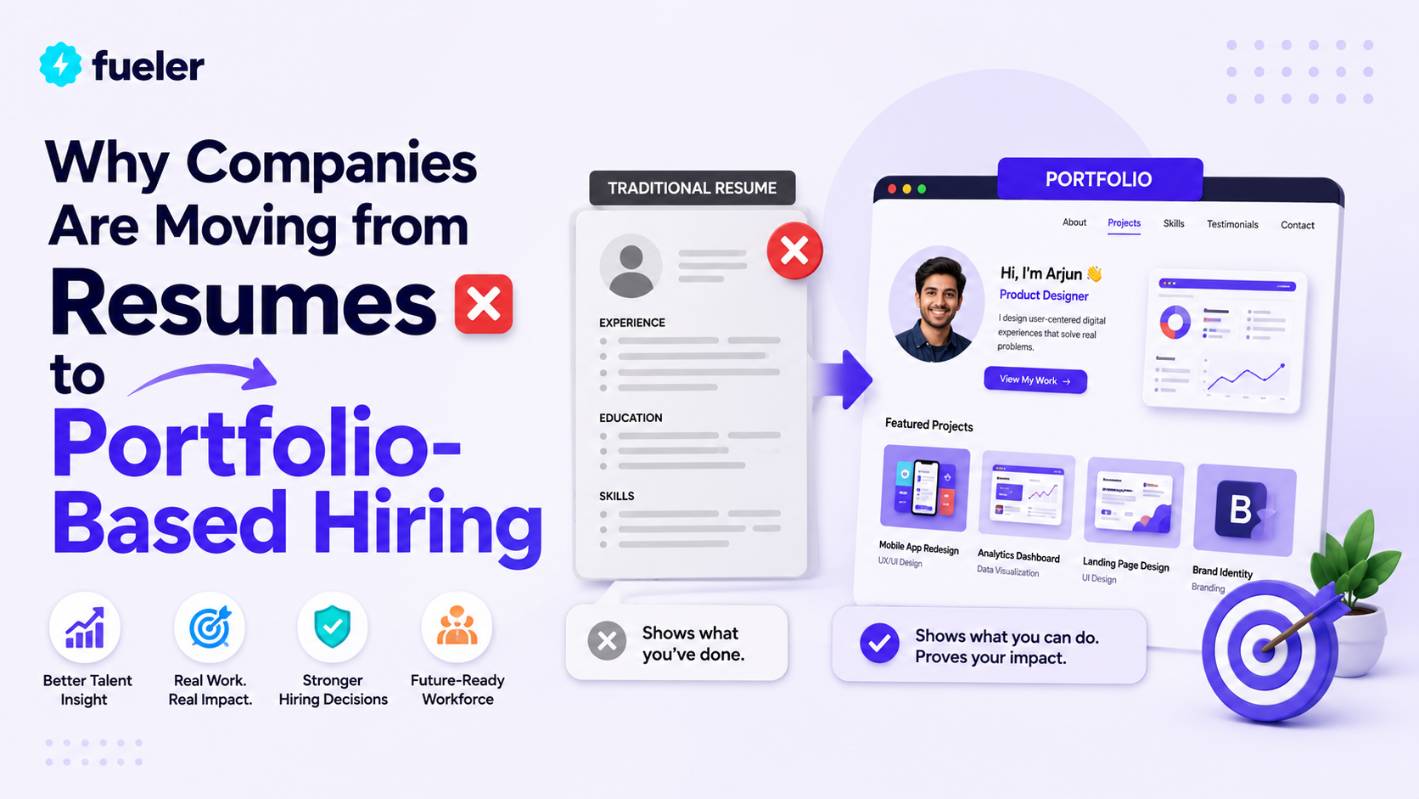
I am Riten, founder of Fueler. Every week, I talk to hiring managers and founders who tell me the same thing in different words: 'We hired someone who looked great on paper and it did not work out. We need a better way to evaluate candidates.'
That better way exists. It is portfolio-based hiring. And it is spreading fast across industries that have traditionally relied almost entirely on resumes and interviews. In this article, I am going to explain exactly why companies are making this shift, what it means for candidates, and how Fueler is accelerating this change.
The Core Problem with Resume-Based Hiring
Resume-based hiring has been the standard for decades. Companies post a job. Candidates send resumes. Recruiters screen the resumes. Qualified candidates get interviews. Someone gets hired.
This process sounds logical. In practice, it is riddled with problems that have compounded as the job market has become more complex, more global, and more competitive.
The first problem is the verification gap. Resumes are self-reported documents with no built-in verification mechanism. Candidates routinely inflate their experience, exaggerate their contributions to team projects, and claim skills they have at a surface level but cannot perform at a professional level. Hiring managers have limited ability to detect this before making an offer.
The second problem is bias amplification. Resume screening is heavily influenced by unconscious bias. Research consistently shows that candidates with certain names, certain universities, and certain career progressions get significantly more callbacks than equally qualified candidates without those signals. Resume screening amplifies these biases rather than eliminating them.
The third problem is credential inflation. As educational credentials have become more widespread, they have become less informative as signals of actual capability. Having a marketing degree from a good university tells you very little about whether someone can actually execute a campaign strategy, analyze data correctly, or write compelling copy.
What Portfolio-Based Hiring Fixes
Portfolio-based hiring addresses each of these problems directly.
It closes the verification gap because the work is the evidence. You cannot fake a functioning application. You cannot fake real campaign performance data. You cannot fake a published case study with documented results. The work either demonstrates the skill or it does not.
It reduces bias amplification because the evaluation is based on the quality of work, not the prestige of the institution on the resume. A candidate who went to a regional university but has eight well-documented, high-impact projects competes on the same terms as a candidate who went to a top institution with fewer concrete achievements.
It solves credential inflation because credentials become supporting context rather than primary evaluation criteria. The question shifts from 'where did you study?' to 'what have you built, and what happened as a result?'
The Industries Leading the Shift
Portfolio-based hiring started in industries where the output of work is naturally observable. Design, where you can see the work directly. Software development, where code can be evaluated. Writing and content, where published work speaks for itself.
But the shift is now spreading well beyond these traditionally portfolio-focused fields. Growth and marketing roles are increasingly evaluated through case studies, campaign results, and documented experiments. Product management roles are evaluated through product specs, user research summaries, and feature launch outcomes. Operations and analytics roles are evaluated through process documentation, dashboards, and insight reports.
The common thread is the recognition that real work evidence is more predictive of job performance than any amount of resume screening or interview performance.
What Assignment-Based Hiring Adds
Portfolio-based hiring evaluates past work. Assignment-based hiring, the model Fueler is built around, takes it a step further. It evaluates present-day performance on a current challenge.
When a company posts an assignment on Fueler, they are not just asking to see what you have done. They are asking you to demonstrate how you think and work right now, on a problem that is relevant to their actual business. This is the closest thing to a real work trial that is practical during a hiring process.
Companies that use assignments consistently report higher confidence in their hiring decisions and better new-hire performance outcomes. The work tells them what they need to know in a way that even the best interview cannot.
What This Shift Means for Candidates
For candidates who have strong skills but have been disadvantaged by traditional hiring systems, this shift is genuinely exciting. It means your university, your previous employer's prestige, and your ability to perform in structured interviews matter less. What matters most is the quality of your documented work and your ability to perform on real challenges.
For candidates who have relied on credential signals and interview skills, this shift requires an adjustment. A strong resume is no longer enough on its own. You need a portfolio. You need documented results. You need to be able to show your work, not just describe it.
The good news is that building a portfolio is not difficult. It just requires intentionality. And Fueler makes it easier than any other platform available.
How Fueler Is Leading This Transition
Fueler is the platform where portfolio-based and assignment-based hiring happen in practice. Hundreds of companies post assignments, discover talent through portfolio search, and hire based on demonstrated work quality. Thousands of professionals document their work, complete assignments, and build proof-of-work track records that open opportunities that would be inaccessible to them in traditional hiring systems.
The shift toward portfolio-based hiring is not a trend. It is a correction. It is the hiring market moving toward a more accurate, more fair, and more effective evaluation method. And it is accelerating. The companies and candidates who adapt to this shift earliest will benefit most from it.
Start building your portfolio at fueler.io today.
What Candidates Should Do Right Now
Understanding that companies are moving toward portfolio-based hiring is useful knowledge. Acting on it is what actually changes your career. Here is what you should do right now, regardless of where you are in your career.
First, document your last three to five significant projects properly. Write the context, your specific contribution, and the measurable outcome for each one. This raw material is the foundation of your portfolio. Second, sign up on Fueler and add those projects. Tag your skills. Write a clear professional headline. Share your portfolio link on LinkedIn and in your resume. Third, browse the assignments posted by companies on Fueler and complete one that is relevant to your skills. This gives you direct exposure to proof-of-work hiring and adds a real company-evaluated project to your track record.
The shift toward portfolio-based hiring rewards preparation. The professionals who have strong portfolios already built when a company moves to this model have a significant advantage over those who scramble to create one after the fact. Be the prepared one. Start today at fueler.io.
The Ripple Effect on Career Progression
The move toward portfolio-based hiring does not only affect how you get your next job. It changes how your entire career progresses. In a proof-of-work world, your reputation is built on what you have visibly produced, not just what your job title implies. This means that professionals who document their work consistently advance faster, negotiate better salaries with more confidence, and attract more interesting opportunities than those who rely on their career history alone.
A strong, continuously updated Fueler portfolio is not just a hiring tool. It is a career compounding machine. Every project documented makes you more credible. Every result recorded makes you more valuable. Every skill tagged makes you more discoverable. The professionals who understand this and act on it early are building advantages that will pay dividends for the rest of their careers. Be one of them. Start at fueler.io today.
Why Waiting Is the Riskiest Move
Every month you delay building your portfolio is a month where companies in your field are getting better at evaluating candidates through their work. The first wave of professionals who adapted to this shift already has a head start. The second wave, the people who start today, can still build a meaningful advantage before portfolio-based hiring becomes so normalized that a portfolio is merely expected rather than differentiating.
A year from now, having a strong portfolio will be table stakes in most knowledge-work professions. Today, it still sets you apart. Use that window. The cost of starting is 30 minutes on fueler.io. The cost of waiting is ceding ground to every peer who does not wait. That is not a trade worth making.
Frequently Asked Questions
Why are companies moving away from resume-based hiring?
Because resumes have a verification gap, amplify hiring biases, and suffer from credential inflation. Portfolio-based hiring addresses all three by evaluating actual work evidence rather than self-reported credentials.
What industries are adopting portfolio-based hiring most rapidly?
Design, software development, writing, marketing, and content were the first movers. Growth, product management, operations, and analytics are now following rapidly. The shift is spreading across virtually every knowledge-work profession.
Is portfolio-based hiring fairer than resume screening?
Yes. Research consistently shows that work-based evaluation reduces the impact of unconscious bias that affects resume screening. It levels the playing field for candidates from non-traditional backgrounds and institutions.
How do I prepare for companies that use portfolio-based hiring?
Build a strong portfolio on Fueler with documented projects and measurable outcomes. Complete assignments on the platform to build a track record of proof-of-work. Share your portfolio link whenever you apply for a role.
Where can I find companies that hire through portfolios and assignments?
Fueler is the platform where portfolio-based and assignment-based hiring happen. Sign up at fueler.io to access opportunities with hundreds of companies that evaluate candidates through their actual work.
What is Fueler Portfolio?
Fueler is a career portfolio platform that helps companies find the best talent for their organization based on their proof of work. You can create your portfolio on Fueler. Thousands of freelancers around the world use Fueler to create their professional-looking portfolios and become financially independent. Discover inspiration for your portfolio
Sign up for free on Fueler or get in touch to learn more.

What should you do next?
You've read the article. Now turn your skills into proof of work and unlock more opportunities.
Build your proof of work portfolio
Create a clean portfolio with projects, assignments, resumes, and AI stack details that companies actually want to see.
Create your Fueler portfolio →Apply through assignments, not resumes
Stand out by solving real tasks from companies hiring on Fueler.
Explore assignments →Get discovered by companies
Make your work public and let recruiters discover your skills through actual projects instead of keywords.
Get discovered →
