Why Leadership Development Programs Fail Without Human Connection

Riten Debnath
07 Jul, 2026
Last updated: July 2026
Leadership development fails when it is treated like a content problem instead of a people problem. In 2026, that gap is even more obvious because work is faster, teams are more distributed, and leaders are expected to communicate well without the safety net of constant in-person contact.
I’m Riten, founder of Fueler, a skills-first portfolio platform that connects talented individuals with companies through assignments, portfolios, and projects, not just resumes/CVs. Think Dribbble/Behance for work samples + AngelList for hiring infrastructure.
This article explains the real reasons leadership programs fail, why human connection changes the outcome, what organizations keep getting wrong, and how to build development that actually sticks. It is written to be practical, human, and useful enough that you do not need a second article to make sense of the topic.
The real reason programs fail
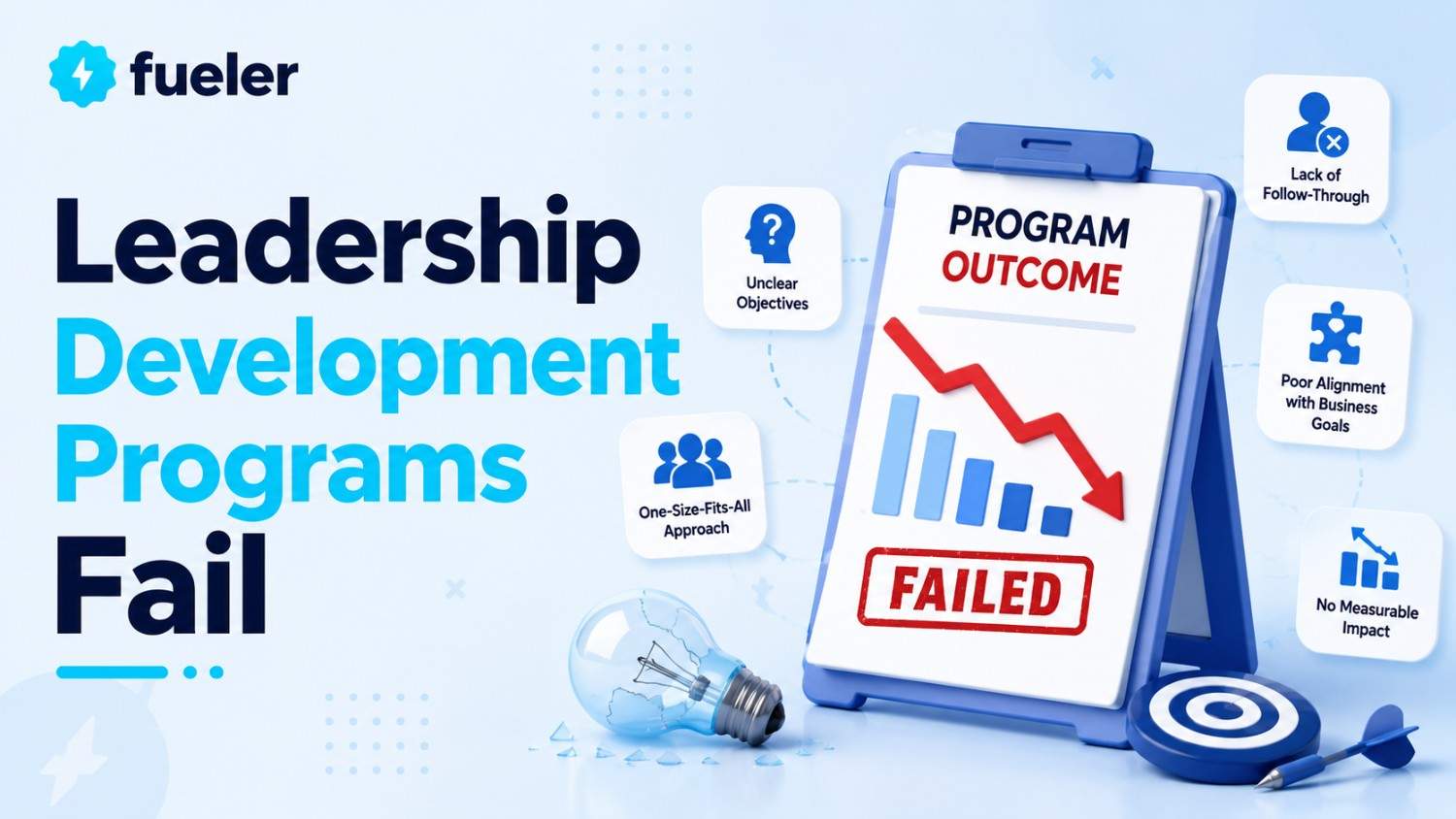
Most leadership programs fail for one simple reason: they teach ideas, but they do not change behavior. People leave with notes, frameworks, and maybe a coffee mug, but when Monday hits, the old habits are still driving the car.
Leadership is not a solo sport. It depends on trust, feedback, influence, and timing. If the program does not make room for real conversation, real tension, and real practice, it becomes expensive motivation with a very nice agenda.
- Programs often overfocus on concepts and underfocus on transfer, so participants understand the lesson but do not apply it in real team situations.
- Many training sessions are isolated from day-to-day work, which means leaders never practice communication, conflict handling, or decision-making in the environment where those skills matter most.
- Attendance is often mistaken for impact, which makes the program look successful on paper even when nothing has changed in behavior or team performance.
- Without peer accountability, people forget the learning quickly, because the brain likes repetition and work calendars do not care about inspirational slides.
- Leadership training often ignores the emotional side of leadership, even though most leadership failures show up in trust, tone, and relationships before they show up in metrics.
Why it matters: If leadership development does not change how people behave with others, it does not really develop leadership. It just creates better note-takers. Organizations end up spending money on programs that sound serious but do very little to improve trust, execution, or team confidence.
Why human connection changes outcomes
Human connection is not a soft add-on. It is the thing that makes leadership development real. People learn faster when they feel safe enough to speak honestly, make mistakes, and hear feedback without turning every correction into a personal crisis.
When leaders connect with peers, coaches, and teams, they get context. That context helps them understand not just what to do, but how their behavior lands with other people. That is where leadership starts to become visible.
- Human connection creates psychological safety, which makes it easier for leaders to admit blind spots, ask questions, and try better behavior without pretending they already know everything.
- Peer relationships make lessons stick because people remember conversations, not just slides, especially when those conversations include tension, disagreement, and practical examples.
- Trust makes feedback usable, and usable feedback is what actually changes behavior instead of just making people nod politely in a workshop.
- Connection helps leaders practice empathy in real time, which matters because managing people is usually less about authority and more about reading what is not being said.
- Strong relational learning reduces the “I already know this” problem, because people become more open when they feel part of a shared process instead of being lectured from a stage.
Why it matters: Leadership is a social job, whether people admit it or not. Human connection turns training into practice and practice into change. Without it, the program may sound good, but it will not survive contact with a real team, a real deadline, or a real disagreement.
The design mistakes nobody fixes
A lot of leadership programs fail because they are designed like events instead of systems. A workshop is easy to sell. A development system is harder to build. Unfortunately, only one of those usually creates actual change.
The usual mistake is separating learning from work. That sounds efficient, but it often removes the exact pressure that helps people grow. Leadership skills do not become stronger because someone completed a module. They become stronger when a leader has to use them in a meeting that is slightly uncomfortable and very real.
- Programs often rely on generic examples, which makes the content easy to understand but hard to apply to the participant’s actual role, team, or culture.
- Many initiatives skip follow-up, so the learning ends when the session ends, even though behavior change usually starts after the session.
- Companies sometimes train leaders without involving managers, which is odd because the manager is often the person who can reinforce or quietly erase the lesson.
- Too much polish can backfire, because overly smooth training leaves no room for honest questions, awkward moments, or the kind of discussion where the real learning usually happens.
- Programs frequently ignore organizational culture, which matters because leadership behavior that works in one environment can fail in another like a badly translated joke.
Why it matters: Good leadership development is not a one-time event. It is a repeatable process that fits the way people actually work. If the design does not include practice, feedback, and reinforcement, the training becomes a nice memory instead of a business result.
What strong programs do differently
The best leadership programs do not just teach leadership ideas. They build conditions where people can practice leadership in real life. That includes feedback, accountability, shared reflection, and enough honesty to make improvement possible.
These programs work because they treat learning as something social and ongoing. They do not assume people will magically transform after a single session. They make the learning visible, repeated, and connected to actual work outcomes.
- They use real workplace problems instead of abstract case studies, so leaders can apply lessons immediately to communication, delegation, and decision-making.
- They include peer cohorts or small groups, which build accountability and make it normal to discuss mistakes, progress, and practical fixes without embarrassment.
- They involve managers in reinforcement, so leaders do not return to work with insights that nobody else knows how to support.
- They add coaching or guided reflection, which helps leaders notice the gap between how they think they lead and how others experience them.
- They measure actual behavior change, because attendance and satisfaction are weak signals if the goal is better leadership in the real world.
Why it matters: Strong programs create visible change in how leaders speak, listen, decide, and respond under pressure. That is the kind of improvement organizations can feel. It shows up in team trust, smoother execution, and fewer leadership meltdowns disguised as “urgent alignment meetings.”
Why trust and feedback matter
Leadership growth stalls fast when people cannot speak honestly. If everyone is too polite to say what is really happening, the program becomes a performance. And performance is not the same thing as progress.
Trust makes feedback possible. Feedback makes improvement possible. That sounds simple, but many organizations are weirdly allergic to directness. They want better leaders, but they do not always want the uncomfortable conversations that create better leaders.
- Trust gives people permission to be imperfect, which matters because leadership growth starts when someone can admit they handled a situation badly without losing status.
- Feedback works best when it is specific and timely, because delayed feedback usually turns into vague memory and vague memory rarely changes behavior.
- Leaders need honest mirrors, not applause, because praise without correction can create confidence that is disconnected from reality.
- Psychological safety helps people ask for help earlier, which prevents small leadership issues from becoming bigger team problems later.
- Teams with stronger trust recover faster from mistakes, which makes leadership development easier to sustain over time.
Why it matters: Trust and feedback are practical tools, not culture slogans. They help teams move faster, reduce confusion, and correct course before small issues turn into expensive ones. That is why leadership programs that build trust usually outperform those that only build presentations.
Why some leaders still resist it
Some leaders resist human-centered development because it feels slower, messier, and less flattering than a neat framework. A checklist is comfortable. Honest feedback is less comfortable. That is usually where the real work begins.
Resistance also comes from identity. Many people have spent years being valued for competence, so being asked to slow down, listen more, or become more self-aware can feel strangely personal. It is not a skill problem alone. It is an ego problem with a calendar invite.
- Some leaders confuse authority with effectiveness, so they think being clear is enough even when their team actually needs empathy, context, and better listening.
- Many avoid feedback because it challenges their self-image, and people generally protect identity before they protect development.
- Busy managers often treat learning as optional, but leadership habits are built inside daily work, not in the spare time everyone pretends exists.
- Organizations sometimes reward technical performance more than relational skill, which teaches leaders that people work is secondary even when it decides success.
- A few programs ask for vulnerability without creating safety first, which is like asking someone to confess their fear of public speaking in front of a laser pointer.
Why it matters: If organizations do not design for resistance, they will keep misreading silence as progress. Human connection is not automatic. It has to be created, protected, and repeated until it becomes normal enough for real growth to happen.
What works in 2026
The leadership programs that work in 2026 are practical, social, and tied to real work. They do not treat leadership as a clean concept. They treat it as an everyday skill that has to survive pressure, ego, and competing priorities.
This is also where visible execution matters. People trust outcomes they can see. That is why proof of work matters so much in modern hiring and growth, and why portfolios keep getting more relevant. Real work beats vague claims.
- Short learning sessions work better when paired with live discussion, because people understand ideas more deeply when they talk through them with others facing similar problems.
- Coaching becomes more valuable when it is linked to active projects, since real work creates real stakes and exposes leadership habits much faster than theory alone.
- Reflection works best when it is specific, because “How did I show up in that meeting?” is more useful than “Was I a strong leader today?”
- Digital tools help only when they support human interaction, not replace it, because software can organize learning but cannot create trust.
- Documented outcomes matter more because leadership credibility today is built through visible decisions, clear communication, and proof that work actually got done.
Why it matters: Leadership development in 2026 is not about sounding prepared. It is about being able to show real improvement. The strongest leaders are the ones who learn in public, take feedback seriously, and turn growth into visible execution instead of private intention.
How does this connect to building a strong career or portfolio?
Leadership growth gets stronger when it is visible. Documenting projects, decisions, and team outcomes builds credibility because modern hiring values proof, not just promises. A strong portfolio shows how you think, lead, and execute, which is often more persuasive than a polished resume.
Final thoughts
Leadership development fails when it forgets that leadership is a human job. People do not follow frameworks alone. They follow trust, consistency, and behavior they can actually feel.
Programs that build connection create better habits, stronger teams, and more honest communication. Programs that skip connection usually create temporary enthusiasm and long-term confusion.
The organizations that win in 2026 will treat leadership development as a living system, not a one-time event. They will care less about the polish of the session and more about what changes after it.
That is the real test: not whether people liked the workshop, but whether they lead differently when the room is normal again.
FAQs
Why do leadership development programs fail so often?
They usually fail because they focus on content delivery instead of actual behavior change. Without trust, feedback, repetition, and manager support, the learning stays abstract and never turns into real leadership habits.
Why is human connection important in leadership training?
Because leadership is relational. People need trust, honest feedback, and a safe environment to practice new behaviors. Without human connection, the training may feel smart but will not translate into better leadership at work.
What makes a leadership program effective in 2026?
The best programs use real work scenarios, peer accountability, coaching, and follow-up. They do not just teach ideas. They help leaders apply those ideas in actual meetings, decisions, and team situations.
Can remote leadership programs still work well?
Yes, but they need intentional discussion, feedback, and accountability. Watching content alone is not enough. Remote programs work when they still create a sense of community and real human interaction.
How does proof of work connect to leadership growth?
Proof of work makes leadership visible. When people document projects, outcomes, and decisions, they build credibility through execution. That matters because modern hiring and promotion increasingly reward evidence over claims.
Why 100,000+ professionals use Fueler
Fueler helps professionals showcase proof of work through projects, assignments, case studies, and achievements.
- Thousands of professionals use Fueler to create their digital portfolio
- Thousands of projects are published on Fueler. Check here
- Startups and Companies hire through proof of work on Fueler
- Used by freelancers, creators, marketers, video editors, writers, designers, and product managers
Our mission is to help the next 100 million professionals build a verified professional identity through proof of work

What should you do next?
You've read the article. Now turn your skills into proof of work and unlock more opportunities.
Build your proof of work portfolio
Create a clean portfolio with projects, assignments, resumes, and AI stack details that companies actually want to see.
Create your Fueler portfolio →Apply through assignments, not resumes
Stand out by solving real tasks from companies hiring on Fueler.
Explore assignments →Get discovered by companies
Make your work public and let recruiters discover your skills through actual projects instead of keywords.
Get discovered →
