Which Jobs Are Safest From AI? What Anthropic's 2030 Economic Model Shows

Riten Debnath
10 Sep, 2026
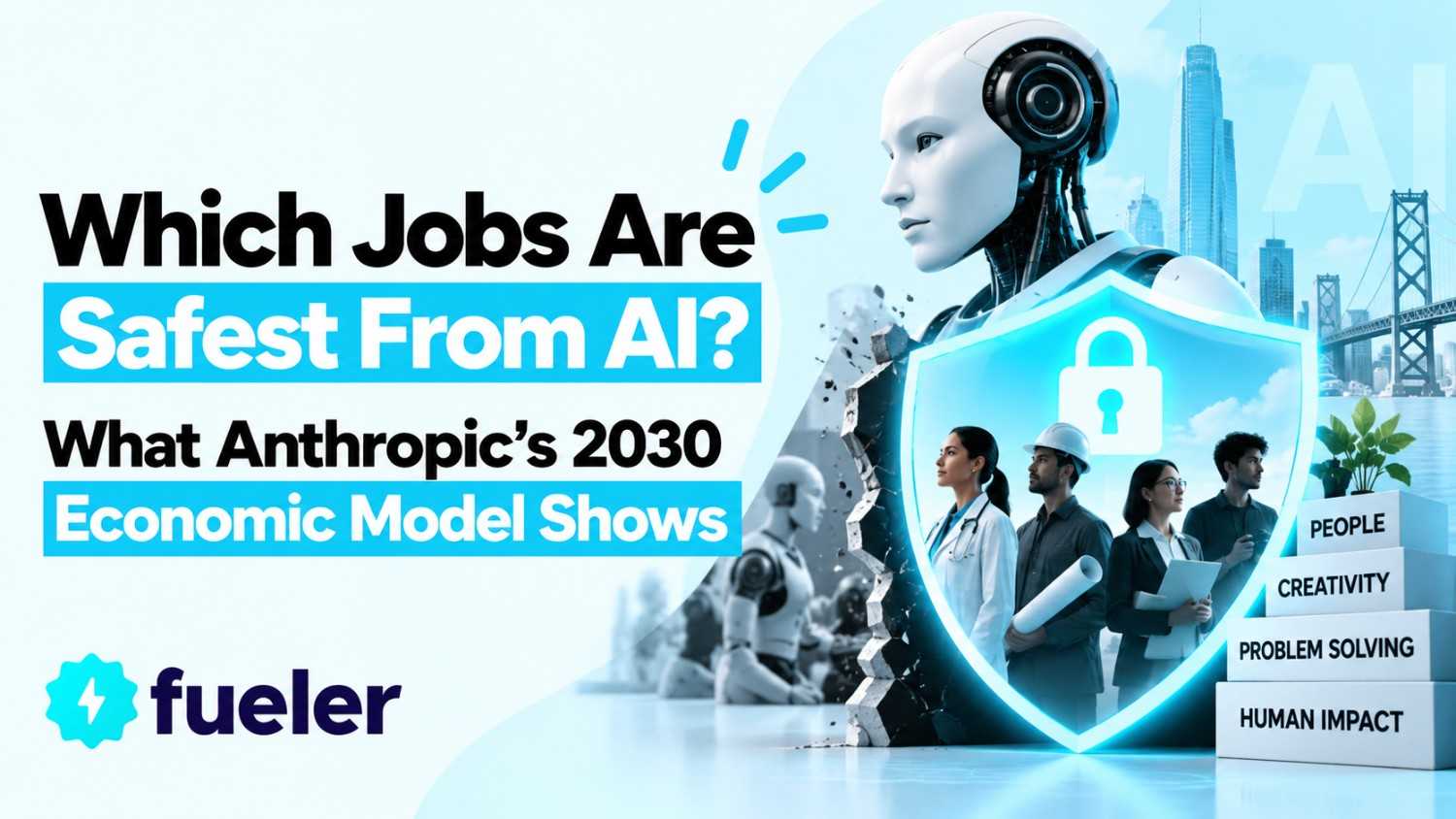
Anthropic's Economics team has published an economic model that tries to answer a question millions of working people are asking: which jobs actually survive AI? The model comes from a technical report called Economic Scenarios for Transformative AI (Korinek et al., 2026), and it is paired with a public scenario explorer that lets anyone plug in their own predictions and see what the economy of 2030 might look like.
I run Fueler, a portfolio platform where people get hired through their work rather than their resume. I read the report twice, because the answer it gives is not the one most people expect. The safest jobs are not the ones with the fanciest titles or the highest degrees. They are the ones full of tasks a machine cannot reach.
Here is what the model actually says, in plain language.
How Anthropic's Model Decides Which Jobs Are Safe From AI
The model starts with an idea that sounds simple but changes everything. It does not treat a job as a single thing. It treats every job as a bundle of tasks.
Anthropic uses the US Department of Labor's O\*NET taxonomy, which lists the tasks that make up each occupation. Then it sorts those tasks into four groups:
- Tasks AI does not touch at all
- Tasks AI makes faster or better, called augmentation
- Tasks AI takes over completely, called automation
- Brand new tasks that only exist because AI exists
A job is safe not because of what it is called, but because of how its bundle splits across those four groups.
The report walks through a nurse to show this. A nurse does rounds. She draws blood. She triages incoming patients, charts their vitals, and orders supplies for the ward. When you sort those tasks, the picture becomes clear. AI can help her draft discharge instructions, monitor patients remotely, and plan the shift's care schedule. It may fully take over charting vitals and ordering supplies. And it creates new work for her, like checking how well an AI triaged a patient or reviewing a care plan the AI proposed.
But there is one line in the report that stayed with me. AI cannot bathe a patient.
That is the whole answer to which jobs are safest, compressed into six words.
Five Things That Make a Job Safer From AI, According to the Model
Reading the model closely, five patterns show up again and again. These are the real markers of safety, and none of them are about seniority.
- The job has physical tasks that must happen in the real world. Bathing a patient, wiring a building, fixing a pipe. The report specifically points to occupations like electrician and nurse as less exposed to AI. It also notes the model deliberately left out any scenario with hyper capable robots, so this protection holds under the model's own assumptions.
- The job has tasks that need a human present with another human. The nurse example ends with the nurse spending more time talking with patients and helping them understand their diagnoses. Where trust, presence and reassurance are the point, the task does not move to software.
- The job sits downstream of knowledge work rather than inside it. This is the finding people miss. The report gives a construction example. If AI produces designs and permits faster, more construction projects start, which raises demand for construction workers. Automation upstream can create more work downstream.
- The job is in an occupation where AI adoption is slow. In the middle scenario, AI is capable of doing half of all knowledge work by 2030, yet most knowledge work tasks are still done without AI. Capability and adoption are two different things, and the gap between them is where a lot of people will keep working normally.
- The job's bundle keeps generating new tasks. In the most extreme scenario, the danger is not just automation. It is that AI creates essentially no new knowledge tasks for people. Historically, new technology has always added new tasks. Thirty years ago nobody monitored patients remotely. Today somebody does. Jobs that keep growing new tasks keep growing new work.
Why It Matters
Across every scenario in Anthropic's model, the economy gets bigger. In the modest scenario GDP is 1.6% higher than it would be without AI. In the substantial scenario, 8.3% higher. In the extreme scenario, 32.4% higher.
But the gains do not land evenly. The report finds that average wages rise in all three scenarios, and that the increase is concentrated in occupations outside knowledge work. In the substantial scenario, wages for knowledge workers are essentially flat. In the extreme scenario, they fall by more than 10% by 2030.
There is also a finding that most coverage skips. In the modest and substantial scenarios, unemployment stays within ranges history has already seen. Only in the extreme scenario, which the report says would likely require recursively self improving AI adopted very quickly, does unemployment spike beyond typical recessionary levels.
So this is not a story about mass joblessness in most futures. It is a story about which parts of your work still carry value, and whether you can show them to somebody.
Anthropic is also honest about the model's limits, which is one reason I trust it more than most forecasts. It leaves out policy responses, business cycles, financial market disruptions and robots. Reviewers disagreed with the authors in both directions. Some felt the extreme scenario reads better as a thought experiment. Others felt the modest one understates what is already visible in the data today.
What This Means for Your Portfolio and How You Get Hired
Here is the part I care about most, because it is the part I work on every day.
If safety comes from your task bundle, then the most valuable thing you can do is make your task bundle visible. A resume cannot do that. A resume says "Graphic Designer, 3 years." It does not say which of your tasks are still yours, which ones you now do with AI in half the time, and which new tasks you picked up that did not exist two years ago.
That gap is exactly what a proof of work portfolio closes. When you build a proof of work portfolio step by step, you are not listing job titles. You are showing the actual tasks you performed and the thinking behind them.
Three practical moves:
Write your task list before you write anything else. Take a sheet of paper and write down every task your job actually contains. Not your title. Your tasks. Most people find between eight and fifteen. Then mark which ones AI already touches. That list is more useful than any career advice you will read this year.
Show your process, not just your output. A finished design tells someone the AI could have made it. A description of how you decided, what you rejected, and why, tells them it could not. This is exactly what I tell every designer who asks how designers build their portfolio properly.
Document the new tasks. The report says new tasks appear with every technology shift. If you now review AI output, direct AI tools, or check AI work for errors, that is real work and it belongs in your portfolio. On Fueler you can add your AI stack to a project and show exactly how you used AI in your process. Companies want to see this. Hiding it helps nobody.
If you are starting out and have no work history yet, the same logic applies even more strongly. A student guide to building your first portfolio is a better use of a weekend than another certificate, because certificates prove attendance and portfolios prove ability.
Final Thoughts
The question "which jobs are safest from AI" has a better version, and Anthropic's model points straight at it. Ask instead: which of my tasks are safest, and can I prove I still do them?
That is a question you can answer this week. You cannot control GDP growth or adoption rates or whether the world lands in the modest scenario or the extreme one. You can control whether the person hiring you can see what you actually do.
I built Fueler because I believe hiring should work on evidence, not on job titles. Anthropic's model has just given that belief an economic backbone. Jobs are bundles of tasks. Hiring should look at the bundle. Most of it still does not.
Start with your task list. Then go build a career portfolio that actually gets jobs. The safest position in any economy is being the person who can show their work.
Frequently Asked Questions
1. Which jobs are safest from AI in 2030?
Anthropic's model points to occupations with tasks that must happen physically and in person. It specifically mentions electrician and nurse as less exposed to AI. Safety comes from the mix of tasks inside a job rather than from the job title or the level of education it requires.
2. Will AI replace all knowledge work jobs?
Not in most scenarios. In Anthropic's substantial scenario, AI is capable of doing half of all knowledge work by 2030, but most knowledge work tasks are still done without AI because adoption lags behind capability. Only the extreme scenario, which would likely need recursively self improving AI adopted very fast, sees knowledge work jobs shrink sharply.
3. Is my job at risk from AI?
Break your job into its individual tasks and check each one. Anthropic's model sorts tasks into four groups: untouched, augmented, automated, and newly created. The risk sits at the task level, not the job level, so a task by task audit gives you a far more honest answer than any job title list.
4. Do I need to change careers because of AI?
The model suggests some workers will need to, particularly in roles like coding and call centre work, and it notes that switching occupations is difficult and slow. But in the modest and substantial scenarios, job reallocation and unemployment stay within ranges history has already seen. Most people will adapt their existing job rather than abandon it.
5. How do I prove my skills to employers in the AI era?
Show the work, not the title. Document your process, the decisions you made, the tools you used, and how you used AI inside your workflow. A portfolio of real projects with detailed descriptions gives a hiring manager evidence that a resume line cannot provide.
Why 100,000+ professionals use Fueler
Fueler helps professionals showcase proof of work through projects, assignments, case studies, and achievements.
- Thousands of professionals use Fueler to create their digital portfolio
- Thousands of projects are published on Fueler. Check here
- Startups and Companies hire through proof of work on Fueler
- Used by freelancers, creators, marketers, video editors, writers, designers, and product managers
Our mission is to help the next 100 million professionals build a verified professional identity through proof of work

What should you do next?
You've read the article. Now turn your skills into proof of work and unlock more opportunities.
Build your proof of work portfolio
Create a clean portfolio with projects, assignments, resumes, and AI stack details that companies actually want to see.
Create your Fueler portfolio →Apply through assignments, not resumes
Stand out by solving real tasks from companies hiring on Fueler.
Explore assignments →Get discovered by companies
Make your work public and let recruiters discover your skills through actual projects instead of keywords.
Get discovered →
