What Recruiters Actually Want to See in a Backend Developer Portfolio

Riten Debnath
22 Jun, 2026
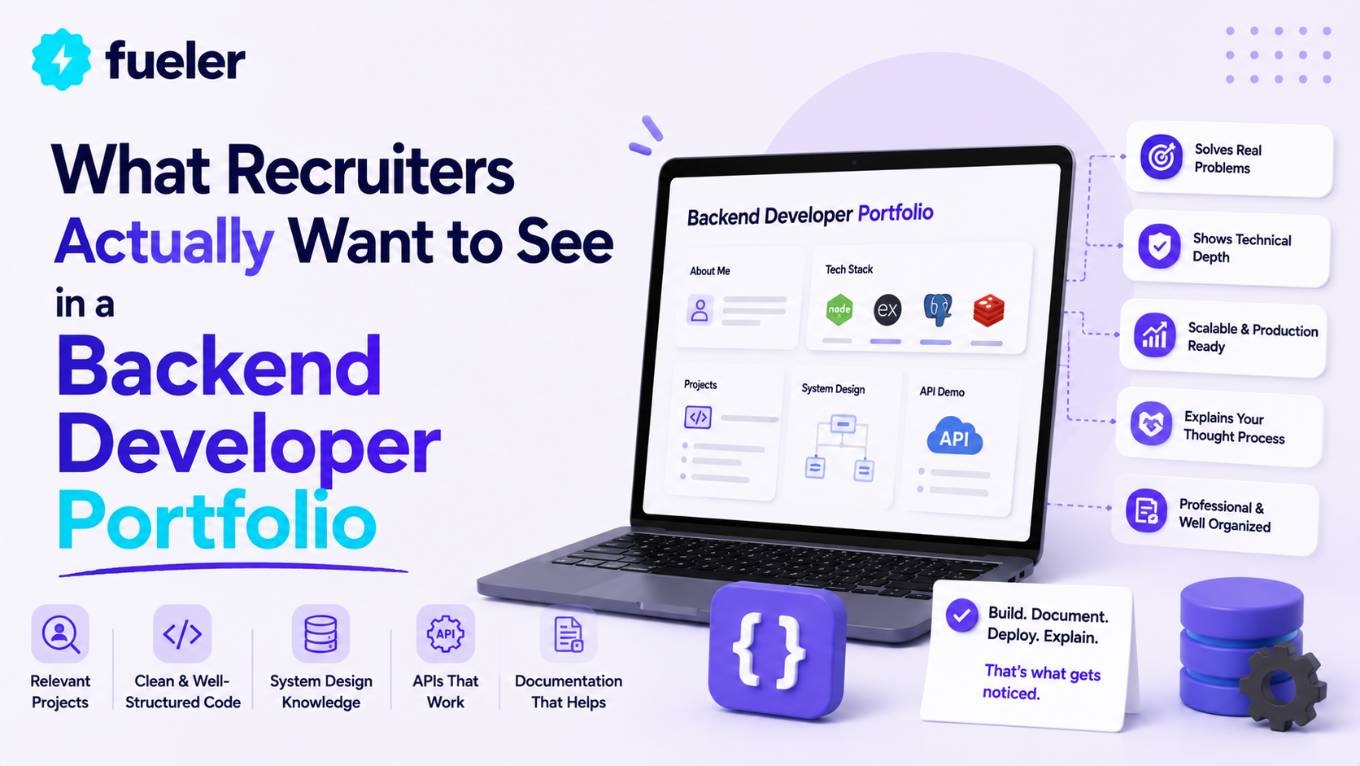
Most backend developers build portfolios for the wrong audience.
They build them to impress other engineers. Clean code, perfect folder structure, clever abstractions. But the first person who looks at your portfolio is usually not an engineer. It is a recruiter or a hiring manager scanning dozens of profiles in a short time. If your portfolio does not make sense to them in under a minute, you get skipped.
I am Riten, founder of Fueler, a platform that helps people get hired through their proof of work instead of a plain resume. I work closely with both job seekers and the companies hiring them. So in this article, I will tell you what recruiters actually look for in a backend developer portfolio, and how to give it to them.
First, understand how a recruiter reads your portfolio
A recruiter is not debugging your code. They are answering a few quick questions:
- Has this person built real, working systems
- Can this person handle scale and make good decisions
- Will this person reduce risk if we hire them
Everything you put in your portfolio should help answer those questions fast. The clearer your evidence, the lower the perceived risk. That is the core idea behind any effective proof of work portfolio.
1. Results and numbers, not just tools
Recruiters skim. Numbers stop the skim.
A line like "Built APIs using Node.js" means nothing to them. A line like "Built a URL shortening service handling 50,000 requests a day with Redis caching and PostgreSQL" tells them about scale, tools, and ownership in one breath.
Always translate your work into impact:
- "Cut API response time from 800ms to 120ms."
- "Scaled architecture to support 10,000 concurrent users."
- "Kept 99.9 percent uptime during high traffic events."
Results lower risk in a recruiter's mind, and lower risk means more interviews.
2. Proof that your APIs actually work
Recruiters love things they can click. Since you have no UI, make your API the clickable thing.
- Share live Swagger or Redoc documentation.
- Add a Postman collection with clean requests and responses.
- Write a one line summary of what the service does.
When a recruiter clicks a link and sees a real response come back, your skill stops being a claim and becomes a fact.
3. System design that shows clear thinking
For mid and senior roles, recruiters and hiring managers care deeply about how you think about systems. A system design case study proves it.
Include:
- The problem
- An architectural diagram
- Your database schema
- Scaling challenges
- Monitoring setup
- Tradeoffs you made
Real example: "Designed a notification service processing 2 million events a month with RabbitMQ and Node.js," with a diagram showing the event flow. This is the kind of clear evidence that makes proof of work portfolio examples stand out from generic resumes.
4. Architecture diagrams they can understand at a glance
A diagram does in five seconds what a paragraph does in five minutes. Recruiters appreciate that.
Add simple diagrams for request flow, database relationships, queues, and cache layers. Free tools like Excalidraw or draw.io are enough. A clean visual signals that you understand the whole system, not just one function.
5. Evidence of how you communicate
Here is something many engineers miss. Recruiters are also judging whether you can explain your work, because backend engineers must work with teams.
Technical write ups prove this beautifully. Titles like:
- How I reduced API latency from 900ms to 120ms
- How I migrated PostgreSQL with zero downtime
- Building rate limiting using Redis
These show you can think and explain at the same time. That ability is exactly what makes proof of work for developers so convincing to hiring teams.
6. Open source as trusted third party proof
Open source contributions are powerful because they are verified by someone other than you. A merged pull request means a real maintainer reviewed and accepted your code. To a recruiter, that is independent proof of competence and teamwork.
7. Consistency and clarity across projects
Recruiters look at many profiles. A messy, inconsistent one is tiring to read and easy to skip.
Use the same clean format for every project:
- Problem statement
- Architecture diagram
- Tech stack
- Database design
- API documentation
- Code repository
- Deployment link
- Performance metrics
- Lessons learned
This consistency signals professionalism, and it makes your work easy to browse. Easy to browse is easy to hire.
What recruiters do not need
It also helps to know what is not worth your time:
- Pretty UI for a heavy backend role. It is not your job, and good teams know it.
- Long code dumps with no explanation. Most recruiters will not read them.
- Buzzword lists with no proof behind them.
If a hiring manager rejects you only because you have no flashy frontend portfolio for a backend role, that is a warning sign about them, not you. Good engineering teams know backend value lives in how you think and design, not in pretty buttons.
When your work is under NDA
Plenty of strong backend work is confidential. Recruiters understand this. You can still satisfy them with:
- Impact metrics about scale, uptime, and performance.
- Architecture walkthroughs that explain how data flowed and how you handled caching and edge cases, without revealing private details.
When you cannot show the code, your clear explanation becomes the proof.
The bottom line
Recruiters are not trying to read your code. They are trying to lower their risk of a bad hire. Give them what they want: clear results, touchable APIs, clean diagrams, honest write ups, and a consistent format.
Do that, and you make their decision easy. Engineers who present their work this way tend to get hired faster with a portfolio than equally skilled people who hide behind a plain resume.
Build for the reader, not just for other coders. That single shift changes everything.
Frequently Asked Questions
1. What do recruiters look for in a backend developer portfolio?
Recruiters want clear results and scale, touchable API documentation, system design case studies, clean architecture diagrams, open source proof, and a consistent project format that is easy to read quickly.
2. How do I make my backend portfolio recruiter friendly?
Lead with numbers like requests per second, uptime, and latency. Make your APIs clickable through Swagger or Postman, add simple diagrams, and keep every project in the same clean format.
3. Do recruiters read code on GitHub?
Usually not. Most recruiters and many hiring managers will not read raw code. They rely on diagrams, metrics, write ups, and live demos to judge your skill, so your portfolio must explain the impact.
4. How important are metrics in a backend developer portfolio?
Very important. Metrics like response time, uptime, and concurrent users lower the perceived risk of hiring you, which is the main thing a recruiter is trying to measure.
5. How do I show backend skills to recruiters when my work is confidential?
Use impact metrics and architecture walkthroughs instead of code. Describe scale, performance, and how you solved problems, while keeping all confidential details private.
Why 100,000+ professionals use Fueler
Fueler helps professionals showcase proof of work through projects, assignments, case studies, and achievements.
- Thousands of professionals use Fueler to create their digital portfolio
- Thousands of projects published on Fueler. Check here
- Startups and Companies hire through proof of work on Fueler
- Used by freelancers, creators, marketers, video editors, writers, designers, and product managers
Our mission is to help the next 100 million professionals build a verified professional identity through proof of work

What should you do next?
You've read the article. Now turn your skills into proof of work and unlock more opportunities.
Build your proof of work portfolio
Create a clean portfolio with projects, assignments, resumes, and AI stack details that companies actually want to see.
Create your Fueler portfolio →Apply through assignments, not resumes
Stand out by solving real tasks from companies hiring on Fueler.
Explore assignments →Get discovered by companies
Make your work public and let recruiters discover your skills through actual projects instead of keywords.
Get discovered →
