Tripura's AVGC-XR Policy Could Create 7,500 Jobs: Here's How the Ecosystem Will Work

Riten Debnath
23 May, 2026
When a government promises jobs, I always ask one question. What kind of jobs, and how exactly will they appear? Numbers without a clear path are just hope. Numbers with a clear path are a plan.
I am Riten, founder of Fueler, a platform that helps people get hired through their work, not just their resume. I spend my days thinking about how people actually earn in the modern economy. So when I sat in the stakeholder consultation for the draft Tripura AVGC-XR Policy in Agartala, I went straight for the employment projections. And what I found was refreshingly honest.
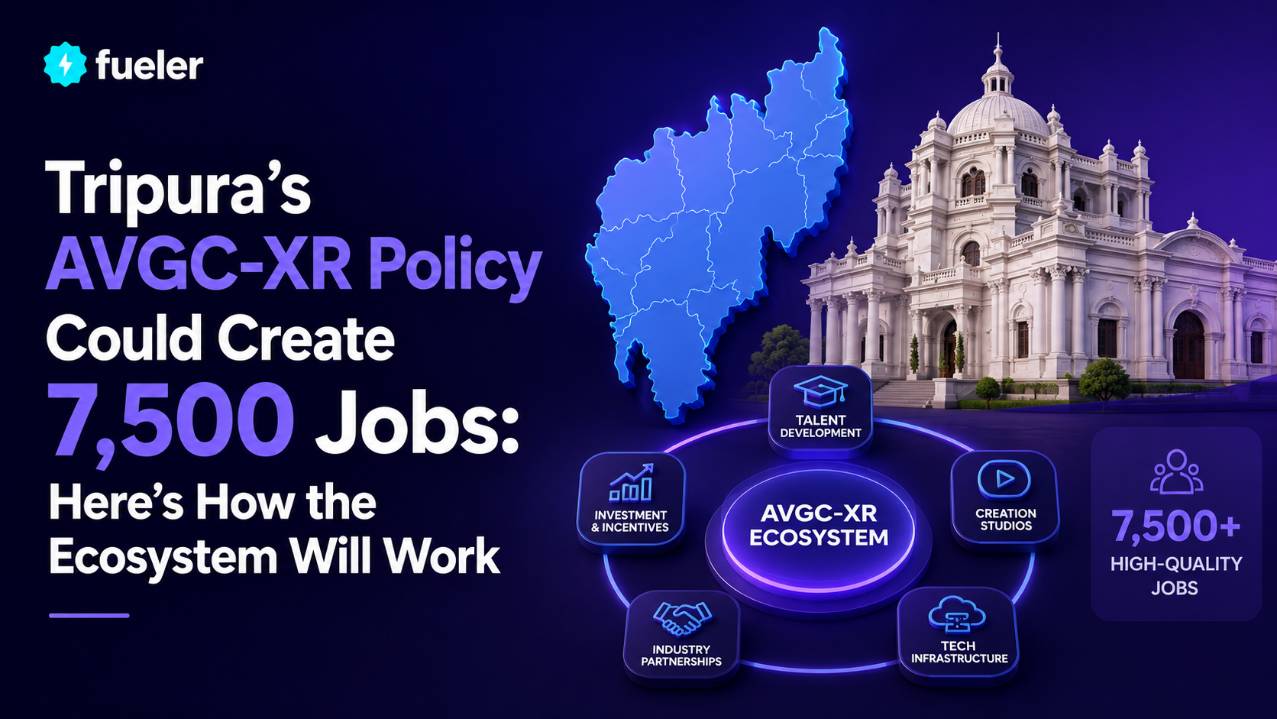
AVGC-XR stands for Animation, Visual Effects, Gaming, Comics, and Extended Reality. It is the creative and immersive digital economy. The Tripura policy projects creating 5,000 to 7,500 jobs over five to seven years. In this article, I will break down where these jobs will come from, why the freelance economy is a big part of the story, and what this means for the next generation of India's digital workforce.
Breaking Down the Employment Projections
Let me start by being clear about the numbers, because they are often misreported.
The wider TRI-NITI initiative, which combines the AVGC-XR Policy, an AI Policy, and a GCC Policy, targets 75,000 jobs and 300 plus startups in total. That is the big umbrella number. But the AVGC-XR Policy on its own is more grounded.
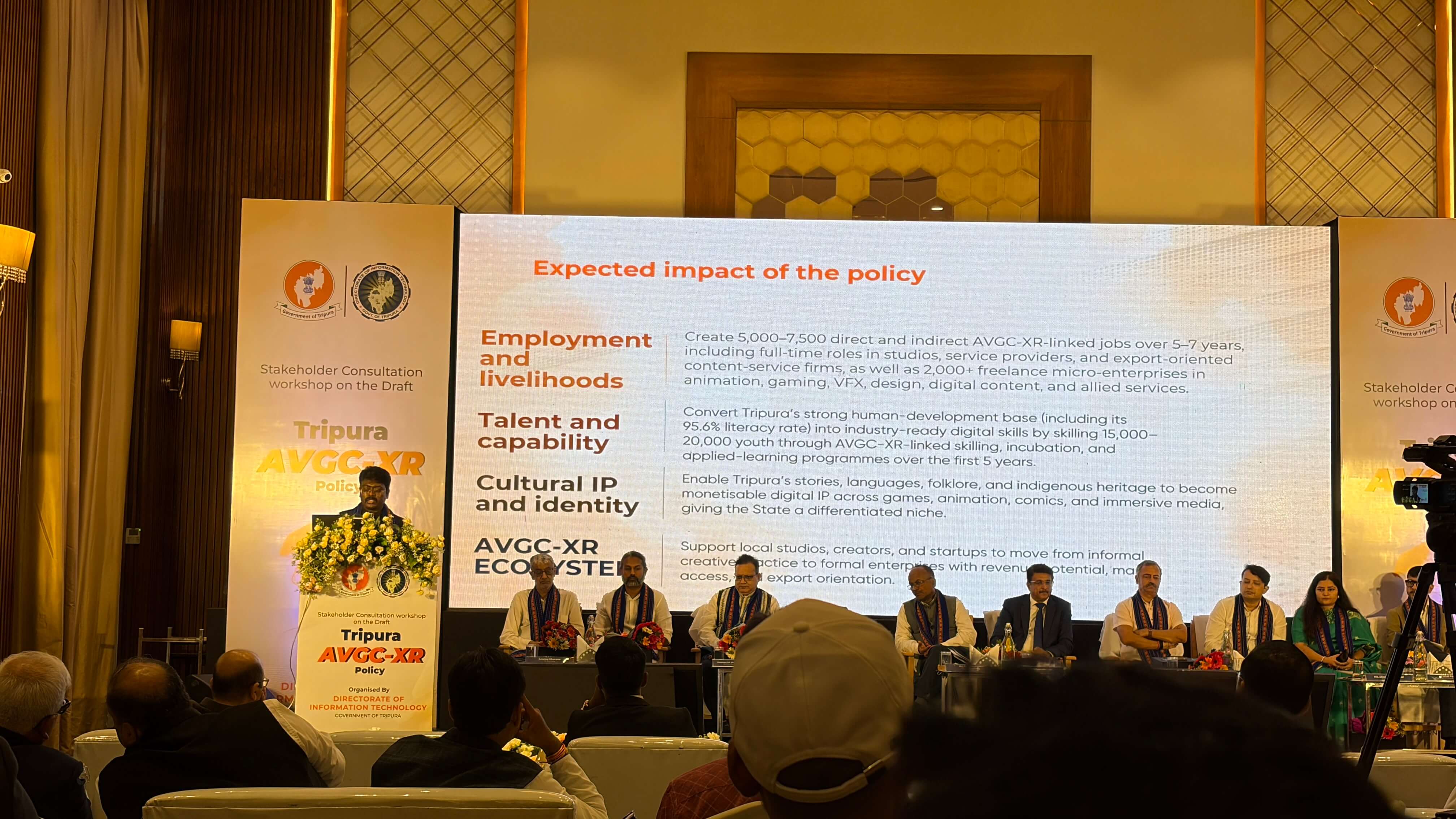
The policy projects creating 5,000 to 7,500 direct and indirect AVGC-XR-linked jobs over five to seven years. This includes full-time roles in studios, service providers, and export-oriented content-service firms. On top of that, it expects 2,000 plus freelance micro-enterprises in animation, gaming, VFX, design, and digital content.
It also aims to skill 15,000 to 20,000 youth through AVGC-XR-linked skilling, incubation, and applied-learning programmes over the first five years.
I respect these numbers because they are realistic. It would have been easy to slap a giant figure on a slide to grab headlines. Instead, the policy separates the umbrella goal from the specific AVGC-XR goal. As a founder, I trust honest projections far more than inflated ones. Honesty in planning usually means honesty in execution.
The split between direct jobs and freelance micro-enterprises is also smart. It accepts how creative work actually happens today. Not everyone wants a desk job in a studio. Many creators want to work for themselves. The policy makes room for both.
The Freelance Economy and Micro-Entrepreneurship
The part of these projections that excites me most is the 2,000 plus freelance micro-enterprises. This is where the future of work really lives.
A micro-enterprise can be one creator with a laptop and a skill. An animator taking projects from clients around the world. A game artist freelancing for studios. A comic creator building an audience and selling their work online. These are real businesses, even if they are run by a single person.
This matters for a state like Tripura because freelancing removes the biggest old barrier, which was location. You no longer have to move to Mumbai or Bangalore to find work. With internet and skill, you can sit in Agartala and earn from clients anywhere. The policy supports this with skill programs, shared workspaces, and infrastructure like high-speed internet and production labs.
But here is the honest part. Freelancing rewards proof, not promises. A client hiring a freelance animator does not ask for a degree. They ask to see your past work. This is the single most important thing I tell every young creator. Your portfolio is your business card, your resume, and your sales pitch all in one.
In the freelance and micro-enterprise world, proof of work is everything. The creators who document and show their projects publicly get hired. The ones who keep their work hidden stay invisible, no matter how talented they are. If Tripura wants its 2,000 freelance micro-enterprises to actually happen, teaching creators to build and show portfolios is just as important as teaching them the skill itself.
Studios, Service Providers, and Creator-Led Businesses
The full-time jobs in this projection will come from three main types of businesses, and it helps to understand each one.
The first is studios. These are companies that produce original content like animated series, games, or comics. They hire animators, artists, writers, developers, and designers. The policy supports studios with production grants up to 25 percent of project cost, capital subsidies, and shared production labs.
The second is service providers. These are companies that do creative work for other companies, often international clients. India is already a huge VFX and animation service hub for global studios. Tripura wants a slice of this by creating export-oriented content-service firms. These firms can bring in foreign revenue while creating local jobs.
The third is creator-led businesses. These are smaller, founder-driven ventures, often built around a specific creator's vision or IP. The policy supports them with seed grants up to 10 lakh, rent subsidies, and incubation spaces.
To help all three, the policy plans an AVGC Centre of Excellence, motion capture and XR studios, high-performance rendering and cloud infrastructure, and co-working spaces. There is also an employment generation incentive that pays enterprises 30,000 to 1,00,000 rupees per new local job. That is a direct, clever push to make hiring local talent attractive.
When you have studios making content, service firms earning export revenue, and creator-led businesses owning original IP, you get a healthy mix. Each type creates different kinds of jobs, which means more options for different kinds of people.
Why This Matters for Bharat's Next-Gen Digital Workforce
Step back and look at the bigger picture. This is not just about Tripura. It is about a question every part of India is facing: Where will the next generation of digital jobs come from?
For decades, good creative-tech jobs were locked inside a few big cities. If you were born in a small town, your only option was to leave. This drained talent from smaller regions and crowded the metros. The Tripura AVGC-XR Policy is a small but real attempt to change that pattern.
If a state with around 94 percent literacy, a young population, and a fresh policy can create even 7,500 quality jobs and 2,000 micro-enterprises in the creative economy, it proves something important. Digital jobs do not have to be concentrated in metros. They can be spread across Bharat, including smaller states and the Northeast.
This is the future I believe in and the future I am building toward at Fueler. A world where your location does not decide your career. A world where your work speaks for you, not your pin code or your college brand.
But none of this is automatic. The jobs will only appear if the skilling is real, if studios and clients actually show up, and if creators learn to present their work to the world. The policy can build the runway. Young people still have to learn to fly.
So if you are a student or young creator reading this, my advice is simple. Do not wait for these 7,500 jobs to be created and then apply. Start building your skill and your portfolio today. Show your work publicly. Become so good and so visible that when the opportunities arrive, you are the obvious first choice. In the next-gen digital workforce, the early movers who build their proof of work now will be the ones who win.
Frequently Asked Questions (FAQ)
How many jobs will the Tripura AVGC-XR Policy create?
The Tripura AVGC-XR Policy projects creating 5,000 to 7,500 direct and indirect jobs over five to seven years, plus 2,000 plus freelance micro-enterprises. The wider TRI-NITI initiative, which includes AVGC-XR, AI, and GCC policies, targets 75,000 jobs and 300 plus startups in total.
What types of AVGC-XR jobs will be available in Tripura?
Jobs will come from studios producing original content, service providers doing creative work for global clients, and creator-led businesses. Roles include animation, game development, VFX, 3D modelling, comic creation, design, and XR experience design, along with freelance and micro-entrepreneurship opportunities.
How will the Tripura AVGC-XR Policy support freelancers?
The policy expects 2,000 plus freelance micro-enterprises and supports them through skill programs, shared workspaces, high-speed internet, and production infrastructure. Freelancing lets creators in Tripura work for clients anywhere without moving to a metro city.
How can young people prepare for AVGC-XR jobs in Tripura?
Young people should learn a specific creative skill like animation, gaming, VFX, or XR, and then build a public portfolio of real projects. In creative-tech hiring, proof of work matters more than certificates, so showing your projects online is the fastest way to get hired or find clients.
Why are AVGC-XR jobs important for India's digital workforce?
AVGC-XR jobs allow creative-tech careers to grow outside big metros, spreading opportunity to smaller states and regions like the Northeast. This helps reduce talent migration, supports local economies, and builds a more distributed and inclusive digital workforce across Bharat.
What is Fueler Portfolio?
Fueler is a career portfolio platform that helps companies find the best talent for their organization based on their proof of work. You can create your portfolio on Fueler. Thousands of freelancers around the world use Fueler to create their professional-looking portfolios and become financially independent. Discover inspiration for your portfolio
Sign up for free on Fueler or get in touch to learn more.

What should you do next?
You've read the article. Now turn your skills into proof of work and unlock more opportunities.
Build your proof of work portfolio
Create a clean portfolio with projects, assignments, resumes, and AI stack details that companies actually want to see.
Create your Fueler portfolio →Apply through assignments, not resumes
Stand out by solving real tasks from companies hiring on Fueler.
Explore assignments →Get discovered by companies
Make your work public and let recruiters discover your skills through actual projects instead of keywords.
Get discovered →
