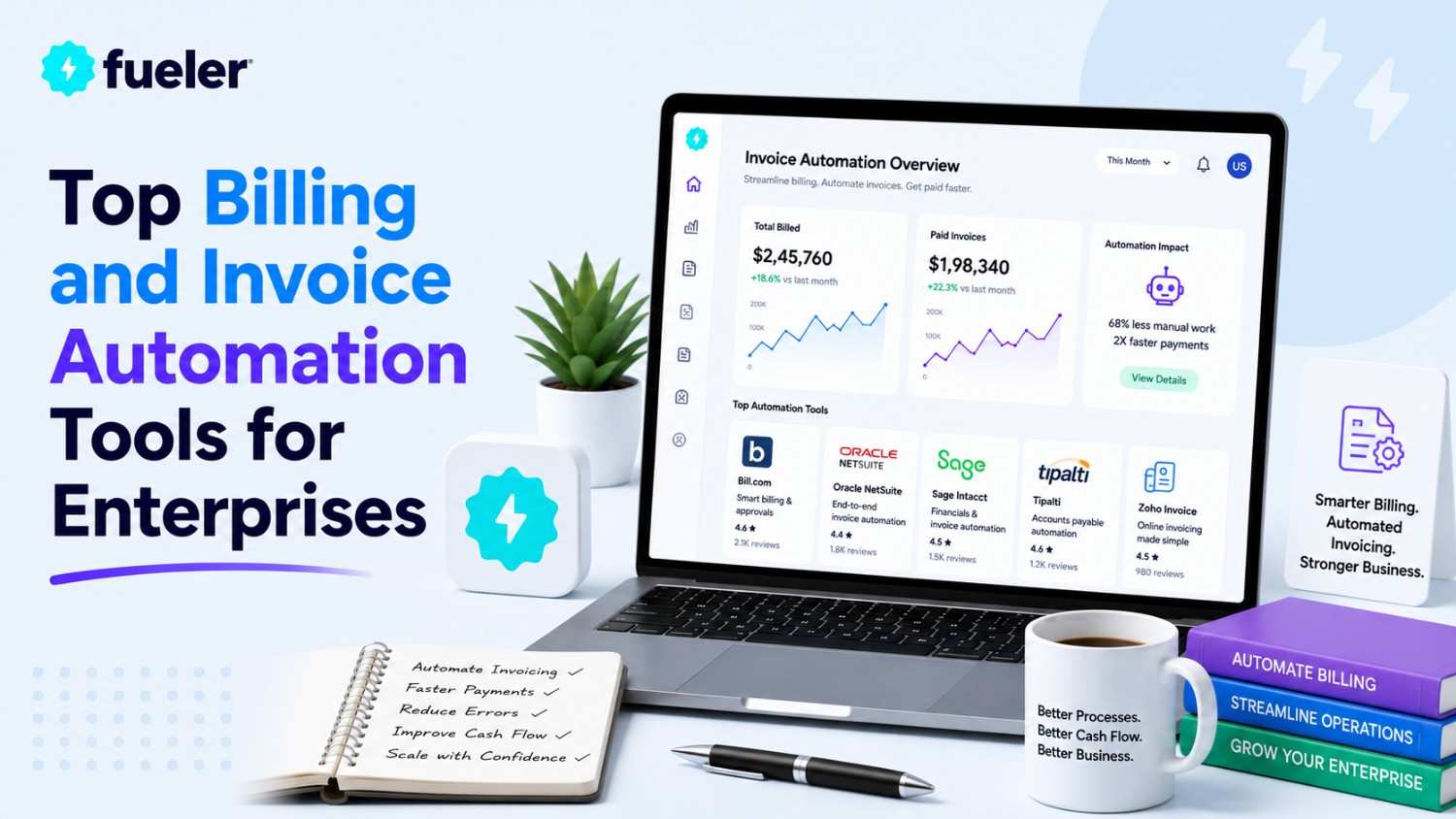
Top Billing and Invoice Automation Tools for Enterprises

Riten Debnath
25 May, 2026
Last updated: May 2026
In 2026, the delta between a growing enterprise and a stalled one is often found in the "back-office plumbing." As businesses move from simple subscription models to complex, usage-based, or multi-entity revenue streams, manual invoicing becomes a silent killer of cash flow. If your finance team is still reconciling spreadsheets at the end of the month, you aren't just losing time; you are losing revenue visibility.
I’m Riten, founder of Fueler, a skills-first portfolio platform that connects talented individuals with companies through assignments, portfolios, and projects, not just resumes/CVs. Think Dribbble/Behance for work samples + AngelList for hiring infrastructure.
I’ve seen firsthand how the right operational stack changes the trajectory of a company. In this guide, we dive into the top nine billing and invoice automation platforms that allow enterprise teams to move away from legacy friction and toward high-velocity financial operations. You will learn the core capabilities, pricing realities, and strategic advantages of each, enabling you to choose the system that actually supports your scale.
At a glance: Comparing the Top Billing and Invoice Automation Tools for Enterprises
1. BillingPlatform
Best For: Enterprises requiring high customization and those managing complex, multi-layered pricing structures.
BillingPlatform is a highly configurable, cloud-native billing system designed to handle the most intricate enterprise revenue models. In 2026, it remains the go-to for companies that have outgrown "off-the-shelf" SaaS billing and need a platform that bends to their unique business logic, rather than forcing their business to conform to the software.
- Configurable Monetization: It excels at managing complex usage-based pricing, hybrid subscription-product models, and tiered discounting. This allows large enterprises to iterate on their product offerings without needing massive engineering overhauls every time a new pricing strategy is launched, ensuring they stay competitive in shifting markets.
- Workflow Automation: The platform automates the entire quote-to-cash process, significantly reducing manual intervention in complex contracts. By integrating deeply with existing CRM and ERP systems, it ensures that data flows seamlessly from sales lead to final invoice generation, minimizing errors caused by disconnected systems.
- Global Compliance: With robust support for multi-currency, multi-language, and local tax requirements, it is built for multinational organizations. It handles the complexities of global revenue recognition, which is critical for enterprises that must adhere to varying international financial reporting standards without maintaining separate billing infrastructures.
- System Integration: It offers a highly extensible API, allowing for custom integrations with existing financial stacks. This is crucial for enterprises that have a massive web of internal tools, ensuring that BillingPlatform acts as the unified source of truth for all billing-related data across the entire organization.
- Data Accuracy: By centralizing billing logic, it prevents "revenue leakage" common in decentralized systems. It provides detailed audit trails and financial reporting, which is essential for public companies or those undergoing rigorous financial audits, providing the transparency required to satisfy stakeholders and regulators alike in 2026.
Pricing: Custom enterprise pricing based on volume and complexity; typically requires a direct sales engagement.
Why It Matters: It turns billing into a competitive advantage by allowing rapid product experimentation. For large-scale teams, it provides the stability of an ERP with the agility of a modern SaaS tool.
2. Zuora
Best For: Established, subscription-heavy enterprises needing deep ecosystem support and advanced revenue management.
Zuora is the long-standing industry leader for subscription management. In 2026, it will provide a comprehensive suite that manages the entire subscriber lifecycle, from initial acquisition to renewal and expansion. It is designed for large-scale operations where managing millions of subscribers and complex contract changes is the daily norm.
- Subscription Lifecycle Management: Zuora handles every facet of the subscription journey, including proration, upgrades, and mid-cycle downgrades. This depth of functionality is critical for large SaaS businesses that need to manage millions of concurrent subscriptions with different terms, ensuring accurate and timely billing for every single user.
- Revenue Recognition: It includes highly sophisticated revenue recognition tools that comply with ASC 606 and IFRS 15 standards. This feature is a game-changer for enterprise finance teams, as it automates the complex task of deferring and recognizing revenue accurately across global multi-entity organizations, significantly reducing the audit burden.
- Enterprise Ecosystem: As an established leader, Zuora boasts an unmatched library of pre-built integrations. Whether connecting to Salesforce, Oracle NetSuite, or specialized accounting software, it offers the most stable and mature integration path for enterprises that cannot afford downtime or data sync errors in their billing pipelines.
- Global Tax/Payment Orchestration: It simplifies the complexity of international payments and tax calculations through a vast network of gateways. This allows enterprises to enter new markets quickly, as the platform automatically manages the varied tax and payment compliance requirements of different jurisdictions on a per-transaction basis.
- Insights and Analytics: Zuora’s reporting module provides deep visibility into key SaaS metrics like ARR, churn, and net revenue retention. For enterprise executives, this data is fundamental for long-term strategic planning, enabling them to make informed decisions based on granular insights into customer behavior and revenue health.
Pricing: Highly customized; average enterprise contracts often exceed $150,000 annually, depending on volume and module usage.
Why It Matters: Zuora remains the bedrock of modern subscription finance. Its maturity and compliance features make it the "safe" and reliable choice for the largest public companies.
3. Maxio
Best For: B2B SaaS and mid-to-large growth-stage companies looking for a balance between billing power and financial reporting.
Maxio is built specifically to address the pain points of B2B SaaS finance leaders. It bridges the gap between operational billing and technical accounting, providing a unified platform where both subscription billing and revenue recognition live side-by-side, which is essential for businesses trying to scale without hiring more finance staff.
- Integrated Finance Ops: Maxio combines billing, subscription management, and revenue recognition into one interface. This eliminates the need for separate, disconnected tools, creating a single source of truth for finance teams who need to track everything from a new customer contract to the final accounting entry.
- Complex Usage Billing: It handles per-unit, tiered, and stairstep usage-based pricing models out of the box. For SaaS companies experimenting with metered billing, Maxio automates the reconciliation process, ensuring that customers are billed accurately for their exact consumption without the risk of manual data entry errors.
- GAAP/IFRS Compliance: The platform provides pre-built rules for compliant revenue recognition, making it an essential tool for companies preparing for audits or funding rounds. It automates complex calculations that would otherwise take teams days of manual effort, ensuring total financial accuracy and institutional readiness at scale.
- Multi-Entity Support: For businesses with multiple subsidiaries or brands, Maxio offers native multi-entity management. This allows finance teams to consolidate reporting and billing across different business units, simplifying the complex financial structure of holding companies or enterprises that have grown through multiple acquisitions.
- Self-Service Customer Portal: It empowers end-customers to manage their own subscriptions, update payment methods, and download invoices. This significantly reduces the volume of support tickets related to billing questions, improving the customer experience while freeing up the finance team to focus on strategic tasks rather than admin.
Pricing: Starts around $599/month for core features; scales based on revenue volume and modular needs.
Why It Matters: Maxio excels in its focus on "Finance-as-a-Service." It is the ideal tool for companies that view their billing platform as a critical part of their broader financial reporting infrastructure.
4. Stripe Billing
Best For: Fast-moving tech teams that prioritize speed of implementation and deep developer-friendly integration.
Stripe Billing is the powerhouse behind millions of modern software companies. In 2026, it is the standard for startups and enterprises that want to keep their billing logic as close to their product codebase as possible. It is less of a standalone finance tool and more of a programmable revenue layer.
- Developer-First Architecture: With a clean and well-documented API, Stripe allows engineers to build highly customized billing logic directly into the product. This flexibility is perfect for AI agents, SaaS, and marketplaces that need to trigger billing based on specific, non-traditional user events or application state changes.
- Global Payment Reach: Stripe supports virtually every payment method on the planet, including digital wallets, local bank transfers, and automated recurring card charges. This is a massive advantage for any enterprise looking to expand into international markets, as it drastically reduces the friction of local payment acceptance.
- Modular Billing Stack: Stripe offers a suite of integrated toolsTax, Revenue Recognition, and Invoicing, that can be toggled on as the business grows. This modular approach allows teams to start simple and progressively add complexity to their financial operations without needing to switch to a more complex platform.
- Automated Dunning: Stripe’s built-in "Smart Retries" and automated email sequences effectively reduce churn by recovering failed payments. For high-volume businesses, this automated recovery directly protects top-line revenue, ensuring that minor technical failures or expired cards do not become significant financial losses in the long term.
- Real-Time Data Streams: Stripe’s webhooks and data pipelines provide instant visibility into billing events. This allows other internal systems, such as CRM or customer success platforms, to react in real-time to subscription status changes, enabling a highly coordinated enterprise approach to customer retention and growth.
Pricing: Revenue-based fees (typically 0.7% to 0.8% of recurring charges) plus payment processing fees.
Why It Matters: If your product defines your billing (like AI usage-based pricing), Stripe is the only logical choice. It is the gold standard for companies that want to automate revenue programmatically.
5. Chargebee
Best For: Growing SaaS businesses that need rapid, no-code configuration of subscription models.
Chargebee is famous for its ease of use and its ability to let non-technical finance teams manage complex pricing changes without asking for help from engineering. In 2026, it is the preferred platform for companies that want to move fast, test new pricing strategies, and manage customer relationships without becoming a custom software project.
- No-Code Pricing Management: Finance teams can create, test, and launch new subscription plans and pricing structures through a user-friendly UI. This agility is vital for companies that need to experiment with different pricing tiers to find product-market fit, as it removes the engineering bottleneck for pricing changes.
- Advanced Dunning and Recovery: Chargebee’s smart dunning logic is highly configurable and effective at recovering failed payments. It allows for custom retry schedules based on specific segments of users, ensuring that your billing strategy is optimized for both recovery rates and the best possible customer experience during payment failures.
- Multi-Gateway Integration: It allows companies to connect multiple payment gateways and switch between them seamlessly. This provides a level of redundancy and cost-optimization that is rare, ensuring that if one processor has an outage, the business can quickly route traffic to another without any disruption in service.
- Global Revenue Compliance: It handles international tax and compliance complexities, including global VAT/GST, out of the box. This makes it an excellent choice for businesses looking to expand globally, as the tool handles the complex regulatory landscape of different regions without requiring deep legal or technical expertise.
- Extensive Integration Ecosystem: Chargebee integrates deeply with leading sales, CRM, and accounting software, ensuring that billing data flows naturally into every other department's tools. This connectivity helps create a unified view of the customer, enabling more effective cross-departmental collaboration on sales, support, and marketing initiatives.
Pricing: Free Starter plan up to $250k in revenue; paid plans start at ~$599/month, with overage fees applying beyond that.
Why It Matters: Chargebee is the "safe middle ground" that combines the power of enterprise billing with the usability of a startup tool. It is perfect for teams that value speed and autonomy.
6. Recurly
Best For: Companies that prioritize subscription lifecycle management and retention metrics.
Recurly is purpose-built for the subscription economy. It focuses heavily on the mechanics of retaining subscribers and managing the complex events that occur during a subscription's life, such as proration, pauses, and renewals. It is widely regarded as one of the best tools for companies where churn prevention is the primary business metric.
- Subscription Lifecycle Automation: Recurly excels at handling the "messy" parts of subscription upgrades, downgrades, and mid-cycle changes. Its proration engine is highly reliable, ensuring that customers are billed correctly for changes even when they happen at unconventional times during the month, which is a common source of billing support tickets.
- Churn Mitigation Tools: Beyond simple dunning, Recurly provides predictive tools to help identify "at-risk" subscribers. By analyzing patterns in payment behavior and billing history, it helps finance and success teams intervene before a customer actually cancels, protecting the most valuable asset of any SaaS company: the recurring revenue stream.
- Advanced Analytics: It offers a dedicated reporting dashboard that tracks subscription-specific KPIs, such as cohort churn, trial conversion, and MRR movement. For growth-focused teams, this insight is crucial for understanding which plans or segments are driving the most value and where adjustments to pricing or packaging might be needed.
- Revenue Recognition: It includes built-in tools for GAAP-compliant revenue recognition, providing a clear path for companies moving toward audit readiness. Automating the deferred revenue schedules, it removes a significant manual workload for finance teams and provides accurate, high-quality financial data for investors and auditors.
- Platform Flexibility: Recurly is not tied to a single payment processor, giving companies total freedom to work with their preferred gateway. This vendor-neutrality is a key strategic advantage for larger enterprises that want to negotiate better payment processing rates independently of their billing infrastructure provider.
Pricing: Starts at ~$249/month (base) plus a percentage of total payment volume (TPV).
Why It Matters: Recurly is the data-driven choice for teams obsessed with retention. Its focus on subscription health makes it a vital tool for long-term growth.
7. Sage Intacct
Best For: Mid-to-large enterprises needing a full-blown financial management system that includes billing capabilities.
Sage Intacct is a comprehensive cloud ERP solution. Unlike the other tools on this list, it is not "just" for billing; it is a full financial engine. For enterprises that need to manage billing alongside AP, AR, general ledger, and advanced reporting, it provides the most consolidated and robust financial environment in the market.
- End-to-End Financial Management: Sage Intacct integrates billing directly into the broader accounting cycle. This means that when an invoice is generated, the impact on the general ledger and cash flow is updated in real-time, providing a level of financial accuracy and transparency that standalone billing tools simply cannot match.
- AI-Powered Automation: The 2026 release features sophisticated AI tools that assist in accounts payable matching, reconciliation, and cash flow forecasting. For large teams, this automation significantly reduces the manual labor involved in daily financial operations, allowing them to scale their finance departments without linear headcount increases.
- Advanced Reporting and Consolidation: It is built for complex, multi-entity organizations. It allows for seamless consolidation of financial data across different business units, regions, or product lines, providing executives with a clear view of the enterprise's overall financial performance and efficiency, even across diverse operations.
- Custom Approval Workflows: It provides granular control over financial processes, allowing for custom approval hierarchies for invoices and payments. This is critical for large enterprises that must maintain strict internal controls to comply with SOX regulations and prevent fraud, ensuring that every cent is accounted for and approved.
- Ecosystem and Scalability: As a core ERP, Sage Intacct sits at the center of the enterprise tech stack. It offers deep integrations with almost every major business application, ensuring that billing data is perfectly aligned with everything from CRM to project management tools, creating a truly unified enterprise operational layer.
Pricing: Custom enterprise pricing; implementation and licensing are usually significant and depend on the specific modules and user count.
Why It Matters: Sage Intacct is the standard for companies that want to move away from "best-of-breed" fragmentation and toward a centralized, audit-ready financial system.
8. Oracle NetSuite
Best For: Massive, global enterprises that require a single, integrated ERP for every department.
NetSuite is the titan of cloud-based enterprise resource planning. Its "SuiteBilling" module brings together the power of a global ERP with the flexibility of modern subscription and usage-based billing. It is the choice for the largest organizations that need a single platform for the entire business, from human resources to billing.
- Unified Global Operations: NetSuite manages everything from inventory and supply chain to billing and payroll. This unification is the ultimate goal for massive global enterprises, as it removes the silos that plague large companies and provides a single version of the truth for the entire organization's performance.
- SuiteBilling Flexibility: The built-in billing module handles virtually any revenue model, including consumption-based commitments and complex multi-currency contracts. It is specifically designed to handle the scale and variety of revenue streams that come with large-scale global operations, making it the most stable platform for truly massive enterprises.
- AI-Powered Close and Reconciliation: NetSuite’s 2026 release focuses heavily on AI agents for period-end closing and bank reconciliation. For enterprises, these tasks were historically the most time-consuming and error-prone; automating them with AI provides massive efficiency gains and drastically reduces the time it takes to produce quarterly financial results.
- Strict Internal Controls: With robust, role-based access and automated audit trails, NetSuite is the gold standard for regulatory compliance in public enterprises. It provides the security and oversight necessary for organizations that operate in highly regulated industries, ensuring that financial data is secure and that all processes are documented.
- Scalable Architecture: Built for the biggest players, NetSuite does not "break" under high transaction volumes. It is designed to grow with the company, whether the enterprise is expanding into new markets or acquiring new business units, providing a scalable backbone that lasts for decades, not years.
Pricing: Highly custom; costs depend on the number of modules, entities, and global users. Usually a significant six-figure investment.
Why It Matters: NetSuite is the ultimate destination for an enterprise's financial journey. It is the platform you move to when you stop caring about "tools" and start caring about "global infrastructure."
9. BILL (formerly Bill.com)
Best For: Companies needing a simplified, automated approach to B2B payments and AR/AP synchronization.
BILL is a leader in automating the back-office payment workflow. It acts as a bridge between buyers and suppliers, digitizing the traditionally fragmented B2B payment process. In 2026, it is the essential tool for any enterprise that wants to accelerate cash collection and reduce the friction of vendor payments.
- Automated Payment Orchestration: BILL digitizes the entire payment process, replacing paper checks and manual wire transfers with automated digital transactions. This significantly improves DSO (Days Sales Outstanding), helping enterprises collect payments faster and with greater predictability, which is a direct boost to overall company cash flow.
- Supplier Network Connectivity: With a network of over 8 million businesses, BILL makes it incredibly easy to pay and get paid by other companies. For enterprises, this network effect reduces the time spent on manual vendor onboarding and communication, as many vendors are already active on the platform.
- AR/AP Synchronization: It perfectly matches incoming payments with outgoing invoices, providing real-time visibility into the company’s cash position. For teams managing hundreds of daily transactions, this automated synchronization is a massive time-saver that ensures the books are always balanced and up-to-date, removing manual reconciliation work.
- Smart Payment Preferences: BILL allows suppliers to set their own payment preferences (ACH, card, wire) without the buyer needing to know the technical details. This simplifies the buyer-supplier relationship, as the platform handles the routing, remittance capture, and settlement, ensuring that both sides get paid and paid on time.
- Unified Visibility: The platform provides a single dashboard for all payment activity, whether in-network or out-of-network. This visibility is essential for enterprise cash forecasting, as it allows finance leaders to see exactly what cash is coming in and going out, enabling more precise financial planning and decision-making.
Pricing: Subscription-based tiers (e.g., $39–$79/user/month for SMB-level, with custom pricing for larger enterprise setups).
Why It Matters: BILL solves the "payment friction" problem. It is the most practical tool for any business that processes a high volume of B2B invoices and wants to modernize their payment workflow quickly.
Which Tool Should You Choose?
Selecting the right billing tool depends on where you sit in the enterprise hierarchy and what your primary pain point is.
- The "Speed-to-Product" Startup/AI Team: Choose Stripe Billing. If your billing is driven by code or usage events (like tokens or API calls), Stripe’s programmatic flexibility is unmatched.
- The Mid-Market "Growth" Company: Choose Chargebee or Maxio. If you want a balance of power and no-code usability, these tools provide the best mix for teams that need to iterate fast without heavy engineering.
- The Large Subscription Enterprise: Choose Zuora. If you are managing complex subscriber relationships, churn metrics, and need a mature ecosystem, Zuora is the proven industry giant.
- The "One-Platform" Enterprise: Choose Oracle NetSuite or Sage Intacct. If you are ready to stop managing "tools" and start managing an integrated ERP, these are the only paths that provide true business-wide consolidation.
- The B2B Payment Focus: Choose BILL. If your biggest problem is the administrative nightmare of paying vendors and chasing payments, BILL is the most immediate way to clear your backlog.
How Does This Connect to Building a Strong Career or Portfolio?
In 2026, the most valuable professionals are those who understand the "revenue engine" of the business. By mastering these billing and automation platforms, you aren't just learning software; you are learning how money moves in modern enterprises. Documenting how you implemented these systems, reduced DSO, or scaled a recurring revenue pipeline provides concrete proof of work. On Fueler, demonstrating this level of operational expertise connecting technical billing stacks to tangible business outcomes far outweighs the bullet points on a generic resume.
Final Thoughts
The tools you choose to run your finance operations reflect your company's maturity. Moving from manual spreadsheets to automated billing systems is more than a technical upgrade; it’s a commitment to scale and visibility. In 2026, the enterprises that survive and thrive are those that minimize administrative friction, letting their teams focus on building and selling rather than reconciling data. Start with your biggest bottleneck, whether it’s payment collection or subscription management, and build your operational stack from there.
Frequently Asked Questions
1. What are the best AI-driven billing systems in 2026?
Platforms like NetSuite, Sage Intacct, and Stripe Billing are leading the way by integrating AI agents that handle automatic reconciliation, fraud detection, and predictive revenue forecasting, significantly reducing the manual overhead previously required to run these tasks.
2. How do enterprises automate billing for usage-based models?
Enterprises typically use specialized platforms like BillingPlatform, Maxio, or Stripe Billing that feature native "metering" engines. These tools track real-time consumption events (API calls, storage, etc.) and automatically translate them into accurate, invoice-ready line items without manual intervention.
3. Is it better to build a custom billing system or use a platform?
For most enterprises, building a custom billing engine is a "trap." Regulatory compliance (like global tax laws), dunning logic, and revenue recognition are too complex to maintain manually. Using a specialized platform is nearly always more cost-effective and secure than maintaining internal proprietary code.
4. How do I choose between an ERP and a dedicated billing tool?
Choose a dedicated billing tool (like Chargebee or Recurly) if your main goal is subscription agility and growth. Choose a full ERP (like NetSuite) if your goal is internal process consolidation, audit compliance, and managing the entire business from a single financial source of truth.
5. How do I reduce billing-related churn?
The most effective way is to implement "smart dunning" using automated retry logic and multi-channel communication (email/SMS) to catch failed payments. Platforms like Recurly and Chargebee include these features out of the box, often recovering 10–20% of revenue that would otherwise be lost to involuntary churn.
What is Fueler Portfolio?
Fueler is a career portfolio platform that helps companies find the best talent for their organization based on their proof of work. You can create your portfolio on Fueler. Thousands of freelancers around the world use Fueler to create their professional-looking portfolios and become financially independent. Discover inspiration for your portfolio
Sign up for free on Fueler or get in touch to learn more.

What should you do next?
You've read the article. Now turn your skills into proof of work and unlock more opportunities.
Build your proof of work portfolio
Create a clean portfolio with projects, assignments, resumes, and AI stack details that companies actually want to see.
Create your Fueler portfolio →Apply through assignments, not resumes
Stand out by solving real tasks from companies hiring on Fueler.
Explore assignments →Get discovered by companies
Make your work public and let recruiters discover your skills through actual projects instead of keywords.
Get discovered →
