The Ultimate Guide to Creating Proof of Work

Riten Debnath
09 May, 2026
Last updated: May 2026
The old way of getting hired is officially broken. For decades, we were told that a fancy degree and a two-page resume were the keys to a successful career, but in today’s world, employers are tired of reading "fast learner" or "team player" on a piece of paper. They want to see what you have actually done, not what you say you can do. Proof of Work is the simple act of showing your results instead of just talking about your potential, and it is about turning your invisible skills into visible assets that nobody can ignore.
I’m Riten, founder of Fueler, a skills-first portfolio platform that connects talented individuals with companies through assignments, portfolios, and projects, not just resumes/CVs. Think Dribbble/Behance for work samples + AngelList for hiring infrastructure.
Most people fail to get the jobs they want because they look exactly like everyone else in a sea of generic applications. They apply with the same templates and the same boring phrases, but by building Proof of Work, you are essentially creating a shortcut for recruiters. You are giving them the confidence to hire you because they can see the evidence of your talent before they even jump on a call with you. Let’s break down how you can start building this today.
Proof of Work Statistics
- Recruiters spend less than 10 seconds on an average resume.
- Portfolio-based hiring is growing rapidly in remote-first companies.
- Startups increasingly prioritize demonstrated skills over degrees.
- Public proof of work improves credibility and trust during hiring.
- Candidates with portfolios are significantly more likely to receive interview callbacks compared to resume-only applicants.
What is Proof of Work?
Proof of Work is publicly visible evidence of your skills, capabilities, and experience. It includes projects, case studies, blogs, designs, code repositories, marketing campaigns, videos, and other real work samples that demonstrate what you can do.
Unlike resumes that describe skills, proof of work shows actual execution.
Examples of proof of work include:
- GitHub projects
- Design portfolios
- Published blogs
- Academic Assignment
- Case studies
- Open-source contributions
- Marketing campaigns
- No-code projects
- Freelance client work
Check more proof of work ideas to help you create your portfolio
The Core Philosophy of Showing Not Telling
The foundation of a modern career is built on the idea that evidence is more valuable than any certificate you can hang on a wall. When you tell someone you are a great writer, they might believe you, but when you show them five published articles that have thousands of views, they know for a fact that you are a great writer. This shift in mindset moves you from being a "candidate" who is asking for a chance to being a "solution" for a company’s specific problems.
- Showing your work removes the massive risk for the employer because they no longer have to guess or take a gamble on whether you are actually capable of doing the tasks they need help with.
- Evidence of your skills creates immediate trust, which is the most difficult thing to build during a short thirty-minute interview where everyone is trying to sound more impressive than they actually are in real life.
- When you document your process, you are proving that you have a logical way of thinking and problem-solving, which is often more important to a founder than just the final polished result of a project.
- Proof of Work acts as a 24/7 salesperson for your career because while you are sleeping, your projects are being discovered by people who might want to hire you or collaborate with you on new ideas.
- This approach levels the playing field for people who might not have gone to the best schools but have the drive to learn and create high-quality work through their own self-taught efforts.
Why it matters
This philosophy changes how you approach your daily tasks because instead of just finishing a job, you start thinking about how to document and present it so that it adds value to your professional reputation.
Documenting the Journey Instead of Just the Result
Most people wait until they think they are "experts" to start showing their work, but the real secret to success is to start documenting everything while you are still in the learning phase. People love to see the growth of a project because it shows persistence and the ability to take feedback and improve over time. By sharing your "messy middle," you show that you are not afraid of challenges and that you have the grit to see a project through.
- Sharing your early drafts and mistakes makes you more relatable and shows that you have the self-awareness to identify where you went wrong and the intelligence to fix those errors on your own.
- Documenting your journey creates a chronological timeline of your growth, which serves as a powerful narrative that proves you are a lifelong learner who is constantly getting better at your chosen craft or industry.
- When you explain the "why" behind your decisions during a project, you are demonstrating your strategic thinking skills, which is a high level trait that companies look for when they are hiring for leadership positions.
- Showing your work in progress invites people to join your journey, which can lead to unexpected mentorship opportunities and advice from industry experts who notice your public commitment to improving your professional skills.
- A documented journey serves as a personal archive that you can look back on to see how far you have come, giving you the confidence to tackle even bigger and more complex projects in the future.
Why it matters
Documenting the process turns every single thing you do into a potential piece of Proof of Work, ensuring that no effort is wasted and that your learning curve is visible to the entire world.
Solving Real Problems Through Side Projects
The best way to prove you can do a job is to actually do a version of that job before you are even hired. Side projects are the ultimate Proof of Work because they show that you have the initiative to identify a problem and the skills to build a solution without anyone telling you to do it. These projects don't have to be massive, but they must be relevant to the kind of work you actually want to be doing for a living.
- Building a side project proves that you have the discipline to manage your own time and resources, which is an essential quality for anyone looking to work in remote or high-trust environments.
- Solving a real-world problem, even a small one, shows that you understand the pain points of an industry and that you have the technical or creative ability to actually fix those specific issues.
- Side projects allow you to experiment with new techniques and ideas that you might not be able to try in a traditional job, showing that you are an innovator who stays on the cutting edge.
- When you put a project out into the real world, you get actual user feedback, which proves that you can handle criticism and iterate on your work based on what people actually need and want.
- A successful side project can often turn into a business of its own, but even if it doesn't, it serves as a massive magnet for recruiters who are looking for proactive and driven individuals.
Why it matters
Side projects are the most honest form of Proof of Work because they are born out of curiosity and drive rather than a requirement, which tells an employer everything they need to know about your work ethic.
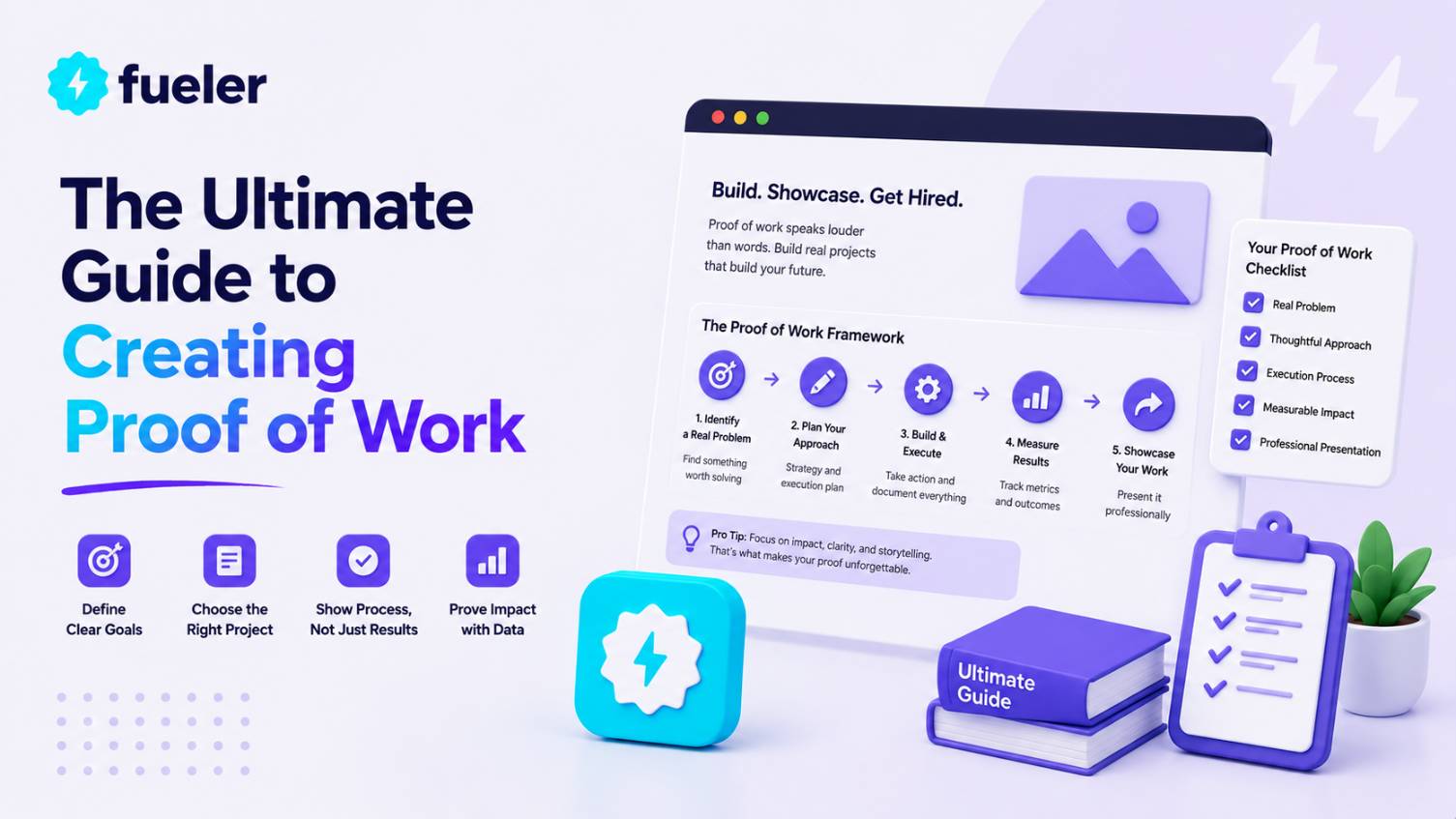
How to Build Proof of Work in 5 Steps
1. Choose a Skill
Select a skill you want to become known for:
- Writing
- UI/UX Design
- Development
- Marketing
- Video Editing
- Product Management
2. Create Real Projects
Build projects around real-world problems:
- Write case studies
- Build landing pages
- Create growth strategies
- Design app interfaces
- Publish technical blogs
3. Publish Your Work Publicly
Use platforms like:
- GitHub
- Behance
- Dribbble
- Fueler
4. Document the Process
Explain:
- Problem
- Approach
- Tools used
- Results achieved
- Learnings
5. Organize Everything in a Portfolio
Create a centralized proof of work portfolio on Fueler where recruiters and clients can evaluate your capabilities instantly.
Writing Case Studies That Capture Your Impact
A portfolio full of pretty pictures is nice, but a portfolio full of case studies is what actually gets you hired in a competitive market. A case study is a deep dive into a specific project where you explain the challenge you faced, the actions you took, and the measurable results you achieved. This format allows you to tell a story that connects your skills directly to the business goals of a potential employer.
- Case studies provide the necessary context for your work, explaining the "how" and the "why" so that a recruiter can understand the complexity of the problems you were tasked with solving during the project.
- Focusing on measurable results, like time saved or revenue increased, proves that you understand the importance of the bottom line and that your work has a tangible impact on the success of a company.
- The structure of a case study shows that you are an organized communicator who can break down complex ideas into simple, understandable steps for people who might not be experts in your specific field.
- Including testimonials or feedback within your case studies adds a layer of social proof, showing that other people have valued your work and that you are easy to collaborate with on team projects.
- Well-written case studies help you rank in search results for specific industry keywords, making it easier for companies that are looking for experts in those areas to find your personal portfolio or website.
Why it matters
Case studies transform your work from a simple task into a strategic achievement, showing that you are a thinker who understands how your daily actions contribute to the larger goals of an organization.
Best Examples of Proof of Work
For Developers
- GitHub repositories
- APIs
- SaaS products
- Open-source contributions
- Technical blogs
For Designers
- UI/UX case studies
- Branding projects
- Mobile app designs
- Landing pages
- Design systems
For Writers
- Blogs
- Newsletters
- SEO articles
- Case studies
- Twitter/X threads
For Marketers
- Growth campaigns
- SEO audits
- Ad creatives
- Email funnels
- Analytics dashboards
For Product Managers
- Product teardown documents
- PRDs
- User research reports
- Product strategy decks
- Roadmaps
Contributing to Open Projects and Communities
You don't always have to start from scratch to build Proof of Work because there are thousands of existing projects and communities that need your help. Whether it is contributing to a public knowledge base, helping an open source project, or answering questions in a professional forum, these contributions are public and permanent. They show that you are a helpful, active member of your professional community.
- Public contributions show that you can work within an existing system and follow established guidelines, which is a critical skill for anyone joining a large or established team in a professional setting.
- Collaborating with strangers on public projects proves that you have the communication and people skills required to work effectively in a global or decentralized environment where team members may never meet.
- Your public history of contributions serves as a "paper trail" of your expertise, allowing anyone to verify your skills and your history of helping others without needing to call a reference.
- Being active in professional communities keeps you "top of mind" for industry leaders, which often leads to job offers and opportunities that are never posted on traditional public job boards or websites.
- Helping others solve problems reinforces your own knowledge and establishes you as an authority in your niche, which is a powerful way to build a personal brand that attracts high quality work.
Why it matters
Community contribution proves that you are a "giver" who adds value to the people around you, which is one of the most attractive qualities a person can have when a company is looking to build a healthy team culture.
Curating Your Best Work for Maximum Visibility
Having a lot of Proof of Work is great, but if it is scattered all over the internet, nobody will ever find it. Curation is the process of selecting your absolute best pieces of work and presenting them in a way that is easy for a busy hiring manager to navigate. You want to make it as easy as possible for someone to see your talent within the first sixty seconds of landing on your page.
- Curating your work shows that you have a "standard of excellence" and that you can distinguish between a quick daily task and a high impact project that represents your true professional capability.
- A clean and organized presentation of your work proves that you have attention to detail and that you care about the user experience, which is a skill that applies to almost every modern job.
- Focusing on a few high quality pieces rather than dozens of mediocre ones ensures that a recruiter only sees your best side, which keeps your professional reputation high and your brand very consistent.
- Regularly updating your curated collection shows that you are active in your field and that your skills are up to date with the latest industry trends and technologies used in the market today.
- Thoughtful curation allows you to "guide" the viewer through your professional story, highlighting the specific skills and experiences that you want them to notice most when they are considering you for a role.
Why it matters
Curation is about respect for the viewer's time; by presenting only your best work, you make it easy for them to say "yes" to your application without having to dig through irrelevant files.
Proof of Work Portfolio Checklist
A strong proof of work portfolio should include:
- Clear introduction
- Professional profile image
- About section
- Best projects first
- Measurable outcomes
- Screenshots or visuals
- Case-study format explanations
- Skills and tools used
- Social proof or testimonials
- Contact information
Common Mistakes While Building Proof of Work
- Uploading low-quality projects
- Not explaining the process
- Missing measurable outcomes
- Showing too many unrelated projects
- Not updating portfolio regularly
- Hiding work behind private links
- Using only resumes without live examples
Validating Your Skills Through Practical Assignments
Sometimes, the best Proof of Work comes from taking on a specific assignment that mimics the actual tasks of the job you want. Many companies now use "work trials" or "paid assignments" to test candidates, and these are golden opportunities to show what you can do. Even if you don't get the job, the work you did for that assignment can be added to your portfolio as a real world example of your ability.
- Completing a practical assignment shows that you are willing to put in the effort to prove your worth, which sets you apart from the hundreds of people who only send a generic resume.
- These assignments give you a "taste" of what the actual job will be like, allowing you to decide if the company and the work are actually a good fit for your personal career goals.
- Presenting the results of a trial assignment in your portfolio shows that you can work under a deadline and follow specific instructions, which are two of the biggest concerns for any hiring manager.
- Using feedback from an assignment to improve the project before adding it to your portfolio shows that you are a "coachable" individual who can take a "no" and turn it into a learning experience.
- The depth and quality of your work on a specific assignment can often overcome a lack of traditional experience, as the proof of your ability is right there in front of the hiring team.
You can hire throught assignment on Fueler
Why it matters
Assignments are the ultimate "litmus test" for your skills; they provide undeniable proof that you can handle the specific pressures and requirements of the role you are currently applying for in the market.
Building a Personal Brand Around Your Expertise
Proof of Work is not just about the projects; it is also about the person behind the projects. Your personal brand is the "vibe" and the "reputation" you build by consistently sharing your thoughts, your work, and your values online. When people know what you stand for and they see the work you produce, they start to associate your name with high quality results and professional reliability.
- A consistent personal brand makes you "memorable" in a crowded market, ensuring that when a specific problem arises, your name is the first one that comes to mind for the people in your network.
- Sharing your unique perspective on your industry shows that you are a "thought leader" who doesn't just follow trends but actually thinks deeply about the future of your professional field and niche.
- Your personal brand acts as a filter, attracting the types of companies and clients that align with your values while naturally repelling the ones that would be a bad fit for your working style.
- Consistency in your brand and your work builds long term authority, which allows you to eventually command higher rates and better positions because you are seen as an expert rather than a generalist.
- A strong brand gives you "career insurance," because even if your current job disappears, your reputation and your body of work stay with you, allowing you to quickly find new and better opportunities.
Why it matters
Your brand is the "wrapper" for your Proof of Work; it gives your projects a human face and a story, making your professional profile much more engaging and trustworthy to a global audience.
The Compounding Effect of Consistency
Building Proof of Work is not a one-time event; it is a habit that you maintain throughout your entire career. The more you create and document, the more "surface area" you have for luck to find you. Over time, your small daily efforts compound into a massive body of work that makes you virtually un-fireable and highly sought after by the best companies in the world.
- Regularly adding to your body of work ensures that your portfolio never becomes "stale," showing that you are a consistent performer who produces high quality results month after month and year after year.
- The more work you have out in the world, the more "referral traffic" you get, as your old projects continue to be discovered by new people who can help you advance in your career path.
- Consistency builds a "momentum" that makes it easier to start new projects, as you have already developed the systems and the mindset required to see a task through from beginning to end.
- A long history of visible work proves that you are not a "one hit wonder" but a reliable professional who has a proven track record of success across many different types of projects and challenges.
- The compounding effect means that each new piece of work is more valuable than the last, because it stands on the foundation of everything you have already built and achieved in your professional life.
Why it matters
Consistency is the "secret sauce" of Proof of Work; it turns a series of small, disconnected tasks into a powerful and unstoppable professional legacy that will serve you for decades to come.
Why Recruiters Prefer Proof of Work
Recruiters increasingly prefer proof of work because it reduces hiring risk.
A resume tells recruiters what a candidate claims to know. Proof of work shows:
- how they think
- how they solve problems
- how they communicate
- how they execute ideas
For example:
- Developers can showcase GitHub repositories
- Designers can share Figma projects
- Marketers can present campaign analytics
- Writers can publish articles and case studies
This helps companies evaluate candidates faster and more accurately.
How Does This Connect to Building a Strong Career or Portfolio?
In the modern world, your career is no longer a ladder that you climb; it is a digital footprint that you build. Because remote work and global hiring are becoming the norm, you are often competing with people you will never meet in person. This means your digital presence, specifically your portfolio, is the only thing a company has to judge you by. If your portfolio is just a list of jobs, you are invisible. But if it is a collection of high-quality Proof of Work, you are a "must-hire" candidate who commands respect.
This is why we built Fueler. We realized that professionals needed a better way to display their actual work samples without the clutter of a traditional social network or the limitations of a boring resume. Fueler is designed to help you organize your assignments, side projects, and case studies into a beautiful, professional portfolio that is ready to share with any employer. It helps you take all the "Proof of Work" we talked about in this blog and put it in one place so that your talent is finally visible to the people who are looking to hire someone exactly like you.
Key Takeaways
- Proof of work is evidence of your actual skills.
- Companies increasingly hire based on demonstrated capability.
- Portfolios outperform resumes in many creative and technical roles.
- Public projects improve credibility and discoverability.
- Structured proof-of-work portfolios increase hiring opportunities.
Final Thoughts
Building Proof of Work is the most important thing you can do for your career in 2026. It moves you away from the "permission-based" world where you have to wait for someone to give you a job, and into a "results-based" world where your skills create your own opportunities. Start small, document everything, and don't be afraid to show your process. Your future self will thank you for the effort you put into making your talent undeniable.
Frequently Asked Questions (FAQs)
How to build proof of work with no experience?
The best way to start is by creating "speculative" projects where you solve a real problem for a company you admire, or by documenting your learning process as you master a new skill from scratch. You don't need a job to create work; you just need a problem to solve and a way to show your solution to the world.
What is the best way to showcase digital proof of work?
A dedicated portfolio platform is the best way to keep your work organized and professional. You should focus on high-quality visuals, clear descriptions of your process, and links to live projects or documents that prove you were the one who actually did the work.
Does proof of work replace a resume in 2026?
While many companies still ask for a resume, a strong portfolio of Proof of Work usually makes the resume a formality. Often, the work in your portfolio is what gets you the interview, while the resume is just a document used to finalize the HR paperwork after they have already decided they like you.
How many projects should I have in my portfolio?
Quality is always better than quantity. Aim for 3 to 5 high-impact projects that show a range of skills and a deep understanding of your field. It is much better to have three amazing case studies than twenty mediocre ones that don't show your true potential as a professional.
Can I use school projects as proof of work?
Yes, but you should frame them in a way that shows how the skills you used apply to the real world. Instead of just saying it was a "class assignment," explain the challenge the project was meant to solve and how you went above and beyond to deliver a high-quality result.
What is Fueler Portfolio?
Fueler is a career portfolio platform that helps companies find the best talent for their organization based on their proof of work. You can create your portfolio on Fueler. Thousands of freelancers around the world use Fueler to create their professional-looking portfolios and become financially independent. Discover inspiration for your portfolio
Sign up for free on Fueler or get in touch to learn more.

What should you do next?
You've read the article. Now turn your skills into proof of work and unlock more opportunities.
Build your proof of work portfolio
Create a clean portfolio with projects, assignments, resumes, and AI stack details that companies actually want to see.
Create your Fueler portfolio →Apply through assignments, not resumes
Stand out by solving real tasks from companies hiring on Fueler.
Explore assignments →Get discovered by companies
Make your work public and let recruiters discover your skills through actual projects instead of keywords.
Get discovered →
