Should Your Portfolio Show Your Process or Just the Final Output? It Depends on the Role

Riten Debnath
30 Sep, 2026
Last updated: September 2026
A hiring manager opens your portfolio.
They see twelve beautiful projects.
Five minutes later, they still have no idea how you think.
That is one of the strangest portfolio problems today. People spend weeks polishing the final output, choosing perfect mockups, adjusting fonts, rewriting project descriptions, and making everything look impressive. Then they forget the one thing a hiring manager may actually want to understand:
What did you do when the obvious answer was not good enough?
But there is another problem.
Some portfolios go completely in the opposite direction. They show every sketch, research note, rejected idea, meeting screenshot, wireframe, revision, and tiny decision ever made.
At that point, the portfolio stops being proof of work and starts looking like evidence from a court case.
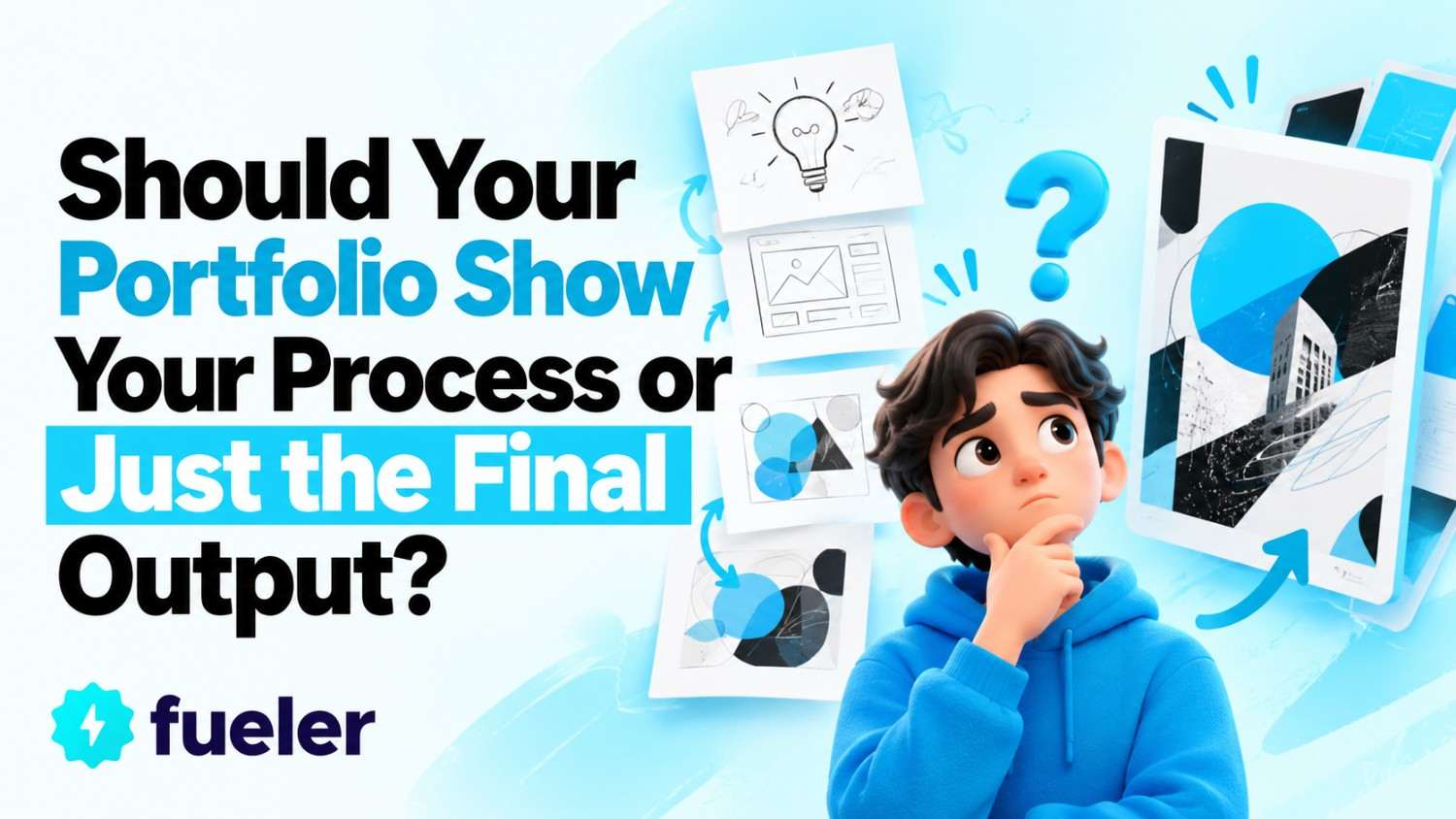
So, should your portfolio show your process or just the final output?
It depends on the role.
I’m Riten, founder of Fueler, a skills-first portfolio platform building the career infrastructure for 100 million creative professionals. Fueler connects talented individuals with companies through assignments, portfolios, and projects, not just resumes or CVs. Think of it as Dribbble/Behance for work samples combined with AngelList for hiring infrastructure.
In this guide, we’ll look at exactly what different professionals should show in their portfolios, how much process is enough, when final work should take priority, and how to build portfolio case studies that actually help someone evaluate your ability.
Because a good portfolio does not show everything you did.
It shows the right evidence of what you can do.
Your Portfolio Should Answer One Question: Why Should Someone Hire You?
A portfolio is not an online storage folder for everything you have ever created.
Its job is to reduce uncertainty.
Someone viewing your portfolio is usually trying to answer a few basic questions: Can this person do the work? Do they understand problems? Did they personally create what they are showing? Can they produce this quality again?
The answers are not always visible in the final output.
Final work proves execution. A finished website, article, campaign, illustration, photograph, video, presentation, or application gives a hiring manager something concrete to judge. This is especially important for roles where the quality of the output is directly connected to the skill being hired. Strong final work should therefore be easy to find without requiring readers to work through a long case study first.
Process proves decision-making. Two people can produce similar-looking work while having completely different levels of skill. One may have arrived at the result through strong research, testing, and reasoning. The other may have simply copied an existing pattern. Showing selected process helps reveal the thinking that cannot be seen in the finished artifact.
Results prove business value. A beautiful campaign is useful evidence, but a campaign that generated qualified leads tells a bigger story. The same applies to design, content, development, and strategy. When you can show a credible outcome, connect it directly to your contribution rather than simply claiming ownership of the entire project.
Your role determines which evidence deserves more space. A photographer does not need the same portfolio structure as a UX designer. A content writer does not need the same case study as a product manager. Portfolio advice becomes much more useful when it starts with the actual job instead of giving every profession the same formula.
Your portfolio should make evaluation easier. The person reviewing it should quickly understand the project, your responsibility, the challenge, the work, and the result. If they have to hunt through ten paragraphs to discover what you actually did, the portfolio is creating friction instead of building confidence.
The central idea is simple:
Show the output when the output proves the skill. Show the process when the process proves the skill.
When Should Your Portfolio Show the Process?
Process deserves space when your decisions are difficult to see in the final result.
This is common in UX design, product management, research, consulting, strategy, marketing, and other roles where the person is hired to make decisions rather than simply produce an artifact.
Show the problem before showing every solution. A strong case study explains what needed to change. Instead of saying “I redesigned the website,” explain what was not working, who was affected, and what the project needed to achieve. A clear problem gives the rest of your portfolio process a reason to exist.
Show decisions that changed the direction of the project. If research changed your original assumption, show it. If testing revealed a major usability problem, show it. If a technical constraint forced a different approach, explain it. These moments demonstrate judgment because they show that your work responded to evidence rather than personal preference.
Remove process that adds no information. Ten screenshots of similar wireframes rarely demonstrate ten times more skill than one useful comparison. Select the artifacts that explain an important change. Your goal is not to prove that you spent fifty hours working. Your goal is to prove that those hours produced thoughtful decisions.
Explain trade-offs. Professional work is rarely about finding a perfect answer. It is about choosing the most appropriate answer under constraints. Explain what you gave up, what you prioritized, and why. This is particularly valuable for experienced candidates because senior work often involves balancing business goals, user needs, technical limitations, budgets, and deadlines.
Connect process to the final result. Process should eventually lead somewhere. After showing research, experimentation, or iteration, explain what changed in the final work. This creates a clear line between your thinking and your output instead of making the case study feel like a collection of unrelated screenshots.
The best portfolio process is not a complete timeline.
It is a decision trail.
When Should Your Portfolio Focus on Final Output?
Sometimes the final work is the strongest evidence you can provide.
If you are being hired because someone needs you to create something excellent, the finished work should not be hidden behind a wall of explanation.
This applies particularly to visual and execution-heavy roles.
Copywriters should let the writing lead. If you are applying for a content writing, copywriting, or editorial role, show actual writing. Give the piece a clear title, explain the audience and objective, and let the quality of the writing do most of the convincing. Nobody needs a twelve-step explanation of how you wrote a 600-word article.
Photographers should lead with photography. Your portfolio should immediately demonstrate composition, lighting, subject selection, consistency, and visual style. Process becomes useful when it explains a difficult shoot, unusual constraint, creative direction, or technical challenge. Otherwise, the photograph itself is the evidence.
Video editors should show finished sequences. A client or employer needs to see whether you understand pacing, storytelling, transitions, sound, rhythm, and visual continuity. Explain the brief and your role, but do not make someone read a mini autobiography before watching the work.
Illustrators should prioritize the artwork. Sketches can demonstrate exploration, but the finished illustration should remain the central attraction. Show early concepts only when they reveal meaningful creative thinking, such as how you developed a visual metaphor or solved a difficult communication problem.
Graphic designers should show systems, not just isolated pieces. A logo can demonstrate visual skill, but a complete identity system can demonstrate much more. Show how the identity works across packaging, social media, print, presentations, websites, or other relevant applications when those applications strengthen the project.
There is nothing wrong with a portfolio that says:
“Here is the work. Here is what I was asked to solve. Here is what happened.”
Not every project needs a documentary.
How Much Process Should You Show in a Portfolio?
The problem is rarely that people show process.
The problem is that they show too much of the wrong process.
A portfolio should contain enough detail to establish credibility without making the reader feel like they accidentally enrolled in your project retrospective.
Start with the finished result. Even process-heavy case studies should usually make the final output visible early. This gives the reader an immediate understanding of what the project produced. They can then decide whether they want to explore the thinking behind it instead of being forced through the entire journey first.
Focus on meaningful decisions. Three strong decisions can reveal more than twenty screenshots. Explain what you knew, what changed, what options you considered, and what you chose. This makes your process useful rather than decorative and gives hiring managers evidence of professional judgment.
Use evidence selectively. Research findings, testing results, analytics, sketches, prototypes, and iterations should appear when they support an important claim. If an artifact does not help explain the project, remove it. A shorter case study with strong evidence usually feels more confident than a massive case study trying to prove everything.
Give more process to complex work. A simple social media graphic may need almost no process. A product redesign involving user research, engineering constraints, accessibility requirements, and multiple stakeholders may need considerably more. Portfolio length should follow project complexity, not a fixed number of screenshots or paragraphs.
Use the two-minute test. Give someone your portfolio and ask them what they understood after two minutes. They should be able to tell you what the project was, what you did, and what the result was. If they cannot, improve clarity before adding more material.
A useful rule is:
If the process makes your work easier to understand, keep it. If it only makes your portfolio longer, remove it.
What Should a UX Design Portfolio Show?
UX design is probably one of the clearest examples of why process matters.
A final interface can look polished while hiding poor research, weak assumptions, or confusing interaction decisions.
The portfolio therefore needs to show not only what you designed, but why you designed it.
Start with the user problem. Explain what users struggled with and why the problem mattered. “I redesigned the checkout flow” is weaker than explaining that users were abandoning the process because important delivery information appeared too late. Specific problems make your design decisions easier to evaluate.
Show research findings that influenced the solution. User interviews, usability tests, surveys, analytics, and competitor research can strengthen a case study when they directly influenced your work. Avoid displaying research simply because it looks impressive. Show the finding and then explain what changed because of it.
Show important iterations. You do not need every wireframe. Instead, compare meaningful versions. Explain what changed and why. Maybe users missed a button. Maybe the navigation was too complex. Maybe engineering limitations required another interaction. The reason behind the change is more valuable than the number of versions.
Explain collaboration and constraints. UX projects rarely happen in isolation. Explain how you worked with developers, product managers, researchers, marketers, or stakeholders. If a decision was affected by technical limitations or business priorities, show how you handled that constraint.
End with the outcome. Show usability improvements, adoption, conversion, task completion, launch results, stakeholder feedback, or another credible outcome. If you do not have metrics, say what you learned. Never invent numbers simply because case studies look more impressive with percentages.
A strong UX portfolio should allow someone to see both sides of your ability:
You can design the interface, and you can explain why the interface should exist.
What Should a Graphic Design Portfolio Show?
Graphic design is more output-focused, but process still matters when it explains the thinking behind a visual system.
The trick is not to turn every branding project into a museum of rejected logos.
Lead with the finished identity. Show the strongest visual application immediately. The reviewer should understand your visual quality before reading the explanation. Your best work deserves the strongest position, not the last slide of a ten-minute scrolling journey.
Explain the original brief. What did the client need? Who was the audience? What problem did the identity need to solve? Was the brand trying to look more premium, approachable, modern, local, technical, or distinctive? This context helps someone understand why the final design looks the way it does.
Show the system behind the design. Typography, color, layout, packaging, social media assets, signage, websites, and other applications can demonstrate consistency. A logo alone proves that you can create a logo. A complete identity system can prove that you understand how branding works in practice.
Include sketches selectively. One or two meaningful sketches can make the process interesting. Ten pages of every discarded idea usually do not. Choose process material that explains a creative decision, demonstrates exploration, or makes the final result more understandable.
Show application rather than decoration. Mockups are useful when they demonstrate how the design works in context. They become less useful when they exist only to make a portfolio look expensive. The work should remain the focus, not the mockup surrounding it.
For graphic designers, the portfolio should answer:
Can this person make excellent work, and do they understand where that work needs to function?
What Should a Content Writing Portfolio Show?
Writing is one of the clearest examples of a role where the final output can carry most of the argument.
Your process matters, but nobody hires a writer because their Google Docs history looks impressive.
They hire the writer because the words work.
Show real writing samples. Articles, landing pages, email campaigns, social media copy, scripts, case studies, product pages, and other published work provide direct evidence. Choose samples based on the role you want rather than simply uploading everything you have written.
Explain the objective briefly. Tell readers whether the content was designed for SEO, lead generation, education, conversion, brand awareness, or another purpose. This lets them judge whether your writing solved the right problem instead of simply deciding whether they personally like your writing style.
Show measurable results when available. Organic traffic, rankings, conversions, engagement, leads, sign-ups, or publishing volume can strengthen a writing portfolio. Be precise about your contribution. If you wrote one section of a campaign, do not present the entire campaign's performance as your personal achievement.
Use before-and-after examples for editing work. Editors and content writers can demonstrate their value particularly well by showing how they improved clarity, structure, readability, search intent, or conversion. The comparison makes the skill visible because readers can see the difference rather than simply being told that you are a strong editor.
Keep explanations shorter than the work. A writing portfolio should be easy to read. Give the sample room to breathe. Use short project descriptions and let the actual writing become the main evidence. If your portfolio description is more interesting than the sample, something has probably gone wrong.
What Should a Marketing Portfolio Show?
Marketing portfolios need a balance between output, process, and results.
A campaign can look fantastic and still fail commercially. A plain-looking campaign can perform exceptionally well.
That means marketers need to show more than aesthetics.
Explain the marketing problem. Start with the objective. Was the campaign designed to generate leads, increase awareness, launch a product, improve engagement, drive traffic, or reach a new audience? The objective gives meaning to the tactics that follow.
Show the strategy behind your decisions. Explain why you selected a particular audience, message, channel, content format, or campaign structure. Marketing portfolios become much stronger when they demonstrate that the person understands why something should work rather than simply showing that they can create it.
Show experiments and learning. If you tested messaging, creative, audiences, landing pages, or content formats, show what happened. The valuable part is not the existence of an experiment. It is what you learned and how that learning affected your next decision.
Connect activities to outcomes. Instead of saying “managed social media,” explain what you actually changed. Maybe you built the content strategy, improved organic reach, generated leads, managed paid campaigns, or created a repeatable content system. Responsibilities become much more credible when connected to outcomes.
Separate your work from team performance. Marketing is collaborative, so be precise. If you worked on a campaign with five people, explain your contribution. Clear ownership does not make your role smaller. It makes your evidence more trustworthy.
For marketers, the portfolio should answer:
Can this person create the work, understand the audience, make strategic decisions, and connect activity to business results?
What Should Developers Show in a Portfolio?
A developer's portfolio needs to demonstrate two things: what was built and how difficult problems were solved.
The finished product proves that you can ship. Technical decisions show whether you understand what happens underneath.
Show the product first. Explain what you built, who it was for, what problem it solved, and what you personally contributed. If there is a working version, make it easy to understand. Do not force visitors to read your entire technical explanation before they can see what you actually made.
Explain meaningful technical decisions. Architecture, APIs, databases, deployment, caching, testing, security, performance, and integrations can be valuable when they influenced the project. You do not need to paste code everywhere. Explain the problem, decision, trade-off, and result.
Show difficult technical problems. A simple CRUD application may demonstrate basic implementation. A project involving performance issues, large datasets, authentication, reliability, third-party integrations, or complex infrastructure can reveal much more about your engineering ability.
Use measurable technical outcomes. Faster response times, lower costs, fewer errors, higher reliability, improved deployment speed, or better performance can make technical work easier to evaluate. Explain what changed and how it was measured.
Show what you would improve. A thoughtful reflection can demonstrate maturity. Explain what you would change with more time, better requirements, or a different architecture. Professional engineering is full of trade-offs, and showing that you understand them is valuable evidence.
What Should Freelancers Show in Their Portfolio?
Freelancers have one additional job.
Your portfolio needs to make a potential client believe that you can deliver the work and be easy to work with.
That means process can sometimes communicate reliability just as much as skill.
Start with the client's problem. Explain what the client needed and what you were hired to solve. This helps prospective clients recognize similar situations. It also positions your work around outcomes rather than simply listing services.
Show your contribution clearly. If you worked with another designer, writer, developer, or agency, explain your part. Clients want to know what they are actually hiring you for. Clear ownership also makes the portfolio more credible.
Show how you handled constraints. Budgets, deadlines, unclear requirements, limited assets, technical restrictions, or changing feedback are normal freelance problems. Showing how you navigated them can demonstrate professional maturity without revealing confidential client information.
Make the final deliverable easy to find. Clients should not need to read your project history before seeing what you created. Put the final website, campaign, brand identity, article, video, or other deliverable somewhere prominent.
Use outcomes to attract similar work. If your content generated leads, your redesign improved conversions, or your campaign increased engagement, explain it. Then choose future portfolio projects that resemble the work you want more of. Your portfolio is quietly shaping your next opportunities.
What Should Students and Freshers Show in a Portfolio?
Students often make one of two mistakes.
They either show only finished college projects with almost no context, or they try to make small projects sound like they were built by a 40-person consulting firm.
Neither is necessary.
Be honest about the project. Label academic, personal, freelance, internship, volunteer, and client projects accurately. A student project is not automatically weak. What matters is what the project demonstrates and how clearly you explain your contribution.
Use process to demonstrate potential. If you lack years of professional experience, your decisions become valuable evidence. Show how you researched a problem, responded to feedback, tested ideas, improved the work, or learned a new skill.
Explain your personal contribution. Group projects are perfectly acceptable. Just make your role clear. “We built an app” tells a hiring manager almost nothing. “I designed the onboarding flow and tested it with five users” gives them something concrete to evaluate.
Show projects related to the role you want. A student applying for a content role should not make their portfolio mostly photography simply because photography happens to be their favorite hobby. Relevance matters. Your portfolio should make your desired career direction obvious.
Show improvement over time. Your first project does not need to be your best project. Showing progression can demonstrate learning. The important thing is that your latest work gives a clear signal about where your skills are now.
For students, process can compensate for a lack of professional history.
It cannot compensate for fake claims.
Portfolio Case Study Structure: What Should Each Project Include?
A good case study does not need a complicated formula.
It needs a logical sequence that makes the evidence easy to understand.
A useful portfolio case study structure is:
Project overview: Explain the project, client or organization, your role, timeline, and objective in a few lines. The reader should understand the basic situation without reading an essay.
The problem: Explain what needed to change and why. Avoid vague statements. Specific problems make stronger stories and give the reader a clear standard against which to judge the final work.
Your approach: Show only the research, exploration, experiments, or decisions that genuinely influenced the project. This is where process belongs when process matters.
The important decisions: Highlight the choices that changed the direction of the work. Explain the reasoning, constraints, alternatives, and trade-offs where relevant.
The final output: Show the finished work prominently. This is the evidence the entire case study has been building toward.
The result: Explain what happened after delivery or launch. Use real metrics where available. Otherwise, describe credible qualitative outcomes and lessons.
Your reflection: Briefly explain what you learned or what you would change. This gives the project a sense of completion and demonstrates that you can evaluate your own work.
Notice what is missing:
A requirement to show every step.
There isn't one.
How Long Should a Portfolio Case Study Be?
Longer does not automatically mean more impressive.
A hiring manager should not need twenty minutes to understand a project that can be explained clearly in five.
The right length depends on complexity, seniority, and the importance of the project.
Simple projects should stay simple. A small social media campaign, logo, article, or illustration may only need a short explanation. Give the work context and show the result. Turning a small deliverable into a giant case study can make the project look more complicated than it actually was.
Complex projects deserve deeper documentation. A product redesign, large campaign, software application, or strategic project may need more explanation because there are more decisions worth understanding. Complexity should justify length, not the desire to make a portfolio appear impressive.
Senior candidates can use fewer but deeper projects. Experienced professionals usually benefit from showing meaningful work rather than dozens of small examples. A few strong case studies can demonstrate ownership, judgment, collaboration, complexity, and outcomes more effectively than a huge gallery.
Keep paragraphs short. Portfolio readers scan. Break long explanations into small sections, use descriptive headings, highlight important evidence, and avoid giant blocks of text. The visual structure of the case study affects whether people actually consume the information.
Make the first screen count. The project title, final output, role, problem, and outcome should be easy to understand near the beginning. If someone only spends thirty seconds on the project, they should still leave with a reasonably clear understanding of what you did.
Your portfolio should respect the reader's time.
That is part of good communication.
How to Decide What to Show in Your Portfolio
When you finish a project, ask five questions before putting it into your portfolio.
These questions are simple, but they can prevent a lot of unnecessary portfolio work.
What was the problem?
If you cannot explain the problem clearly, the project may need more context.
What did I personally do?
If the answer is unclear, explain your contribution.
What decision required real judgment?
That is usually where your process belongs.
What did the final work achieve?
Show the outcome without exaggerating it.
What can someone learn about my ability from this project?
If the answer is nothing specific, the project probably does not deserve much space.
This approach changes your portfolio from a collection of finished files into a body of evidence.
And that is what a portfolio should be.
How Does This Connect to Building a Strong Career or Portfolio?
A strong career portfolio makes your work easier to verify.
Final outputs demonstrate execution. Selected process demonstrates judgment. Project documentation gives hiring managers something concrete to discuss during interviews instead of relying entirely on resume claims.
This matters especially when your experience is still growing. A well-documented project can show how you think, what you contributed, and what changed because of your work. Fueler gives professionals a place to organize that proof of work, but the principle exists regardless of where the portfolio lives.
Final Thoughts: Show the Evidence That Matters
Your portfolio does not need to show every step.
It also should not hide everything behind polished final images.
Show the final output when the output is the strongest proof.
Show the process when the thinking is what makes your work valuable.
Show the decisions that reveal judgment, the outcomes that demonstrate impact, and the constraints that make the work understandable.
The best portfolio is not the one with the most screenshots.
It is the one that makes a hiring manager think:
“I understand what this person can do.”
Frequently Asked Questions
Should my portfolio show the process or the final output?
It depends on the role. Visual and execution-focused roles often benefit from emphasizing finished work, while UX, strategy, research, marketing, and problem-solving roles usually need more process. Most portfolios benefit from showing the final result first and selected process afterward.
How much process should I include in a portfolio case study?
Include enough process to explain meaningful decisions, research findings, iterations, constraints, and trade-offs. Avoid documenting every step. If removing an artifact does not make the project harder to understand, it probably does not need to be included.
Do employers prefer portfolio case studies or final work?
There is no single preference across every profession. Employers need to quickly evaluate relevant work, but some roles also require evidence of decision-making. The strongest approach is usually to make the final output easy to see while providing deeper process for projects where thinking matters.
Should a student portfolio show the process?
Yes, particularly when professional experience is limited. Process can demonstrate problem-solving, research, experimentation, feedback, and learning. Students should clearly identify academic and personal projects and explain their individual contribution instead of trying to make small projects appear larger than they were.
How many projects should a portfolio have?
There is no fixed number, but relevance and quality matter more than volume. Choose projects that demonstrate the skills required for the role you want. A smaller portfolio with strong, relevant projects is often easier to evaluate than a large collection of unrelated work.
Why 100,000+ professionals use Fueler
Fueler helps professionals showcase proof of work through projects, assignments, case studies, and achievements.
Thousands of professionals use Fueler to create their digital portfolio
Thousands of projects are published on Fueler. Check here
Startups and Companies hire through proof of work on Fueler
Used by freelancers, creators, marketers, video editors, writers, designers, and product managers
Our mission is to help the next 100 million professionals build a verified professional identity through proof of work

What should you do next?
You've read the article. Now turn your skills into proof of work and unlock more opportunities.
Build your proof of work portfolio
Create a clean portfolio with projects, assignments, resumes, and AI stack details that companies actually want to see.
Create your Fueler portfolio →Apply through assignments, not resumes
Stand out by solving real tasks from companies hiring on Fueler.
Explore assignments →Get discovered by companies
Make your work public and let recruiters discover your skills through actual projects instead of keywords.
Get discovered →
