10 Proof of Work Ideas Every Backend Developer Should Add to Their Portfolio

Riten Debnath
22 Jun, 2026
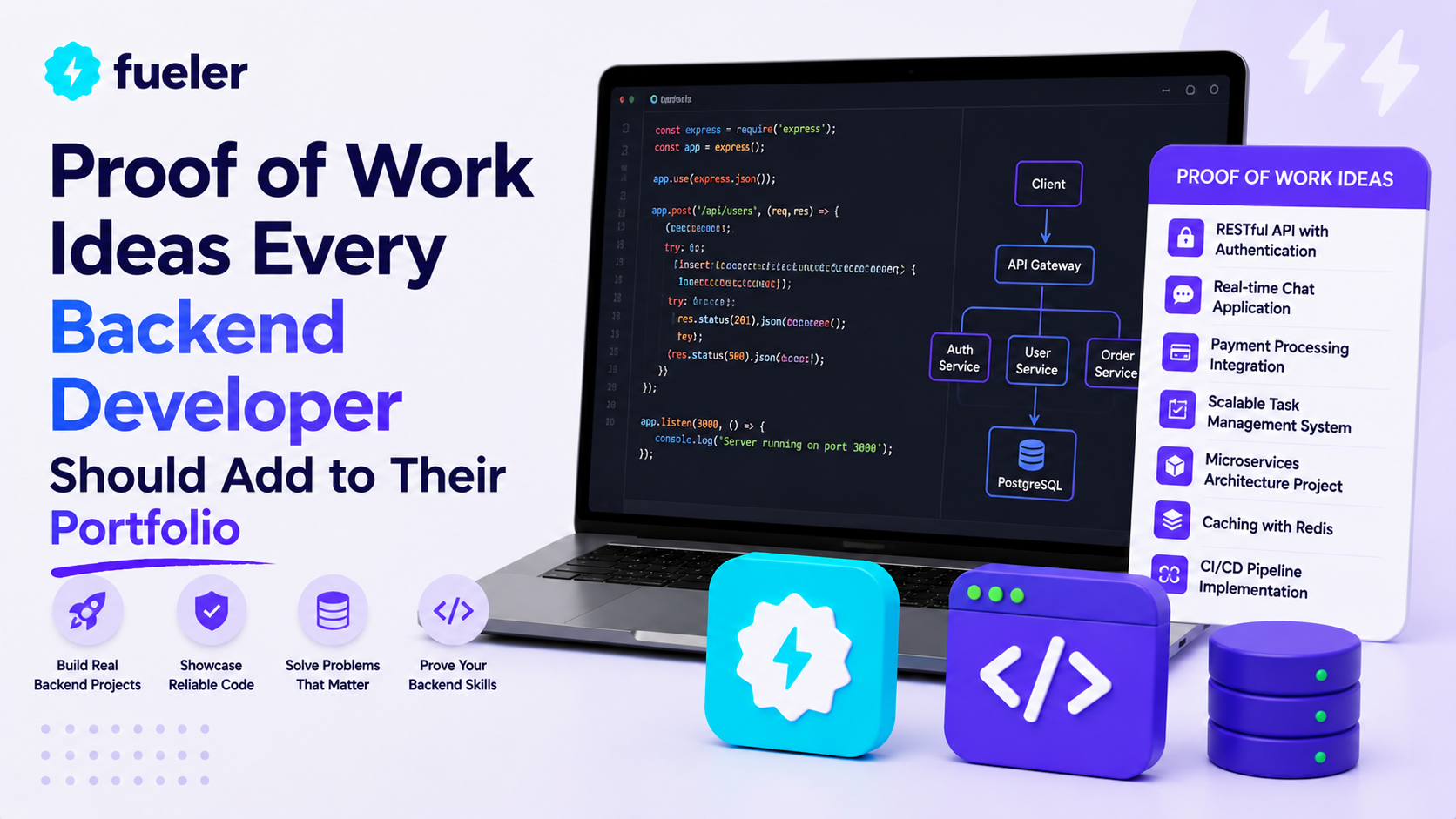
Most backend developers have a portfolio that says almost nothing.
It is usually a GitHub link and a line like "Built APIs using Node.js." That is not proof. That is a label. And labels do not get you hired.
I am Riten, founder of Fueler, a platform that helps people get hired through their proof of work instead of a plain resume. I have looked at thousands of developer profiles, and the same pattern repeats. The engineer is talented, but the portfolio is empty of evidence.
So here is a simple, copy-ready list. Ten proof-of-work ideas you can add to your backend portfolio starting this week. Pick a few, build them well, and explain your thinking. That alone will put you ahead of most applicants.
1. Public APIs with live documentation
Your API is the most direct way to show backend skill without a UI.
Do this:
- Publish interactive docs with Swagger or Redoc so anyone can test your endpoints.
- Share a Postman collection with clean sample requests and responses.
- Add a short note explaining what each endpoint does.
Example line to pair with it: "Built a URL shortening service handling 50,000 requests a day with Redis caching and PostgreSQL." Numbers plus a live link equals trust.
2. System design case studies
Hiring managers love these because they reveal how you think.
Write each project up using this structure:
- The problem
- An architecture diagram
- Your database schema
- Scaling challenges you faced
- How you monitored it
- The tradeoffs you made
This turns a quiet side project into a story a recruiter can follow. It is the same idea behind a strong proof of work portfolio, just applied to backend systems.
3. Open source contributions
Open source is verifiable proof. People can inspect the exact code you wrote.
Show:
- Merged pull requests
- Issues you solved
- Features you shipped
- Code reviews you took part in
Even a small fix to a known library carries weight, because a real maintainer trusted your work enough to merge it.
4. Production projects with real metrics
Do not just paste a GitHub link. Document what the project actually handled.
Include:
- Traffic handled
- Database size
- Response times
- Uptime
- Deployment pipeline
Example: "Designed a notification service processing 2 million events a month with RabbitMQ and Node.js." That single line shows scale, tools, and ownership.
Architecture diagrams
Backend work becomes visible the moment you draw it.
Add diagrams for:
- Request flow
- Database relationships
- Queue systems
- Cache layers
- How your microservices talk to each other
You do not need design talent. Free tools like Excalidraw or draw.io do the job. A clean diagram next to a project is one of the strongest signals you can send. If you want format inspiration, this proof of work guide covers many developer friendly options.
6. Technical write ups
When you solve a hard problem, the write up is proof of your thinking.
Strong, clickable titles:
- How I reduced API latency from 900ms to 120ms
- How I migrated PostgreSQL with zero downtime
- Building rate limiting using Redis
- Designing a scalable chat backend
These posts prove you understand systems, not just syntax. Publishing them works the same way technical writing proof of work helps writers stand out from the crowd.
7. Infrastructure projects
Many backend engineers forget this one, and it is a missed chance.
Show:
- Docker setups
- Kubernetes deployments
- CI and CD pipelines
- AWS or GCP architecture
- Monitoring dashboards
Modern backend roles care a lot about how you ship and run software, not only how you write it.
8. Performance improvements
This is one of the most powerful proof types, because results beat screenshots.
Put your wins in a simple before and after table:
Then explain how you got there in one short paragraph. The number grabs attention. The explanation proves you earned it.
9. Backend coding challenges
If you lack job experience, build things on purpose and explain your decisions.
Great projects to build and publish:
- An authentication service
- A payment gateway clone
- A URL shortener
- A chat system
- A recommendation engine
- An event processing pipeline
The real value is in explaining why you chose one approach over another. That is the part most people skip, and the part recruiters care about most.
10. A clear project format on a portfolio
Finally, package everything in one consistent structure so your work looks professional.
Every backend project should include:
- Problem statement
- Architecture diagram
- Tech stack
- Database design
- API documentation
- Code repository
- Deployment link
- Performance metrics
- Lessons learned=
This format alone makes you look ten times more serious. It is exactly how I encourage people to create proof of work for developers when they build their profile.
How to actually use this list
Do not try to do all ten at once. That leads to nothing finished.
Here is a simple plan:
- This week, take one existing project and add a diagram, API docs, and metrics.
- Next week, write one technical deep dive about a problem you solved.
- The week after, make one small open source contribution.
In one month you will have three solid pieces of proof. That beats a year of "I will build my portfolio someday."
Talent is common. Proof is rare. The developers who show their work clearly are the ones who get hired faster with a portfolio, while equally skilled engineers stay stuck behind a quiet resume.
You already have the skills. Now make them visible.
Frequently Asked Questions
1. What should a backend developer add to their portfolio?
Add live API docs, system design case studies, architecture diagrams, performance before and after metrics, open source contributions, infrastructure setups, and technical write ups. Each piece shows your thinking and your results.
2. How many projects should a backend developer's portfolio have?
Quality beats quantity. Three to five well-documented projects with diagrams, metrics, and clear write ups are stronger than ten plain GitHub links with no context.
3. What is the best proof of work for a backend developer with no experience?
Build real projects like an authentication service, a chat backend, or an event pipeline, then explain your engineering decisions in detail. Pair them with open source contributions and technical blog posts.
4. How do I make my backend portfolio stand out to recruiters?
Lead with results and scale, not tools. Use numbers like requests per second, uptime, and latency improvements, and back them with diagrams and short explanations of your tradeoffs.
Where can I host my backend developer portfolio?
You can use a personal site, a blog, or a dedicated portfolio platform that lets you publish projects with links, metrics, and context in one clean profile that recruiters can browse quickly.
Why 100,000+ professionals use Fueler
Fueler helps professionals showcase proof of work through projects, assignments, case studies, and achievements.
- Thousands of professionals use Fueler to create their digital portfolio
- Thousands of projects published on Fueler. Check here
- Startups and Companies hire through proof of work on Fueler
- Used by freelancers, creators, marketers, video editors, writers, designers, and product managers
Our mission is to help the next 100 million professionals build a verified professional identity through proof of work

What should you do next?
You've read the article. Now turn your skills into proof of work and unlock more opportunities.
Build your proof of work portfolio
Create a clean portfolio with projects, assignments, resumes, and AI stack details that companies actually want to see.
Create your Fueler portfolio →Apply through assignments, not resumes
Stand out by solving real tasks from companies hiring on Fueler.
Explore assignments →Get discovered by companies
Make your work public and let recruiters discover your skills through actual projects instead of keywords.
Get discovered →
