Product Management Salary in India 2026: From Associate PM to CPO

Riten Debnath
23 Aug, 2026
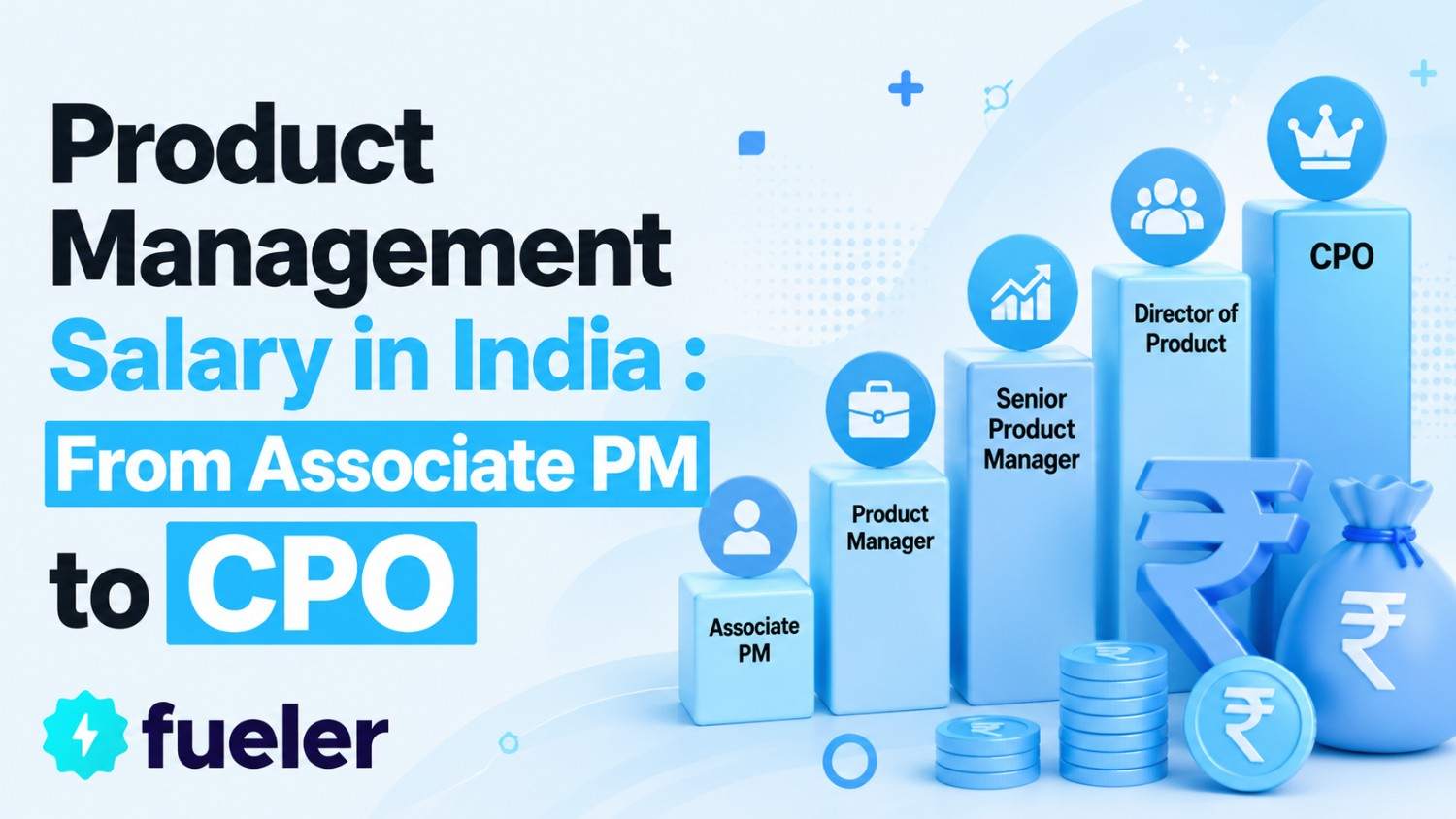
Product management has become one of the most attractive career paths in India's technology sector. A product manager sits between customers, business teams, designers, engineers, data teams, and leadership, making decisions about what a company should build and why. Because the role can directly influence revenue, growth, customer experience, and product adoption, experienced product managers can command strong compensation.
But there is no single product management salary in India. An Associate Product Manager in a startup, a Product Manager at a large technology company, and a Chief Product Officer at a fast-growing company can have completely different compensation packages.
I’m Riten, founder of Fueler, a skills-first portfolio platform building the career infrastructure for 100 million creative professionals. Fueler connects talented individuals with companies through assignments, portfolios, and projects, not just resumes or CVs. Think of it as Dribbble/Behance for work samples combined with AngelList for hiring infrastructure.
In this guide, I will break down product management salaries in India in 2026 by experience, seniority, company type, and major cities. I will also explain how PM compensation changes as your responsibilities grow, what skills can increase your earning potential, and why showing your product thinking through real work can help you build a stronger career.
What Is the Average Product Management Salary in India in 2026?
There is a wide range in current salary data because product management compensation depends heavily on company, experience, location, product complexity, and the candidate's track record.
Current Glassdoor data puts the median total pay for Product Managers in India at around ₹28 lakh per year, with a total-pay range of roughly ₹16 lakh to ₹40 lakh. Its current salary data also shows average base pay around ₹25 lakh, with additional compensation averaging around ₹3 lakh.
Other 2026 salary benchmarks place entry-level and Associate PM compensation around ₹8 lakh to ₹22 lakh, mid-level PMs around ₹20 lakh to ₹40 lakh, and Senior PMs around ₹35 lakh to ₹60 lakh. These are market ranges rather than guaranteed salaries.
A practical way to understand the product management salary in India is to look at the career ladder.
- Associate Product Manager: Around ₹8 lakh to ₹22 lakh
- Product Manager: Around ₹20 lakh to ₹40 lakh
- Senior Product Manager: Around ₹35 lakh to ₹60 lakh
- Group or Principal PM: Around ₹55 lakh to ₹1 crore+
- Director or VP of Product: Around ₹60 lakh to ₹1.5 crore+
- Chief Product Officer: Often ₹1 crore+ and can go substantially higher with equity and performance-linked compensation
These ranges overlap because titles are not standardised across every company. A startup may call someone a "Senior PM" while a larger organisation may use a different title for a similar level of responsibility.
Why It Matters: Your salary is influenced more by the scope and business impact of your work than by the title printed on your LinkedIn profile. A PM who owns a high-revenue product can earn substantially more than someone with the same title working on a smaller product area.
Product Management Salary in India by Experience
Experience is one of the biggest factors affecting PM compensation. As you move from supporting product decisions to independently owning product strategy and business outcomes, your compensation generally increases.
0 to 2 Years: Associate Product Manager
An Associate Product Manager, or APM, is usually the entry point into product management. The role focuses on learning product discovery, execution, analytics, customer research, and collaboration with engineering and design teams.
Current 2026 benchmarks place APM salaries roughly between ₹8 lakh and ₹22 lakh, although top product companies can offer considerably more. Glassdoor-based data cited by a current 2026 APM benchmark puts the average around ₹14.6 lakh.
At this stage, companies usually care about analytical thinking, communication, problem-solving, customer understanding, and the ability to work with cross-functional teams.
- Typical experience: 0 to 2 years
- Indicative salary: ₹8 lakh to ₹22 lakh
- Top product companies: Can go beyond the general range
- Important skills: Product sense, analytics, communication, SQL, user research, and execution
Why It Matters: The APM stage is where you learn how products actually get built. Your biggest career asset at this point is not your salary. It is the quality of problems you get to solve.
2 to 5 Years: Product Manager
Once you become a Product Manager, your responsibility changes significantly. Instead of mainly supporting a senior PM, you may own a complete product area, roadmap, feature set, or customer journey.
Current 2026 benchmarks commonly place PM compensation between ₹20 lakh and ₹40 lakh, although company and individual performance can push compensation outside this range. Glassdoor's current India data shows median total pay around ₹28 lakh.
At this level, companies expect you to make independent decisions and connect product work to business outcomes.
- Typical experience: 2 to 5 years
- Indicative salary: ₹20 lakh to ₹40 lakh
- Core responsibility: Product area ownership
- Important skills: Product strategy, analytics, prioritisation, stakeholder management, experimentation, and execution
Why It Matters: This is often the stage where product management becomes less about managing a list of features and more about understanding why a company should build something in the first place.
5 to 8 Years: Senior Product Manager
A Senior Product Manager generally owns larger and more complex product areas. They may manage multiple product initiatives, mentor junior PMs, influence company strategy, and work closely with senior leadership.
Current 2026 salary estimates generally place Senior PM compensation around ₹35 lakh to ₹60 lakh, with top product companies potentially paying more.
At this level, your compensation becomes increasingly connected to the scale of the problems you solve.
- Typical experience: 5 to 8 years
- Indicative salary: ₹35 lakh to ₹60 lakh
- Core responsibility: Product strategy and multi-team influence
- Important skills: Strategic thinking, leadership, business understanding, experimentation, and mentoring
Why It Matters: Senior PMs are expected to create leverage. Instead of simply shipping more features, they should help teams make better decisions and move important business metrics.
8 to 12 Years: Group Product Manager or Director of Product
At this stage, product leadership becomes increasingly important. A Group Product Manager or Director may manage several PMs, multiple product areas, or an entire product line.
Current salary benchmarks place this level around ₹55 lakh to ₹90 lakh, although compensation can vary significantly between companies.
The role becomes less about individual feature decisions and more about setting direction for teams.
- Typical experience: 8 to 12 years
- Indicative salary: ₹55 lakh to ₹90 lakh+
- Core responsibility: Product line and team leadership
- Important skills: Leadership, strategy, business planning, hiring, product portfolio management, and executive communication
Why It Matters: Leadership compensation grows when your decisions affect larger teams, products, customers, and revenue. Your ability to create strong PM teams becomes as important as your own product skills.
12+ Years: VP of Product and CPO
At the executive level, compensation becomes much less predictable.
Current 2026 benchmarks put VP and CPO-level compensation anywhere from around ₹80 lakh to ₹2 crore+, while other career-roadmap estimates place CPO compensation at ₹1.5 crore or higher. Equity can make the total compensation significantly larger at startups and high-growth companies.
A CPO is responsible for the overall product vision and strategy of the organisation.
- Typical experience: 12 to 15+ years
- Indicative salary: ₹1 crore+ at the senior executive level
- Core responsibility: Company-wide product direction
- Important skills: Business strategy, leadership, product vision, organisational design, capital allocation, and executive communication
Why It Matters: At the CPO level, product management is no longer simply a product function. It becomes a business leadership function.
Product Management Salary in India by Company Type
The type of company you work for can have a major impact on your compensation.
A product manager at a global technology company may receive a different package from a PM at an early-stage startup, even if both have similar years of experience.
Large Global Technology Companies
Large global technology companies generally offer strong base salaries and may add bonuses and equity to the compensation package.
Current Glassdoor data shows examples such as Amazon with median PM total pay around ₹30 lakh and Microsoft around ₹32 lakh, while reported ranges can extend substantially higher depending on seniority and equity.
These companies usually have structured product organisations and clearly defined levels.
Indian Unicorns and Major Product Companies
Large Indian product companies in fintech, e-commerce, consumer technology, and SaaS can also pay strong compensation.
Current 2026 APM benchmarks place Indian unicorns such as Flipkart, Razorpay, CRED, Swiggy, and PhonePe around ₹15 lakh to ₹25 lakh for APM roles, although actual offers vary by company and candidate.
Funded Startups
Startups can offer competitive salaries, but compensation often includes ESOPs.
An APM at a funded Series A to Series C startup may earn roughly ₹12 lakh to ₹20 lakh plus equity according to current 2026 benchmarks.
The important difference is that startup equity may become valuable if the company grows, but it is not the same as cash compensation.
IT Services Companies
PM or product-adjacent roles at IT services organisations generally pay less than top product companies, especially at junior levels. Current APM benchmarks place these roles around ₹8 lakh to ₹15 lakh.
However, these companies can provide broad exposure to enterprise clients, industries, and large technology projects.
Why It Matters: Do not compare two PM offers using CTC alone. Look at base salary, bonus, equity, role scope, company stage, learning opportunities, and the actual product you will own.
Product Management Salary in India by City
Location also affects PM compensation because India's major product hubs have different concentrations of technology companies.
Bengaluru
Bengaluru remains one of India's strongest product management markets because of its large technology ecosystem, startups, SaaS companies, fintech businesses, and global technology centres.
Current APM benchmarks put Bengaluru around ₹14 lakh to ₹22 lakh for starting roles.
Delhi NCR and Gurugram
Delhi NCR and Gurugram have strong fintech, e-commerce, consumer internet, SaaS, and startup ecosystems.
Current APM benchmarks place the region around ₹12 lakh to ₹20 lakh.
Mumbai
Mumbai has strong opportunities in fintech, banking, financial services, consumer businesses, and D2C technology.
Current APM estimates put typical starting salaries around ₹12 lakh to ₹18 lakh.
Hyderabad
Hyderabad has continued to develop as a technology and Global Capability Centre hub. Current APM estimates place typical starting salaries around ₹10 lakh to ₹17 lakh.
Pune
Pune has a large technology and SaaS ecosystem, along with strong IT services and enterprise technology presence.
Current APM estimates place typical starting salaries around ₹9 lakh to ₹15 lakh.
Why It Matters: Location affects salary, but it should not be the only factor in choosing a PM job. A remote role at a strong product company may provide better career growth than a higher-paying role with limited product ownership.
What Skills Increase a Product Manager's Salary?
Product management is not a single technical skill. It combines business thinking, customer understanding, analytics, communication, and execution.
The skills that can help increase your earning potential include:
- Product Strategy: Understanding what the company should build and why.
- Data Analytics: Using metrics, SQL, experiments, and customer data to make decisions.
- User Research: Understanding customer needs instead of relying only on assumptions.
- Business Understanding: Connecting product decisions with revenue, retention, costs, and growth.
- Technical Knowledge: Understanding APIs, databases, software architecture, and development workflows.
- AI Product Skills: Understanding how AI models, agents, evaluation, and AI-enabled products work.
- Stakeholder Management: Aligning engineering, design, marketing, sales, operations, and leadership.
- Communication: Explaining complex product decisions clearly to different audiences.
Current 2026 career research increasingly highlights AI and technical skills as advantages for PM candidates.
Why It Matters: The highest-paid PMs are rarely just good at writing product requirement documents. They understand customers, technology, data, business models, and execution well enough to make difficult decisions.
How Much Does an AI Product Manager Earn in India?
AI is becoming an important part of product management, and companies increasingly need PMs who can work with AI-enabled products.
There is not enough consistent public salary data to give one reliable nationwide salary range specifically for "AI Product Manager" in 2026. However, current PM salary benchmarks indicate that specialised AI and technical product skills can help candidates compete for higher-paying roles, particularly at technology companies.
An AI PM may work on areas such as:
- AI assistants
- Recommendation systems
- Generative AI products
- AI agents
- Machine learning platforms
- Search and ranking systems
- AI-powered automation
- Data products
The important point is that you do not need to become a machine learning engineer to become an AI PM. But you should understand how AI systems work, what their limitations are, how they are evaluated, and where they create real customer value.
What Does Product Manager Take-Home Salary Look Like?
One common mistake is confusing CTC with monthly take-home pay.
When a company says your package is ₹20 lakh per year, that does not necessarily mean ₹1.67 lakh will reach your bank account every month.
CTC can include base salary, employer PF contributions, bonuses, stock, gratuity, and other components. Taxes and employee-side deductions also affect your final take-home salary.
Current salary guides estimate that take-home can often be around 65% to 75% of CTC at lower salary levels, with the percentage changing as compensation increases and more components enter the package.
For example, a ₹20 lakh CTC should not automatically be treated as ₹1.67 lakh monthly take-home.
Always ask the recruiter for:
- Fixed base salary
- Variable bonus
- Employer contributions
- ESOP or RSU value
- Joining bonus
- Annual bonus
- Expected monthly gross salary
Why It Matters: Understanding the salary structure helps you compare offers properly. A ₹25 lakh package with a large variable component may be less attractive than a ₹23 lakh package with a much higher fixed salary, depending on your priorities.
How Can You Get a High-Paying Product Management Job?
If you want to reach the upper end of the product management salary in India, you need to show more than an interest in product management.
You need to demonstrate product thinking.
Start by analysing products you already use. Identify problems, study competitors, look at customer reviews, and propose improvements.
Then turn those observations into actual case studies.
For example, instead of writing "I understand product strategy," create a product teardown of a real application. Explain the user problem, analyse the existing experience, identify the biggest opportunity, propose a solution, define success metrics, and explain how you would measure the result.
This is where proof of work in hiring becomes useful. Your portfolio can demonstrate product thinking before you have the formal Product Manager title.
You can also follow this guide to building a career portfolio that actually gets jobs and turn your product analyses, experiments, case studies, and shipped projects into a clear body of work.
What Should a Product Manager Portfolio Include?
A product management portfolio does not need to look like a designer's portfolio.
It should show how you think.
You can include:
- Product teardown case studies
- Feature prioritisation exercises
- User research projects
- Product requirement documents
- Product strategy documents
- Experiment designs
- Analytics dashboards
- Growth experiments
- AI product prototypes
- Products you have shipped
- Product launches
- Business impact reports
Each project should clearly explain the problem, your contribution, your decision-making process, and the outcome.
I wrote more about why proof of work can make career transitions easier, especially for people moving from another role into product management.
For example, someone moving from customer support to product management may already understand customer pain points. If that person documents customer problems, creates product improvement proposals, analyses competitors, and builds product case studies, they can create evidence that supports the career transition.
Your previous job title tells people where you have been.
Your proof of work can show where you are going.
How Does This Connect to Building a Strong Career or Portfolio?
I believe product management is one of the clearest examples of why portfolios are becoming important.
A PM's work is often invisible.
You may spend weeks researching customers, analysing data, prioritising features, working with engineers, and aligning stakeholders without producing something that can easily fit into a resume bullet point.
A portfolio changes that.
You can document the problem you were solving, the options you considered, the decision you made, the experiment you ran, and the outcome.
This is why I believe every professional needs a career portfolio, including product managers.
A strong PM portfolio should make it easy for a hiring manager to understand how you think.
It should answer three simple questions:
- What product problem did you identify?
- What decision did you make and why?
- What happened after the decision?
The more clearly you can answer those questions, the easier it becomes for a company to evaluate your product ability.
Final Thoughts
The product management salary in India in 2026 can range from roughly ₹8 lakh for some entry-level roles to more than ₹1 crore at senior executive levels. Current market data places Associate PMs around ₹8 lakh to ₹22 lakh, PMs around ₹20 lakh to ₹40 lakh, Senior PMs around ₹35 lakh to ₹60 lakh, and senior product leaders from roughly ₹60 lakh upward.
But salary is not determined by experience alone.
Company type matters.
City matters.
Product complexity matters.
Technical skills matter.
Business impact matters.
And your ability to show measurable results matters.
Bengaluru remains one of the strongest PM markets, while Delhi NCR, Mumbai, Hyderabad, and Pune also offer significant opportunities. Current APM benchmarks show Bengaluru at roughly ₹14 lakh to ₹22 lakh, Delhi NCR at ₹12 lakh to ₹20 lakh, Mumbai at ₹12 lakh to ₹18 lakh, Hyderabad at ₹10 lakh to ₹17 lakh, and Pune at ₹9 lakh to ₹15 lakh.
If you are starting your product career, do not focus only on reaching a certain salary number.
Focus on becoming someone who can understand users, analyse data, work with engineers and designers, make difficult trade-offs, and connect product decisions to business outcomes.
And document that work.
A resume can tell a company that you are a Product Manager.
A portfolio can show them how you think like one.
That difference can become increasingly valuable as product hiring becomes more skills-focused.
Frequently Asked Questions
What is the average product management salary in India in 2026?
Current Glassdoor data shows a median total pay of around ₹28 lakh per year for Product Managers in India, with a total-pay range of roughly ₹16 lakh to ₹40 lakh. Other 2026 market benchmarks place the broader PM range around ₹20 lakh to ₹40 lakh depending on experience and company.
What is the salary of an Associate Product Manager in India?
An Associate Product Manager in India can earn roughly ₹8 lakh to ₹22 lakh per year depending on experience, company, city, and skills. Current 2026 benchmarks put the Glassdoor-based average around ₹14.6 lakh, while top product companies can offer higher packages.
What is the Product Manager salary in India after 5 years?
A Product Manager or Senior Product Manager with around five years of experience can typically fall into the ₹30 lakh to ₹60 lakh range, depending on seniority, company, and product ownership. Current 2026 benchmarks place Senior PM salaries around ₹35 lakh to ₹60 lakh.
Which city pays the highest Product Manager salary in India?
Bengaluru is generally one of India's strongest markets for product management because of its concentration of technology companies, startups, SaaS businesses, and global technology centres. Current APM benchmarks put Bengaluru around ₹14 lakh to ₹22 lakh, above the typical starting ranges reported for Delhi NCR, Mumbai, Hyderabad, and Pune.
How can I get a high-paying Product Manager job in India?
Build strong skills in product strategy, analytics, user research, business thinking, technical concepts, communication, and increasingly AI. More importantly, create proof of work through product teardowns, case studies, experiments, prototypes, and shipped products. A strong product portfolio can help employers evaluate your thinking before you have a long PM track record.
Why 100,000+ professionals use Fueler
Fueler helps professionals showcase proof of work through projects, assignments, case studies, and achievements.
- Thousands of professionals use Fueler to create their digital portfolio
- Thousands of projects are published on Fueler. Check here
- Startups and Companies hire through proof of work on Fueler
- Used by freelancers, creators, marketers, video editors, writers, designers, and product managers
Our mission is to help the next 100 million professionals build a verified professional identity through proof of work

What should you do next?
You've read the article. Now turn your skills into proof of work and unlock more opportunities.
Build your proof of work portfolio
Create a clean portfolio with projects, assignments, resumes, and AI stack details that companies actually want to see.
Create your Fueler portfolio →Apply through assignments, not resumes
Stand out by solving real tasks from companies hiring on Fueler.
Explore assignments →Get discovered by companies
Make your work public and let recruiters discover your skills through actual projects instead of keywords.
Get discovered →
