Portfolio Website Examples: What a Great Portfolio Looks Like in 2026

Riten Debnath
11 Jun, 2026
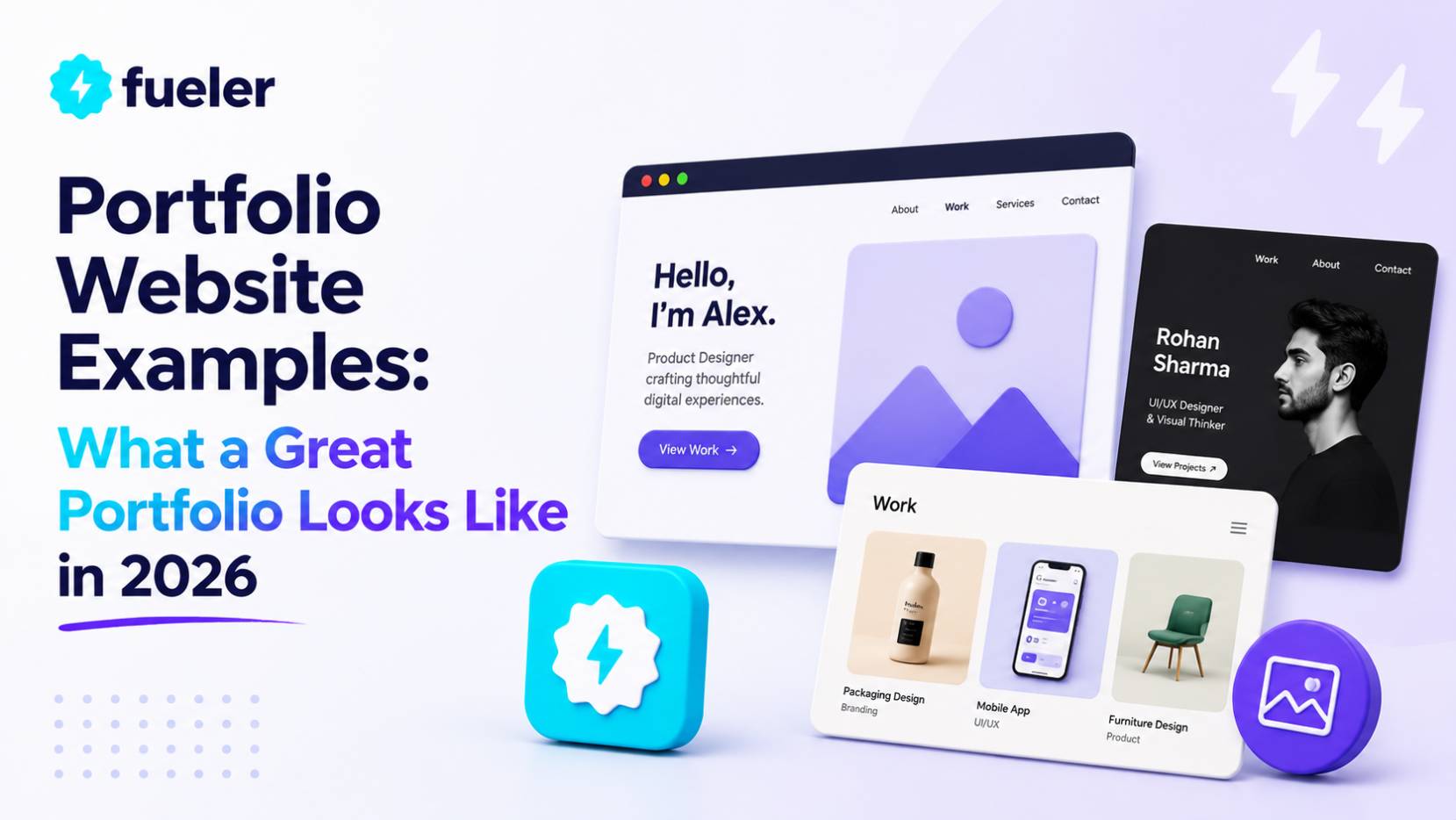
I have looked at thousands of portfolios since I started building Fueler.
And I can tell you with confidence: most of them are not doing what the person thinks they are doing.
They look nice. They have a clean design, a professional headshot, and a list of tools and skills. But when a recruiter or a startup founder lands on it, they leave without knowing why they should hire this person.
The problem is not the design. The problem is the content.
In this article, I want to show you what a great portfolio website actually looks like. Not in theory. With real structure, real examples, and the reasoning behind every section. I will walk you through what works, what does not, and how to build a portfolio that makes the person looking at it say "I want to work with this person."
Why Most Portfolio Websites Fail
Let me start with the uncomfortable truth.
Most portfolios are built for the person who made them, not for the person who is going to read them.
They are organized by what feels natural to the creator: "here are my skills, here is my education, here is my work." But that is not how a recruiter or a founder thinks when they land on your page.
They are thinking: "Can this person solve my problem? Have they done this before? What will I get if I hire them?"
A great portfolio website answers these questions within the first 30 seconds.
The Anatomy of a Great Portfolio Website
Here are the sections every strong portfolio website should have, in order of importance.
1. The Headline: What You Do and Who You Do It For
This is the first thing people see. And most people get it completely wrong.
Bad headline: "Creative Professional | Open to Work"
Bad headline: "Passionate Marketer and Content Strategist"
Bad headline: "I help brands tell their story"
Good headline: "Content marketer who helps B2B SaaS companies grow organic traffic"
Good headline: "Designer specializing in landing pages that convert"
Good headline: "Growth marketer for early-stage startups in consumer tech"
See the difference? The good ones are specific. They tell you exactly who this person helps and how. If you are a startup founder hiring a content marketer and you see the first example, you immediately know this person is for you.
Your headline should answer: What do you do? Who do you do it for? What outcome do you create?
2. A Short, Honest Bio
Two to four sentences. Maximum.
Tell me who you are, what you have done, and what you are focused on right now. No jargon. No buzzwords. No "passionate, driven, results-oriented professional.
Write like you would talk to a friend who just asked you "so what do you do?"
Example: "I'm a content marketer with 3 years of experience helping SaaS startups grow their blog traffic. I've helped 5 early-stage companies go from 0 to 10,000 monthly readers. I'm currently looking for a full-time content role at a product-focused startup."
That tells me everything I need to know in 3 sentences.
3. Your Best Work: The Proof Section
This is the heart of your portfolio. And this is where most people go wrong.
Do not just show a screenshot or a link. Show the *story* of the work.
For each piece of work, include:
What was the goal or problem?
What did you do specifically?
What was the result?
Even a simple format works:
Project: Content Strategy for [Company Name]
Goal: Grow organic traffic from 2,000 to 20,000 monthly visits in 6 months
What I did: Built a topic cluster strategy, wrote 15 SEO-optimized articles, optimized 10 existing ones
Result: Traffic grew to 18,000/month. Three articles ranked on Page 1 of Google.
This is infinitely more powerful than just linking to your articles. It shows thinking, execution, and results. For an SEO professional, an SEO portfolio website can bring this same approach together by showing the work, the reasoning behind it, and the results in one place.
If you want to see real examples of how to structure your work pieces, read our article on proof of work examples for different roles. It has templates you can follow.
4. The Skills Section (Done Right)
Most people have a skills section that looks like this: "SEO, Content Writing, Social Media, Copywriting, Google Analytics, Canva, Figma."
That is a list of tools, not a demonstration of skills.
Here is a better way to think about it. For each skill you list, ask yourself: "Can I point to a real piece of work where I used this skill and got a result?"
If yes, link to that work. If no, remove the skill from your list.
A skills section with 5 skills you can prove is worth more than a list of 20 skills you cannot.
5. Testimonials or Social Proof
If you have any positive feedback from clients, managers, teammates, or professors, put it here. Even one or two short quotes can make a big difference.
If you do not have any yet, this is a good reason to go ask for them. Send a message to someone you have worked with. Ask them to describe what it was like working with you and what impact you made. Most people are happy to help.
6. A Clear Call to Action
At the end of your portfolio, tell people what to do next. Do not make them guess.
"Email me at xyz@gmail.com" works fine. So does "Book a 15-minute call" or "DM me on LinkedIn."
Make it easy. The goal is to make it as simple as possible for someone who likes your work to take the next step.
Portfolio Website Examples by Role
Let me give you a breakdown of what a strong portfolio looks like for different types of creative professionals.
Content Marketer Portfolio
Strong elements to include:
Articles you have written with traffic data or ranking positions
Newsletters or email campaigns with open rates
A content strategy you built (even if in a slide deck)
Screenshots of Google Analytics or similar tools showing results
One thing I see missing most often in marketer portfolios: the *strategy* behind the work. Anyone can show you a published article. But can you show the keyword research, the content brief, the distribution plan? That is what separates a junior from a senior.
Read our detailed breakdown of [portfolio pieces every marketer should have](https://fueler.io/blog/10-portfolio-pieces-every-marketer-should-have-before-applying) before you apply for your next role.
Designer Portfolio
Strong elements to include:
Full case studies with before and after
Your design process (sketches, wireframes, prototypes)
Business outcomes if available (conversion rates, user feedback)
Personal projects that show your aesthetic and thinking
The biggest mistake designers make: showing only the final output. The thinking process is what companies want to see. Show your iterations. Show what you tried that did not work. Show how you made decisions.
Developer Portfolio
Strong elements to include:
Live projects you can link to
GitHub with active contributions
Open source projects or tools
A write-up of a technical problem you solved and how
For developers, the portfolio is often less about a fancy website and more about the work itself. A clean GitHub profile and two or three live projects you can walk through are often enough.
Student or Fresher Portfolio
Strong elements to include:
Personal projects (even small ones)
Any freelance or volunteer work
College projects with documented outcomes
Content you have created (posts, threads, articles)
If you are a fresher, do not worry about not having "real" work experience. What matters is showing that you have initiative and that you learn by doing. Even a personal project you built over a weekend tells a hiring manager more about you than 4 years of coursework.
What Makes a Portfolio Stand Out in 2026
The bar has gone up. Everyone has a website now. So what actually makes a portfolio stand out?
Specificity. The more specific you are about what you do and who you do it for, the more you stand out. Being the best "content marketer for SaaS companies in the fintech space" is more valuable than being an okay "general marketer."
Documented results. Numbers beat words. Always. Even imperfect numbers are better than no numbers.
A clear point of view. Show that you think about your craft. Write a short note about how you approach your work, what you believe in, what you care about.
Easy navigation. If I cannot figure out what you do in 10 seconds, I am leaving. Keep it simple.
Regularly updated. A portfolio last updated in 2022 signals that the person has stopped growing. Keep adding new work.
Here, you can explore five portfolio examples from different professional fields. These profiles show how a strong portfolio can present specialised skills, practical work, and professional experience in a clear format.
Profile | What You Can Learn |
|---|---|
Learn how a content and social media professional can bring different types of creative and strategic work together in one portfolio. | |
Learn how to present work related to a founder’s office role and communicate professional experience beyond a traditional resume. | |
Learn how a digital marketer can showcase work across digital marketing, email, and social media. | |
Learn how a UI/UX professional can use a portfolio to make design skills and project work easier to understand. | |
Learn how an SEO and performance marketer can organise specialised marketing skills and work into a professional portfolio. |
Should You Build Your Own Portfolio Website or Use a Platform?
This is a common question. Here is my honest take.
Building your own portfolio website from scratch takes time. It requires design skills, development knowledge, or money to hire someone. And after all that work, you still have to figure out how to structure the content.
Using a platform like Fueler is faster and more focused. It is built specifically for proof-of-work portfolios. You can be up and running in under an hour with a profile that is already structured the right way.
That said, if you are a developer, building your own site can itself be proof of work. If you are a designer, your personal site is a design portfolio in itself.
For everyone else, a platform built for this purpose is almost always the better choice.
You can learn how to get discovered by companies using your Fueler profile and what steps to take to make your portfolio visible to the right people.
The One Thing Most People Forget
Here is something I have noticed after looking at thousands of portfolios.
Most people build a portfolio and then wait.
They publish it, share the link once or twice, and hope that someone important sees it. But that is not how it works.
Your portfolio is a starting point, not an ending point. It is a tool you use actively in conversations, applications, and outreach. You share it in your LinkedIn bio. You link to it when applying. You send it to people you want to work with.
Think of your portfolio as a sales asset, not a digital resume. Use it accordingly.
Frequently Asked Questions
What should a portfolio website include to get noticed by recruiters?
A clear headline about what you do, a short bio, 3-5 strong work examples with documented results, a skills section backed by proof, and a clear way to contact you. The most important thing is that each work example shows the problem, your contribution, and the outcome.
What are some good portfolio website examples for marketers?
The best marketer portfolios show actual campaigns, content strategies, and results. They do not just list skills, they show proof of execution. Look for portfolios that include traffic data, growth numbers, or campaign outcomes. Our article on [portfolio pieces every marketer needs](https://fueler.io/blog/10-portfolio-pieces-every-marketer-should-have-before-applying) gives you a breakdown.
How long should a portfolio website be?
Short enough to be read in 5-10 minutes. You do not need to show everything. Pick your best 3-5 pieces of work and document them well. A focused, high-quality portfolio beats a long, cluttered one every time.
Do I need to know how to code to build a portfolio website?
No. Platforms like Fueler let you build a professional proof-of-work portfolio without any coding. If you are not a developer, use a platform built for this purpose. If you are a developer, building your own site is itself a good piece of proof of work.
What is the best portfolio website builder for creative professionals in India?
Fueler is built specifically for creative professionals who want to build careers based on proof of work. It is designed for marketers, designers, writers, and other knowledge workers. You can build your profile, document your work, and get discovered by companies that are actively hiring.
What is Fueler Portfolio?
Fueler is a career portfolio platform that helps companies find the best talent for their organization based on their proof of work. You can create your portfolio on Fueler. Thousands of freelancers around the world use Fueler to create their professional-looking portfolios and become financially independent. Discover inspiration for your portfolio
Sign up for free on Fueler or get in touch to learn more.

What should you do next?
You've read the article. Now turn your skills into proof of work and unlock more opportunities.
Build your proof of work portfolio
Create a clean portfolio with projects, assignments, resumes, and AI stack details that companies actually want to see.
Create your Fueler portfolio →Apply through assignments, not resumes
Stand out by solving real tasks from companies hiring on Fueler.
Explore assignments →Get discovered by companies
Make your work public and let recruiters discover your skills through actual projects instead of keywords.
Get discovered →
