PhonePe Hiring Process 2026: How to Get Hired and What to Expect

Riten Debnath
27 Aug, 2026
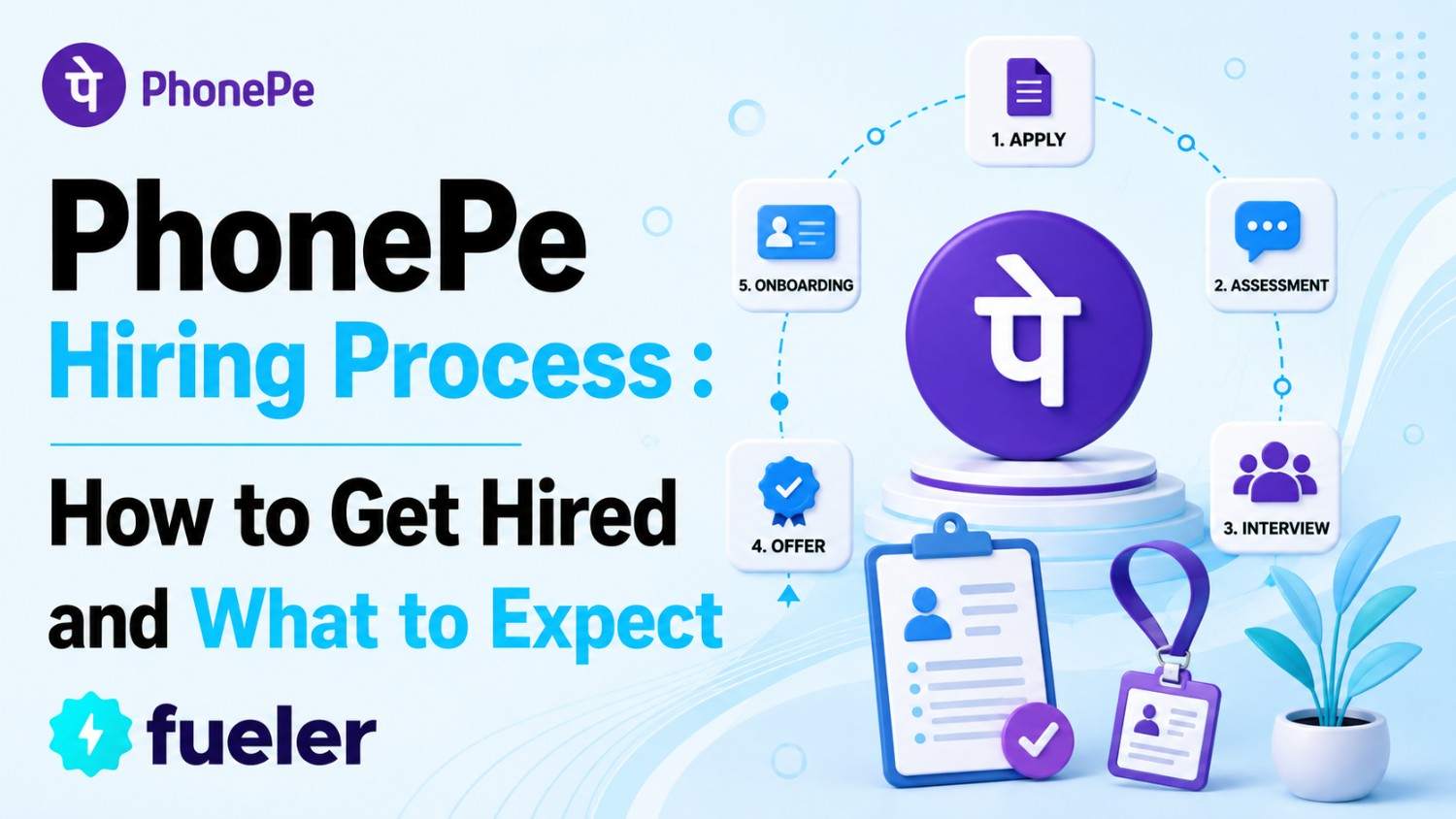
Getting a job at PhonePe is not only about having a strong resume or a good degree. PhonePe works across digital payments, financial services, merchant products, technology, data, customer operations, and other areas, which means the hiring process can be very different depending on the role you choose.
PhonePe's official careers page currently lists opportunities across Business Development & Sales, Engineering, Corporate Tech Infra & IT, Product Management, Data Science, Design & Creative, Customer Experience & Operations, and Business Enablement. The company also highlights autonomy, learning, and impact as important parts of its work culture.
I’m Riten, founder of Fueler, a skills-first portfolio platform building the career infrastructure for 100 million creative professionals. Fueler connects talented individuals with companies through assignments, portfolios, and projects, not just resumes or CVs. Think of it as Dribbble/Behance for work samples combined with AngelList for hiring infrastructure.
If you are searching for the PhonePe hiring process in 2026, you need to prepare for the exact job you want. A software engineer needs strong coding and system design skills, while a product manager needs product thinking, analytics, and execution skills. A designer needs strong case studies, while a business candidate needs communication, commercial thinking, and evidence of results.
In this guide, I will explain the PhonePe hiring process, major technical and non-technical career paths, interview preparation, skills you should develop, and how you can use real work to make your application stronger.
What Does the PhonePe Hiring Process Look Like in 2026?
There is no single hiring process that every PhonePe candidate follows. The number and type of rounds can change based on the job, seniority, team, and hiring requirement.
For technical positions, recent candidate reports commonly describe multiple stages involving coding, technical discussions, machine coding or design, project discussions, and hiring manager conversations. Some reported processes include an online assessment followed by technical interviews and managerial discussions.
Product management processes reported in 2026 commonly include product strategy, analytical problem solving, technical understanding, business thinking, and hiring manager or leadership discussions. These reports are useful for preparation, but they should not be treated as a fixed PhonePe process for every candidate.
A candidate's journey can therefore include:
- Application or referral: Your resume, experience, skills, and portfolio are reviewed.
- Recruiter screening: The recruiter checks your background, motivation, experience, and role fit.
- Assessment: Some roles may include coding, analytical, technical, or role-specific assessments.
- Role-specific interviews: You are evaluated on the skills required for the position.
- Project discussion: Interviewers may ask detailed questions about your previous work.
- Hiring manager round: This can focus on ownership, execution, communication, and judgement.
- Leadership or final discussions: Senior roles may require additional discussions before an offer.
The exact sequence can change, so candidates should prepare for the responsibilities in the job description rather than trying to memorise one fixed interview pattern.
Why It Matters: The best way to prepare for PhonePe is to understand the work you are applying to. Your preparation should reflect the actual skills required for that role.
1. Software Engineering Jobs at PhonePe
Engineering is one of the most important career paths at PhonePe because the company operates large-scale digital payment and financial technology products.
PhonePe's official careers page lists engineering as one of its major job categories, while the company's engineering material has previously described a strong focus on ownership, learning, and impact.
For software engineering roles, prepare around:
- Data Structures and Algorithms: Arrays, strings, trees, graphs, heaps, recursion, dynamic programming, and problem-solving patterns.
- Programming: Strong command of at least one programming language.
- Database Systems: SQL, indexing, transactions, data modelling, and database design.
- Object-Oriented Programming: Classes, interfaces, abstraction, inheritance, and clean design.
- Machine Coding: Writing modular, working software from a practical problem statement.
- Low-Level Design: Classes, interfaces, relationships, and maintainable code structure.
- System Design: APIs, databases, caching, queues, scalability, reliability, and failure handling.
- Debugging: Finding the cause of problems instead of only fixing visible errors.
Recent interview reports describe PhonePe engineering interviews that can include DSA, machine coding, low-level design, system design, and detailed discussions about previous projects. The exact combination varies by level and team.
Do not prepare only by solving coding questions.
Build something.
Deploy it.
Document the architecture.
Then understand why you made every important technical decision.
For example, if you build a payment application, be ready to explain how you handle duplicate transactions, failed requests, database consistency, authentication, and high traffic.
You can also build a proof of work portfolio where you document your projects, technical decisions, and outcomes.
Why It Matters: A resume can say that you know Java, Python, Go, SQL, or system design. A working project gives the interviewer something concrete to discuss.
2. Product Management Jobs at PhonePe
Product management at PhonePe requires more than knowing standard product frameworks. You need to understand customers, payments, financial products, business models, technology, and the trade-offs involved in building products at scale.
Recent 2026 interview guides describe PhonePe product interviews around product strategy and design, analytical problem solving, root-cause analysis, technical understanding, business thinking, and monetisation.
For product roles, prepare around:
- Product Thinking: Understand the user problem before suggesting features.
- Customer Understanding: Identify different users and their needs.
- Metrics: Know how to measure product performance.
- Root-Cause Analysis: Understand why a metric changed before suggesting a solution.
- Prioritisation: Decide what should be built first.
- Experimentation: Create hypotheses and define success metrics.
- Business Thinking: Connect product decisions with revenue, retention, cost, or other business goals.
- Technical Understanding: Understand APIs, databases, integrations, and system limitations.
- Stakeholder Management: Work with engineering, design, operations, sales, and business teams.
Imagine an interviewer asks you to improve a payment feature.
Do not immediately suggest a new feature.
First identify the user.
Then understand the problem.
Next identify the business impact.
After that, consider different solutions.
Finally, explain how you would measure whether your solution worked.
You can strengthen this preparation by creating a product management portfolio that shows your product decisions, research, prioritisation, and case studies.
Why It Matters: Product managers are hired to make decisions when the answer is unclear. Your ability to structure an ambiguous problem is more important than memorising frameworks.
3. UI UX and Design Jobs at PhonePe
PhonePe also hires for Design & Creative roles, according to its official careers page.
If you are applying for a design position, your portfolio can become one of the strongest parts of your application.
A good case study should explain:
- The Problem: What user or business problem were you solving?
- Research: What did you learn about users?
- User Flow: How did users complete the task before your solution?
- Exploration: What solutions did you consider?
- Design Decisions: Why did you choose the final approach?
- Testing: What feedback did you receive?
- Iteration: What changed after testing?
- Outcome: What improved after your work?
Fintech design requires particular attention to clarity because users need to understand important information, transactions, errors, and next steps.
For example, if you redesign a payment confirmation screen, do not only show attractive UI screens. Explain how your design makes transaction status easier to understand and reduces user confusion.
You can also use this guide to creating a designer portfolio to structure your work around the problem, process, contribution, and outcome.
Why It Matters: A visually attractive portfolio can get attention, but a case study that explains your thinking gives the hiring team evidence that you can solve real product problems.
4. Data Science and Analytics Jobs at PhonePe
Data Science is another career path listed on PhonePe's official careers page.
Candidates targeting data roles should develop skills in:
- SQL
- Python
- Statistics
- Data analysis
- Data visualisation
- Experimentation
- Machine learning where relevant
- Business analysis
- Product metrics
- Problem solving
Do not stop at making dashboards.
Practise solving business problems.
Imagine that the success rate of payments suddenly drops.
Your first response should not be to create another dashboard.
Ask what changed.
You might investigate the payment method, bank, geography, device type, transaction size, time period, API errors, or recent product changes.
Then use data to identify the most likely cause.
The same approach applies to fraud, customer retention, merchant growth, product adoption, and operational problems.
Why It Matters: Companies need data professionals who can turn information into decisions. Knowing SQL is useful, but knowing what question to ask is even more valuable.
5. Business, Sales and Operations Jobs at PhonePe
PhonePe's current careers page lists Business Development & Sales, Customer Experience & Operations, and Business Enablement alongside its technical functions.
These roles require a different preparation strategy.
Candidates should develop:
- Communication
- Customer understanding
- Sales skills
- Negotiation
- Business analysis
- Problem solving
- Relationship management
- Process improvement
- Commercial awareness
- Ownership
For sales roles, prepare examples that show how you generated leads, converted customers, handled objections, or improved a sales process.
For operations roles, show how you solved process problems, reduced errors, improved turnaround time, or managed difficult customer situations.
For business roles, demonstrate that you understand the market and can connect your work to measurable business outcomes.
Do not simply write "strong communication skills" on your resume.
Show where you used those skills.
Why It Matters: Non-technical roles still require proof of execution. Communication becomes much more convincing when you can connect it to actual outcomes.
6. What Skills Does PhonePe Look For?
PhonePe's careers page highlights three important ideas that candidates should pay attention to: Autonomy, Learning, and Impact. The company describes autonomy around ownership and decision-making, learning around continuous development, and impact around making a difference.
This tells candidates something important about how they should present themselves.
Do not only explain what tasks you completed.
Explain what you owned.
Do not only say that you learned a tool.
Explain how you used it.
Do not only list responsibilities.
Show the outcome of your work.
For example:
"I worked on a website" is weak.
"I redesigned the checkout flow and reduced the number of steps from five to three" is stronger if the result is genuine and can be supported.
The same principle works for engineering, product, design, data, sales, and operations.
Why It Matters: Companies need people who can take responsibility for problems and create measurable impact rather than simply complete assigned tasks.
7. How to Prepare for a PhonePe Engineering Interview
If you are targeting an engineering position, divide your preparation into four areas.
Start with DSA. Practise common problem-solving patterns and learn to explain your approach clearly.
Revise computer science fundamentals. Focus on databases, operating systems, networking, OOP, concurrency, and other topics relevant to the position.
Practise machine coding and design. Recent candidate reports suggest that practical coding and design can be important parts of the engineering process.
Know your projects deeply. Anything on your resume can become an interview question.
If you say you built an API, know how it works.
If you say you improved performance, know how you measured it.
If you say you used Kafka, know why you needed it.
If you say you designed a database, understand the trade-offs.
Why It Matters: Strong engineers do not only write code. They understand how their code behaves inside a larger system.
8. How to Prepare for a PhonePe Product Interview
Product candidates should practise real product problems rather than memorising frameworks.
Pick a financial product and ask yourself:
- Who is the user?
- What problem are they facing?
- How frequently does the problem occur?
- What is the business impact?
- What data would you need?
- What possible solutions exist?
- Which solution would you prioritise?
- What could go wrong?
- How would you measure success?
Recent 2026 interview reports specifically describe analytical problem solving, root-cause analysis, product strategy, technical understanding, and business thinking as important parts of PhonePe PM preparation.
Your answer should therefore show your reasoning rather than just naming a framework.
Why It Matters: Good product managers turn unclear problems into structured decisions and can explain why their solution makes sense.
9. How Freshers Can Get a Job at PhonePe
Getting your first job at a large fintech company can be difficult because many candidates have similar degrees, courses, and certificates.
The easiest way to start differentiating yourself is to build evidence.
A developer can build a payment-related application.
A product candidate can create a fintech case study.
A designer can redesign a financial workflow and explain the design decisions.
A data candidate can analyse a public dataset.
A marketing candidate can create a campaign for a fintech product.
These projects are not the same as professional experience, and you should describe them honestly. But they can show that you have already started practising the work.
This is why I believe in proof of work portfolios.
Your portfolio should answer five simple questions:
- What problem did you solve?
- What did you personally do?
- How did you approach it?
- What was the result?
- What did you learn?
You do not need 20 projects.
Three to five strong projects that match your target role can be enough to start.
Why It Matters: You cannot create years of professional experience overnight, but you can create evidence that shows how you think and work.
10. How to Apply for PhonePe Jobs in 2026
The safest place to start is PhonePe's official careers page, where current openings are organised across different functions.
Before applying, follow a simple process.
Read the job description carefully. Identify the most important skills and responsibilities.
Customise your resume. Put relevant experience and projects first.
Prepare your portfolio. Show work related to the job.
Explain your contribution. If you worked with a team, clearly explain what you personally handled.
Use real outcomes. Add genuine numbers where you have them.
Prepare your projects. Interviewers can ask detailed questions about anything you mention.
Understand PhonePe's business. Learn how its products serve customers, merchants, and businesses.
Practise role-specific questions. An engineering interview needs different preparation from a product or design interview.
Why It Matters: A focused application makes it easier for the hiring team to understand why your skills match the specific role.
Common Mistakes Candidates Make in the PhonePe Hiring Process
Many candidates spend most of their preparation time on interview questions and ignore the quality of their application.
Avoid these mistakes:
- Using a generic resume: Match your application to the actual role.
- Listing tools without evidence: Do not simply write Python, Java, Figma, SQL, or AI.
- Showing only certificates: Projects provide stronger evidence of practical ability.
- Not knowing your projects: Interviewers can ask detailed questions about your own work.
- Ignoring business context: Understand why your work matters to customers and the company.
- Using AI without understanding the output: AI can help with productivity, but you remain responsible for the result.
- Inventing metrics: Never create fake results.
- Building too many weak projects: A few detailed projects are more useful than many unfinished ones.
- Memorising answers: Learn how to reason through unfamiliar problems.
A strong application should make one thing easy for the recruiter to understand: what can this candidate actually do?
Why It Matters: The more directly your application connects your skills to real work, the easier it becomes for the hiring team to evaluate your fit.
How Does This Connect to Building a Strong Career or Portfolio?
The PhonePe hiring process shows why I believe careers are moving toward skills and evidence.
A resume can say that you know system design.
A project can show the system you designed.
A resume can say that you understand product management.
A case study can show how you solved a product problem.
A resume can say that you are a designer.
A portfolio can show how you researched, designed, tested, and improved an experience.
A resume can say that you are good at marketing.
A campaign can show what you created and what happened afterward.
This is the idea behind Proof of Work.
At Fueler, I am building around this idea because I believe companies should have better ways to evaluate what candidates can actually do.
Your portfolio does not need to be perfect.
It needs to be honest, relevant, and useful.
Start with your strongest work.
Explain the problem.
Show your process.
Highlight your contribution.
Add real outcomes.
Then keep improving it as your skills grow.
Why It Matters: Your resume introduces you, but your work gives hiring managers a reason to believe you can actually perform the job.
Final Thoughts
The PhonePe hiring process in 2026 can vary significantly depending on the position, team, and experience level. PhonePe currently hires across engineering, product management, data science, design, business, sales, operations, and other functions, so there is no single preparation strategy that works for everyone.
Technical candidates should focus on coding, computer science fundamentals, practical development, and system design. Product candidates should build strong product thinking, analytics, business understanding, and execution skills. Designers should create detailed case studies, while business and operations candidates should demonstrate communication, ownership, and measurable outcomes.
The most important thing is to prepare around the work you actually want to do.
Learn the skills.
Understand the product.
Build relevant projects.
Document your decisions.
Practise explaining your work.
And create evidence that makes your ability visible.
You should not only tell a company, "I can code," "I can design," "I can manage products," or "I can solve business problems."
Show them.
Your resume can introduce you.
Your interview can explain how you think.
Your work can prove what you can do.
Frequently Asked Questions
What is the PhonePe hiring process in 2026?
The PhonePe hiring process depends on the role, team, and experience level. Technical hiring can include coding assessments, DSA interviews, machine coding, system design, project discussions, and hiring manager rounds, while product and business roles can involve product cases, analytical discussions, technical understanding, and business or leadership rounds. Recent candidate reports show that the exact process varies between roles.
How can I apply for jobs at PhonePe in 2026?
You can start by checking PhonePe's official careers page for current openings across engineering, product management, data science, design, sales, operations, and other functions. Select positions that match your actual skills and customise your resume and portfolio for those roles.
What skills are required for PhonePe software engineer jobs?
Software engineering candidates should prepare data structures and algorithms, programming fundamentals, databases, object-oriented design, machine coding, debugging, and system design. The importance of each area can change according to the level and team, so candidates should also study the specific job description. Recent interview reports describe DSA, machine coding, design, and project discussions as common preparation areas.
How should I prepare for a PhonePe product manager interview?
Prepare for product strategy, product design, customer problems, metrics, root-cause analysis, prioritisation, technical concepts, business models, and execution. Recent 2026 interview reports describe product strategy, analytical problem solving, technical understanding, and business thinking as key areas in PhonePe PM interviews.
Can a portfolio help me get hired at PhonePe?
A portfolio cannot guarantee an interview or job offer, but it can make your skills easier to evaluate. This is especially useful for product, design, engineering, data, and marketing candidates because projects and case studies can show your actual decisions, contribution, execution, and outcomes instead of only listing skills on a resume.
Why 100,000+ professionals use Fueler
Fueler helps professionals showcase proof of work through projects, assignments, case studies, and achievements.
- Thousands of professionals use Fueler to create their digital portfolio
- Thousands of projects are published on Fueler. Check here
- Startups and Companies hire through proof of work on Fueler
- Used by freelancers, creators, marketers, video editors, writers, designers, and product managers
Our mission is to help the next 100 million professionals build a verified professional identity through proof of work

What should you do next?
You've read the article. Now turn your skills into proof of work and unlock more opportunities.
Build your proof of work portfolio
Create a clean portfolio with projects, assignments, resumes, and AI stack details that companies actually want to see.
Create your Fueler portfolio →Apply through assignments, not resumes
Stand out by solving real tasks from companies hiring on Fueler.
Explore assignments →Get discovered by companies
Make your work public and let recruiters discover your skills through actual projects instead of keywords.
Get discovered →
