20 Indian Startups Hiring Marketing Talent in 2026

Riten Debnath
28 Aug, 2026
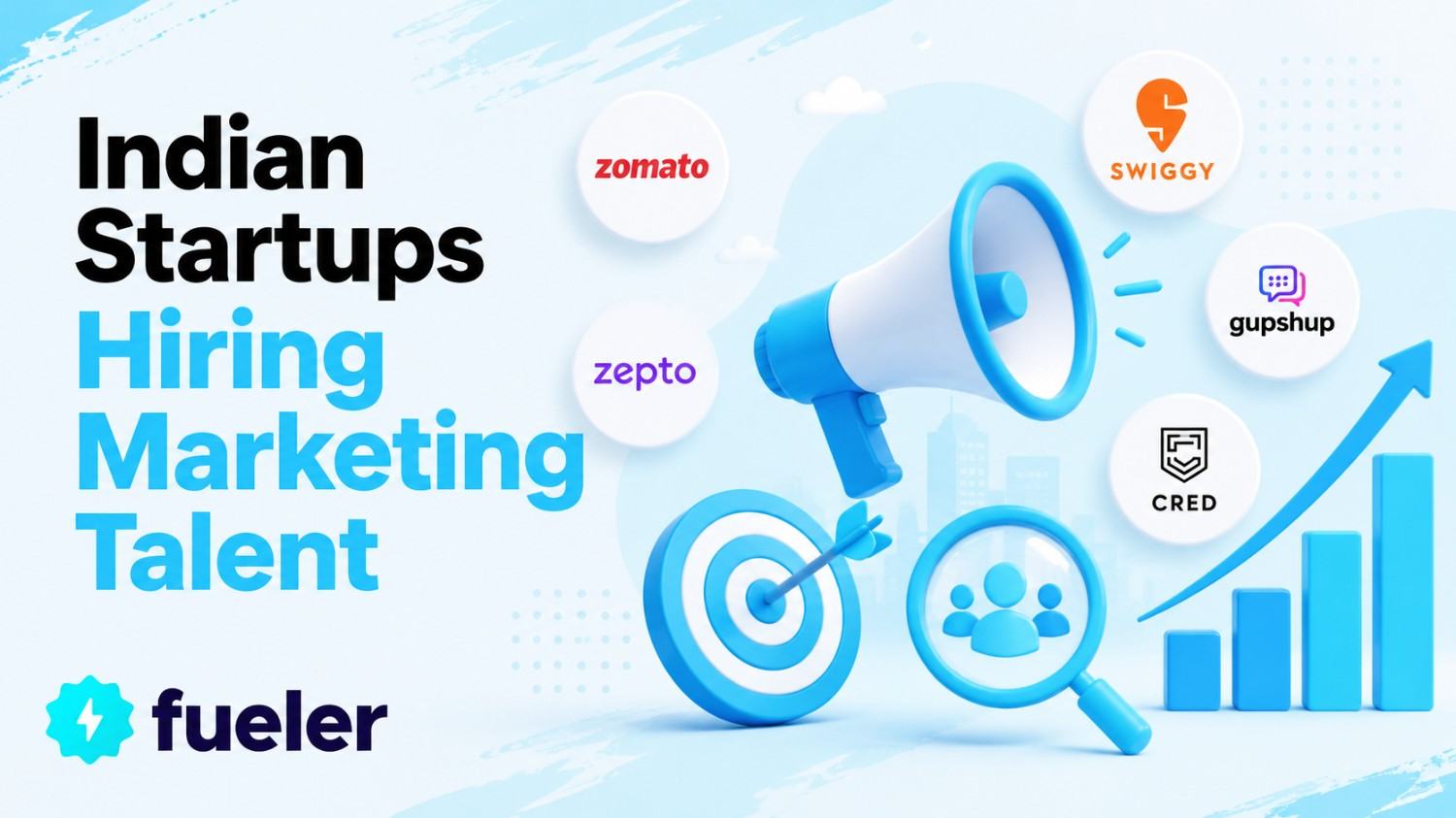
Marketing has become one of the most important functions inside India's startup ecosystem because a good product cannot grow if customers do not discover it, understand it, trust it, and eventually buy it. Startups are therefore building marketing teams across growth, content, SEO, performance marketing, social media, brand, community, product marketing, and marketing operations.
The nature of these jobs is also changing quickly. Companies are using AI to create content, automate campaigns, analyse customer behaviour, and improve marketing workflows, which means marketers are increasingly expected to do more than publish posts or write blogs. Startups want people who can understand customers, run experiments, analyse data, create strong content, manage acquisition channels, and connect marketing activity to business outcomes.
I’m Riten, founder of Fueler, a skills-first portfolio platform building the career infrastructure for 100 million creative professionals. Fueler connects talented individuals with companies through assignments, portfolios, and projects, not just resumes or CVs. Think of it as Dribbble/Behance for work samples combined with AngelList for hiring infrastructure.
If you are searching for startups hiring marketers in India, I would not focus only on finding a job title such as "Digital Marketing Executive." Instead, understand what the company is trying to achieve and match your marketing skills to that problem. A growth startup may need someone who can improve acquisition, while a B2B SaaS company may need content, SEO, demand generation, or product marketing.
Current startup hiring data shows that marketing roles in 2026 include growth marketing, content and community, demand generation, marketing automation, campaign execution, brand strategy, and GTM roles. For example, current public listings include Growth Marketing at SigNoz, Growth and Marketing at Landeed, VP Growth at GoSats, and multiple marketing roles at Cityfurnish.
1. Zepto
Zepto is one of India's biggest quick-commerce startups, and its business depends heavily on customer acquisition, retention, brand communication, campaigns, promotions, and understanding consumer behaviour. The company's marketing work is closely connected with its fast-moving consumer business, which means marketers need to understand both creative communication and commercial performance.
A recent Zepto Campaign Executive opening shows the kind of work involved, with the role sitting between campaign execution, stakeholder management, creative collaboration, and brand operations.
Best fit: Growth marketers, brand marketers, campaign managers, social media marketers, performance marketers, and marketing operations professionals.
What to show: Build a campaign case study where you explain the audience, campaign objective, creative idea, distribution strategy, budget assumptions, and measurable outcome.
2. Meesho
Meesho operates a large marketplace where marketing has to support both customer growth and seller activity. This creates opportunities across performance marketing, brand marketing, content, CRM, social media, creator partnerships, and growth.
For marketers, Meesho is especially interesting because its audience is diverse and its growth depends on understanding different customer groups rather than relying on one generic marketing message.
Best fit: Performance marketers, growth marketers, content marketers, social media managers, CRM marketers, and brand professionals.
What to show: A marketplace growth campaign that explains how you would acquire users, improve activation, and bring customers back.
3. Swiggy
Swiggy operates across food delivery, quick commerce, restaurant discovery, and other consumer services, giving its marketing teams a wide range of problems to solve. Marketers can work on customer acquisition, brand campaigns, retention, content, partnerships, social media, and category growth.
The company is particularly relevant for candidates who enjoy fast-moving consumer marketing because campaigns need to respond to trends, seasons, competitors, and changing customer behaviour.
Best fit: Growth marketers, brand marketers, performance marketers, social media marketers, content creators, and CRM professionals.
What to show: A consumer growth campaign with clear acquisition and retention metrics rather than a collection of attractive social media posts.
4. Razorpay
Razorpay is a strong destination for marketers who want to work in fintech and B2B technology. Its marketing challenges are different from those of consumer apps because the company needs to communicate complex financial products to businesses while building trust and supporting revenue growth.
Razorpay announced in May 2026 that Apuarv Sethi had been elevated to Chief Marketing Officer, with responsibility covering marketing, SME business growth, go-to-market strategy, ecosystem initiatives, and revenue acceleration across India and Southeast Asia.
Best fit: B2B marketers, product marketers, demand generation professionals, content marketers, SEO specialists, and growth marketers.
What to show: A B2B marketing case study showing how you would turn a complicated product into a clear message and build a funnel around it.
5. PhonePe
PhonePe operates at huge consumer scale across payments and financial services, making customer trust, education, engagement, and retention important parts of marketing. Marketers working in this environment need to understand how communication changes when the product involves money and financial decisions.
Best fit: Growth marketers, brand marketers, CRM professionals, performance marketers, content marketers, and product marketing professionals.
What to show: Create a campaign around a financial product where you explain the customer problem, communication strategy, acquisition channel, and expected business outcome.
6. Groww
Groww has built its brand around making investing and financial services easier for consumers to understand. This creates marketing opportunities around content, education, acquisition, product communication, social media, and growth.
For marketers, Groww is particularly useful to study because financial marketing requires simple communication. A marketer must make complicated subjects understandable without making the information misleading or overly promotional.
Best fit: Content marketers, growth marketers, performance marketers, SEO professionals, social media managers, and product marketers.
What to show: Create an educational content funnel showing how you would move a new user from learning about investing to taking a meaningful product action.
7. CRED
CRED has developed a distinctive consumer brand that combines financial products with strong creative communication. This makes it an interesting company for marketers who want to work where brand, content, social media, community, and product growth overlap.
The company is particularly relevant for marketers who understand internet culture and can create communication that feels different from traditional financial advertising.
Best fit: Brand marketers, social media marketers, content strategists, growth marketers, influencer marketers, and creative strategists.
What to show: Build a campaign concept that demonstrates both creative thinking and a clear reason why the campaign should improve customer behaviour.
8. Zomato
Zomato operates in a highly competitive consumer category where marketing is closely connected with food discovery, restaurant partnerships, customer retention, offers, events, and brand communication.
This makes Zomato useful for marketers who want to understand how a large consumer platform balances brand-building with performance-driven campaigns.
Best fit: Brand marketers, social media managers, growth marketers, content marketers, campaign managers, and partnership marketers.
What to show: Build a social or brand campaign around a real customer behaviour and explain how you would measure reach, engagement, conversion, and retention.
9. Blinkit
Blinkit's quick-commerce model creates a constant need for customer acquisition, category marketing, promotions, retention, brand campaigns, and localised communication. Marketing decisions can directly influence what customers discover and purchase.
For candidates, the company represents the kind of startup environment where marketing needs to move quickly and work closely with business, product, operations, and creative teams.
Best fit: Growth marketers, performance marketers, campaign managers, social media professionals, and brand marketers.
What to show: A quick-commerce campaign with a clear target audience, offer strategy, creative approach, channel mix, and measurement plan.
10. Nykaa
Nykaa combines e-commerce, beauty, content, product discovery, brands, influencers, and consumer education. This makes it particularly relevant for marketers interested in content-led commerce.
A strong marketer in this category needs to understand not only advertising but also how content influences product discovery, trust, consideration, and purchase decisions.
Best fit: Content marketers, influencer marketers, social media managers, SEO professionals, performance marketers, and brand marketers.
What to show: Create a content-to-commerce strategy showing how educational content could move users from discovery to purchase.
11. Landeed
Landeed is one of the more interesting current examples for marketers because its public careers page lists a Growth and Marketing Lead as well as a Content and Community Lead. The Growth and Marketing Lead role covers digital and offline campaigns, hyperlocal marketing, performance, and communication across different Indian audiences.
Its Content and Community Lead role also focuses on content strategy, storytelling, audience engagement, and community building.
Best fit: Growth marketers, content marketers, community managers, SEO professionals, performance marketers, and brand strategists.
What to show: Build a hyperlocal marketing plan for a technology product entering a new Indian city or customer segment.
12. SigNoz
SigNoz is an open-source observability company, which means its marketing problem is very different from consumer startups. Its growth can come from developers, open-source adoption, content, communities, product-led growth, and B2B demand generation.
The company currently has a public Head of Demand Gen opening in India. The role includes paid digital, search, campaigns, reporting, sequences, and building a demand-generation engine. SigNoz has also listed an AI GTM Engineer role focused on marketing systems, data, campaigns, and conversion improvement.
Best fit: B2B marketers, demand generation specialists, growth marketers, content marketers, SEO professionals, and marketing operations specialists.
What to show: Create a B2B SaaS demand-generation funnel and explain how content, SEO, email, paid acquisition, and sales development would work together.
13. GoSats
GoSats is a YC-backed startup focused on helping consumers earn rewards from everyday spending. Its current public hiring includes a VP, Growth role in Bengaluru, with the company describing a strong organic acquisition engine and rapid growth.
This is a useful company to watch if you want to work in growth rather than traditional brand marketing because the role is directly connected with acquisition and business expansion.
Best fit: Growth marketers, acquisition specialists, lifecycle marketers, performance marketers, and marketing strategists.
What to show: A growth experiment portfolio with hypotheses, metrics, experiment design, results, and what you learned from each test.
14. Cityfurnish
Cityfurnish is actively recruiting across several marketing and creative functions in Gurugram. Its public job listings include Social Media Executive, Brand Strategist, Marketing Intern, Brand Content and Social Media Marketing Intern, and Marketing Intern roles.
The Social Media Executive role specifically asks for social-first content, copywriting, influencer marketing, campaign planning, community building, analytics, and performance marketing support.
Best fit: Social media marketers, content marketers, brand marketers, influencer marketers, and marketing interns.
What to show: Build a 30-day social media strategy with content pillars, sample posts, creator ideas, campaign objectives, and measurement.
15. Freshworks
Freshworks operates in B2B SaaS, so its marketing ecosystem includes content, SEO, product marketing, demand generation, customer education, events, and sales enablement.
This makes the company a strong target for marketers who want to move beyond social media into technology marketing. B2B SaaS marketers need to understand the customer's business problem and explain why the software provides a better solution.
Best fit: B2B marketers, product marketers, content writers, SEO specialists, demand generation professionals, and marketing operations specialists.
What to show: Create a SaaS content funnel that connects a search query to an educational article, product page, lead capture, and sales conversation.
16. Whatfix
Whatfix works in digital adoption and enterprise software, which creates marketing challenges around explaining complicated technology to business buyers. Content, product marketing, demand generation, customer education, and sales enablement can all play important roles.
Best fit: B2B content marketers, product marketers, SEO specialists, demand generation marketers, and marketing operations professionals.
What to show: Take a complicated SaaS product and create a simple positioning statement, landing page structure, content plan, and lead-generation campaign.
17. MoEngage
MoEngage operates in customer engagement and marketing technology, making it a natural environment for marketers who want to understand lifecycle marketing, analytics, retention, automation, and customer journeys.
The company's market also means that marketers need to understand how technology buyers evaluate software and how content can support both demand generation and product education.
Best fit: Product marketers, B2B marketers, content marketers, demand generation specialists, SEO professionals, and lifecycle marketers.
What to show: Build a customer lifecycle campaign showing how messaging changes from acquisition to activation, retention, and expansion.
18. Human Archive
Human Archive is a newer YC startup working in physical AI and has a current public marketing-related opening for a Videographer in India. While this is not a traditional performance marketing role, it shows how modern startup marketing teams are expanding into video, storytelling, and founder-led content.
This type of opportunity is useful for marketers who combine content strategy with production skills.
Best fit: Content marketers, video marketers, social media professionals, creative producers, and brand storytellers.
What to show: Build a short-form content series around a technology startup, including the content strategy, scripts, visual direction, publishing plan, and expected audience.
19. GroMo
GroMo operates in financial distribution and uses technology to help independent agents sell financial products. This creates marketing challenges around user acquisition, agent engagement, financial education, partnerships, and digital growth.
Best fit: Growth marketers, performance marketers, content marketers, community marketers, and lifecycle marketing professionals.
What to show: Create an acquisition campaign for a two-sided or agent-led marketplace where you explain how you would attract and activate the right users.
20. Emerging AI and SaaS Startups
The final category I would watch closely in 2026 is India's growing group of AI-first and SaaS startups. These companies are creating new marketing roles because they need to explain unfamiliar products, reach technical audiences, build communities, generate demand, and compete in crowded global markets.
Current YC startup listings show marketing roles across growth, content, marketing automation, product marketing, GTM, and demand generation, while the India startup directory includes companies hiring across technology, product, marketing, and other functions.
Best fit: Growth marketers, AI-native marketers, content strategists, SEO professionals, product marketers, demand generation specialists, and marketing operations professionals.
What to show: Build an AI startup go-to-market case study showing positioning, audience research, content strategy, acquisition channels, and an experiment roadmap.
What Skills Are Indian Startups Looking for in Marketers?
Marketing hiring in startups is becoming much more outcome-focused. Companies do not only want someone who can operate Meta Ads, write blogs, or schedule Instagram posts. They want people who understand why a campaign should work, how to measure it, and what should change when the numbers do not move.
The current roles at Landeed, SigNoz, and Cityfurnish show this shift clearly. Landeed's roles combine growth, performance, content, and community, while SigNoz's demand-generation role includes paid acquisition, campaigns, reporting, and pipeline building. Cityfurnish's social role combines copywriting, content strategy, influencer marketing, community building, analytics, and performance support.
For 2026, I would focus on these skills:
- Growth marketing: Understand acquisition, activation, retention, referrals, and revenue instead of looking only at traffic.
- Performance marketing: Learn how paid campaigns work and how to connect spend with leads, customers, and revenue.
- SEO: Understand search intent, content strategy, technical basics, internal linking, and how search behaviour is changing.
- Content marketing: Create useful content that answers customer questions and supports business goals.
- Social media: Understand platforms, audience behaviour, creators, trends, storytelling, and community.
- Analytics: Be comfortable with basic marketing metrics and understand what they actually mean.
- Copywriting: Explain a product clearly and persuade the right audience without using unnecessary jargon.
- AI marketing: Use AI for research, ideation, analysis, automation, and production while maintaining human judgment.
- Experimentation: Form a hypothesis, run a test, measure the result, and use the learning to decide what to do next.
Why It Matters: Startups cannot afford marketing teams that only produce activity. They need marketers who can connect activity to growth, understand customers, test ideas quickly, and improve the system over time.
Types of Marketing Jobs at Indian Startups
Startup marketing teams use different titles for overlapping responsibilities. The most common functions include:
How Can You Stand Out When Applying for Marketing Jobs?
The biggest mistake marketers make is building a portfolio that contains only certificates, course completions, and lists of marketing tools. Knowing Google Analytics, Meta Ads Manager, Canva, HubSpot, or SEO tools does not automatically prove that you can grow a business.
Your portfolio should show actual work. You can document a campaign you ran, an SEO experiment, a content strategy, a landing page test, a social media growth project, or even a well-designed independent project. If you do not have professional experience, you can create realistic projects using public information and clearly label them as independent work.
I have written more about this in my guide on how to build proof of work for digital marketing opportunities, because marketing is one of the easiest careers to demonstrate through actual work.
You can also use the digital marketing portfolio guide to decide what projects, campaigns, reports, and case studies should be included in your portfolio.
Why It Matters: A hiring manager can understand a real campaign much faster than a list of certificates. Your work gives the company something concrete to evaluate and gives you better material to discuss during an interview.
What Should a Marketing Portfolio Include in 2026?
A strong marketing portfolio should show how you think from beginning to end. Start with the business problem, explain who the target audience is, describe the strategy, show the work you created, and then present the results or expected metrics.
For example, an SEO case study could include keyword research, search intent, content structure, on-page improvements, internal linking, and traffic or ranking changes. A performance marketing project could include audience segmentation, creative variations, campaign structure, budget allocation, conversion data, and lessons from failed experiments.
If you are building your portfolio from scratch, my guide on how to build a career portfolio that actually gets jobs explains why the portfolio should be designed around the job you want rather than simply becoming a collection of everything you have ever done.
For marketers who have no professional experience yet, proof of work without experience can help you understand how independent projects can become evidence of your ability when they are documented honestly.
Why It Matters: Marketing is measurable, so your portfolio should make your thinking and results visible. Even when you do not have professional metrics, a well-designed project can show your research, strategy, execution, and understanding of measurement.
How Does This Connect to Building a Strong Marketing Career?
Marketing is changing because AI can now produce basic copy, generate creative variations, summarise research, automate reports, and assist with campaign workflows. This does not mean marketing jobs will disappear, but it does mean the value of purely manual marketing work is likely to decline.
The marketer who only writes generic articles or schedules routine social posts will have more competition from automation. The marketer who understands customers, creates positioning, designs experiments, reads data, builds distribution systems, and makes strategic decisions becomes much more valuable.
This is why I believe marketers need to build a proof-of-work portfolio instead of depending entirely on a resume. My broader proof of work portfolio guide explains how real projects can give employers evidence of what you can actually do.
The same principle applies to growth marketers, content writers, SEO professionals, social media managers, and performance marketers. Your profession may have a different output, but the hiring question remains the same: Can you show me that you can do the work?
Final Thoughts
There are many opportunities for marketers in India's startup ecosystem in 2026, but the definition of a marketer is becoming much broader. Startups need people who can acquire customers, create useful content, build communities, improve organic visibility, run paid campaigns, communicate products, and understand the numbers behind growth.
Companies such as Zepto, Meesho, Swiggy, Razorpay, PhonePe, Groww, CRED, Zomato, Blinkit, Landeed, SigNoz, GoSats, Cityfurnish, and other growing startups show how different the marketing function can look depending on the business model. Current public listings include roles ranging from social media and brand strategy to demand generation, growth marketing, marketing automation, and content.
If you want to get hired as a marketer in 2026, do not spend all your time collecting certifications. Learn the fundamentals, build projects, run experiments, publish your work, and document what you learned.
A strong marketing portfolio does not need to show that every campaign was successful. It needs to show that you can understand a problem, make a reasonable decision, execute the idea, measure what happened, and learn from the result.
That is the kind of evidence startups can use to make a better hiring decision.
The future of marketing hiring will belong to people who can show the work, not just describe the skills.
Frequently Asked Questions
Which Indian startups are hiring marketers in 2026?
Indian startups with current or recent public marketing hiring activity include Zepto, Landeed, SigNoz, GoSats, Cityfurnish, and several other consumer, fintech, SaaS, AI, and marketplace companies. Current public startup listings show roles across growth, content, demand generation, marketing automation, brand, social media, and GTM.
What marketing jobs are available at Indian startups in 2026?
The main roles include growth marketer, performance marketer, SEO specialist, content marketer, social media manager, brand marketer, product marketing manager, demand generation specialist, community manager, influencer marketer, and marketing operations professional. Smaller startups may combine several of these responsibilities into one generalist marketing role.
Can freshers get marketing jobs at Indian startups?
Yes, although the easiest entry point depends on the company and role. Freshers can target internships, junior marketing positions, content roles, social media roles, and growth assistant positions while building practical projects alongside their applications. A portfolio containing real campaigns, SEO projects, content experiments, or social media work can give hiring teams evidence beyond academic qualifications.
What skills should I learn to get a marketing job at a startup?
Start with marketing fundamentals and then develop a practical combination of growth, content, SEO, performance marketing, social media, analytics, copywriting, and AI-assisted workflows. You do not need to master every area at once, but you should develop one strong core skill and enough knowledge of adjacent areas to understand how the complete marketing funnel works.
How can I get hired by an Indian startup as a marketer without experience?
Start by creating proof of work before waiting for a company to give you a formal marketing title. Build an SEO case study, analyse a startup's marketing funnel, create a social campaign, design a performance marketing experiment, publish useful content, or work on a small project for a local business. Document the problem, strategy, execution, and results honestly so that your portfolio gives hiring managers something real to evaluate.
Why 100,000+ professionals use Fueler
Fueler helps professionals showcase proof of work through projects, assignments, case studies, and achievements.
- Thousands of professionals use Fueler to create their digital portfolio
- Thousands of projects are published on Fueler. Check here
- Startups and Companies hire through proof of work on Fueler
- Used by freelancers, creators, marketers, video editors, writers, designers, and product managers
Our mission is to help the next 100 million professionals build a verified professional identity through proof of work
What should you do next?
You've read the article. Now turn your skills into proof of work and unlock more opportunities.
Build your proof of work portfolio
Create a clean portfolio with projects, assignments, resumes, and AI stack details that companies actually want to see.
Create your Fueler portfolio →Apply through assignments, not resumes
Stand out by solving real tasks from companies hiring on Fueler.
Explore assignments →Get discovered by companies
Make your work public and let recruiters discover your skills through actual projects instead of keywords.
Get discovered →
